
Every culture that watched the sun had to explain how it got from one side of the sky to the other, and the answers come in three shapes. In Greece, Rome, India, Iran and Scandinavia the sun rides: a chariot, usually with horses. In Egypt it sails: one barque crosses the sky by day and another crosses the underworld by night, with the god standing in it. And in a third group, from Akhenaten’s Egypt to Japan, the Andes and the Mexica, the god is not carried by the sun at all; the god is the disc, or its light, or its heat. The vehicle, or the lack of one, tells you most of what a culture thought the sun was: a traveller with duties, a passenger who needs protecting, or a presence that simply is.
The other thing to know is that almost no pantheon had just one sun god. Egypt had Ra, Khepri, Atum, Horakhty, Amun-Ra and the Aten, overlapping by hour of the day, by city and by century. Greece had Helios in cult and, from the fifth century BC, Apollo in poetry. The Mexica had Tonatiuh as the sun itself and Huitzilopochtli as the warrior who fought its battles. So “the sun god” of a culture is usually a question of period and place, and each entry below says which. The twenty run by region, roughly oldest first. Surya and Amaterasu belong to living religions and are written that way; Lugh and Māui are here to explain why they are not sun gods.
Is Helios or Apollo the Greek sun god?
Helios, in the religion people practised; both, in later poetry. In Homer and Hesiod they are separate gods with separate jobs: Helios drives the sun, sees everything and witnesses the oath in Iliad 3; Apollo shoots plague arrows, plays the lyre and gives oracles, and is never called the sun. The earliest certain text to merge them is a fragment of Euripides’ lost Phaethon, produced around 420 BC, in which Clymene, mourning the son Helios killed, says the god is rightly called Apollo by those who know the gods’ true names (fragment 781 in the Nauck and Kannicht numberings). The identification becomes a commonplace of Hellenistic and Roman verse; by the time Ovid tells Phaethon’s story in Metamorphoses 2, the sun god is simply Phoebus. Cult never followed: Rhodes worshipped Helios, Delphi and Delos worshipped Apollo, and no classical Greek city is known to have built a temple to Apollo as the Sun.
1. Shamash (Utu): the judge who comes out of the mountain
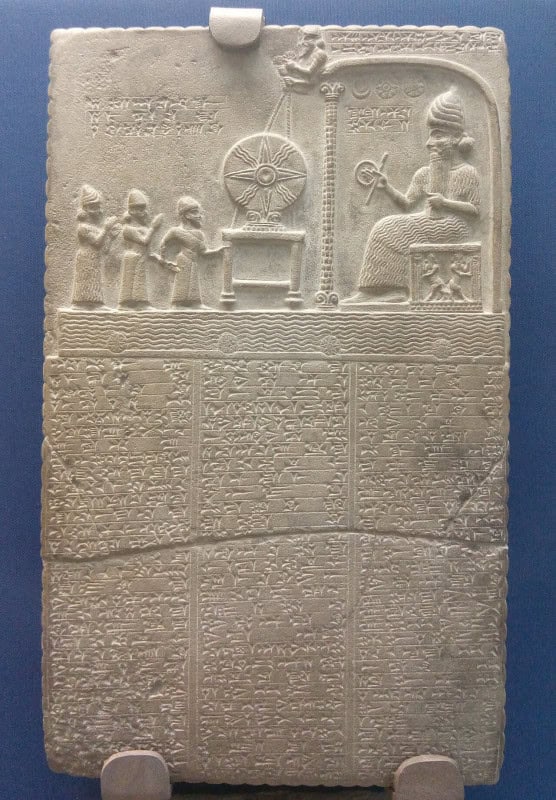
Mesopotamia, Sumerian Utu and Akkadian Shamash, third to first millennium BC; cult centres Sippar and Larsa. In the Epic of Gilgamesh (Standard Babylonian version, tablet IX) the sun rises each day through a gate in the twin-peaked mountain Mashu, guarded by scorpion-people, crosses the sky and passes under the earth at night; Akkadian seals show him climbing out between the peaks with a saw in his hand. The saw is his symbol, with a disc of four points and four wavy rays. Because he sees everything he judges: on Hammurabi’s law stele in the Louvre (about 1750 BC) the seated Shamash hands the king the rod and ring of authority. See it today: the Tablet of Shamash in the British Museum (ME 91000), from Sippar, dated to the reign of Nabu-apla-iddina (about 888 to 855 BC): the god enthroned under a canopy, a huge sun disc on an altar before him. Afterlife: Hebrew shemesh, “sun”, and the shamash, the servant candle on a Hanukkah menorah.
2. Ra: the sun in a boat
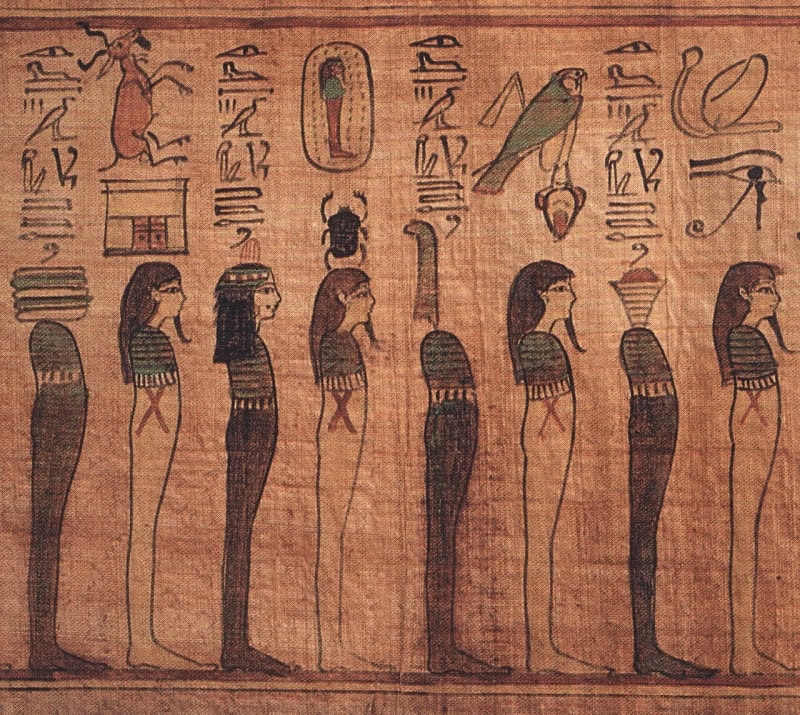
Egypt, Old Kingdom onward; also written Re; cult centre Heliopolis. Ra appears in the Pyramid Texts of Unas (about 2350 BC). His sun sails: by day in the day barque, the mandjet, and from sunset in the night barque, the mesektet, through the twelve hours of the Duat, where he fights the serpent Apophis every night. The route is mapped hour by hour in the Amduat, whose earliest complete copy is in the tomb of Thutmose III (KV 34), and the Litany of Ra in the same royal tombs invokes him under seventy-five forms. His symbol is the disc with a cobra, on a falcon’s head. The underworld he crossed is on the gods of death and the underworld page. See it today: the Papyrus of Ani, held by the British Museum (EA 10470, about 1250 BC) and shown only in rotation, which opens with a hymn to his rising. Afterlife: every “-re” in a pharaoh’s name, from Khafre to Ramesses, and the Cairo district still called Heliopolis.
3. Khepri and Ra-Horakhty: one sun, three times of day
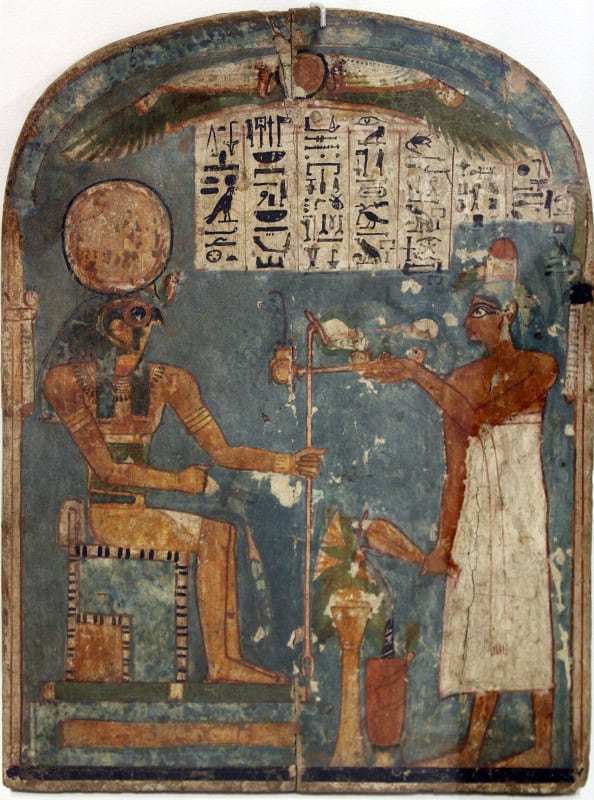
Egypt, Pyramid Texts onward; Khepri, Ra-Horakhty (“Ra, Horus of the Two Horizons”) and Atum. The Egyptians divided the sun’s day between forms of one god. At dawn he is Khepri, a scarab, because the dung beetle rolls its ball across the ground as the sun is rolled across the sky (kheper means “to come into being”). At noon he is Ra-Horakhty, a falcon-headed man crowned with the disc. At evening he is Atum, the old creator. The hymn that opens the Book of the Dead (spell 15) greets him rising as Khepri, and in spell 17 the god says he was Atum alone in the primeval waters and Ra at his first appearances. See it today: the tomb of Nefertari in the Valley of the Queens (QV 66, about 1255 BC), where Ra-Horakhty sits enthroned beside Hathor. Afterlife: the scarab amulet, the most common Egyptian object in any museum.
4. Amun-Ra: the hidden god who became the sun
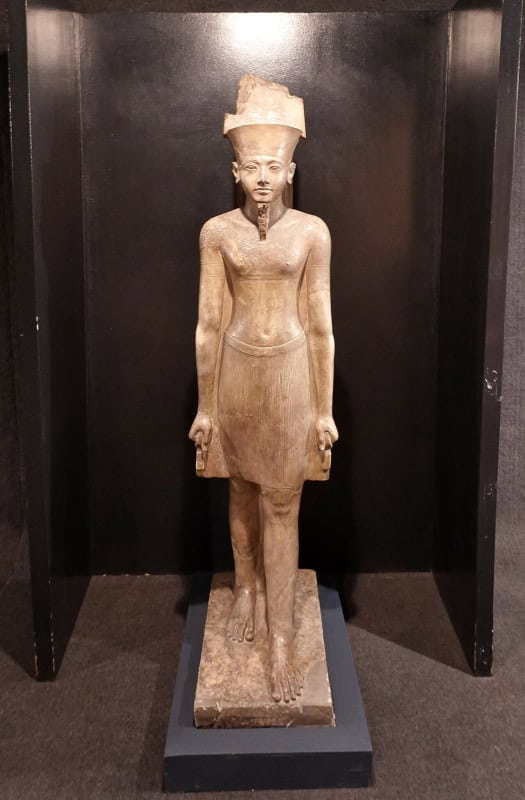
Egypt, New Kingdom (from about 1550 BC), Thebes and Karnak. Amun was the local god of Thebes, “the hidden one”, with no solar character. When Theban families took the throne he was joined to the sun god of Heliopolis, and Amun-Ra was king of the gods for five centuries. Papyrus Leiden I 350, written under Ramesses II (about 1250 BC), spells out the fusion: hidden as Amun, visible as Ra in his face, bodily present as Ptah. As Ra he sails the solar barque; as Amun his statue was carried in a gilded barque from Karnak to Luxor each year at the Opet festival. His symbols are the double-plumed crown and the ram. See it today: Karnak, the largest temple complex of the ancient world, with its ram-headed sphinxes and the Avenue of Sphinxes to Luxor, reopened in November 2021. Afterlife: Alexander’s visit to Amun’s oracle at Siwa in 331 BC, where he was hailed as the god’s son, and the name Tutankhamun, “living image of Amun”.
5. Aten: the disc with hands
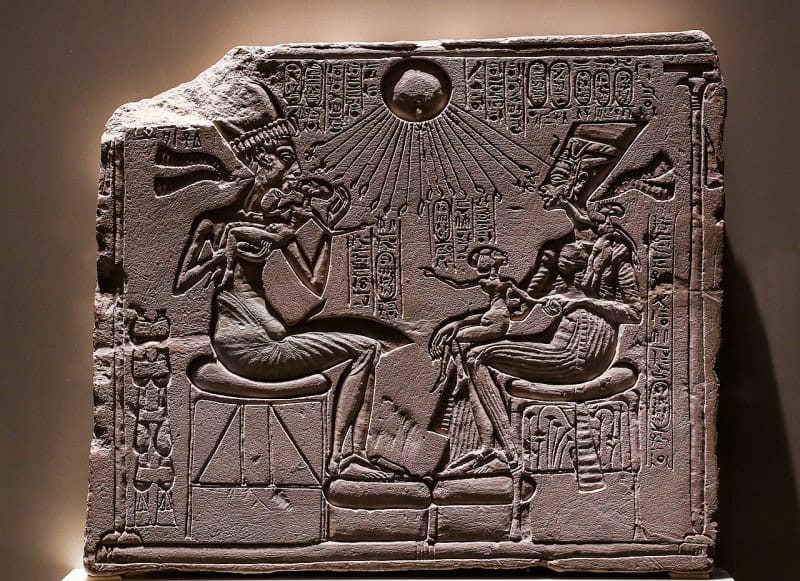
Egypt, Amarna period, the reign of Akhenaten, usually dated about 1353 to 1336 BC. Akhenaten built a new capital at Amarna and raised the Aten, the physical disc of the sun, above every other god. The Aten has no barque, no underworld and, after the first years, no human or animal form. It is the disc, with rays ending in small hands that hold the sign of life to the king and queen, and only to them. The Great Hymn to the Aten, carved in the tomb of the courtier Ay at Amarna (tomb 25), describes the world waking when the disc rises and lying as if dead when it sets; nothing happens to the sun at night, and that silence is the hymn’s most radical idea. See it today: the limestone house altar in the Neues Museum, Berlin (ÄM 14145): Akhenaten, Nefertiti and three daughters under the rays. Afterlife: Freud’s Moses and Monotheism (1939) and Philip Glass’s opera Akhnaten (1984).
6. Sekhmet: the Eye of Ra
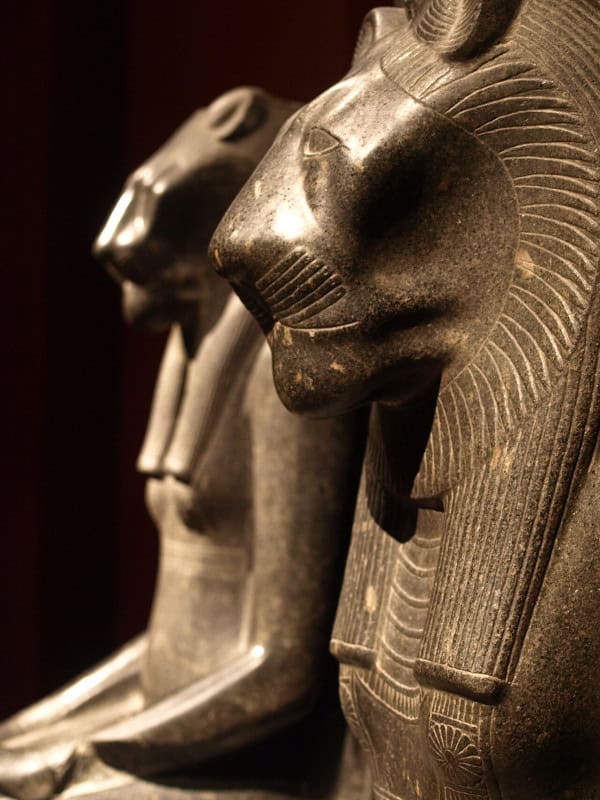
Egypt, Old Kingdom onward, with the great statue series of Amenhotep III (about 1390 to 1352 BC) at Thebes. Not a traveller but the sun’s heat and fury given a body: a lioness-headed woman with disc and cobra on her head, “the powerful one”. She is the Eye of Ra, the part of the sun god he sends out against his enemies. In the Book of the Heavenly Cow, first attested on Tutankhamun’s outer shrine and written out in full in the tombs of Seti I and Ramesses II and III, an aged Ra sends his Eye down as Hathor, who becomes Sekhmet and slaughters humanity until Ra floods the fields with beer dyed red, which she drinks as blood and falls asleep. See it today: Amenhotep III had about 730 granodiorite statues of her made (the usual estimate) for the Mut precinct at Karnak and his temple at Kom el-Hettan, so most large collections have one. Afterlife: she is the most numerous surviving statue of any Egyptian deity, and Kom el-Hettan has yielded more since 2016.
7. Mithra: the god who rides ahead of the sun
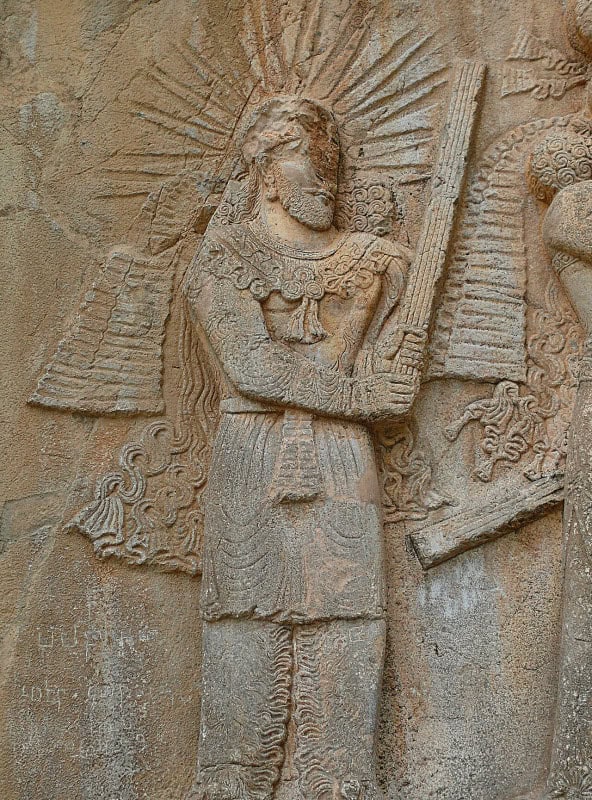
Iran, Avestan to Sasanian, roughly 1000 BC to AD 650; Avestan Mithra, Middle Persian Mihr, Latin Mithras. In the oldest text, the Mihr Yasht (Yasht 10 of the Avesta), Mithra is not the sun. He is the god of the covenant, with ten thousand eyes, the first to climb over Mount Hara each morning ahead of the “swift-horsed immortal sun” (a separate being, Hvare-khshaeta), riding a chariot drawn by four white horses. Over the centuries the escort absorbed the thing it escorted: by the Sasanian period Mihr simply meant sun, as mehr still does in Persian, and his symbol was a halo of rays. See it today: the investiture relief of Ardashir II at Taq-e Bostan, carved between AD 379 and 383: Mithra stands at the left on a lotus flower, head ringed with rays, holding the barsom of sacred twigs, while Shapur II hands the diadem to Ardashir over a fallen Roman, probably the emperor Julian. Afterlife: Mehregan, the autumn festival still kept in Iran, and Mehr, the seventh month of the Iranian calendar.
8. Helios: four horses and a golden cup
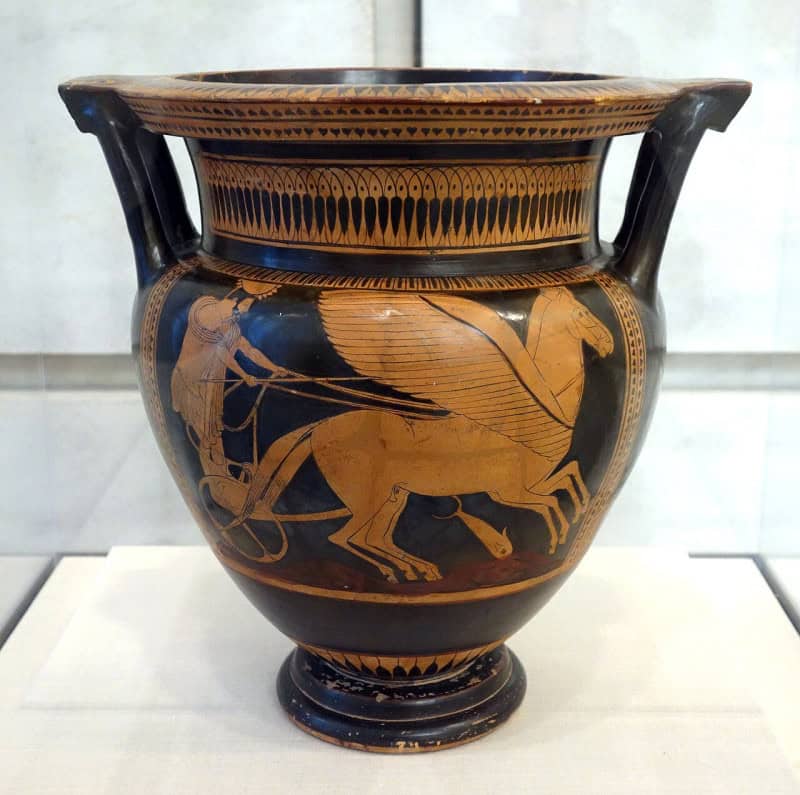
Greece, archaic to Hellenistic; Rhodes was his island. The Greek sun is a charioteer, and Ovid names the four horses Pyrois, Eous, Aethon and Phlegon (Metamorphoses 2.153 to 155). Getting back east was the problem the chariot could not solve, so the lyric poets gave him a way back: a winged golden bed in Mimnermus (fragment 12), a golden cup in Stesichorus, carrying him sleeping round the stream of Ocean overnight. His best-known story is in Odyssey 12: his sacred cattle on Thrinacia, seven herds of fifty, which Odysseus’ starving crew slaughter; Helios demands justice and Zeus sinks the ship. The cattle have their own entry on the Greek mythical creatures page. See it today: the Helios metope from the Temple of Athena at Ilion (Troy), early third century BC, in Berlin’s Antikensammlung (shown in the Altes Museum while the Pergamon Museum is closed for rebuilding): the god with a rayed crown driving four horses up out of the sea. Afterlife: helium, named in 1868 for the line it left in the solar spectrum.
9. Apollo: a sun god only in poetry
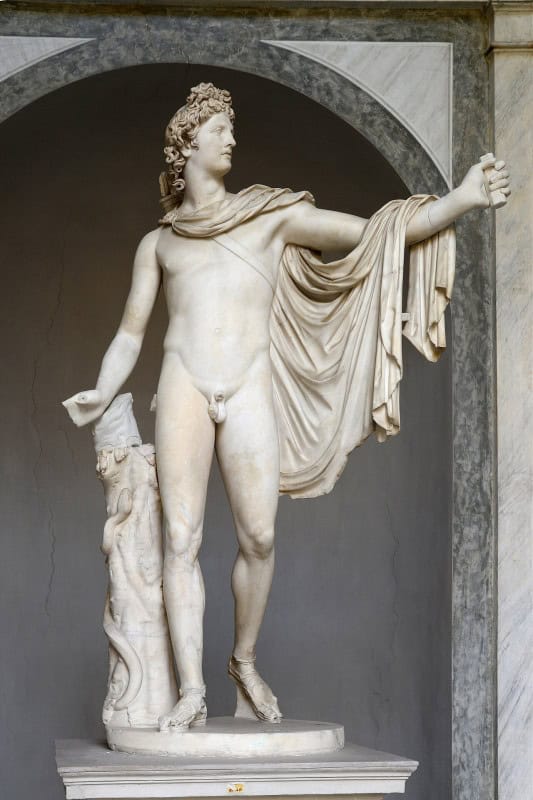
Greece and Rome; Phoebus Apollo; identified with the sun from the fifth century BC. Apollo’s own domains were prophecy, music, archery, healing and plague; his symbols are the lyre, the bow, the laurel and the tripod. None of that is solar, and as the section above explains, Homer and Hesiod keep him apart from Helios. The sun came to him through his epithet Phoebus, “bright”. Once the identification existed the poets used it freely: in Roman verse Phoebus drives the sun’s chariot, and Horace’s Carmen Saeculare (17 BC) addresses the Sun and Apollo in consecutive breaths. See it today: the Apollo Belvedere in the Vatican Museums, a Roman marble of about AD 120 to 140 after a fourth-century BC bronze; it and his other surviving images are on the famous statues of the Greek gods page. Afterlife: NASA’s Apollo programme, named in 1960 by the engineer Abe Silverstein, who had in mind the god driving his chariot across the sun.
10. Sol Invictus: the unconquered sun and 25 December
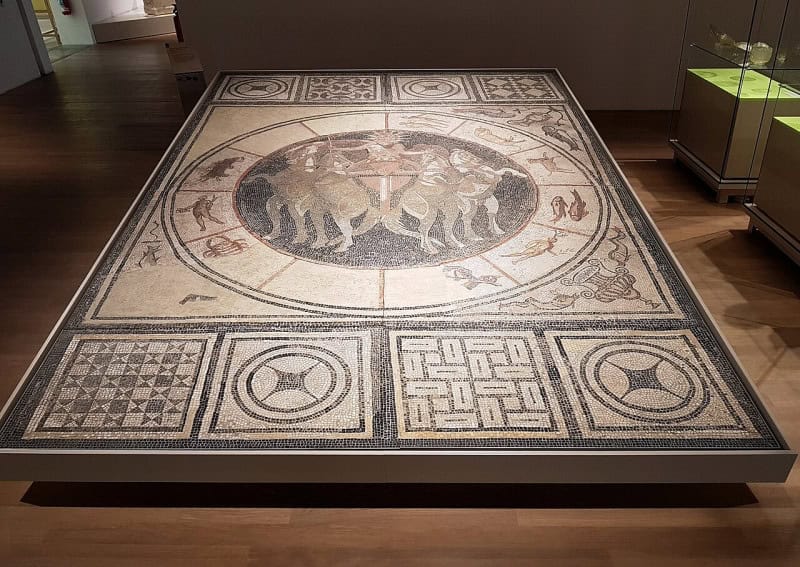
Rome, third and fourth centuries AD; “the Unconquered Sun”. Aurelian made the sun the empire’s chief god in AD 274. Sol rides a four-horse chariot and wears a crown of rays, as on the coins of Aurelian and then Constantine, whose issues of the 310s read SOLI INVICTO COMITI, “to the Unconquered Sun, companion”. The text for the date everyone asks about is the Chronograph of 354, a Roman almanac whose calendar marks 25 December as the birthday of the Invincible one and whose list of feasts gives the same day for Christ’s birth; which borrowed from which is still argued. Julian’s Hymn to King Helios (December 362) is the cult’s last great statement. The pantheon Sol briefly outranked is on the Roman gods and goddesses page. See it today: the third-century mosaic in Mausoleum M of the Vatican necropolis under St Peter’s, a rayed charioteer usually read as Christ in the guise of Sol. Afterlife: Sunday, made a rest day by Constantine’s law of 321 as the “day of the Sun”.
11. Sól (Sunna): the goddess with a wolf behind her
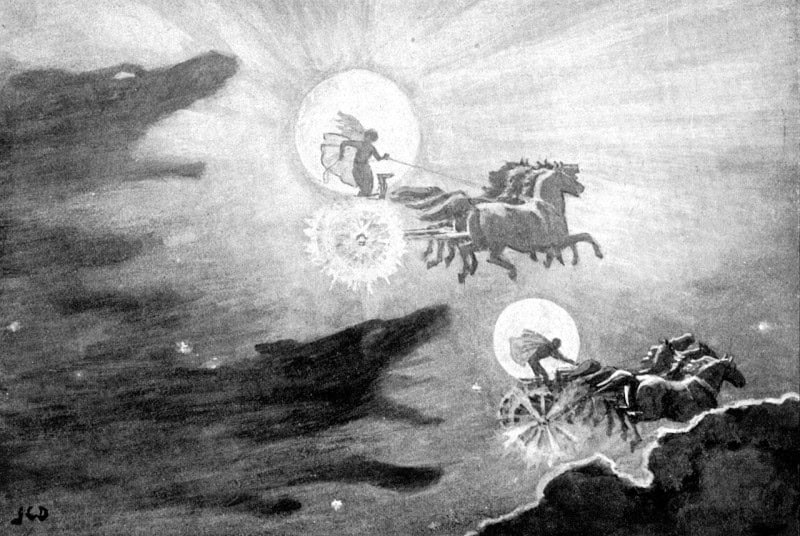
Norse, from the Eddas (thirteenth century, from older poems); Old Norse Sól, Old High German Sunna; the sun is feminine in the Germanic languages. Snorri’s Prose Edda (Gylfaginning 11) tells how a man called Mundilfari named his daughter Sól and his son Máni after the sun and moon, and how the gods, offended, set the children to drive the sun’s and moon’s chariots. Gylfaginning 12 explains her speed: the wolf Sköll runs behind her and will catch her at the end of the world. The Eddic poem Vafþrúðnismál (stanza 47) names Fenrir as the wolf instead. Her place among the gods is on the Norse gods and goddesses page. See it today: the Trundholm sun chariot in the National Museum of Denmark, Copenhagen: a bronze horse drawing a disc gilded on one side only, made around 1400 BC and found in a bog on Zealand in 1902. Afterlife: Sunday, which is Sunna’s day, and J. C. Dollman’s 1909 painting of the wolves chasing sun and moon.
12. Surya: seven horses and a temple shaped like a chariot
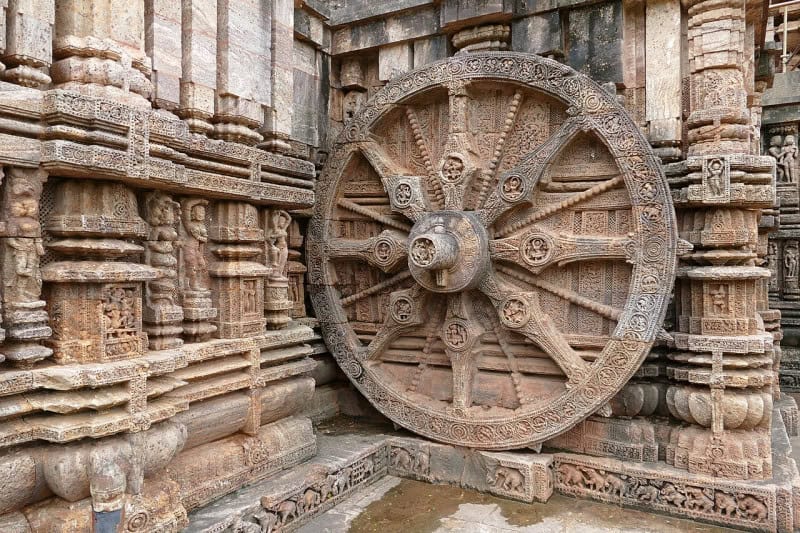
India, from the Vedic hymns to present-day Hindu practice; Surya, also Aditya, Savitr, Bhaskara, Ravi and other names. The Rigveda, usually dated to the second half of the second millennium BC, addresses the sun in hymns 1.50 and 1.115, and 1.50.8 already gives him a chariot with seven horses. The Gayatri mantra recited at sunrise is Rigveda 3.62.10, addressed to Savitr, the sun as mover. “The twelve names of the sun god” has two answers in the tradition: the twelve Adityas, sons of Aditi, listed in the Puranas (the names vary by text), and the twelve names recited with the twelve positions of Surya Namaskar, the sun salutation. See it today: the Sun Temple at Konark in Odisha, built under Narasimhadeva I around 1250 and a World Heritage Site since 1984, carved as a stone chariot with twelve pairs of wheels and seven horses. Today: Surya’s living temples and festivals are described under “Sun gods still worshipped today” below.
13. Amaterasu: the sun who shut herself in a cave
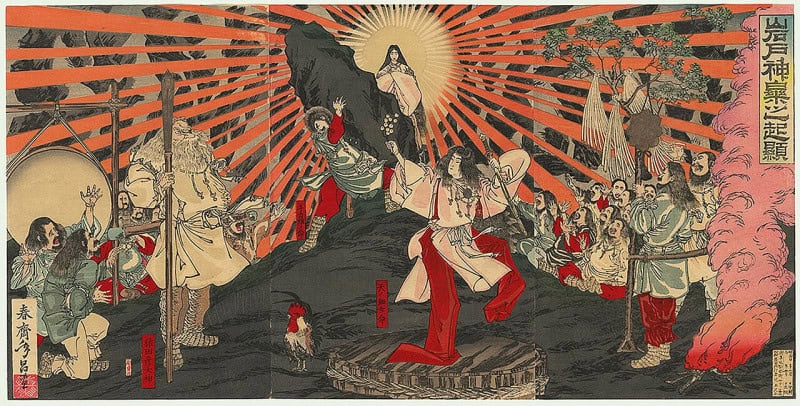
Japan, from the Kojiki (712) and Nihon Shoki (720) to present-day Shinto; in full Amaterasu Ōmikami. The Kojiki, book 1, records her birth from the left eye of Izanagi, and how, when her brother Susanoo ravaged her rice fields and weaving hall, she withdrew into the heavenly rock cave, Ama-no-Iwato, and the world went dark. The gods hung a mirror outside and Ame-no-Uzume danced until the assembly roared with laughter; Amaterasu opened the door to see why, saw her own light in the mirror and was pulled out. The mirror went to earth with her grandson Ninigi, ancestor of the imperial house. She has no chariot and no barque; the cave story is about the day’s absence. See it today: the Inner Shrine of Ise Jingū in Mie Prefecture, where the mirror is held to be enshrined and the buildings are rebuilt to the same plan every twenty years; Shunsai Toshimasa’s woodblock triptych of 1887, Origin of Music and Dance at the Rock Door, shows the cave scene. Today: see “Sun gods still worshipped today” below.
14. Xihe and the ten suns: the mother who drove the sun’s chariot
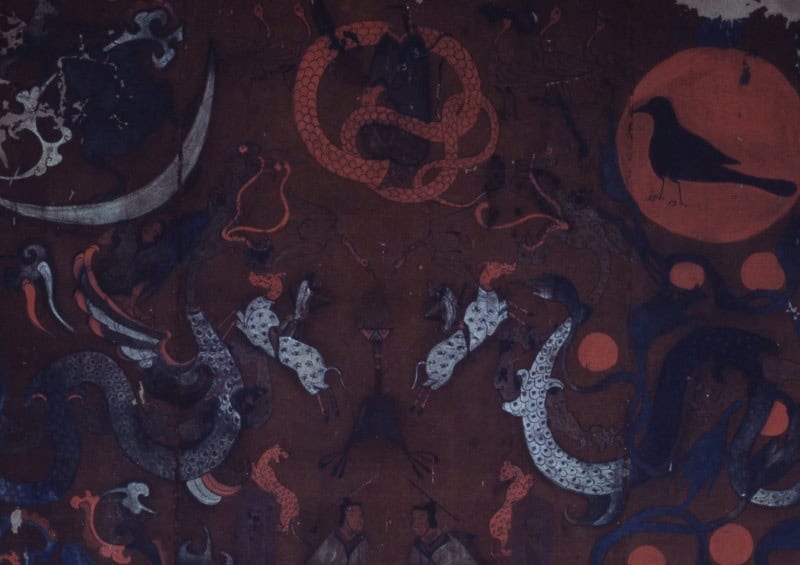
China, texts of the Warring States and Han periods; Xihe, the ten suns and the archer Yi (Hou Yi). The Classic of Mountains and Seas (“Great Wilderness: South”) says that Xihe, wife of the god Di Jun, bore ten suns and bathes them in the Gan Gulf; its “Regions Beyond the Seas: East” puts the suns in the Fusang mulberry tree, and “Great Wilderness: East” adds that each is carried by a crow. In the Songs of Chu Xihe drives the sun’s chariot. The disaster is in the Huainanzi, chapter 8: in the reign of Yao all ten suns rose at once and Yao had the archer Yi shoot them down. The crow became the sun’s emblem, drawn with three legs in Han art. See it today: the painted silk banner from Tomb 1 at Mawangdui, Changsha, 160s BC, now in the Hunan Museum: in its upper right corner a crow stands in a red sun above the Fusang tree. Afterlife: China named its first solar observation satellite Xihe at its launch in October 2021.
15. Inti: the sun whose son ruled the Andes
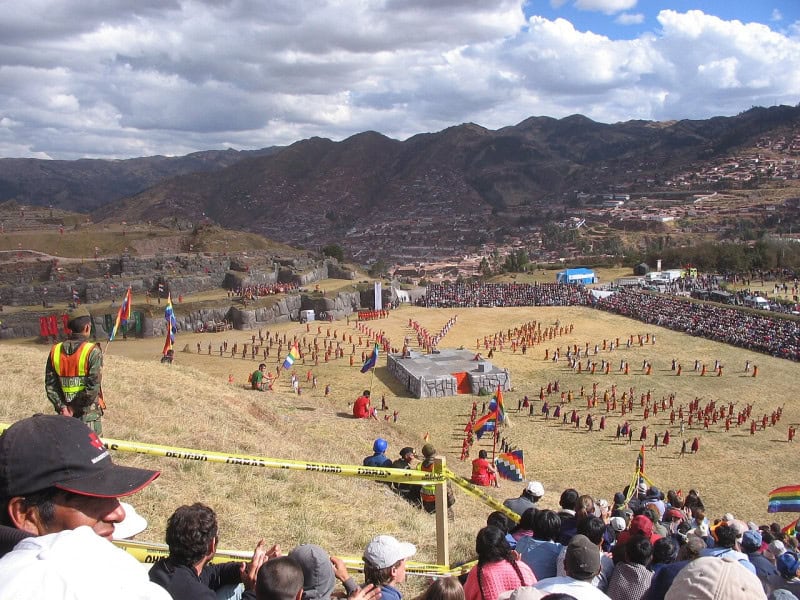
Inca, Cusco and the Andes, fifteenth and sixteenth centuries AD; Inti, with Punchao as the image of the daytime sun. The Inca ruler was Intip Churin, son of the sun; the state cult of the sun was the empire’s cult of itself. The chief source is Garcilaso de la Vega, whose Royal Commentaries (1609), book 3, describes the Coricancha, the “golden enclosure” in Cusco, with its gold-sheathed walls and a great gold image of the sun. That image was lost in the plunder of 1533 and 1534; another cult image, the Punchao, which Manco Inca had carried off to the Inca refuge of Vilcabamba, was captured with the last emperor, Tupac Amaru, in 1572, after which the sources disagree about what became of it. No surviving account gives Inti a chariot or a boat; what mattered was the June solstice festival, Inti Raymi. The famous rayed gold mask in Quito, emblem of the Central Bank of Ecuador, is often captioned as Inca but is Tolita work, centuries older. See it today: the Coricancha in Cusco, whose curved wall still stands under the church of Santo Domingo. Afterlife: the Sun of May on the flags of Argentina and Uruguay, and the revived Inti Raymi described below.
16. Tonatiuh: the Fifth Sun
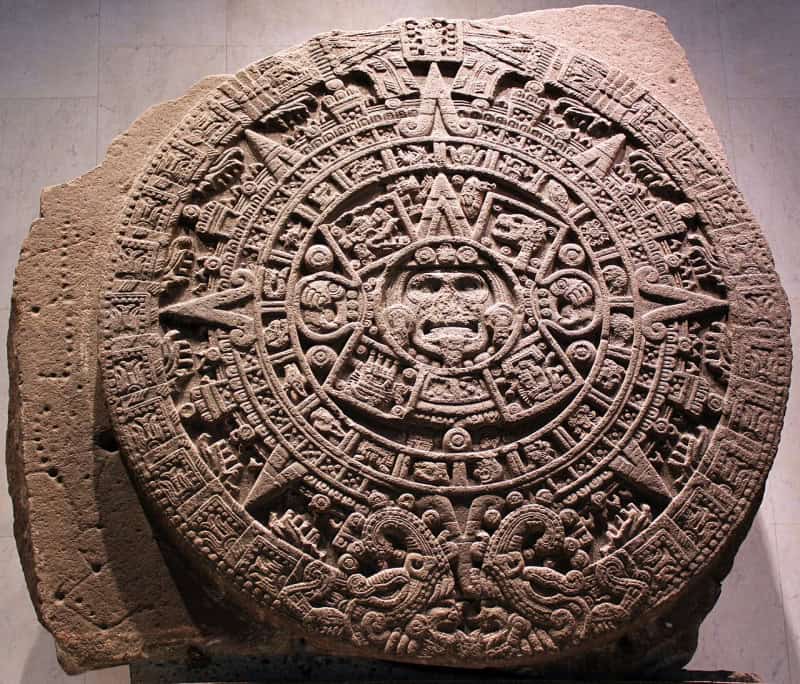
Aztec (Mexica), central Mexico, fourteenth to sixteenth centuries AD; Tonatiuh, the sun of the present age, called Nahui Ollin, “Four Movement”. The Mexica held that four suns had already been destroyed. The Legend of the Suns (1558) and book 7 of Sahagún’s Florentine Codex tell how the gods gathered in darkness at Teotihuacan; Tecciztecatl hesitated at the fire, the sore-covered Nanahuatzin threw himself in and rose as Tonatiuh. He travels in a litter: dead warriors carry him from dawn to noon, the women who died in childbirth from noon to sunset, after which he passes through the underworld. See it today: the Sun Stone (Piedra del Sol), a basalt disc 3.6 metres across, dug up in the Zócalo of Mexico City on 17 December 1790 and in the Museo Nacional de Antropología since 1964; the central face is usually, not universally, read as Tonatiuh. Afterlife: the Sun Stone is the most reproduced image of ancient Mexico, and the Mexica nicknamed the fair-haired conquistador Pedro de Alvarado “Tonatiuh”.
17. Huitzilopochtli: the warrior sun of the Mexica
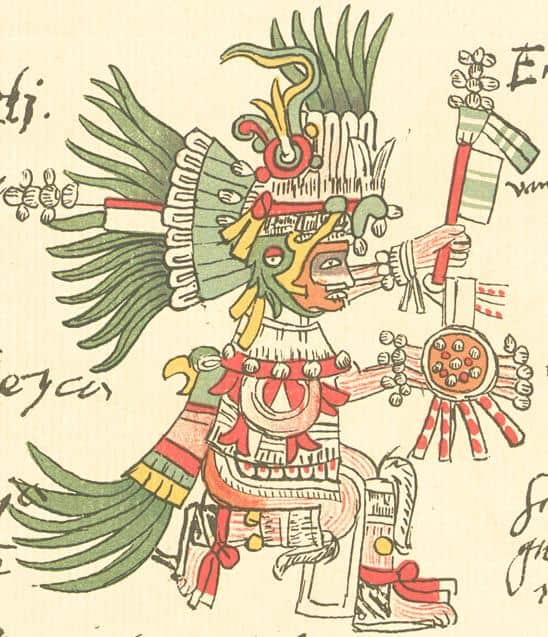
Aztec (Mexica), Tenochtitlan, fourteenth to sixteenth centuries AD; “Hummingbird of the South”. Huitzilopochtli is the Mexica’s own god, identified with the sun as a fighter. Book 3 of the Florentine Codex tells his birth at Coatepec, “Snake Mountain”: his sister Coyolxauhqui led her four hundred brothers to kill their mother Coatlicue; Huitzilopochtli was born fully armed, cut Coyolxauhqui to pieces and scattered the brothers, read as the sun rising to rout the moon and stars. The Mexica held that the sun needed human hearts and blood to keep moving, and captives taken in war were sacrificed at his temple for that stated reason. His festival, Panquetzaliztli, is pictured in the Codex Borbonicus (the page usually numbered 34). See it today: the stone disc of the dismembered Coyolxauhqui, found on 21 February 1978 at the foot of the Templo Mayor, in the Museo del Templo Mayor, Mexico City. Afterlife: the eagle on the cactus, the sign he gave the Mexica for their city, now the coat of arms of Mexico.
18. Kinich Ahau: the sun-faced lord of the Maya
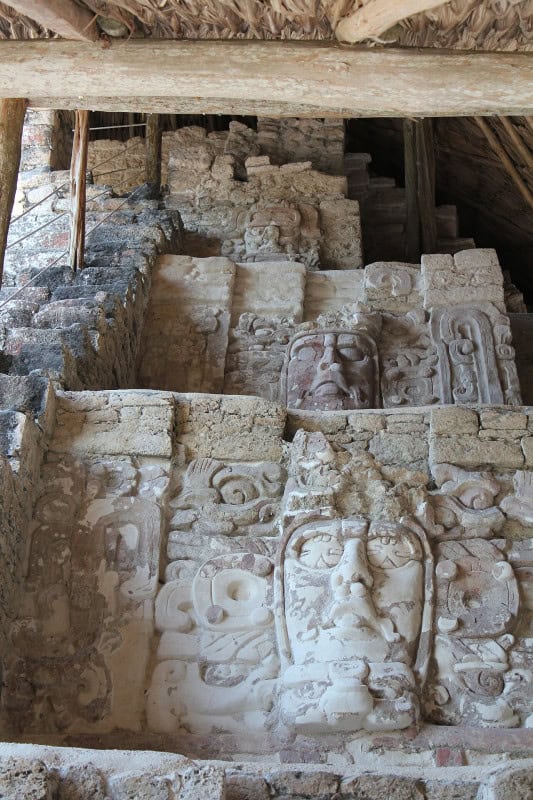
Maya, Classic period (about AD 250 to 900) and after; K’inich Ajaw, “Sun-faced Lord”. The Maya sun god is known from his face more than from stories: large square eyes, a hooked nose and the four-petalled k’in day sign on his cheek or brow. Classic kings took his name as a title, most famously K’inich Janaab’ Pakal of Palenque (died 683); the Temple of the Sun that his son K’inich Kan Bahlam II dedicated in 692 carries a shield with the face of the night sun. That is the Maya journey: by day the sun-faced lord crosses the sky, and by night he becomes the Jaguar God of the Underworld and fights through Xibalba to rise again. See it today: the Temple of the Masks at Kohunlich in Quintana Roo, Early Classic, whose stucco faces combine a ruler’s portrait with the sun god’s eyes and k’in signs (Mexico’s INAH describes them as rulers with solar attributes rather than the god himself). Afterlife: Pakal’s name, and the k’in sign on every Maya calendar sold in the Yucatán.
19. Māui and the sun: a hero, not a god
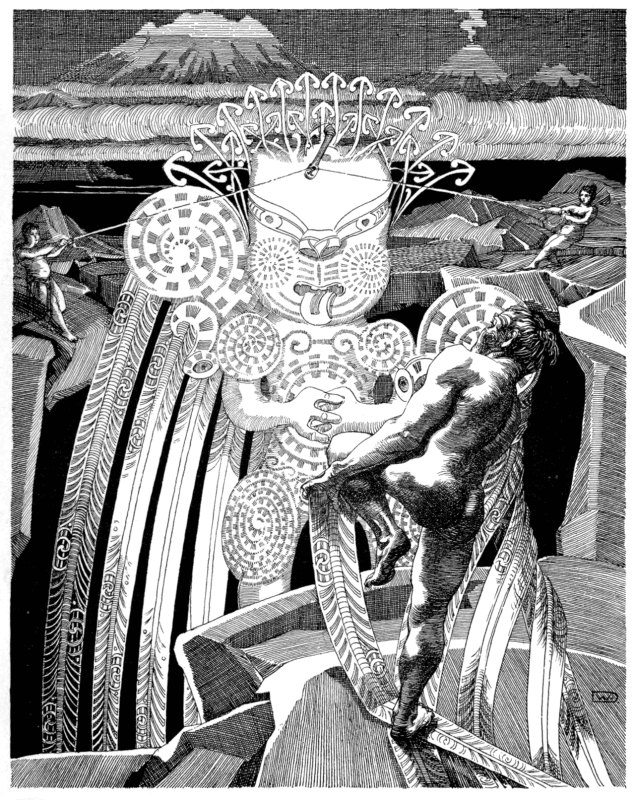
Polynesia; Māori, Hawaiian and other versions; Sir George Grey’s Polynesian Mythology (1855) is the best-known Māori collection. Māui is on most lists of sun gods and is not one. He is a demigod and trickster who fished up the North Island of New Zealand and stole fire from the goddess Mahuika. The sun in the Māori account is Tama-nui-te-rā, who crossed the sky so fast that the days were too short for work. Māui and his brothers plaited ropes of flax, snared him at the pit where he rises and beat him with the jawbone of Māui’s grandmother Muri-ranga-whenua until he agreed to go slowly. The sun has no vehicle here; the story is about regulating a body that moves by itself. See it today: the summit of Haleakalā on Maui, “the house of the sun”, where the Hawaiian version sets the snaring; Wilhelm Dittmer’s illustrations in Te Tohunga (1907) are the pictures most often reproduced. Afterlife: Disney’s Moana (2016), which kept the sun-snaring among his boasts.
20. The Celtic sun: the wheel god, Belenus, and why Lugh is not a sun god
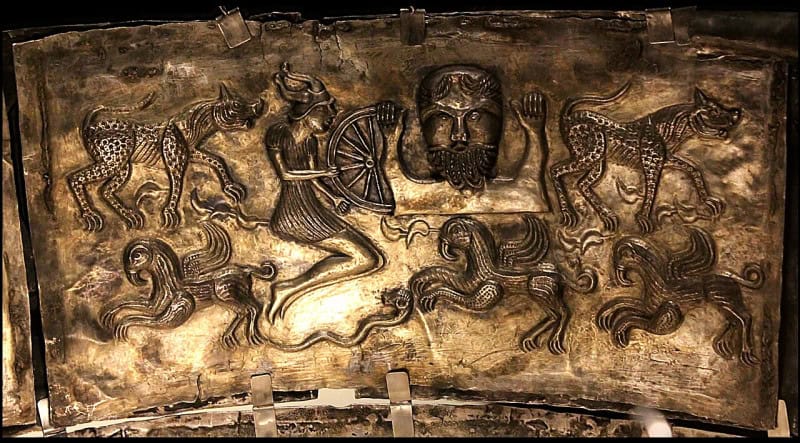
Gaul, Britain and Ireland; Iron Age objects, Irish texts written down from the eighth century onward. The Celtic world left no sun myth, only objects and names. The object is the wheel. On the Gundestrup cauldron (usually dated to the second or first century BC) a bearded god grips a spoked wheel, usually taken for Taranis, the thunder god, which makes it a sky symbol as much as a sun symbol. The name is Belenus, an Alpine and Gaulish god equated with Apollo in inscriptions. Then there is Lugh. The Irish Cath Maige Tuired makes him Lámfada, “of the long arm”, and Samildánach, “skilled in all arts”, a king and warrior. Nineteenth-century scholars, deriving his name from a word for light, made him a sun god; most specialists now reject the “light” derivation (a root meaning oath or binding is one of the proposals), and nothing in the Irish texts gives him the sun. More on the Celtic gods and goddesses page. See it today: the Gundestrup cauldron in the National Museum of Denmark, Copenhagen. Afterlife: Lughnasadh on 1 August, a harvest festival rather than a solar one.
Why are there so many sun gods?
Because “a culture” is a long time and a lot of places. Egypt worshipped the sun for about three thousand years, from the Pyramid Texts around 2350 BC to the closing of the last temples in the sixth century AD, and every major city had its own god who, when that city’s kings took power, was joined to the sun, as Amun of Thebes became Amun-Ra. The five Egyptian entries above are not duplicates; they are the same sun seen from different hours and different thrones. Greece kept Helios for worship and Apollo for poetry. The Mexica had a sun and a sun-warrior. Elsewhere: Nyame of the Akan, Liza of the Fon, Saulė the Baltic sun mother, Dazhbog of the Slavs, and Malina of the Inuit, who flees her brother the moon across the sky. If the question is which sun god was greatest, the only measurable answer is span of worship, and by that measure it is Ra.
Sun gods still worshipped today
Two of the twenty belong to major living religions, and one festival has been brought back. Surya is worshipped in Hinduism today. The Gayatri mantra is recited at sunrise; Surya Namaskar, the sun salutation, is practised as a sequence of twelve postures each paired with one of his names; Makar Sankranti marks the sun’s turn north in January; and Chhath, six days after Diwali in Bihar and the regions around it, draws millions of people to riverbanks to fast and make offerings to the setting and the rising sun. Amaterasu is the principal deity of Ise Jingū, and the emperor’s ritual role still centres on her: the Niiname-sai harvest offering each November, and the Daijōsai performed once in a reign, most recently in November 2019. Inti Raymi, banned by the Spanish in 1572, was reconstructed in 1944 by the Cusco scholar and actor Faustino Espinoza Navarro and is now performed every 24 June at the Coricancha and the fortress of Sacsayhuamán, a revival rather than an unbroken tradition.
Where the sun goes at night
The half of the journey nobody could see is where the sun gods meet the gods of the dead. Shamash passes under the earth from the western gate to the eastern one. Helios sails back along Ocean in a golden cup. Tonatiuh crosses Mictlan. The Maya sun becomes a jaguar and fights through Xibalba. And Ra, in the most detailed account any culture produced, spends twelve hours in the Duat, hauled past the gate of each hour, waking the dead for a moment as he passes, joining with Osiris at the midpoint so that the dead god and the living sun become one body, and killing Apophis before dawn. That is why Egyptian tombs are painted with the sun’s route rather than the sky’s: the dead hoped to travel with him. The gods who waited at those gates, and the underworlds the sun crossed, are on the gods of death, destruction and the underworld page.
Image credits
All images are from Wikimedia Commons. Public domain: the Litany of Ra papyrus of Nany (Metropolitan Museum of Art), the Mawangdui silk banner (Hunan Museum), Amaterasu emerging from the cave by Shunsai Toshimasa (1887), The Wolves Pursuing Sol and Mani by J. C. Dollman (1909), Maui’s fight with the sun by Wilhelm Dittmer (1907) and the Codex Telleriano-Remensis page. CC BY: the stela of Padikhonsu by Anagoria (3.0), the Amun statue by Olaf Tausch (3.0), the Helios krater by Mark Landon (4.0), the Konark wheel by Ankur Panchbudhe (2.0), the Sun Stone by Anagoria (3.0), the Kohunlich masks by Arian Zwegers (2.0). CC BY-SA: the Tablet of Shamash by Zunkir (4.0), the Aten relief by ArchaiOptix (4.0), the Sekhmet statues by Captmondo (3.0), Mithra at Taq-e Bostan by dynamosquito (2.0), the Apollo Belvedere by Alvesgaspar (4.0), the Bonn sun god mosaic by Kleon3 (4.0), Inti Raymi by Mme Berthe (3.0), the Gundestrup plate by Claude Valette (3.0). Title card by The Popular List.