
Ask which animal is the smartest and you will get a confident answer from almost everyone, and the answers will not agree. Dolphins, says one person. Crows, says another. Pigs, octopuses, elephants, the family dog. What most of those answers have in common is that they are based on a story someone heard rather than on a test someone ran.
This list is built the other way round. Every animal on it is here because a named experiment, published in a scientific journal in a stated year, showed it doing something specific: making a tool, recognising itself in a mirror, remembering what it hid and when, planning for a need it did not yet have, or grasping an idea as abstract as zero. The study is named in each entry and listed again at the end, so you can check any of it.
Two things to hold in mind while you read. First, there is no such thing as an animal IQ. Intelligence is not one quantity, and a species that is brilliant at one kind of problem may be hopeless at another, so the ranking here is by the strength and range of the evidence, not by a score. Second, the surprises are real. The entries at the end of this list are the ones that most people would never guess.
How scientists actually test animal intelligence
A handful of experiments come up again and again below, so it is worth knowing what they are. The mirror test puts a mark on an animal where it cannot see it, then shows it a mirror: an animal that inspects or touches the mark on its own body is treated as recognising itself. Tool-use studies look for animals that make or modify an object to solve a problem, and the strongest cases are ones where the animal invents a tool it has never seen. Memory tests ask whether an animal can remember not just where something is but what it was and how long ago it was put there. Planning tests offer an animal a tool or a token it cannot use now but will need later, and see whether it saves it. And numerical tests check whether an animal can order quantities, including the hardest one to grasp, nothing at all.
None of these is a perfect measure, and every one has been argued over. Where a result is contested, the entry says so. Where it has been replicated, the entry says that too.
Great apes and monkeys
1. Chimpanzee
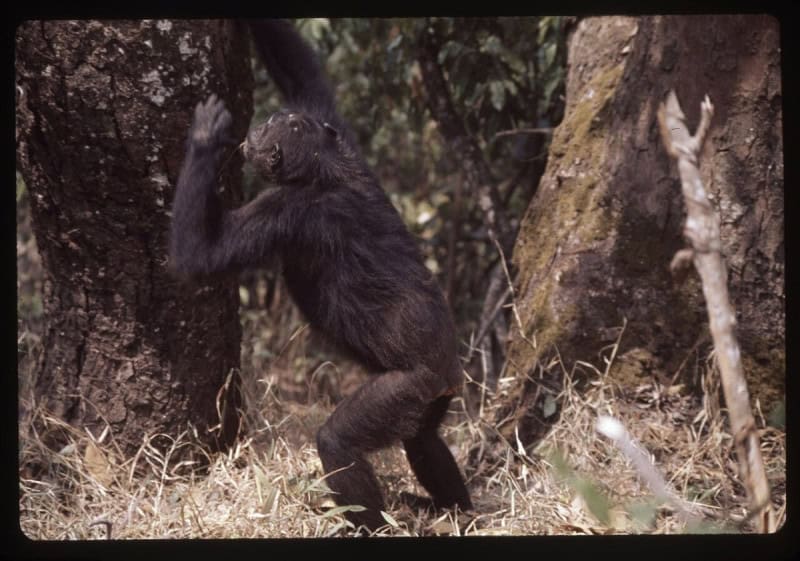
The chimpanzee is first because no other animal has passed so many different kinds of test. The tool use is the oldest evidence: in 1960 Jane Goodall watched a chimpanzee at Gombe, in Tanzania, strip the leaves from a stem and use it to fish termites out of a mound, the first documented tool-making by a wild non-human animal. The photograph above is a 1976 slide from a Colorado State University collection, catalogued as a chimpanzee with a grass tool at a tree, sixteen years after that first observation.
The memory evidence is more startling. In 2007, Sana Inoue and Tetsuro Matsuzawa at Kyoto University’s Primate Research Institute published a study in Current Biology in which a young chimpanzee named Ayumu was shown five numerals drawn from 1 to 9 scattered on a touchscreen for a fraction of a second before they were masked by white squares. He then touched the squares in numerical order, from memory, and he did it faster and more accurately than the adult humans tested against him.
Chimpanzees were also the first animals shown to recognise themselves in a mirror, in Gordon Gallup’s 1970 study in Science, and a 1999 survey in Nature led by Andrew Whiten documented 39 behaviours, nut-cracking among them, that vary between chimpanzee communities as learned traditions. The reason they lead this list is not any one of those results. It is that all of them have been shown, repeatedly, in the same species.
2. Bonobo
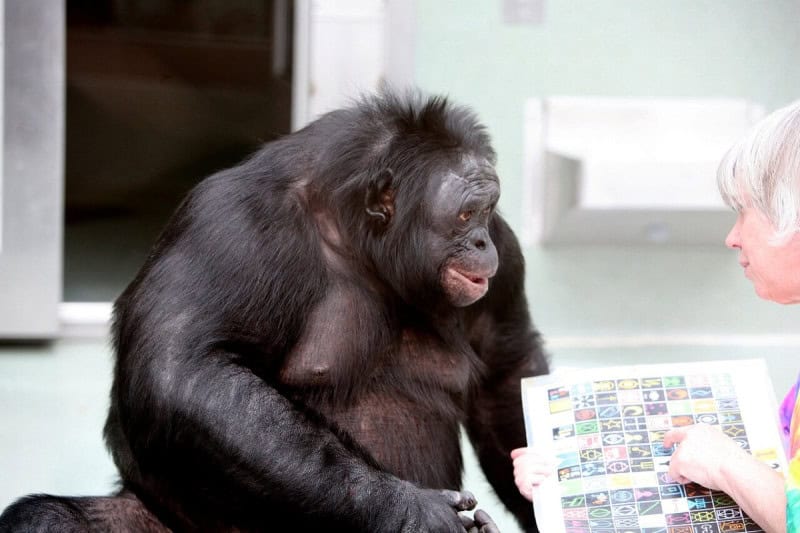
The bonobo’s place on this list rests largely on one individual. Kanzi, born in 1980, was not the subject of the language study that made him famous. His adoptive mother, Matata, was. Researchers at the Language Research Center in Georgia spent two years trying to teach Matata to communicate using a keyboard of printed symbols called lexigrams, with little success, while her infant son played around the edges of the sessions. When Matata was moved away for breeding, Kanzi walked up to the keyboard and started using it.
Sue Savage-Rumbaugh and colleagues reported that in the Journal of Experimental Psychology: General in 1986, under the title “Spontaneous symbol acquisition and communicative use by pygmy chimpanzees,” pygmy chimpanzee being the older name for the bonobo. Kanzi had picked up the symbols by watching, the way a human child picks up words. In later work, reported in a 1993 monograph, he went on to use hundreds of them and to respond to spoken English sentences he had never heard before. The photograph shows him in 2006, with a later portable version of the lexigram keyboard and with Sue Savage-Rumbaugh beside him.
What makes the case scientifically interesting rather than just charming is the word spontaneous. Nobody trained him. That is the strongest kind of evidence for a mind that was ready for symbols before anyone offered them.
3. Orangutan
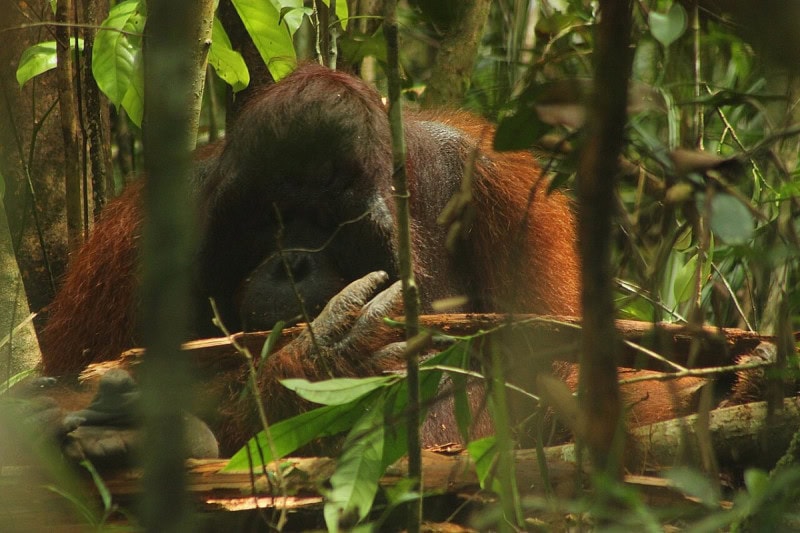
Orangutans are the great ape that plans. In 2013 Carel van Schaik, Laura Damerius and Karin Isler published a study in PLOS ONE of wild male orangutans at Tuanan, in Borneo, showing that the long, booming calls a male gives in the evening predict the direction he will travel the next morning, and that females use the information to position themselves. A wild animal announcing tomorrow’s route today is planning in the plain sense of the word.
They also have culture. A 2003 paper in Science led by van Schaik compared orangutan populations across Borneo and Sumatra and identified 24 behaviours, from using leaves as gloves and napkins to particular ways of making a nest, that varied between sites in a way that could only be explained by social learning. Some populations had them; neighbouring ones did not; the difference was not genetic and not ecological. It was learned.
4. Bearded capuchin
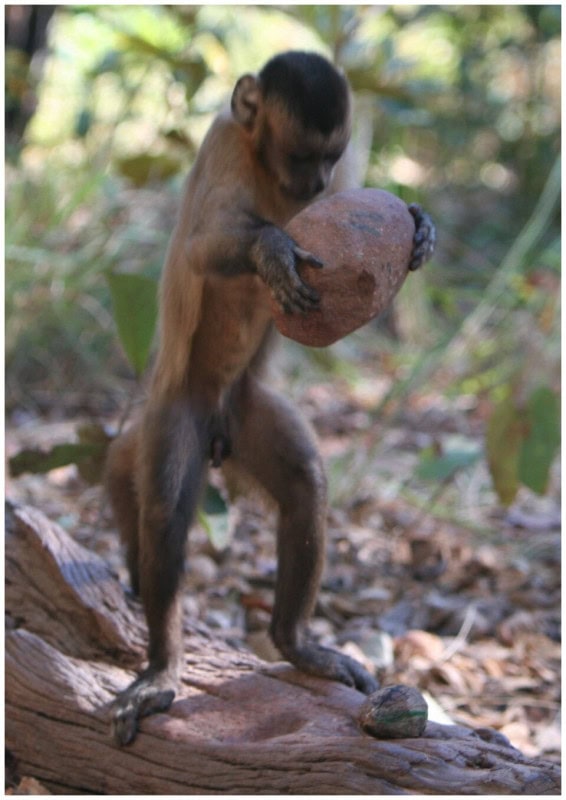
The only monkey on this list, and it is here because of archaeology. Bearded capuchins in Brazil crack palm nuts by carrying a heavy stone to a flat anvil rock and pounding, exactly as in the photograph. In 2019 a team including Tiago Falótico and Michael Haslam published excavations at Serra da Capivara National Park in Nature Ecology and Evolution showing that capuchins had been using stone tools at that site for around 3,000 years, and that the tools changed over that time as the monkeys shifted between different foods.
That is a tool tradition older than most human technologies still in use, maintained by a monkey that weighs a few kilograms, and passed down without anyone writing it down. The selection of the right stone, heavy enough to crack the nut but light enough to lift, is the part that takes the most skill.
Elephants and dolphins
5. Asian elephant
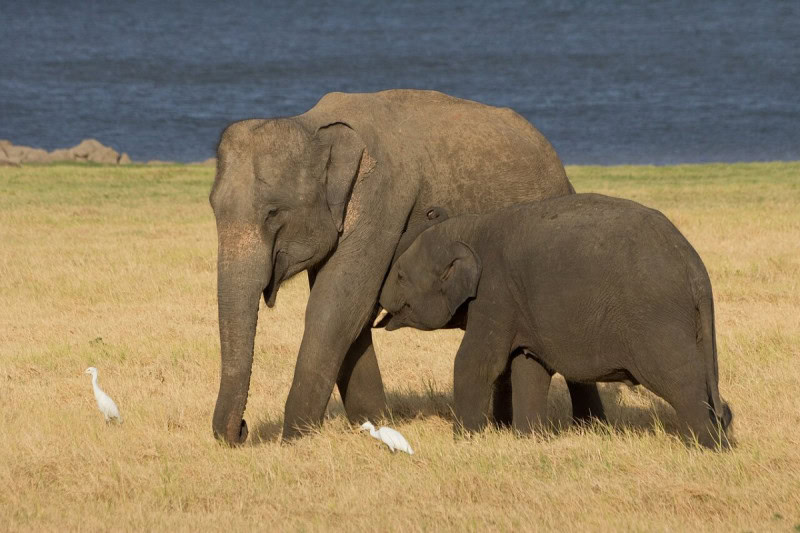
In 2006, Joshua Plotnik, Frans de Waal and Diana Reiss put an elephant-sized mirror in front of three Asian elephants at the Bronx Zoo and reported the result in the Proceedings of the National Academy of Sciences. One of them, a female named Happy, repeatedly touched a white X painted on her forehead while looking at her reflection, and ignored an invisible mark painted on the other side as a control. She was the first elephant shown to pass the mirror test, joining the great apes and dolphins.
Five years later Plotnik led a second study, also in PNAS, with elephants in Thailand. Two elephants had to pull the two ends of a rope at the same time to drag a table of food within reach; pull alone and the rope simply slid out. The elephants learned to wait for a partner to arrive before pulling, and one of them worked out that she could simply stand on her end of the rope and let the other elephant do all the work, which still counts as understanding the task.
6. Bottlenose dolphin
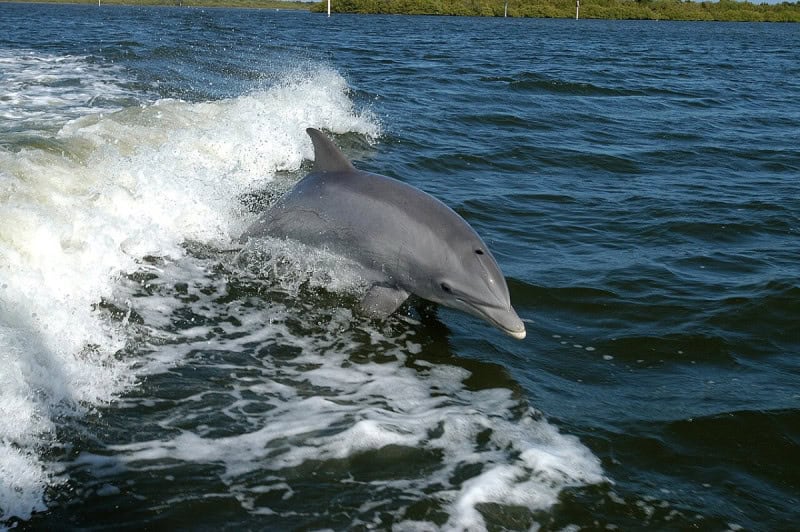
Dolphins were the first animals outside the great apes to pass the mirror test. Diana Reiss and Lori Marino reported it in PNAS in 2001: two bottlenose dolphins at the New York Aquarium, marked with a non-toxic pen, went straight to a mirror and twisted to inspect the marked part of their bodies. Five years later Reiss did the same with Happy the elephant.
The evidence that gets less attention is about names. Every bottlenose dolphin develops its own signature whistle, and in 2013 Stephanie King and Vincent Janik showed in PNAS that wild dolphins off the Scottish coast responded to synthesised copies of their own signature whistle by calling back, and ignored copies of other dolphins’ whistles. In other words, a dolphin answers when you call its name. Add the sponge-carrying dolphins of Shark Bay in Western Australia, which protect their beaks with a marine sponge while foraging on the seabed and pass the habit from mother to daughter, documented by Michael Krützen and colleagues in PNAS in 2005, and the case is as broad as the chimpanzee’s.
Birds
Bird brains are small, and for a century that was taken to mean bird minds were simple. The corvids and parrots below have done more than any other group to overturn that assumption, and the pigeon at the end of this section is the one that overturns it for the birds nobody expected.
7. New Caledonian crow
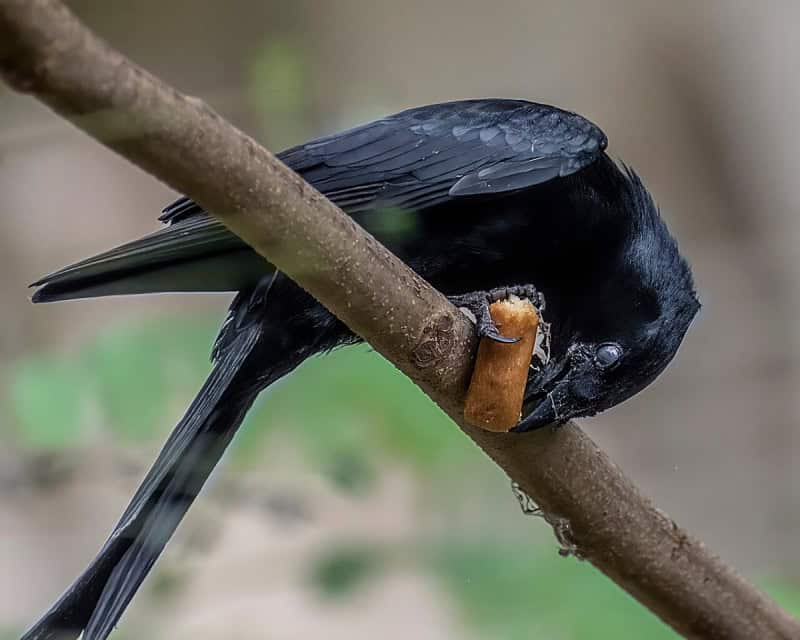
A crow from one group of Pacific islands is the best tool-maker in the animal kingdom after humans. In 1996 Gavin Hunt reported in Nature that wild New Caledonian crows manufacture hooked tools from twigs, and barbed tools from the edges of pandanus leaves, to hook grubs out of holes in wood. Making a hook, rather than just using a stick, had never been documented in any non-human animal.
Then, in 2002, a captive New Caledonian crow named Betty at Oxford did something that was reported in Science. Given a straight piece of wire and a small bucket of food at the bottom of a tube, she bent the wire into a hook and lifted the bucket out. She had never been shown how; Alex Weir, Jackie Chappell and Alex Kacelnik reported that she went on to do it again in nearly every trial that followed. It remains one of the cleanest demonstrations of an animal inventing a tool to fit a problem.
8. Common raven
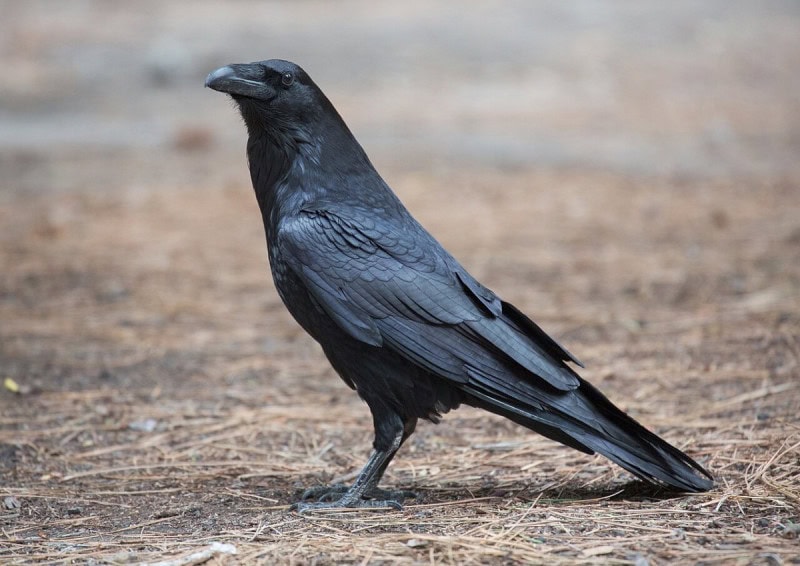
Planning for the future was long thought to be uniquely human, then extended to the great apes. In 2017 Can Kabadayi and Mathias Osvath at Lund University showed in Science that ravens do it too. The birds were taught that a particular tool opened a puzzle box containing food, then offered the tool among distractor objects at a time when the box was absent, with the box returning fifteen minutes or, in one condition, seventeen hours later. The ravens picked the right tool and held on to it. They did the same with a token they could later exchange with a human for food, and they turned down an immediate small reward to keep the token for a better one.
The authors’ comparison was direct: on these tasks the ravens performed at least as well as the great apes tested on them. The result has been argued over: later in 2017 Jonathan Redshaw, Alex Taylor and Thomas Suddendorf suggested in Trends in Cognitive Sciences that simpler learning could account for it, and Osvath and Kabadayi replied in the same journal in 2018. The planning reading stands, but it is not unopposed. The photograph is a wild raven in Yosemite National Park.
9. Scrub-jay
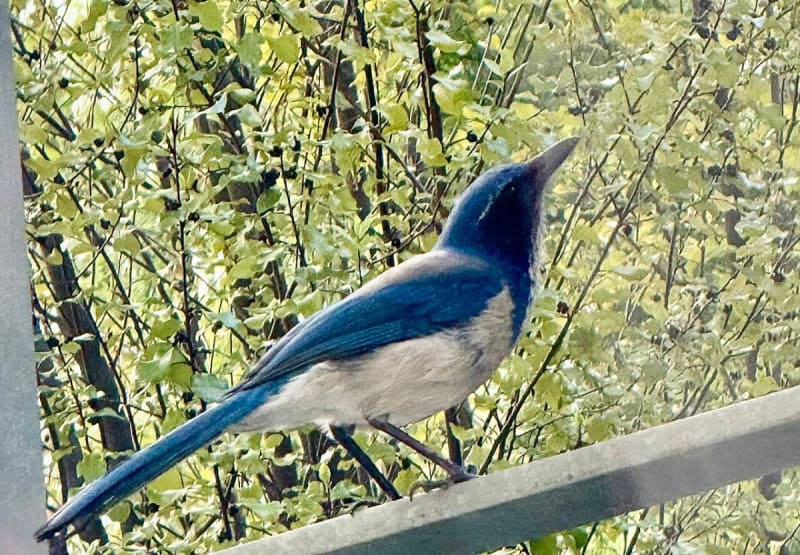
Scrub-jays hide food, and they remember where. That is not unusual. What Nicola Clayton and Anthony Dickinson showed in Nature in 1998 is that they also remember what they hid and how long ago. Jays that had cached both wax worms, which they prefer but which rot, and peanuts, which keep, went back for the worms first if only a few hours had passed and for the peanuts if several days had, having learned that old worms are no good. Remembering what, where and when together is the definition of episodic memory, and this was the first demonstration of it in an animal.
Three years later Nathan Emery and Clayton, again in Nature, added the part that sounds like a novel. Jays that had been watched while hiding food later moved it to a new place when they were alone. Only jays that had themselves stolen from other birds’ caches did this; the innocents did not bother. A bird that has been a thief takes precautions against thieves. The studies used western scrub-jays; the coastal form in the photograph is now classified as the California scrub-jay.
10. African grey parrot
Alex was an African grey parrot bought from a pet shop in 1977 by Irene Pepperberg, then a young researcher, who spent the next thirty years testing what he could do. By the time he died in 2007 he could label dozens of objects, colours and shapes, answer questions about which of two objects was bigger or what material one was made of, and count small sets. Pepperberg’s book The Alex Studies, published by Harvard University Press in 1999, sets out the methods and the results.
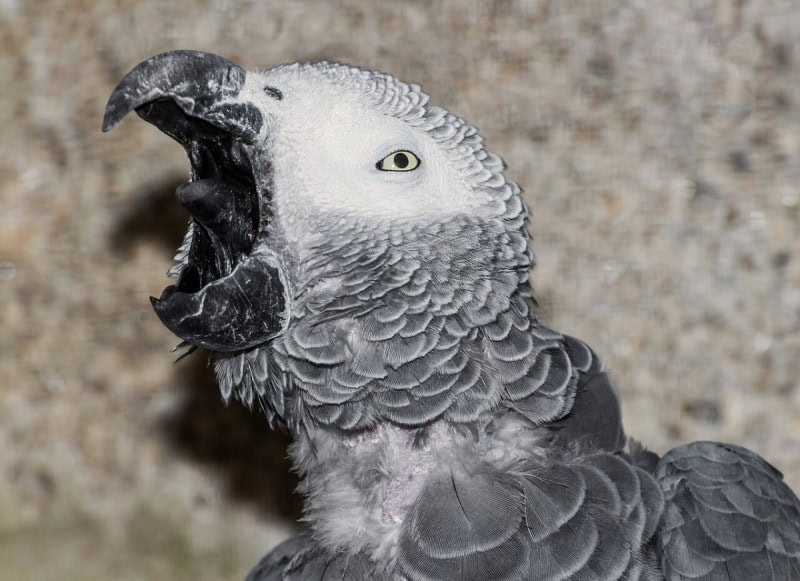
The finding that gets cited most came in a 2005 paper by Pepperberg and Jesse Gordon in the Journal of Comparative Psychology. Asked how many objects of a particular colour were on a tray when there were none, Alex answered “none,” a label he had learned in a different context, and used it consistently. A grasp of nothing as a quantity is something human children take years to acquire. The parrot in the photograph is not Alex, but a bird of the same species.
11. Goffin’s cockatoo
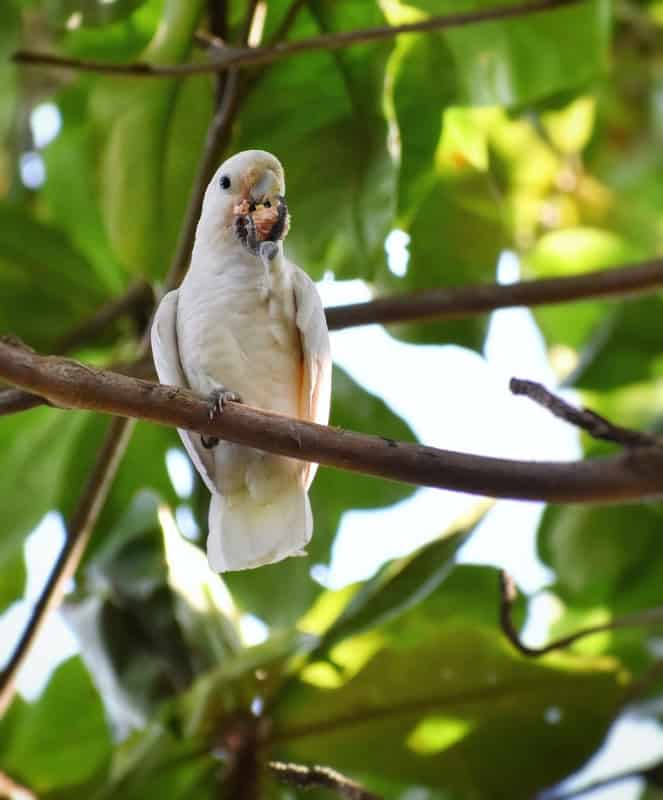
Parrots were not supposed to make tools. Their beaks and feet are for cracking and climbing, and no wild parrot had been seen to do it. Then in 2012 a Goffin’s cockatoo named Figaro, living in a research aviary in Vienna, was seen biting a long splinter from a wooden beam and using it to rake a nut in through the bars of his cage. Alice Auersperg and colleagues published it in Current Biology, and the accompanying video shows him shaping the tool until it works.
The following year the same group reported, in PLOS ONE, cockatoos solving a lock-box that needed five different mechanisms opened in sequence: a pin, a screw, a bolt, a wheel and a latch. One bird worked it out unaided in under two hours, and the birds that watched him could then do it too. For a species nobody had studied a decade earlier, that is a remarkable record.
12. Pigeon
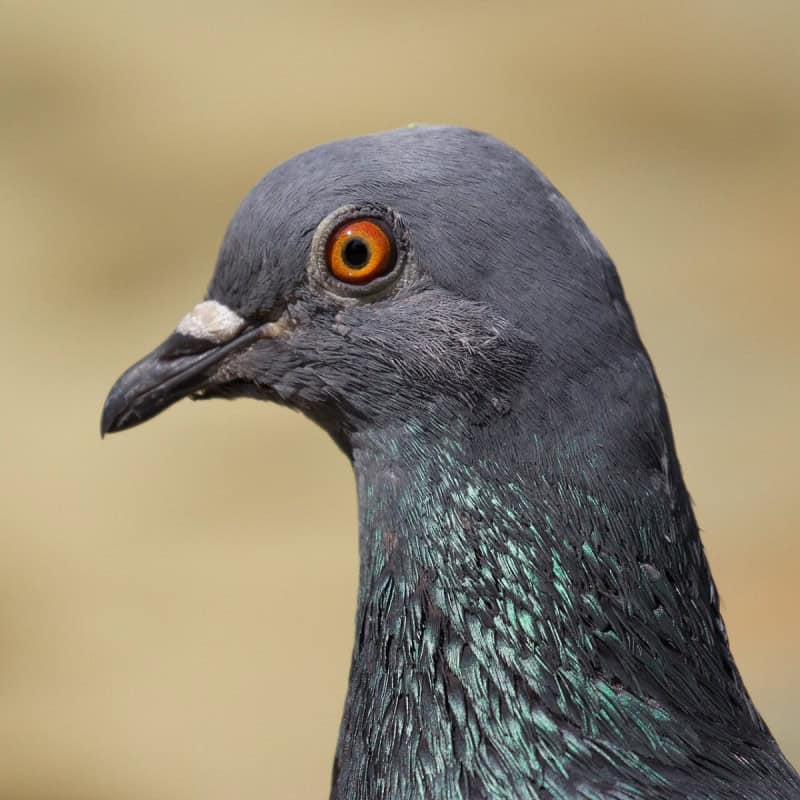
The pigeon is the bird people step around, and it can be trained to spot cancer. In 2015 Richard Levenson and colleagues published a study in PLOS ONE in which pigeons were shown microscope images of breast tissue and rewarded for pecking the correct answer, benign or malignant. Within weeks the birds were about 85 percent accurate on images they had never seen, and when the answers of a group of pigeons were pooled, the flock reached 99 percent, matching trained pathologists. They did it by learning the visual patterns, which is exactly what a pathologist does.
Pigeons also handle abstract number. In 2011 Damian Scarf, Harlene Hayne and Michael Colombo showed in Science that pigeons trained to order sets of one, two and three items could then correctly order pairs of sets containing up to nine, a task previously demonstrated only in rhesus monkeys. The pigeon’s problem has never been its brain. It has been its reputation.
Invertebrates and fish
Everything above has a backbone and a brain built on roughly the same plan as ours. The next four do not, or have brains so small that the results below should not, on the old view, have been possible. That is why they are the most interesting entries on the page.
13. Coconut octopus
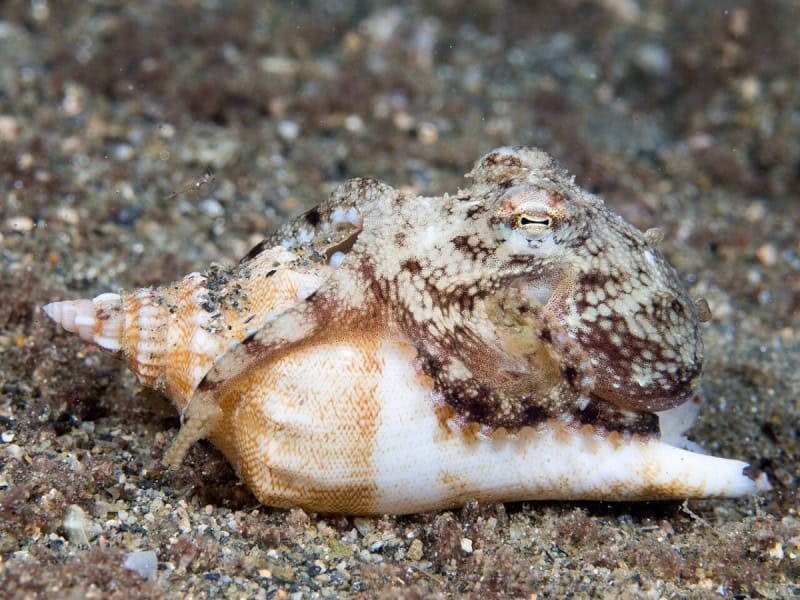
Octopuses solve mazes, open jars and escape from tanks, and every aquarium has a story. The evidence that put a specific octopus on this list is a 2009 paper in Current Biology by Julian Finn, Tom Tregenza and Mark Norman, who filmed veined octopuses, better known as coconut octopuses, in Indonesian waters carrying discarded coconut half-shells across the seabed, stacking them, and later assembling two halves into a closed sphere to hide inside.
Carrying something awkward now, at a cost in speed and safety, for a use later is the part that qualifies as tool use rather than mere shelter-seeking, and the authors made exactly that argument. The octopus in the photograph has done the same with a seashell. It manages all this with a nervous system in which, as Binyamin Hochner and colleagues set out in a 2006 review, most of the neurons are in the arms rather than the head.
14. Common cuttlefish
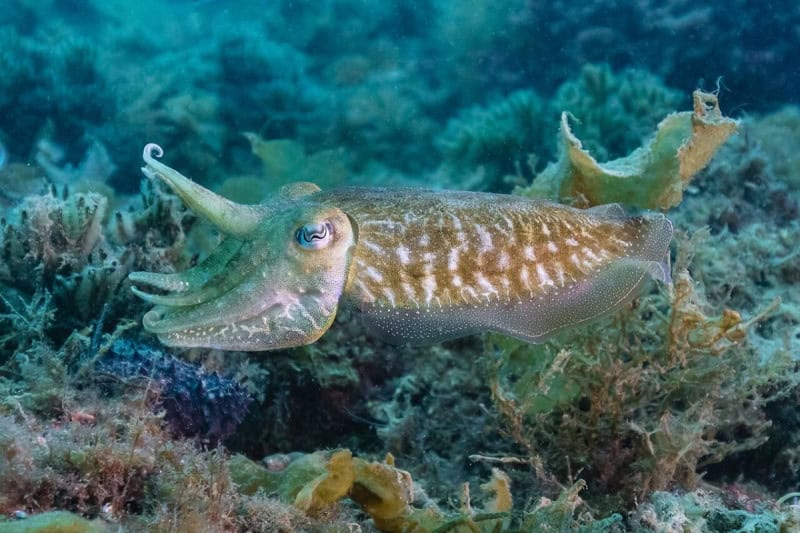
The famous marshmallow test offers a child one treat now or two if they can wait, and how long they hold out has been linked to all sorts of later outcomes. In 2021 Alexandra Schnell and colleagues gave a version of it to cuttlefish and published the result in Proceedings of the Royal Society B. The animals could take a piece of prawn immediately or wait for a live grass shrimp, which they prefer. They waited, for between about 50 seconds and more than two minutes depending on the individual.
Two things made it more than a curiosity. The cuttlefish clearly understood the deal, turning away from the prawn while they waited, and the individuals that could wait longest were also the ones that learned fastest on a separate task. That link between self-control and learning ability had previously been reported only in humans and chimpanzees. Cuttlefish live for about two years.
15. Bluestreak cleaner wrasse
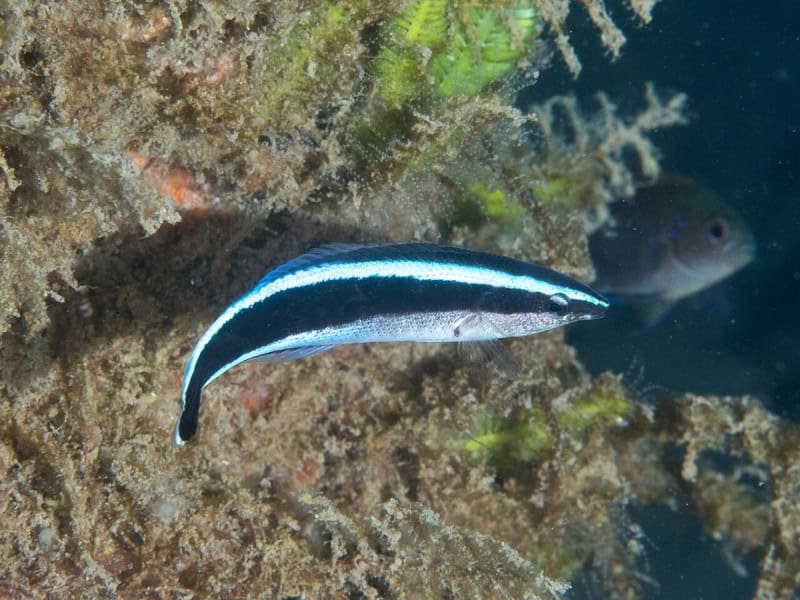
A finger-length reef fish that makes a living picking parasites off bigger fish is the most contested entry on this list, and it belongs here for exactly that reason. In 2019 Masanori Kohda and colleagues at Osaka City University reported in PLOS Biology that cleaner wrasse given a brown mark on the throat, in a place they could only see in a mirror, repeatedly scraped that spot against rocks after seeing their reflection, and did not do so when the mark was transparent or when there was no mirror. By the standard applied to elephants and dolphins, they passed.
The reaction was immediate and sceptical. Frans de Waal, who ran the elephant study, argued in a commentary in the same journal that the mark might have looked like a parasite and triggered ordinary cleaning behaviour rather than self-recognition. Kohda’s group answered with a larger follow-up study in 2022, again in PLOS Biology, that reported the same result under tighter controls. The argument is not settled, but a fish the length of a finger has forced the people who study self-awareness to define what they mean by it. That is a contribution to the science in its own right.
16. Honey bee
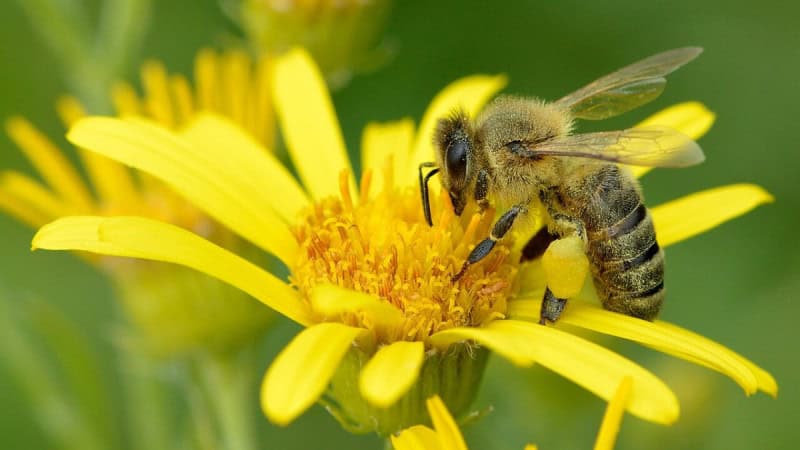
The idea of zero as a number below one took human mathematics thousands of years to accept. In 2018 Scarlett Howard and colleagues at RMIT University in Melbourne showed in Science that honey bees can place it on the number line. Bees trained to fly to the card with fewer shapes on it, given a choice between cards, were then shown a blank card against a card with one or more shapes. They chose the blank one, treating nothing as less than something, and they did it more reliably the further the other card was from zero, which is the same pattern human subjects show.
A honey bee’s brain contains under a million neurons, a figure Randolf Menzel and Martin Giurfa used in a 2001 review that called it a mini-brain. A human’s contains tens of billions. The bee result does not mean bees think about mathematics; it means that a grasp of quantity, including empty quantity, can be built from far less machinery than anyone assumed. That reframes every entry above it.
The ones that surprise people
17. Pig
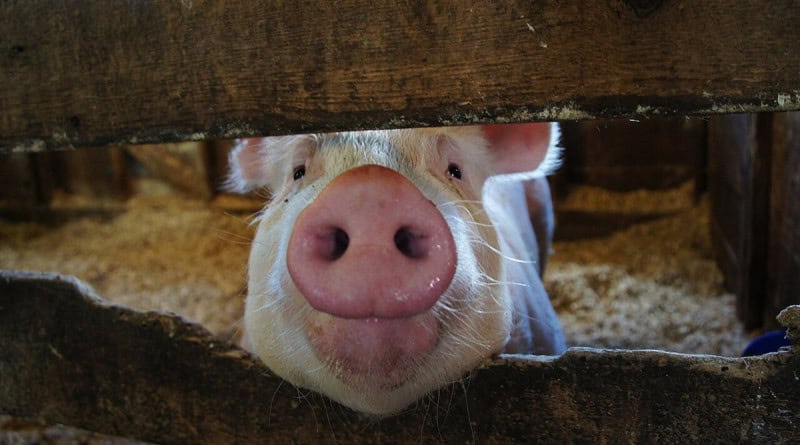
In 2021 Candace Croney and Sarah Boysen published a study in Frontiers in Psychology that had been years in the making: four pigs, two Yorkshire farm pigs named Hamlet and Omelette and two Panepinto micro pigs named Ebony and Ivory, were taught to operate a joystick with their snouts to move a cursor on a screen into a target. All four learned the task well above chance, and the two farm pigs were still doing it when they became too big for the equipment. The comparison the authors drew was with earlier work on monkeys and chimpanzees using the same apparatus.
Pigs do this despite being far-sighted and having no hands, which makes the joystick harder for them than for a primate. What the study shows is that the understanding was there: the pigs grasped that moving the stick moved the cursor, and that the cursor reaching the target was the point.
18. Brown rat
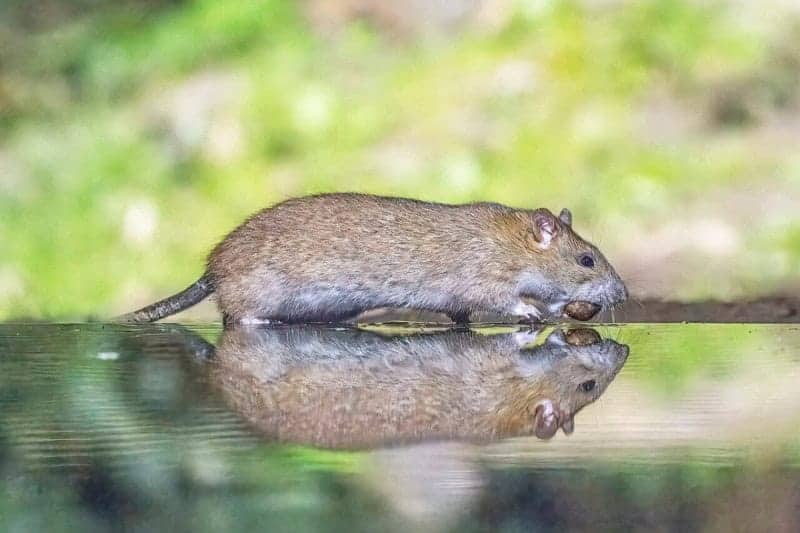
Rats learn mazes fast, which everyone knows. The study that earns them a place here is about something else. In 2011 Inbal Ben-Ami Bartal, Jean Decety and Peggy Mason at the University of Chicago reported in Science that a free rat, placed in an arena with a cage-mate shut inside a small restrainer, would learn to open the restrainer’s door and let the other rat out, and would keep doing it session after session with no reward beyond the release itself. Given a second restrainer containing chocolate chips, the rats typically opened both, and shared the chocolate.
The authors called it empathically motivated helping, and the phrase was argued over, but the same group reported the behaviour again in a 2014 follow-up in eLife. Whatever the right word for it is, an animal that will work to end another animal’s distress, and then split the reward, is doing something most people would not credit to a rat.
19. Dog
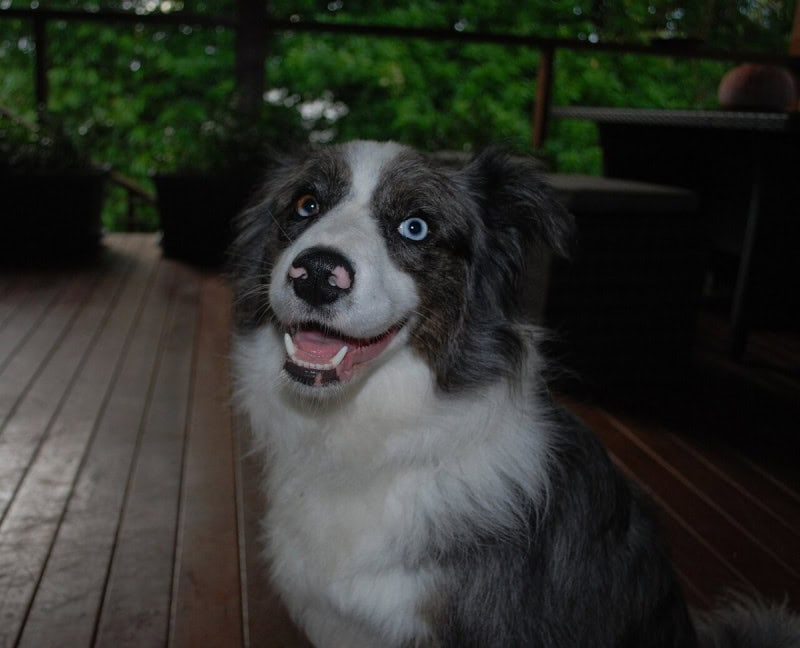
Dogs read us better than any other animal, and that is a kind of intelligence, but it is hard to test. The clearest number comes from a border collie. Over three years, John Pilley, a retired psychology professor in South Carolina, taught his dog Chaser the names of 1,022 different objects, and in 2011 he and Alliston Reid published the results in Behavioural Processes. Chaser could fetch any named toy from a pile, could distinguish the names of objects from the names of actions, and could sort toys by category, so that “ball” or “frisbee” brought back any of several.
Pilley’s methods were unusually careful for a home study: the tests were run with the toys out of his sight, so that he could not cue her, and Chaser’s vocabulary was checked repeatedly across the three years. She died in 2019, by which time she was widely described as the dog with the largest tested vocabulary in the world. The dog in the photograph is a border collie, though not Chaser.
20. Sea otter
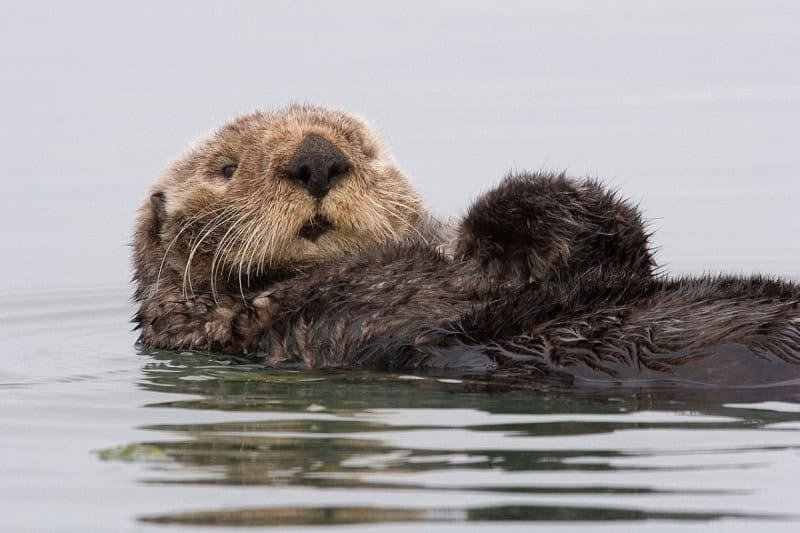
Sea otters float on their backs and crack shellfish open on a stone balanced on their chests, and they are the only marine mammal known to use stones as tools. In 2019 Michael Haslam, Jessica Fujii and colleagues published a study in Scientific Reports that treated the otters of Elkhorn Slough in California the way archaeologists treat early humans: they mapped the rocks the otters use as anvils at a site called Bennett Slough Culverts, recorded the distinctive wear on them, and showed that the broken mussel shells left behind carry a recognisable pattern of damage that distinguishes otter work from anything else on the shore.
That gives future researchers a way to find sea otter tool sites in the geological record, in places where the otters themselves were wiped out by the fur trade. It closes this list where it started, with an animal whose tools outlast it.
So which is the smartest animal in the world?
If the question means which animal has passed the widest range of rigorous tests, the answer is the chimpanzee, with the bottlenose dolphin and the New Caledonian crow close behind on their own kinds of evidence. If it means which result should most change how you think about animal minds, it is probably the honey bee, or the cuttlefish, or the fish that made scientists argue about what self-awareness is. The strongest thing this list shows is that intelligence in nature is not one ladder with humans at the top and everything else below. It is a set of different abilities, and they turn up in bodies that have almost nothing else in common.
If you like the natural world at its strangest, the same approach, what the record actually shows rather than what the stories say, runs through our lists of rare natural phenomena and unusual cloud formations, and our rewrite of the most dangerous spiders in the world applies it to the animals people fear most.
Sources
Chimpanzee: Inoue and Matsuzawa, “Working memory of numerals in chimpanzees,” Current Biology, 2007; Goodall’s 1960 Gombe observations, reported in Nature in 1964 (“Tool-using and aimed throwing in a community of free-living chimpanzees”); Gallup, “Chimpanzees: self-recognition,” Science, 1970; Whiten et al., “Cultures in chimpanzees,” Nature, 1999. Bonobo: Savage-Rumbaugh et al., “Spontaneous symbol acquisition and communicative use by pygmy chimpanzees,” Journal of Experimental Psychology: General, 1986; Savage-Rumbaugh et al., “Language comprehension in ape and child,” Monographs of the Society for Research in Child Development, 1993. Orangutan: van Schaik et al., “Orangutan cultures and the evolution of material culture,” Science, 2003; van Schaik, Damerius and Isler, “Wild orangutan males plan and communicate their travel direction one day in advance,” PLOS ONE, 2013. Capuchin: Falótico, Proffitt, Ottoni, Staff and Haslam, “Three thousand years of wild capuchin stone tool use,” Nature Ecology and Evolution, 2019. Asian elephant: Plotnik, de Waal and Reiss, “Self-recognition in an Asian elephant,” PNAS, 2006; Plotnik et al., “Elephants know when they need a helping trunk in a cooperative task,” PNAS, 2011. Bottlenose dolphin: Reiss and Marino, “Mirror self-recognition in the bottlenose dolphin,” PNAS, 2001; King and Janik, “Bottlenose dolphins can use learned vocal labels to address each other,” PNAS, 2013; Krützen et al., “Cultural transmission of tool use in bottlenose dolphins,” PNAS, 2005. New Caledonian crow: Hunt, “Manufacture and use of hook-tools by New Caledonian crows,” Nature, 1996; Weir, Chappell and Kacelnik, “Shaping of hooks in New Caledonian crows,” Science, 2002. Raven: Kabadayi and Osvath, “Ravens parallel great apes in flexible planning for tool-use and bartering,” Science, 2017; Redshaw, Taylor and Suddendorf, “Flexible Planning in Ravens?”, Trends in Cognitive Sciences, 2017; Osvath and Kabadayi, “Contrary to the Gospel, Ravens Do Plan Flexibly,” Trends in Cognitive Sciences, 2018. Scrub-jay: Clayton and Dickinson, “Episodic-like memory during cache recovery by scrub jays,” Nature, 1998; Emery and Clayton, “Effects of experience and social context on prospective caching strategies by scrub jays,” Nature, 2001. African grey parrot: Pepperberg, The Alex Studies, Harvard University Press, 1999; Pepperberg and Gordon, “Number comprehension by a grey parrot, including a zero-like concept,” Journal of Comparative Psychology, 2005. Goffin’s cockatoo: Auersperg et al., “Spontaneous innovation in tool manufacture and use in a Goffin’s cockatoo,” Current Biology, 2012; Auersperg et al., “Explorative learning and functional inferences on a five-step means-means-end problem in Goffin’s cockatoos,” PLOS ONE, 2013. Pigeon: Levenson et al., “Pigeons as trainable observers of pathology and radiology breast cancer images,” PLOS ONE, 2015; Scarf, Hayne and Colombo, “Pigeons on par with primates in numerical competence,” Science, 2011. Coconut octopus: Finn, Tregenza and Norman, “Defensive tool use in a coconut-carrying octopus,” Current Biology, 2009; Hochner, Shomrat and Fiorito, “The octopus: a model for a comparative analysis of the evolution of learning and memory mechanisms,” Biological Bulletin, 2006. Cuttlefish: Schnell et al., “Cuttlefish exert self-control in a delay of gratification task,” Proceedings of the Royal Society B, 2021. Cleaner wrasse: Kohda et al., “If a fish can pass the mark test, what are the implications for consciousness and self-awareness testing in animals?”, PLOS Biology, 2019; de Waal, “Fish, mirrors, and a gradualist perspective on self-awareness,” PLOS Biology, 2019; Kohda et al., PLOS Biology, 2022. Honey bee: Howard et al., “Numerical ordering of zero in honey bees,” Science, 2018; Menzel and Giurfa, “Cognitive architecture of a mini-brain: the honeybee,” Trends in Cognitive Sciences, 2001. Pig: Croney and Boysen, “Acquisition of a joystick-operated video task by pigs,” Frontiers in Psychology, 2021. Rat: Ben-Ami Bartal, Decety and Mason, “Empathy and pro-social behavior in rats,” Science, 2011; Ben-Ami Bartal et al., “Pro-social behavior in rats is modulated by social experience,” eLife, 2014. Dog: Pilley and Reid, “Border collie comprehends object names as verbal referents,” Behavioural Processes, 2011. Sea otter: Haslam et al., “Wild sea otter mussel pounding leaves archaeological traces,” Scientific Reports, 2019.
Image credits
Images are Creative Commons licensed or public domain, via Wikimedia Commons. Attribution where the licence requires it: chimpanzee, Warren Garst, Colorado State University via the Digital Public Library of America (CC BY-SA 4.0). Kanzi, William H. Calvin (CC BY-SA 4.0). Orangutan, A. Baihaqi (CC BY-SA 4.0). Bearded capuchin, B. Wright (CC BY-SA 4.0). Asian elephants, Carlos Delgado (CC BY-SA 4.0). New Caledonian crow, MD Sajjad Hossain Photography (CC BY-SA 4.0). Common raven, Diliff (CC BY-SA 3.0). African grey parrot, H. Zell (CC BY-SA 3.0). Goffin’s cockatoo, bloodlesshunting via iNaturalist (CC BY 4.0). Rock pigeon, Carlos Delgado (CC BY-SA 4.0). Coconut octopus, Rickard Zerpe (CC BY 2.0). Common cuttlefish, Diego Delso (CC BY-SA 4.0). Cleaner wrasse, Rickard Zerpe (CC BY 2.0). Honey bee, Ivar Leidus (CC BY-SA 4.0). Pig, Steve Evans (CC BY 2.0). Brown rat, Charles J. Sharp, Sharp Photography (CC BY-SA 4.0). Border collie, 7575u (CC BY-SA 4.0). Sea otter, Mike Baird (CC BY 2.0). The bottlenose dolphin (NASA) is public domain and the California scrub-jay is CC0.