
Most of the famous “Greek” statues in the world’s museums are Roman. The Apollo Belvedere, the Farnese Hercules, the Capitoline Venus and the Dying Gaul are all marble copies, made in Roman workshops for Roman buyers, of Greek originals, most of them bronzes that were melted down centuries ago. That is the first thing to know about Roman statues: the Romans collected, copied and adapted Greek sculpture on an industrial scale, and much of what we know about Greek art we know through them. The second thing is what the Romans added that was their own: the brutally lifelike portrait, the historical relief that tells a story in stone, and the statue as a political instrument, put up in forums and basilicas to say exactly who was in charge.
The twenty below are the statues and sculptures people have actually seen pictures of, chosen because each stands for something the Romans did with stone or bronze. Each entry gives the date, the material, where it was found, where it stands today and what it was made to say, plus one thing the museum label usually leaves out. They run in rough date order from a wolf that may not be ancient at all to a head of Constantine the size of a car. Where to see the most in one day is at the end, and so are the two questions everyone asks: how Roman statues differ from Greek ones, and whether they were really painted. The gods these statues depict are on the Roman gods and goddesses page, and the Greek originals behind the copies are on the famous Greek god statues page.
Three things to know before the list
Verism. Republican Romans wanted portraits that showed age: the wrinkles, the sagging jaw, the receding hair. The style is called verism, and it comes from the funeral custom of keeping wax masks of ancestors in the house and parading them at funerals. A face that looked old and severe looked experienced, and in a republic run by old senators that was the point. Augustus ended it; he was shown as a thirty-year-old for the rest of his life.
The copy problem. Greek sculptors of the fifth and fourth centuries BC worked mostly in bronze. Bronze is valuable and melts, so almost all of it is gone, surviving only where a ship sank or a building collapsed on top of it. Roman workshops produced marble versions for villas and baths, sometimes dozens of the same figure. Marble cannot stand on its own in the poses bronze allows, which is why so many Roman copies have a tree stump or a strut against the leg. When a label says “Roman copy of a Greek original by Lysippos”, it means the original no longer exists and this is the best evidence of what it looked like.
Colour. They were painted. Traces of pigment survive on the Prima Porta Augustus, on reliefs, on hundreds of lesser pieces, and ancient writers describe painted statues as normal. The white marble ideal is a Renaissance misunderstanding that the 18th century turned into a doctrine. More on this in the last section.
1. The Capitoline Wolf
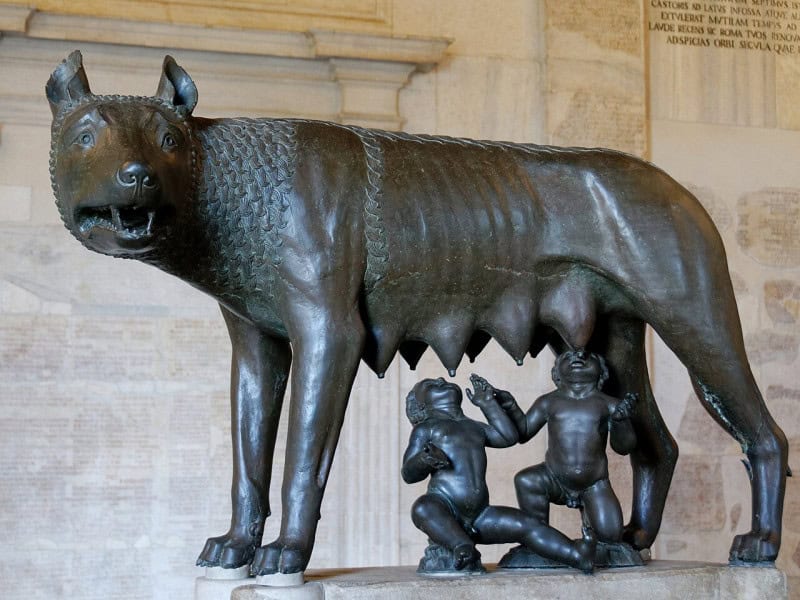
Bronze, 75 cm high, Capitoline Museums (Palazzo dei Conservatori). The symbol of Rome: the she-wolf that suckled Romulus and Remus, with the twins underneath. From the 18th century it was called Etruscan and dated to around 500 BC, which made it one of the oldest large bronzes in Italy. Then in 2006 the conservator who had cleaned it, Anna Maria Carruba, argued from the casting technique (it was cast in one piece, a medieval method, not in sections as ancient bronzes were) that it was medieval, and radiocarbon and thermoluminescence tests published in 2012 dated it to between the 11th and 12th centuries AD. The museum now labels it with both views. The twins were added in the late 15th century, probably by Antonio del Pollaiuolo, after the wolf was given to the Roman people by Pope Sixtus IV in 1471. What it was made to say: if it is ancient, that Rome’s founders were nursed by a wild animal and were therefore wild themselves; if it is medieval, that the Rome of the popes claimed the same founding story. Either way it has been the city’s emblem since the Middle Ages. The marble and bronze statues of the city’s other founders and rulers are on the most famous statues in the world page.
2. The Orator (L’Arringatore)
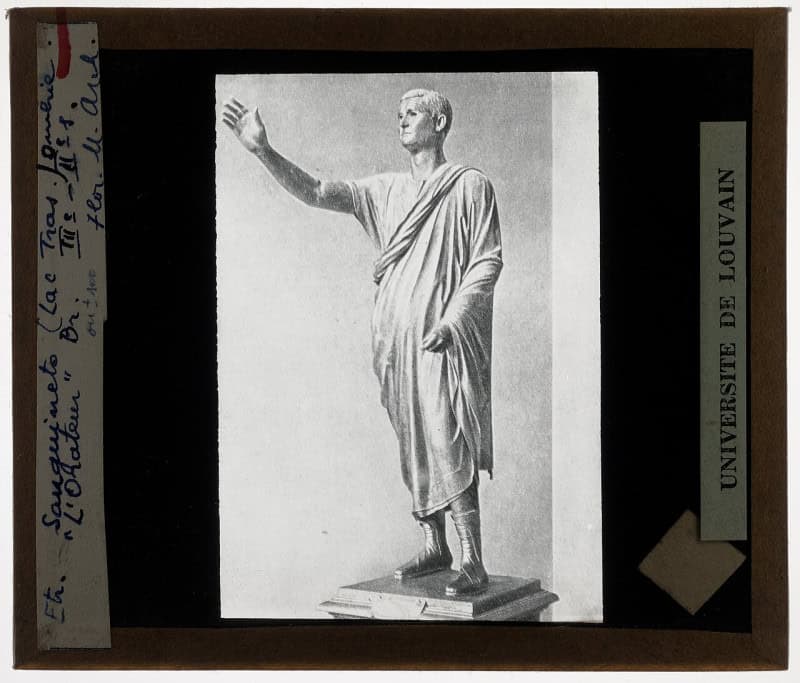
Bronze, 179 cm, late 2nd or early 1st century BC, Museo Archeologico Nazionale, Florence. A life-size bronze of a man in a short toga and senatorial boots, right arm raised for silence before he speaks. Found in 1566 near Lake Trasimeno, it carries an Etruscan inscription on the hem naming the subject as Aule Metele, Aulus Metellus in Latin: an Etruscan who had become a Roman citizen and magistrate, dressed and posed as a Roman. What it was made to say: that the subject belonged to the new order. It is the moment Etruscan art becomes Roman art, in one figure, and it is one of very few large ancient bronzes that was never melted down. The lined, individual face is early verism; the gesture is the one Augustus would borrow for the Prima Porta statue a century later.
3. The Capitoline Brutus
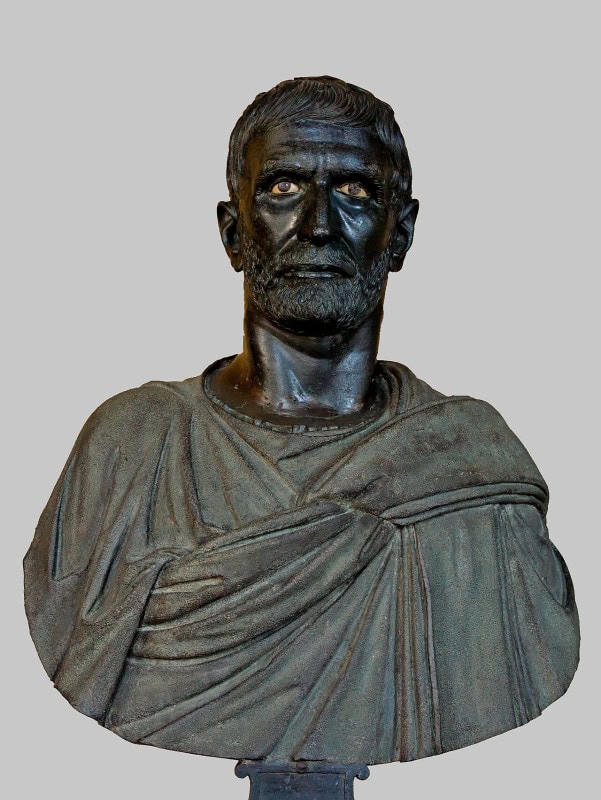
Bronze head, 69 cm with the later bust, usually dated to the 4th or 3rd century BC, Capitoline Museums. A bearded man with inlaid eyes of ivory and glass paste, a tight mouth and a look of total seriousness. Since the 16th century it has been called Lucius Junius Brutus, the man who drove out the last king and founded the Republic in 509 BC, which is a guess with no evidence beyond the face looking like a founder should. The bust it sits on is Renaissance. What it was made to say: nobody knows who it is, which is why it matters: it is the earliest surviving Roman portrait of the type the Republic prized, grave, unsmiling and old, made at least a century before the Greeks’ idealising habits arrived in force. It came to the Capitoline in 1564 as a gift from a cardinal.
4. Head of a Roman Patrician (the Otricoli Head)
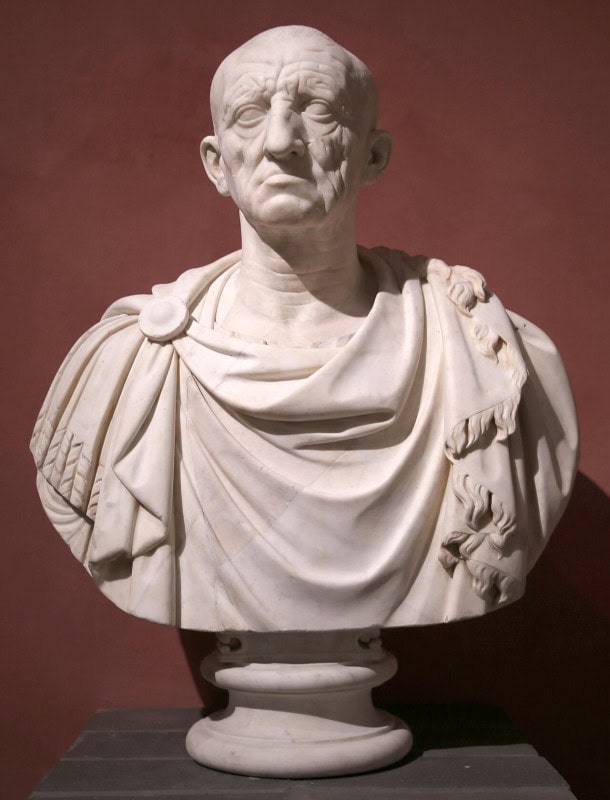
Marble, mid-1st century BC, Torlonia Collection, Rome. The textbook example of verism: an old man with a face like a dry riverbed, every fold and hollow carved, the mouth turned down. Found at Otricoli north of Rome, it belongs to the Torlonia family’s private collection of 620 ancient marbles, which was shut away for most of a century and began touring in 2020. What it was made to say: that this man had lived long, held office, and suffered for the state, and that his descendants had the right to keep his image in their hall. It was not meant as a likeness in the modern sense: the style exaggerates age the way Greek statues exaggerate youth. Compare it with the next entry, made a generation or two later, and you can watch the Republic end.
5. The Togatus Barberini
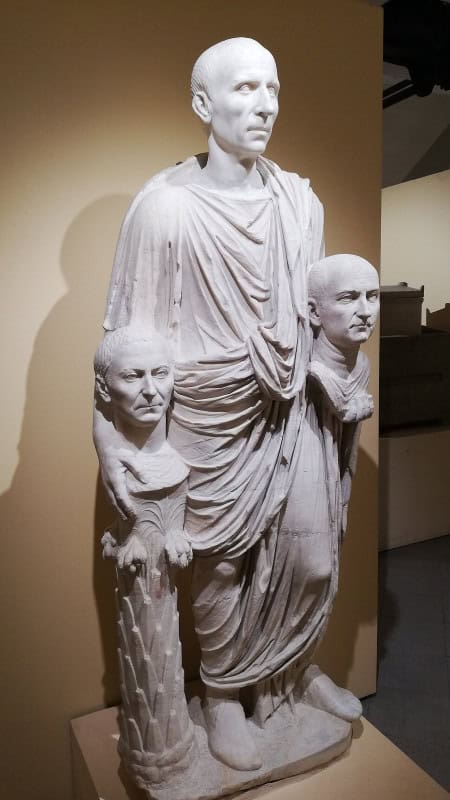
Marble, 165 cm, late 1st century BC, Centrale Montemartini (the Capitoline Museums’ annex in a former power station). A man in a toga holding two portrait busts of older men, one in each hand: his father and grandfather, almost certainly. The head on the statue is ancient but not original; it was fitted in a later restoration. What it was made to say: this is the ancestor cult carved in marble. Roman nobles had the right, the ius imaginum, to display the images of ancestors who had held high office, and here a man displays his. It is the clearest surviving statement of why Republican portraits look the way they do: they were made to be carried, kept and compared, not admired.
6. Augustus of Prima Porta
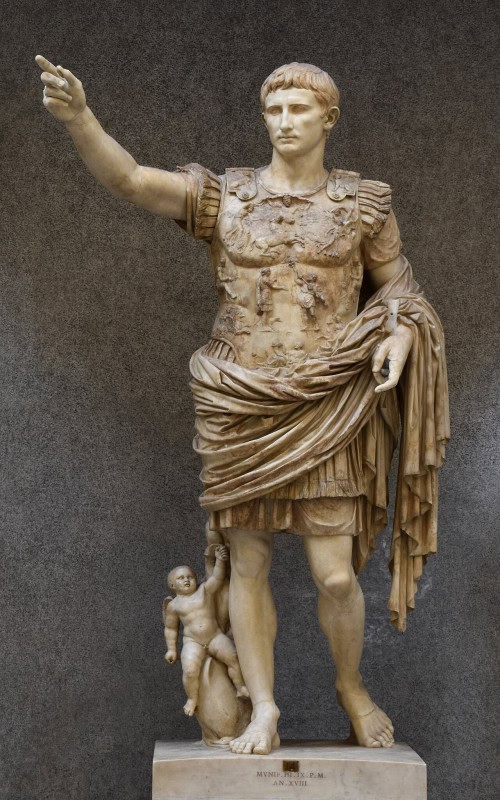
Marble, 208 cm, early 1st century AD after a bronze of c. 20 BC, Vatican Museums (Braccio Nuovo). The most famous Roman statue there is, and the most carefully designed. Found in 1863 at the villa of Augustus’s wife Livia at Prima Porta, north of Rome, it shows the emperor barefoot in a general’s breastplate, right arm raised in the Orator’s gesture, a Cupid riding a dolphin at his leg. The pose is lifted from the Doryphoros of Polykleitos, the Greek statue of ideal proportion, so Augustus has a Greek athlete’s body and a thirty-year-old’s face; he was in his fifties or older when this copy was made. What it was made to say: everything. The breastplate shows a Parthian handing back a Roman legionary standard, the eagles lost by Crassus in 53 BC and recovered by negotiation in 20 BC, which Augustus sold as a victory; above and around it are the sky god, the sun, the dawn and the earth goddess with a cornucopia, meaning the whole cosmos approves. The Cupid says the family descends from Venus. The bare feet are how gods and heroes are shown. The statue has traces of its paint, and the Vatican displays a coloured reconstruction nearby: red cloak, blue and red breastplate, brown hair.
7. The Ara Pacis reliefs
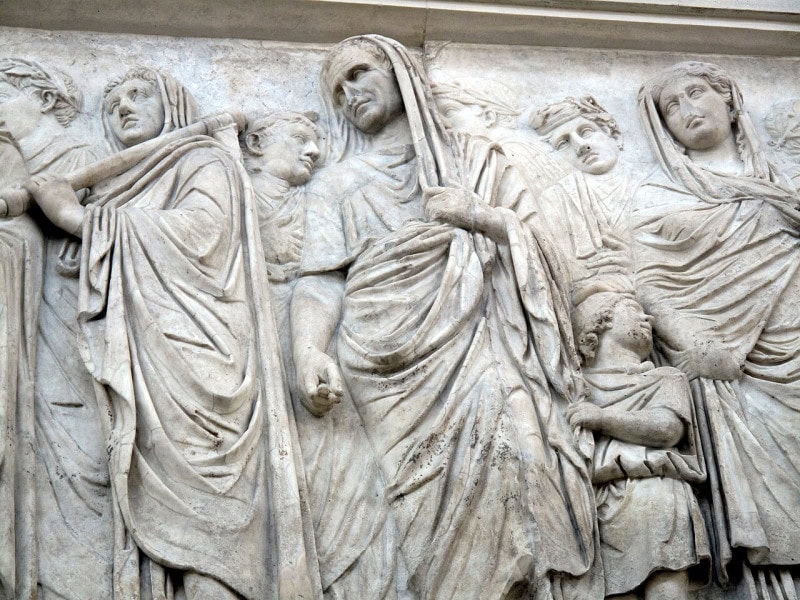
Marble altar enclosure, 11.6 by 10.6 m, voted 13 BC, dedicated 30 January 9 BC, Museo dell’Ara Pacis, Rome. The Altar of Augustan Peace is not a statue but it is the most important Roman sculpture after the Prima Porta, and it is sculpture in the round in its own way: a walled enclosure carved inside and out, with the imperial family, priests and senators processing along the long sides in the order they walked at the dedication. Children fidget and tug at togas; a woman hushes a man with a finger to her lips. Panels at the ends show Aeneas sacrificing and a seated goddess with two babies, fruit and animals, the earth at peace. What it was made to say: that Augustus’s rule was peace, fertility and piety, guaranteed by his family, who are shown as individuals you could recognise. It is the first time in Western art that a state monument shows the ruling family as a family, children included. The pieces were dug up between 1568 and 1938, reassembled under Mussolini in 1938, and rehoused in Richard Meier’s glass pavilion in 2006.
8. Augustus as Pontifex Maximus (the Via Labicana Augustus)
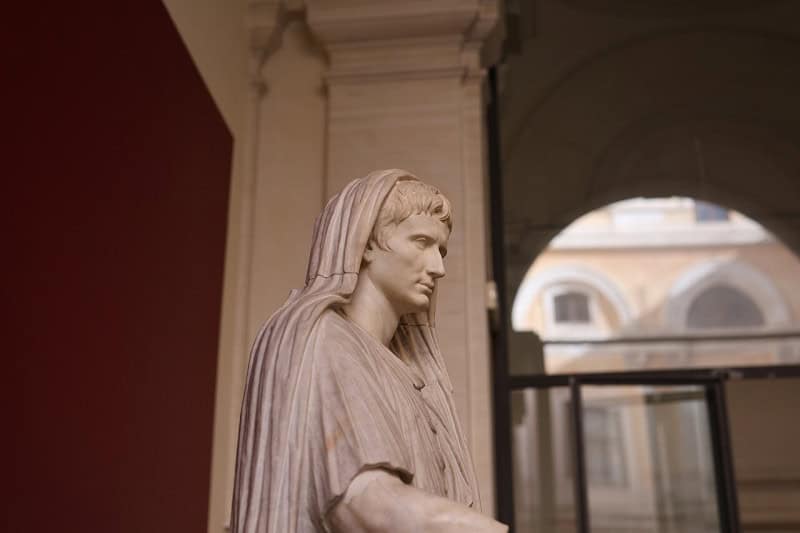
Marble, 217 cm, after 12 BC, Palazzo Massimo alle Terme (National Roman Museum). The other Augustus. Found in 1910 on the Via Labicana, it shows him with his toga pulled over his head, the capite velato of a Roman making a sacrifice, and without a trace of armour. He became Pontifex Maximus, chief priest, in 12 BC, and this is the statue of that role: head slightly bowed, one hand (lost) once holding a dish for offerings. The head and hands are finer marble than the body and were carved separately, a common Roman practice. What it was made to say: that the man who held the army also held the gods. Side by side with the Prima Porta it shows how carefully the image was managed: the same ageless face, two entirely different costumes for two different audiences.
9. The Portland Vase
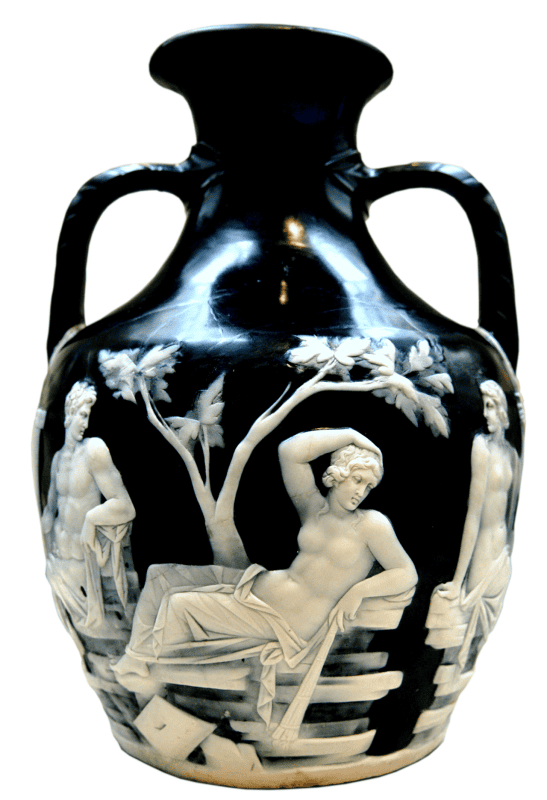
Cameo glass, 24.5 cm, c. AD 1 to 25, British Museum. The one object on this list that is not stone or bronze, included because it is sculpture by any other name: a layer of white glass was fused over a dark blue body and then cut away, like a cameo gem, to leave figures in white relief. Seven figures in two scenes, a sea serpent, Cupid and a tree; what the scenes mean has been argued for 400 years, with the marriage of Peleus and Thetis the usual answer. What it was made to say: that its owner could afford the most difficult object a Roman glass workshop ever made. It was in the Barberini collection by the 1620s, bought by the Duchess of Portland in 1784, lent to the British Museum in 1810, and smashed into pieces by a drunk visitor in 1845. It has been restored three times, most recently in 1989. Josiah Wedgwood spent four years copying it in black jasperware; his copies are the blue-and-white vases in half the museums of England.
10. The Boxer at Rest
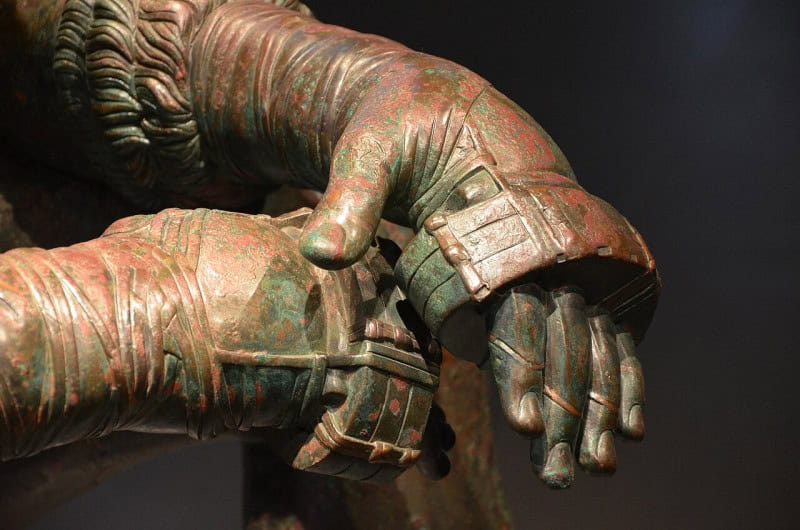
Bronze, 128 cm, Hellenistic, usually dated between the 4th and 1st centuries BC, Palazzo Massimo alle Terme. A Greek bronze found in Rome, which is how most Greek bronzes survived at all: it was buried carefully on the Quirinal hill, perhaps to protect it, and dug up in 1885 with soil still packed around it. A heavyweight sits after a fight, hands still wrapped in leather thongs, turning his head as if someone has spoken. His nose is broken, his ears are swollen, and the cuts on his face and the drops of blood on his arm and thigh are inlaid in copper so they would show red against the bronze. What it was made to say: whatever the Greek sculptor meant, the Romans who owned it prized it enough to bury it, and the toes of one foot are worn bright where people touched it for luck. It is the most human object in Roman Rome and it is not Roman, which is the copy problem in reverse.
11. Laocoön and His Sons
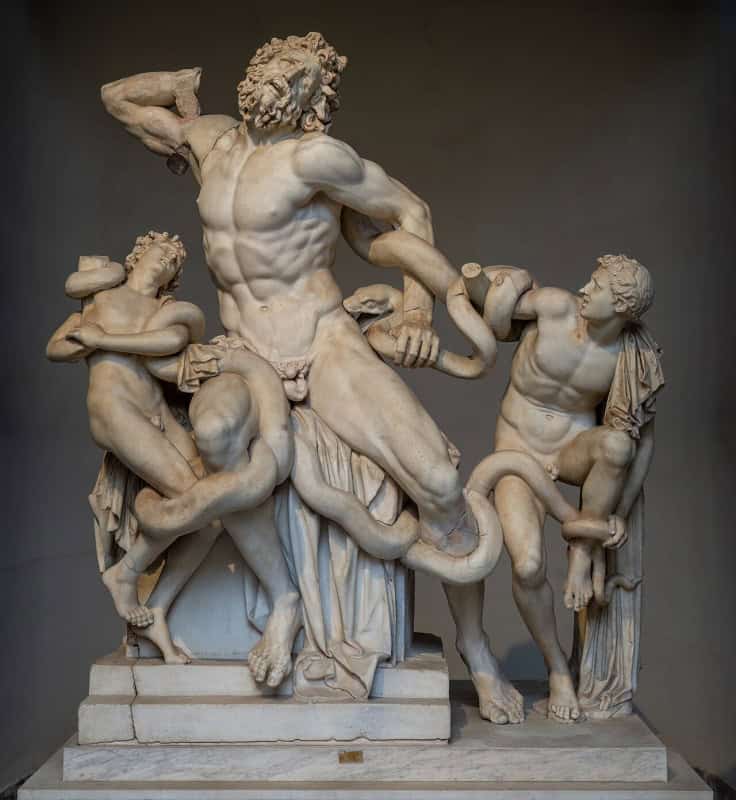
Marble, 208 cm, probably 1st century BC or AD, Vatican Museums (Pio-Clementino). The Trojan priest who warned against the wooden horse, being crushed with his sons by two sea serpents sent by the gods. Pliny the Elder saw it in the palace of Titus and named three sculptors from Rhodes, Hagesandros, Polydoros and Athenodoros; whether what we have is their original, a Roman copy, or a Roman commission in a Greek style is still argued. It was dug up on the Esquiline on 14 January 1506 in a vineyard, Michelangelo went to see it come out of the ground, and Pope Julius II bought it within weeks. What it was made to say: to its Roman owners, that Troy’s fall was Rome’s beginning; to everyone since, that marble can scream. Laocoön’s right arm was missing and was restored, wrongly, stretched out heroically; the real arm, bent back behind his head, was found in a stonemason’s yard in 1906 and put back in 1957.
12. The Dying Gaul
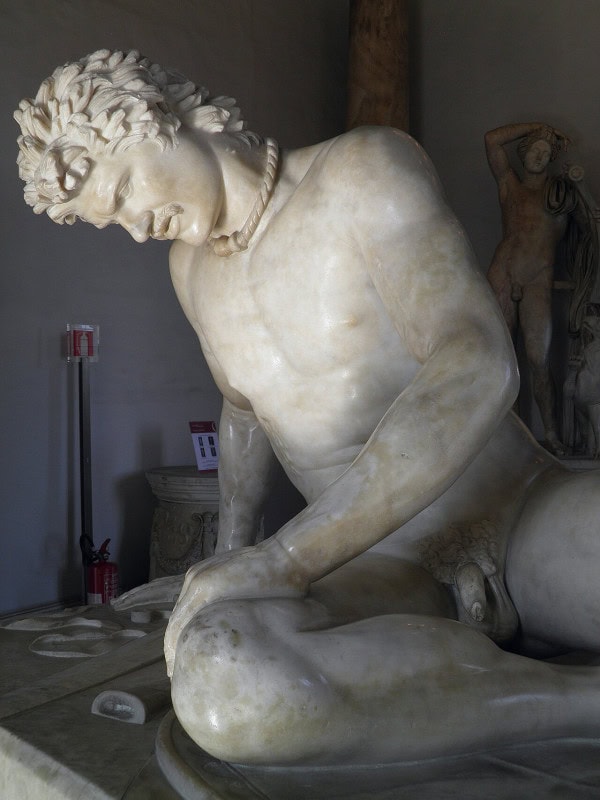
Marble, 93 cm high, Roman copy of a bronze of c. 230 to 220 BC, Capitoline Museums. A Celtic warrior, naked as Gauls fought, with the twisted gold neck-ring called a torc and a moustache, sits on his fallen shield with a sword wound in his chest, propping himself on one arm as his strength goes. The original was bronze, part of a victory monument at Pergamon in Asia Minor celebrating a defeat of the Galatians, Celts who had settled in Turkey. The copy was found in Rome in the early 1620s, in what had been the gardens of Sallust, and was in the Ludovisi collection before the Capitoline bought it. Napoleon took it to Paris in 1797; it came back in 1816. What it was made to say: that the enemy was brave and the victory therefore great. It is the most sympathetic portrait of a defeated people in ancient art, and it was made by the victors. For a long time it was called the Dying Gladiator, and Byron wrote it up as one; the torc and the hair gave the game away.
13. The Farnese Hercules
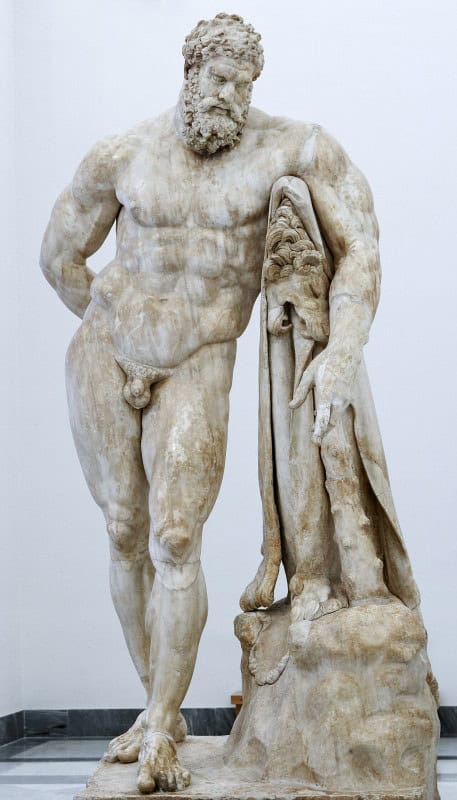
Marble, 317 cm, early 3rd century AD, signed by Glykon of Athens, after a bronze by Lysippos of c. 320 BC, National Archaeological Museum, Naples. Hercules at the end of his labours, exhausted, leaning on his club with the lion skin over it, holding the apples of the Hesperides behind his back where you have to walk round to see them. It was found in 1546 in the Baths of Caracalla, where it had stood in a niche for bathers to look up at, and the Farnese family put it in their palace courtyard. The legs were missing and Guglielmo della Porta carved new ones, which were kept even after the originals turned up, because Michelangelo said the new ones were just as good; the originals went back on in 1787. What it was made to say: in a public bath, that strength is work and even Hercules gets tired; to the Farnese, that they owned the biggest Hercules in Rome. It is nearly twice life size and the most copied statue of the Baroque.
14. The Apollo Belvedere
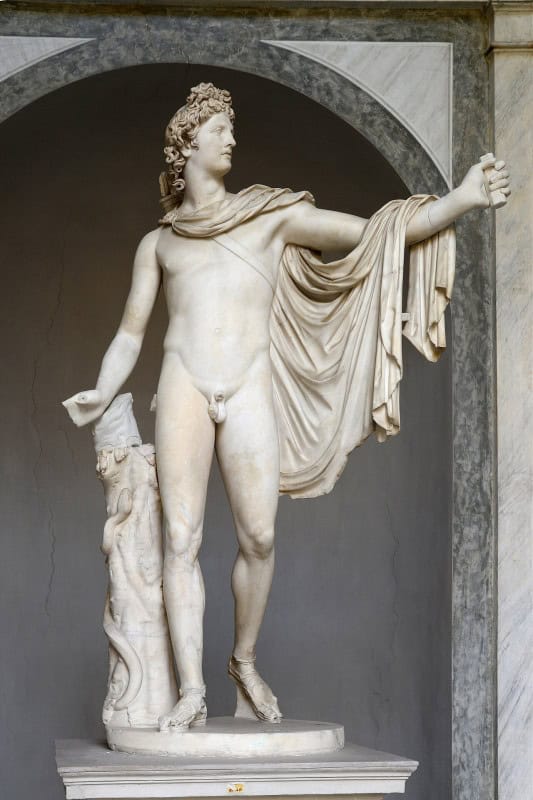
Marble, 224 cm, Roman copy of c. AD 120 to 140 after a bronze of c. 330 BC attributed to Leochares, Vatican Museums (Pio-Clementino). Apollo has just loosed an arrow, probably at the serpent Python, and watches it go: weight on one leg, cloak over the left arm, hair tied up. It was found in the late 15th century, probably near Anzio, and placed in the Vatican’s Belvedere courtyard by Julius II around 1511, which gave it its name. What it was made to say: for its Roman buyer, taste; for the 18th century, everything. Johann Joachim Winckelmann called it “the highest ideal of art among all the works of antiquity” in 1764, and for 150 years it was the most admired statue in the world, copied in every academy. Then taste turned to the Greek originals it was copied from, and it became a byword for cold perfection. The tree trunk against the leg is the marble copyist’s strut; the bronze needed none.
15. The Belvedere Torso
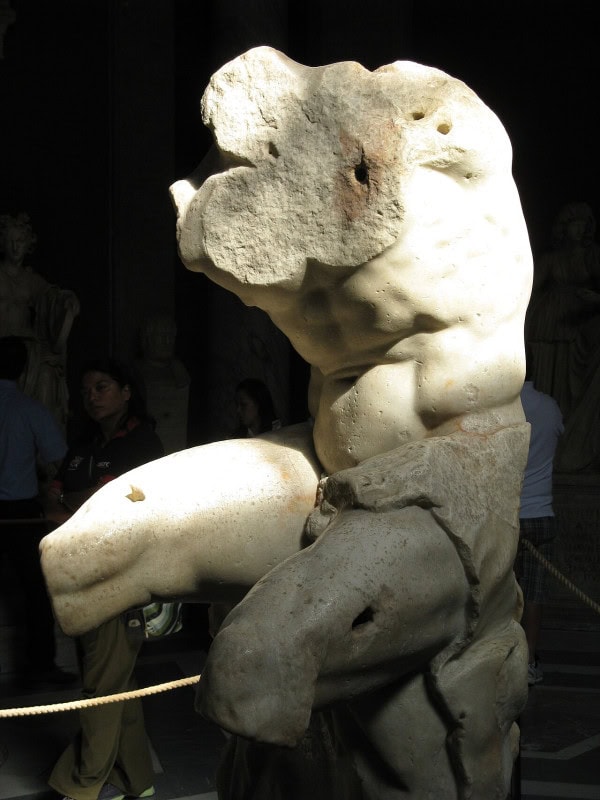
Marble, 159 cm, 1st century BC, signed “Apollonios, son of Nestor, Athenian”, Vatican Museums. A seated male figure with no head, no arms and no lower legs, sitting on an animal skin, the torso twisting. Who it is has never been settled: Hercules, Ajax contemplating suicide, Polyphemus and Marsyas have all been proposed. It was known by the 1430s and in the Vatican by the 1530s. What it was made to say: what it said to Michelangelo, who refused to restore it and is said to have called himself its pupil. The twist of the back is in the Sistine ceiling’s ignudi and in the Christ of the Last Judgement; Rodin kept a cast. It is the fragment that taught the Renaissance that a fragment could be enough, and it is on this list for that reason rather than for anything Roman about it, since the signature is Greek and the date is a guess.
16. The Capitoline Venus
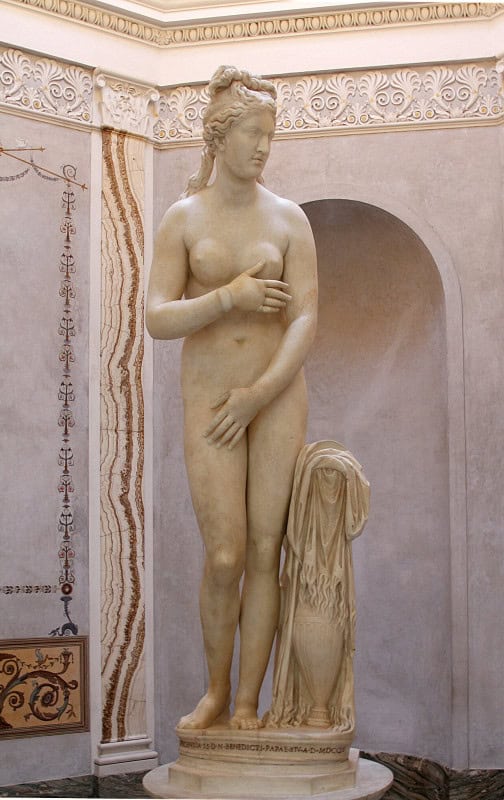
Marble, 193 cm, Roman copy of the 2nd century AD after a Greek type of the 4th century BC, Capitoline Museums (Palazzo Nuovo). The best-preserved Roman version of the Venus Pudica type, the goddess at her bath, which descends from the Aphrodite that Praxiteles carved for the city of Knidos around 350 BC, the first life-size female nude in Greek art and the most famous statue of antiquity. The Knidian original is lost; this and the Medici Venus in Florence are how it is known. It was found around 1670 near the church of San Vitale, bought by Pope Benedict XIV in 1752 for the Capitoline, taken to Paris by Napoleon and returned in 1816. What it was made to say: to its Roman owner, that he had a Praxiteles; the Romans traced their descent from Venus, and no villa was complete without her. It has its own small octagonal room in the museum, built so that it is seen alone.
17. Trajan’s Column
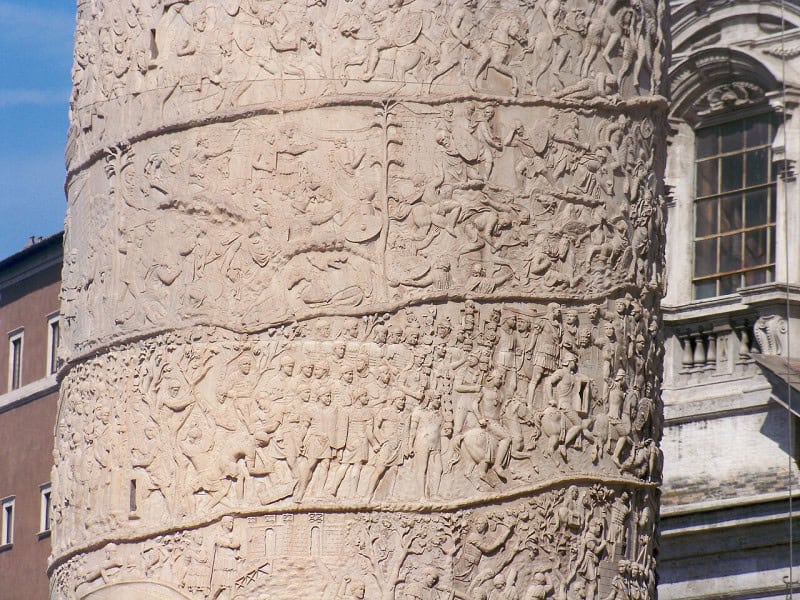
Marble, about 30 m of shaft on a pedestal, dedicated AD 113, Trajan’s Forum, Rome. Not a statue but the greatest piece of Roman narrative sculpture: a frieze about 190 m long winding 23 times around a column, with some 2,500 figures telling the story of Trajan’s two wars against the Dacians in what is now Romania. Soldiers build forts, cross the Danube on a bridge of boats, fight, receive embassies, burn villages; Trajan appears nearly sixty times, always calm. The emperor’s ashes were placed in the base; a statue of St Peter has stood on top since 1587. What it was made to say: that the war was orderly, the army disciplined and the emperor everywhere. Nobody standing at the bottom could read the upper spirals, which has puzzled people ever since; the best guess is that the libraries flanking it had balconies. Casts made in 1861 to 1862 for Napoleon III are in the Victoria and Albert Museum, where the frieze can be read at eye level. Trajan’s Column sits with Rome’s other arches and columns on the famous monuments page.
18. The Equestrian Statue of Marcus Aurelius
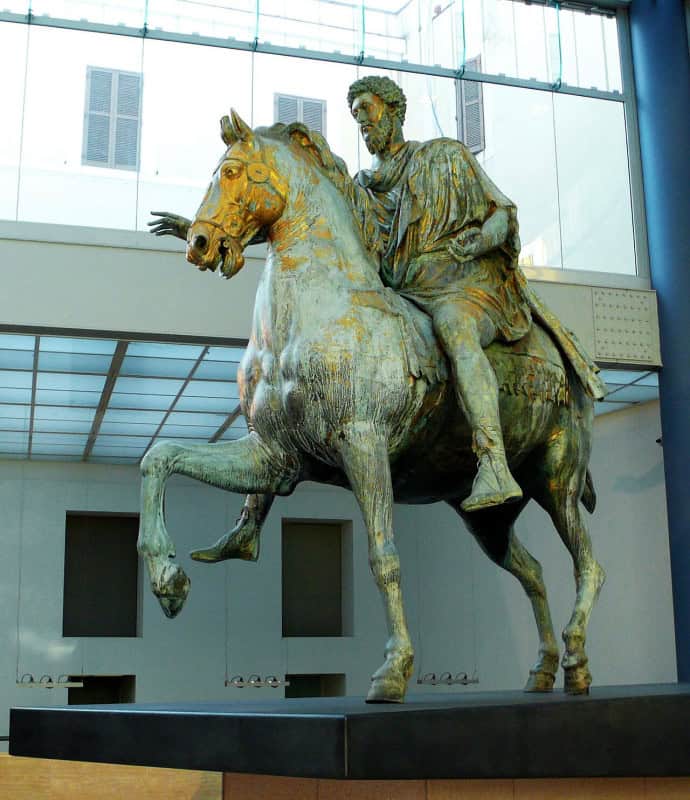
Gilded bronze, 424 cm, c. AD 175, Capitoline Museums (the original); a replica stands on the piazza. The only large bronze equestrian statue to survive from antiquity, out of perhaps two dozen that once stood in Rome. Marcus Aurelius, the philosopher emperor, rides without stirrups (the Romans had none) and without weapons, right hand out in a gesture of address or clemency; a kneeling barbarian probably once crouched under the horse’s raised hoof. It survived because the Middle Ages thought it was Constantine, the first Christian emperor, and so did not melt it. It stood outside the Lateran until 1538, when Michelangelo moved it to the Capitoline and designed the piazza around it. Traces of the original gilding remain; a Roman legend said that when the gold returned the world would end. Pollution forced it indoors in 1981, and since 2005 it has had its own glass-roofed hall. What it was made to say: command without a drawn sword. Every equestrian statue of a ruler since, from Donatello’s Gattamelata to the generals in American parks, descends from it.
19. Commodus as Hercules
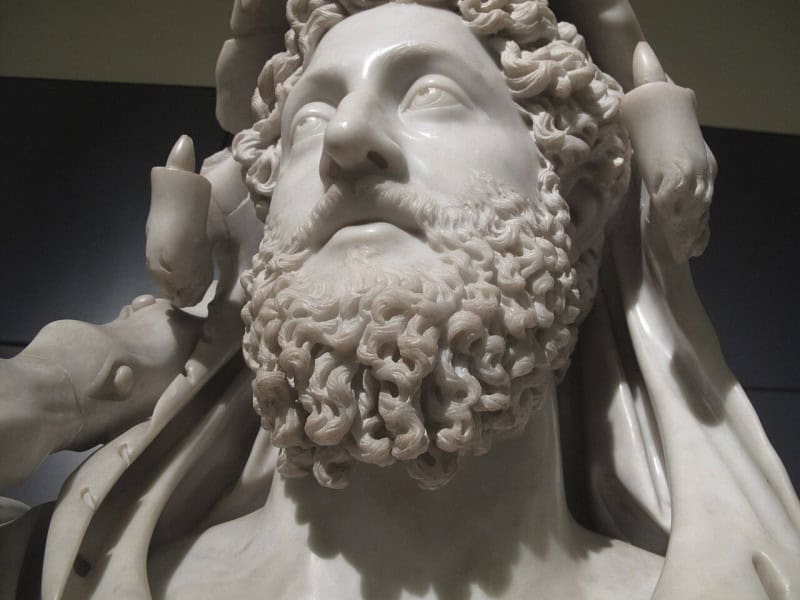
Marble, 133 cm, c. AD 192, Capitoline Museums (Palazzo dei Conservatori). The son of Marcus Aurelius, with the lion skin of Hercules over his head, the club in one hand and the golden apples in the other, on a base of kneeling Amazons and a globe with the signs of the zodiac. (The glowering bust of Caracalla, a generation later, is the other late-imperial portrait type everyone recognises; the Capitoline and Naples both have one.) It was found in 1874 in the ruins of the Horti Lamiani on the Esquiline, buried in a vaulted room, which may be why it survived in such perfect condition: after Commodus was strangled in his bath in December 192 his memory was condemned and his statues destroyed. What it was made to say: that the emperor was a god. Commodus had renamed Rome after himself, fought in the arena as a gladiator, and told the Senate he was Hercules reborn; this is the official portrait of that claim, carved with great skill, and it is the point at which the imperial portrait stops pretending to be a portrait of a man. The polished face against the drilled, deeply shadowed hair is the late Antonine style at its height.
20. The Colossus of Constantine
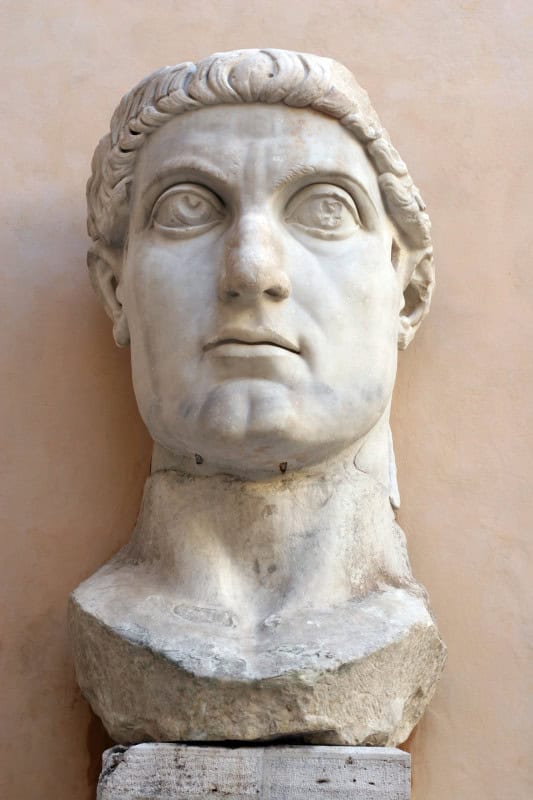
Marble and (originally) bronze, head about 2.5 m, the seated figure about 12 m, c. AD 312 to 315, Capitoline Museums (Palazzo dei Conservatori courtyard). A head, a right hand with a raised finger, a kneecap, two feet and parts of arms and legs are all that remain of a seated statue of the first Christian emperor that filled the west apse of the Basilica of Maxentius in the Forum. The exposed flesh was marble; the body and drapery were brick and wood sheathed in gilded bronze, which was stripped long ago. The fragments were found in 1486 and have been in the courtyard since. What it was made to say: that the emperor was no longer a man among men. The huge eyes look up and past you; the face is a mask of authority, not a likeness, and the Republic’s wrinkled senators are six centuries and a whole idea of power away. In 2024 a full-size reconstruction, 13 m high, was put up in the Capitoline gardens. The basilica it stood in, and the Pantheon and the Colosseum that its builders were competing with, are on the famous buildings page.
Roman statues vs Greek statues: how to tell
Four rules of thumb, none of them perfect. Material: a Greek original of the classical period is usually bronze; a marble version of a famous type is almost always Roman. Supports: a tree trunk, a strut or a drape propping up a marble figure means a copyist solving a weight problem that the bronze never had. Faces: a portrait that shows age, baldness or a scar is Roman; Greek portraits of the classical period idealise, and the Hellenistic ones that do not are usually of philosophers or boxers. Subject: a named Roman, a historical event told in relief, an emperor on a horse, or a togate figure holding ancestor busts is Roman by definition. The exceptions are the Greek bronzes the Romans imported and the Roman commissions carved by Greek sculptors, which is to say most of the best things on this list.
Were Roman statues painted?
Yes. Pliny, Vitruvius and Pausanias all describe painted sculpture as normal; traces of red, blue, yellow and pink survive under ultraviolet light on the Prima Porta Augustus, on the Ara Pacis and on portrait heads whose eyes and lips were coloured; bronze statues had inlaid copper lips and nipples, silver teeth and glass eyes, as the Boxer at Rest still shows. The colour was lost to burial and to cleaning, and the Renaissance, which dug the statues up white, decided white was the ideal. The German archaeologist Vinzenz Brinkmann’s reconstructions, shown since 2003 under the title Gods in Color, are the easiest way to see what the statues looked like new, and the Vatican keeps a painted copy of the Prima Porta next to the original. Whether the paint was as lurid as the reconstructions suggest is debated; that there was paint is not.
Where to see the most in one day
Rome, in two museums. The Capitoline Museums on the Campidoglio have eight of the twenty: the Wolf, the Brutus, the Dying Gaul, the Capitoline Venus, the Marcus Aurelius, the Commodus, the Constantine fragments and, a bus ride away at their Centrale Montemartini annex, the Togatus Barberini. The Vatican Museums have four: the Prima Porta Augustus, the Laocoön, the Apollo Belvedere and the Belvedere Torso, all within a few rooms of each other in the Braccio Nuovo and the Pio-Clementino. The Palazzo Massimo by Termini station has the Boxer and the veiled Augustus, and the Ara Pacis is a fifteen-minute walk from the Spanish Steps. Naples has the Farnese Hercules, Florence the Orator, London the Portland Vase. If you want the full list of what the ancient world left standing, the most famous statues in the world page starts there and runs to the present.
Image credits
All photographs are from Wikimedia Commons. Public domain or CC0: the Capitoline Wolf by Jastrow (released to the public domain), the Arringatore lantern slide, the Capitoline Brutus by Jastrow (released to the public domain), the Via Labicana Augustus by Fabrizio Garrisi (CC0), the Laocoön by Wilfredor (CC0). CC BY: the Otricoli head by Sailko (CC BY 3.0); the Ara Pacis procession and the Commodus bust by the Institute for the Study of the Ancient World (CC BY 2.0); the Portland Vase and the Farnese Hercules by Marie-Lan Nguyen (CC BY 2.5); Trajan’s Column detail by Larry of Charlottetown (CC BY 2.0); the Marcus Aurelius by Rosemania (CC BY 2.0). CC BY-SA: the Prima Porta Augustus by Joel Bellviure (4.0); the Dying Gaul and the Boxer at Rest by Carole Raddato (2.0); the Togatus Barberini by Carlo Dell’Orto (4.0); the Apollo Belvedere by Alvesgaspar (4.0); the Belvedere Torso by Yair Haklai (3.0); the Capitoline Venus by José Luiz (4.0); the head of Constantine by Camille King (2.0). Title card by The Popular List.