
Ask what Nikola Tesla invented and you get two kinds of answer. One is a short list that is mostly right: the alternating-current induction motor, the Tesla coil, a radio-controlled boat. The other is a long list that is mostly wrong, in which Tesla invented radio outright, lit the world for free, built a death ray and photographed thoughts. Tesla himself is partly to blame for the second list. He was a brilliant engineer and a tireless self-publicist, and in the last thirty years of his life he announced far more than he built.
This page sorts the record. Fifteen of Tesla’s inventions and designs are listed in the order they happened, and each one carries a label built from three words, built, patented and claimed. Built and patented means a working device existed and a United States patent was granted, and the patent number is given. Built, not first means Tesla made it work but someone else got there first, or the credit is shared. Claimed, never demonstrated means the only evidence is Tesla’s own word. Where the record is mixed, the label says so. The labels are kept honest by the evidence in each entry, and the sources are listed at the end. Tesla has an entry on our list of the most famous inventors in history, and his alternating-current system appears among the great inventions of the 19th century; this page is the longer answer to what, exactly, he did.
1. The alternating-current induction motor and polyphase system (1888)
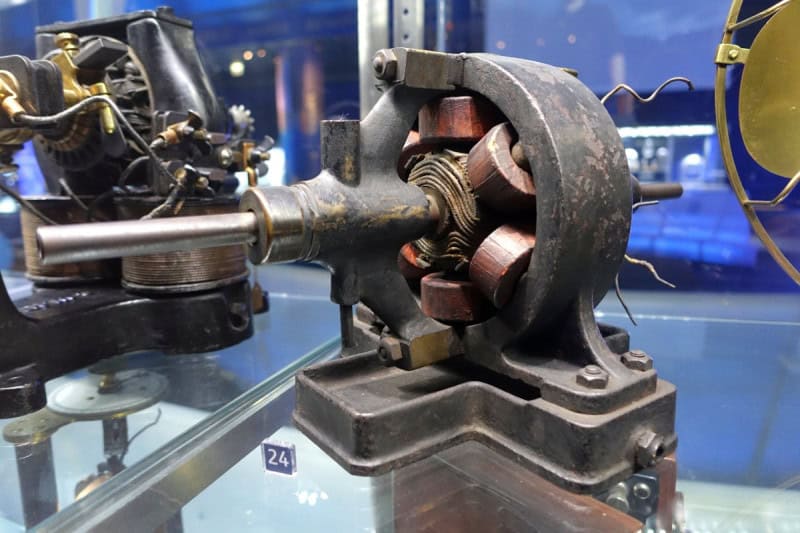
Built and patented. This is the invention that matters most, and it is the one with the cleanest paper trail. On 1 May 1888 the United States Patent Office granted Tesla a group of patents on an electric motor with no brushes and no commutator, the parts that wore out in every direct-current motor of the day; the central one is US 381,968, “Electro-Magnetic Motor”. Two or more alternating currents, out of step with each other, set up a magnetic field that rotates inside the motor, and the rotor simply follows it. Two weeks later Tesla read a paper to the American Institute of Electrical Engineers describing the whole polyphase system, generator, transmission and motor together, and that summer George Westinghouse bought the patents.
The honest footnote is that the Italian physicist Galileo Ferraris had worked out the rotating magnetic field independently and lectured on it in Turin in March 1888, a few weeks before Tesla’s patents were granted. Ferraris thought the idea had no practical future; Tesla built a motor on it and sold the rights. The induction motor is still the most common motor in the world, in everything from factory pumps to the fan in a kitchen extractor, and the three-phase power that reaches most buildings on earth is the system Tesla described in 1888.
2. The Tesla coil (1891)
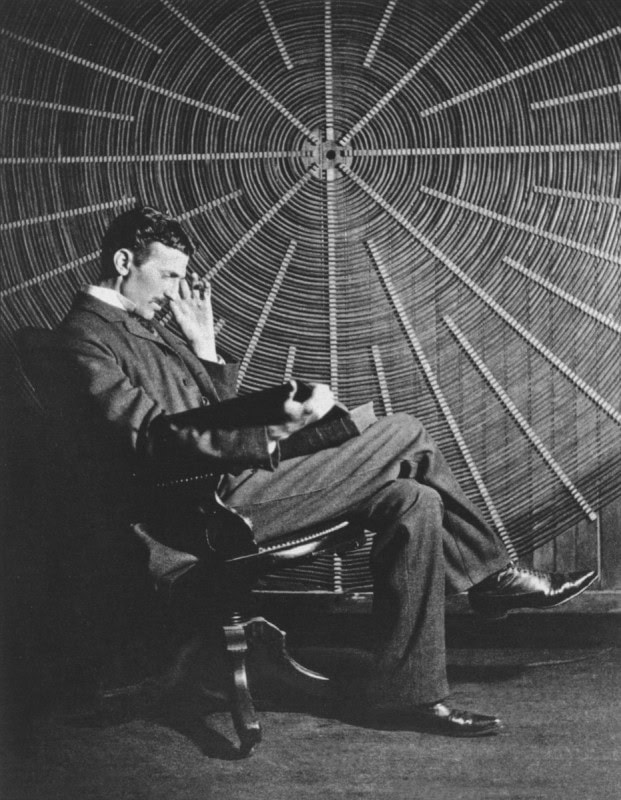
Built and patented. US 454,622, “System of Electric Lighting”, granted 23 June 1891, describes the circuit the world now calls a Tesla coil: a transformer with no iron core, driven by a spark gap and a capacitor, that turns ordinary current into very high voltages at very high frequencies. Tesla built it to power a new kind of lamp (the next entry), but the coil outlived the lamp. For thirty years it was the standard way to generate radio-frequency current, it sat inside early radio transmitters, and versions of it still drive the ignition in some engines and the high-voltage stage in old television sets.
The photograph above, taken in his East Houston Street laboratory in 1896, shows Tesla reading in front of the flat spiral coil of one of his large transformers. The coil was also his stagecraft: in lectures in New York, London and Paris he let the discharge from it pass over his body to light lamps in his hands, a demonstration that was safe because of the high frequency and that made him famous.
3. High-frequency and wireless lamps (1891)
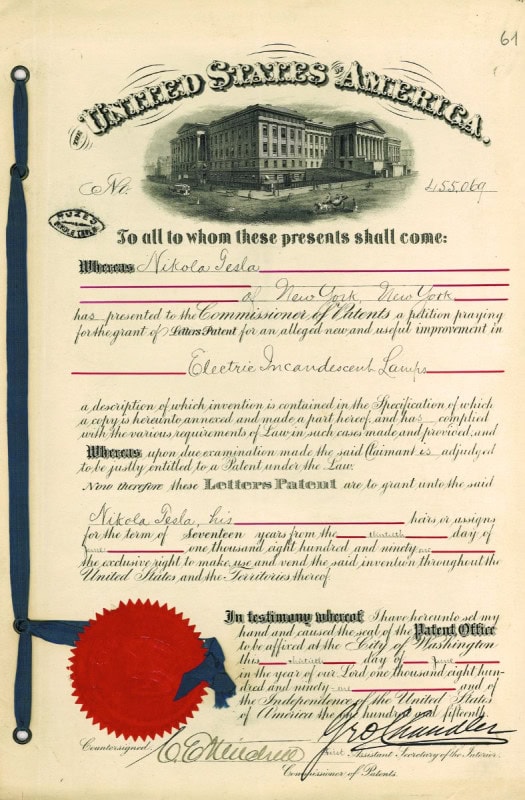
Built, not first. Tesla’s 1891 lamp patents, including the one whose letters patent are shown above, covered lamps in which a small carbon button or a gas-filled tube glowed under the high-frequency current from his coil, with one wire or none. In a lecture at Columbia College on 20 May 1891 he lit such tubes by holding them in a high-frequency field, with no wires attached, and the sight of lamps glowing in mid-air became the image of Tesla for a generation.
Why “not first”? Because gas-discharge lighting was already old: Heinrich Geissler’s tubes had glowed in the 1850s, and the practical fluorescent and neon lamps that reached shops and streets in the twentieth century came from other hands, Georges Claude’s neon in 1910 and the General Electric fluorescent of 1938 among them. Tesla’s lamps were real, they worked, and they were never a product. What lasted from the work was the demonstration that energy could be moved across a room without a wire, which set the course of the next twenty years of his life.
4. The Egg of Columbus (1893)
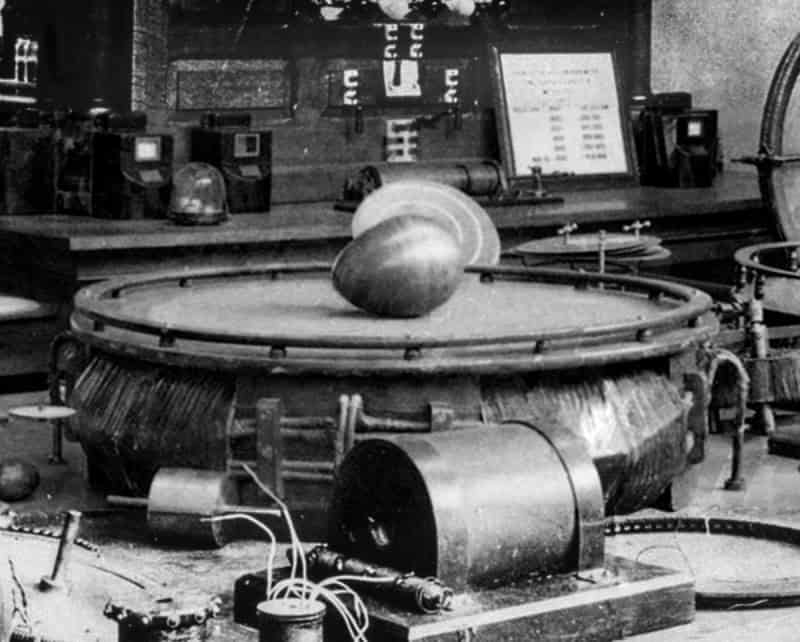
Built and demonstrated. Not a patent but a teaching device, and one of the best ever made. At the World’s Columbian Exposition in Chicago in 1893, in the Westinghouse exhibit that was lit entirely by Tesla’s alternating current, visitors were shown a copper egg lying on a wooden plate. When the current was switched on, the egg began to turn, then stood up on its end and spun upright, apparently by magic. Under the plate was a coil carrying polyphase current: the rotating magnetic field that drives an induction motor was spinning the egg exactly as it spins a rotor, and the egg stood up for the same reason a spinning top does.
The name is a joke on the old story of Columbus standing an egg on its end by cracking the shell. Tesla’s version needed no crack, which was the point: the rotating field was invisible and real. The Westinghouse installation at the fair, running on Tesla’s patents, is usually given as the moment alternating current won the public argument against Edison’s direct current, and the egg was its most memorable exhibit.
5. The mechanical oscillator, or “earthquake machine” (1893)
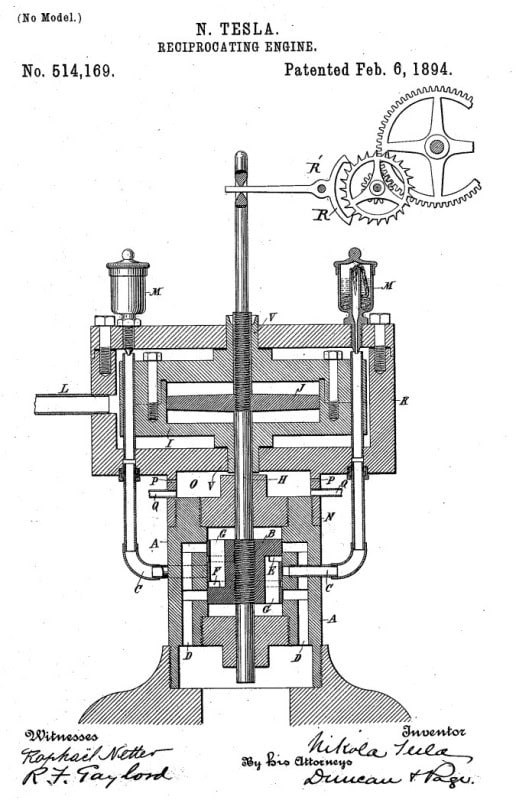
Built and patented; the earthquake was claimed. US 514,169, “Reciprocating Engine”, granted 6 February 1894 on an application filed the previous August, is a steam-driven piston that shuttles back and forth at a very steady rate with no crankshaft or flywheel. Tesla built several and used them to drive small generators, because a steady oscillation gives a steady alternating current. The machine was real and the patent is one of the most elegant he filed.
The famous part is not in the patent. In an interview given in 1935, when he was seventy-nine, Tesla said that in 1898 a small oscillator clamped to a column in his Houston Street laboratory had found the resonant frequency of the building and shaken the neighbourhood until he smashed it with a hammer, and that a bigger one could bring down the Empire State Building. No contemporary report of the shaking exists, and the claim rests on Tesla’s recollection nearly forty years after the event. The label for the engine is “built and patented”; the label for the earthquake is “claimed”.
6. The Niagara Falls power station (1895)
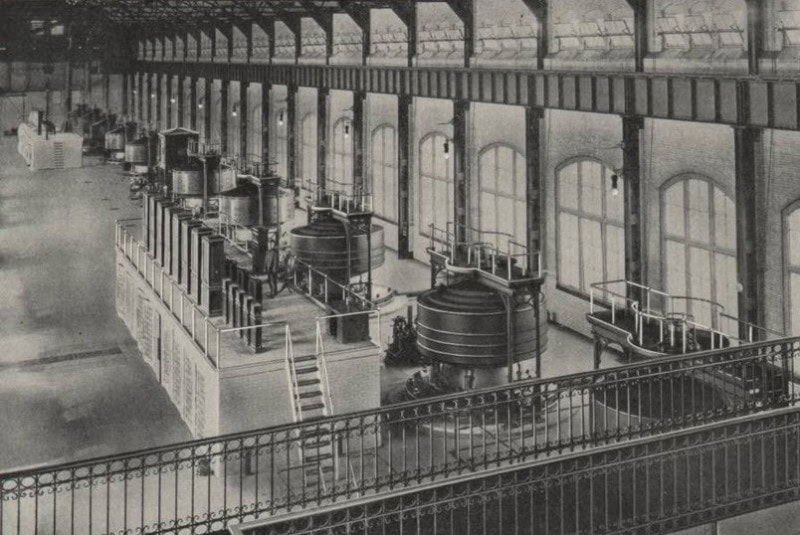
Built, with others. Tesla did not design the Adams Power Plant at Niagara Falls, and his name is on it because his patents were. In 1893 the Niagara Falls Power Company chose Westinghouse’s alternating-current system over the direct-current proposals, and the ten 5,000-horsepower generators that Westinghouse built for the first powerhouse, shown above in a 1904 photograph, were two-phase machines working under Tesla’s polyphase patents. The first of them began turning in August 1895, and in November 1896 the plant sent power twenty-six miles to Buffalo, the first long-distance transmission of its kind on that scale.
It settled the argument. Direct current could not be sent that far, and after Niagara nobody seriously proposed building a national grid on it. The engineering was Westinghouse’s, the money was a syndicate’s, and the falls were nobody’s; what was Tesla’s was the system of generation and motors that made the distance possible. In 1897, with Westinghouse under financial pressure, Tesla accepted a lump sum for his polyphase patents in place of the royalty he had been promised, a bargain that cost him a great deal in the decades that followed.
7. X-ray shadowgraphs (1896)
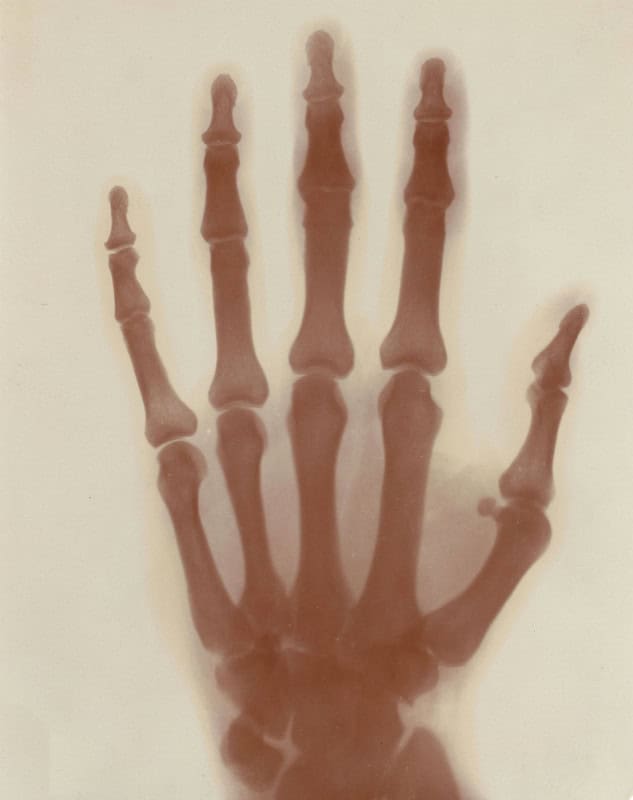
Built, not first. Wilhelm Röntgen announced X-rays in December 1895. Within weeks Tesla, who had been running high-voltage vacuum tubes for years and had noticed fogged photographic plates in his laboratory without understanding why, was producing what he called shadowgraphs: X-ray images of hands, feet and skulls, including the picture of his own left hand above. He published a series of articles in the Electrical Review in 1896 describing single-electrode tubes that produced the rays, the dangers of long exposures, which he noticed early, and his own methods for sharpening the pictures.
Tesla’s admirers sometimes say he discovered X-rays before Röntgen because of the fogged plates, and Tesla himself hinted at it. He did not: a fogged plate is not a discovery, and Röntgen’s paper is what told Tesla what he had been looking at. What Tesla did do was build good X-ray tubes very quickly and write sensibly about them, which earns the entry.
8. The wireless transmission patents, and the radio question (1897)
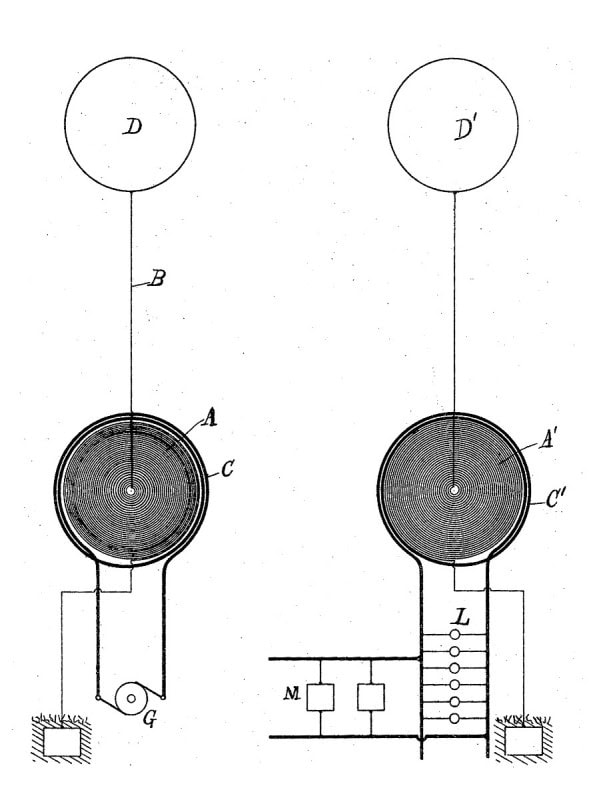
Patented; the radio claim is contested. On 2 September 1897 Tesla filed the application that became US 645,576, “System of Transmission of Electrical Energy”, granted 20 March 1900, with a companion, US 649,621, granted that May. The drawing above is the whole idea in one picture: two elevated terminals, each fed by a coil tuned to the same frequency, with energy passing between them through the air and the ground. Tesla meant it for power as much as for messages, and tuning the two circuits to each other, so that a receiver answered only its own transmitter, is the part that mattered for radio.
Did Tesla invent radio? Marconi sent signals across the Atlantic in 1901 using tuned circuits of the kind Tesla had patented, and in 1943 the United States Supreme Court, in Marconi Wireless Telegraph Co. of America v. United States, held Marconi’s main American tuning patent invalid because the ideas in it had been published or patented earlier by Oliver Lodge, John Stone Stone and Tesla. That ruling is often quoted as the court “giving radio to Tesla”. It did not. It decided a money claim about one patent, and it named three predecessors, not one. Tesla’s patents were real and early; the working system that carried messages across an ocean was Marconi’s. The fairest label is the one above.
9. The radio-controlled boat (1898)
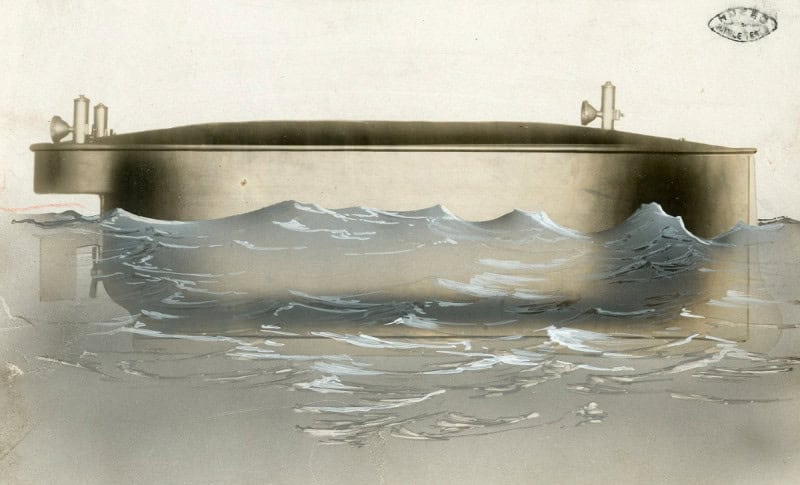
Built and patented. At the Electrical Exhibition in Madison Square Garden in 1898 Tesla floated a four-foot iron boat in a tank of water and steered it, started and stopped it, and lit its lamps from across the room, using radio signals and no visible connection. Members of the audience were invited to call out commands, which Tesla then sent. US 613,809, “Method of and Apparatus for Controlling Mechanism of Moving Vessels or Vehicles”, was granted on 8 November 1898. The boat survives in the Nikola Tesla Museum in Belgrade; the image above is from 1898.
It is the first radio-controlled vehicle on record and, in the modern sense, the first drone. Tesla called it a “teleautomaton” and tried to sell the idea to the United States Navy as a guided torpedo, with no success; the Navy did not take remote control seriously until the First World War. The patent also describes a receiver that responds only to a particular combination of signals, an early form of what would later be called a coded or secure channel. The Belgrade museum calls the boat his second most important invention.
10. The magnifying transmitter at Colorado Springs (1899)
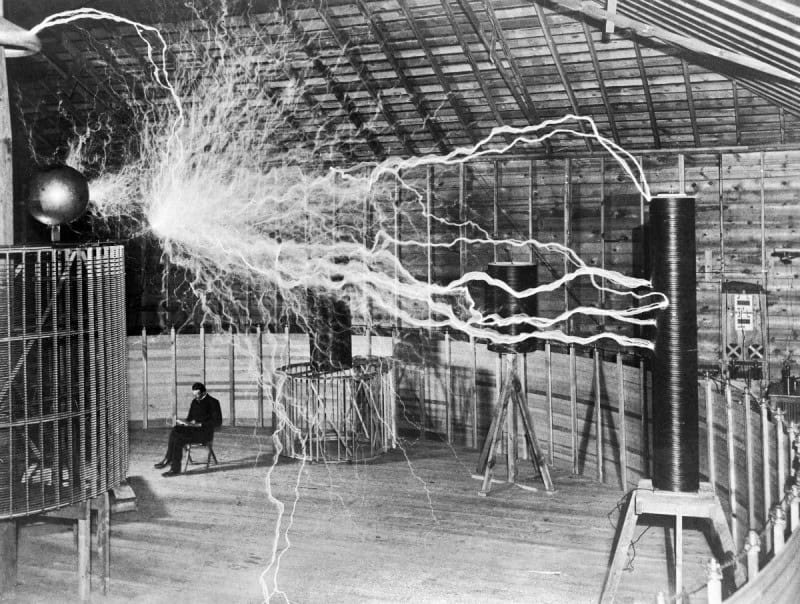
Built; the results were claimed. In May 1899 Tesla moved to Colorado Springs, where land and power were cheap and the air was dry, and built a laboratory around the largest Tesla coil ever made, a “magnifying transmitter” with a fifty-foot primary coil and a mast carrying a copper ball far above the roof. It worked, in the sense that it produced discharges tens of feet long, loud enough to be heard miles away, and once burned out the generator at the local power company. The photograph above, the most famous image of Tesla, is a double exposure made by the photographer Dickenson Alley for a magazine article: the discharge was photographed first in the dark, and Tesla was then photographed sitting in the quiet room. He was never in the chair while the machine ran.
What Tesla claimed to have done at Colorado Springs, in his notebooks and later articles, was to send power through the earth itself and light lamps at a distance by it, to detect standing waves in the planet, and to receive signals from another world. The lamps he lit near the laboratory are documented; the long-distance claims are not, and no one has reproduced them. The experiments ended in January 1900, and Tesla went back to New York to raise money for the full-size version, which is the next entry.
11. Wardenclyffe Tower (1901 to 1917)
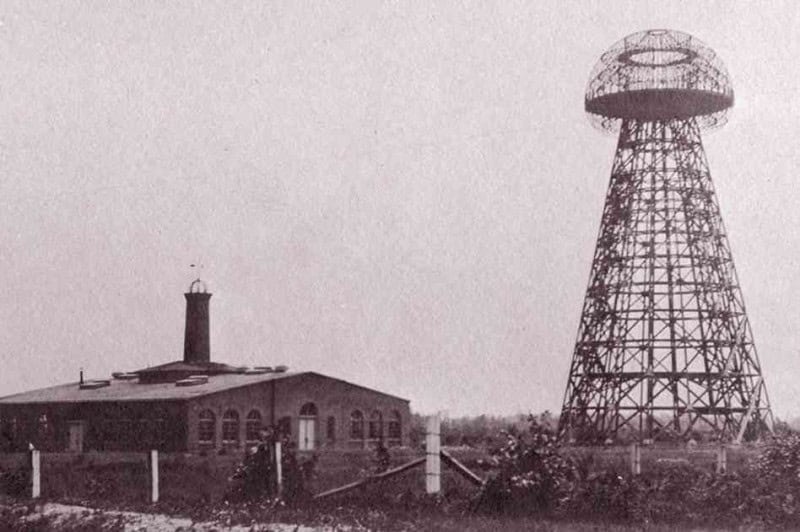
Built, never operated. With $150,000 from J. P. Morgan, Tesla bought land at Shoreham on Long Island in 1901 and began a wireless station meant, he told Morgan, to send messages across the Atlantic. The brick laboratory was designed by Stanford White; the tower beside it rose 187 feet to a mushroom-shaped dome, with a shaft sunk deep into the ground beneath. The apparatus it was to carry is described in US 1,119,732, “Apparatus for Transmitting Electrical Energy”, filed in 1902 and not granted until 1914.
What Tesla actually intended was larger than he had told his backer: not messages but power, broadcast through the earth to receivers anywhere. When Marconi crossed the Atlantic in December 1901 with far cheaper equipment, Morgan declined to put in more money, and the project ran out of funds with the tower and its steel dome standing but the transmitting apparatus inside never installed. Tesla mortgaged the property to pay his hotel bills, and in 1917 the tower was dynamited for scrap. The laboratory building survived, and since 2013 it has been the Tesla Science Center at Wardenclyffe. The photograph above, from 1904, was taken for Tesla to show Morgan how far the work had come.
12. The bladeless turbine (1913)
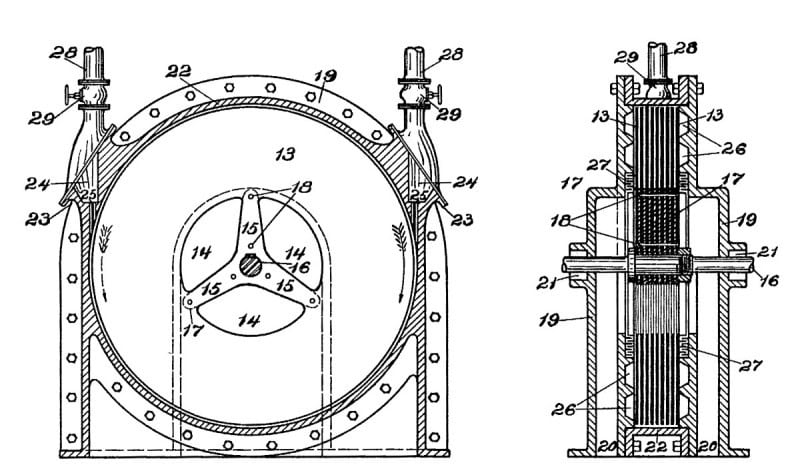
Built and patented. US 1,061,206, “Turbine”, granted 6 May 1913 on an application filed in January 1911 (a companion patent, 1,061,142, “Fluid Propulsion”, had been filed in October 1909 and was granted the same day), has no blades at all. A stack of thin flat discs sits on a shaft inside a casing; steam or another fluid enters at the rim, spirals inward between the discs, and drags them round by friction and the fluid’s own stickiness before leaving at the centre. Tesla built several, including units tested at the Edison Waterside power station in New York in 1911, and he believed it would replace the bladed turbine in power stations and the piston engine in cars.
It did neither. The discs of the day warped and stretched at speed, the efficiency fell short of the bladed turbines that Parsons and others were already building at enormous scale, and no manufacturer took it up. The design has had a long afterlife, though: it works well as a pump for thick or dirty fluids, where blades would clog, and it is a favourite of engineering students and hobbyists because it can be built in a workshop. The label is “built and patented”; the claim that it was the engine of the future was Tesla’s, and it was wrong.
13. The Tesla valve (1920)

Patented; measured fully only in 2021. US 1,329,559, “Valvular Conduit”, granted 3 February 1920, is a pipe with no moving parts that lets fluid pass easily one way and resists it the other. The trick is in the shape, shown in the drawing above: a straight channel with a row of teardrop-shaped side loops, so that fluid going the “wrong” way is turned back on itself and fights its own flow, while fluid going the “right” way slides past the loops. Tesla designed it as a one-way valve for his turbine, and in the patent he put the ratio of reverse to forward resistance at about 200 to 1, a figure he presented as what the design could reach rather than as a measurement.
It was ignored for most of a century and then rediscovered. With no parts to wear or jam, a Tesla valve suits very small channels and harsh conditions, and versions have been made for microfluidic chips and tested in engine fuel lines; a study published in 2021 measured the effect across a range of flows for the first time and found it works best with fast, pulsing flow, which is what a piston engine produces; the best ratio it measured was about two to one, not Tesla’s two hundred. It is the one Tesla patent whose reputation has risen rather than fallen since his death.
14. The vertical take-off aircraft (1928)
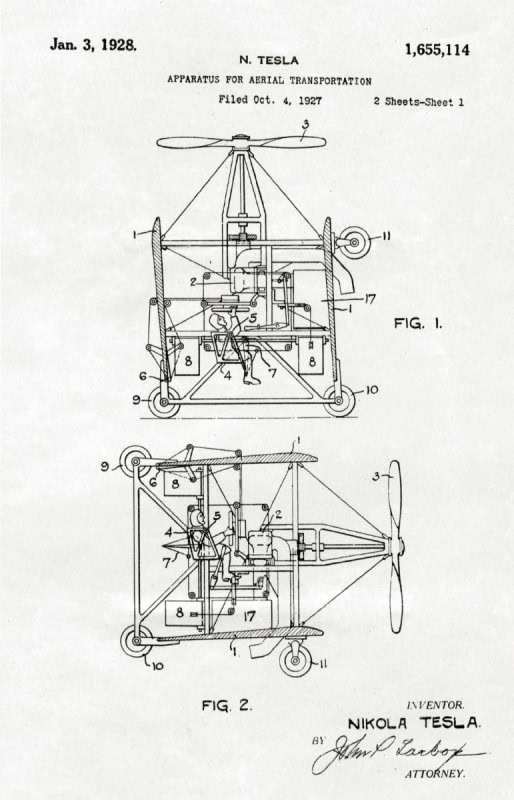
Patented, never built. Tesla’s last patent, US 1,655,114, “Apparatus for Aerial Transportation”, was granted on 3 January 1928, when he was seventy-one. The patent drawing above, from the Nikola Tesla Museum’s copy, shows a machine that takes off and lands standing on its tail, with a propeller pointing upward, then tilts forward to fly like an aeroplane on its wings. Tesla called it a “flivver plane” and said it would cost less than a thousand dollars.
Nothing was built, and Tesla had neither the money nor an engine powerful enough to try. The idea, though, is recognisable: tail-sitting vertical take-off aircraft were flown experimentally by the United States Navy in the 1950s, and tilting rotors and ducted fans that convert between vertical and forward flight are in service today. The patent is evidence of a good idea on paper and of nothing else, which is what the label says.
15. Teleforce, the “death ray” (1934)
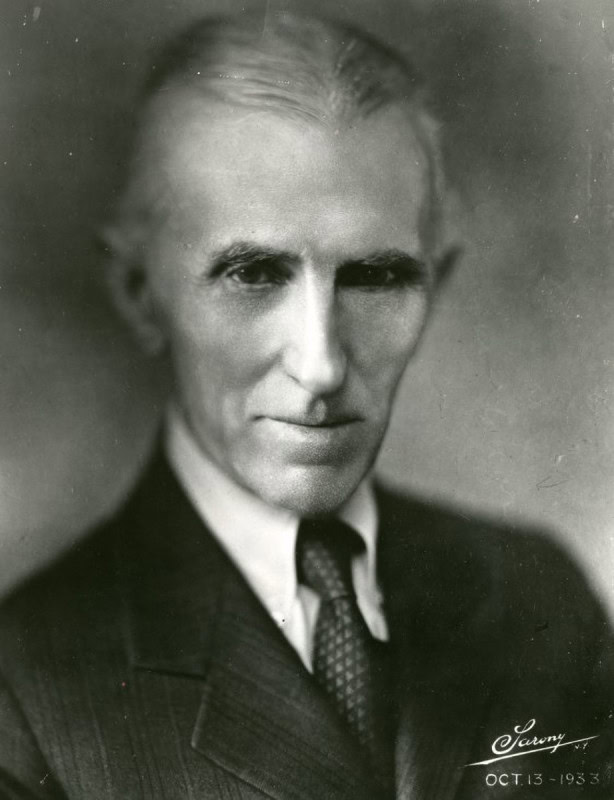
Claimed, never demonstrated. On his seventy-eighth birthday, in July 1934, Tesla told reporters he had invented a weapon that could send concentrated beams of particles through the air with enough energy to bring down a fleet of ten thousand aircraft at 250 miles, and that it would make war impossible by making every border impassable. He called it teleforce; the newspapers called it a death ray, a name he disliked because, he said, it was not a ray. In 1937 he wrote a technical description and offered it to several governments. None built it, and the paper describes a design, not a device.
No prototype, test or demonstration was ever shown, and the portrait above, taken a few months before the announcement, is the honest illustration for an invention that existed only in words. The same is true of the other late claims that gather around Tesla’s name: a machine to photograph thoughts, a motor run by cosmic rays, a way to split the earth like an apple. He said he could build them. He never did. The record of what he did build, from the induction motor to the valve, is long enough not to need them.
What Tesla did not invent
Three things are commonly credited to him that belong elsewhere. He did not invent electricity or alternating current: alternating generators and transformers existed before him, and his contribution was the motor and the complete polyphase system that made AC worth distributing. He did not invent radio outright, for the reasons in entry 8. And he did not give the world free energy: the Wardenclyffe idea was to broadcast power, not to make it, and the plant would have burned coal like any other. The “Tesla” electric car company is named after him and has no other connection to him. For the inventions that came after his, from the transistor to the internet, see the greatest inventions of the 20th century, and for the whole sweep from the wheel onward, the inventions that changed the world. The wireless power he chased is still being chased, on a far smaller scale, in the charging pads and medical implants on our list of 21st-century inventions.
Sources
Patent numbers, titles and grant dates are from the United States patents themselves: 381,968 (1 May 1888); 454,622 (23 June 1891); 514,169 (6 February 1894); 613,809 (8 November 1898); 645,576 (20 March 1900) and 649,621 (15 May 1900); 1,061,142 and 1,061,206 (both 6 May 1913); 1,119,732 (1 December 1914); 1,329,559 (3 February 1920); 1,655,114 (3 January 1928). Tesla’s own account of the motor, the coil, the boat and Wardenclyffe is in My Inventions, his serialised memoir in the Electrical Experimenter, 1919. The 1943 ruling is Marconi Wireless Telegraph Co. of America v. United States, 320 U.S. 1. The Niagara dates are the Niagara Falls Power Company’s (first generator August 1895; power to Buffalo November 1896). The Colorado Springs photograph’s history is from the photographer’s own account as recorded on the Wikimedia Commons file page. The earthquake story is from Tesla’s 1935 press interviews and is labelled as his recollection. The 2021 Tesla valve study is Nguyen et al., Nature Communications 12, 2884.
Image credits
Patent drawings and photographs made before 1929 are in the public domain and are reproduced via Wikimedia Commons. Attribution for the rest: early Tesla motor at the Museum of Science and Industry, Chicago, by Daderot (CC0). Letters patent for electric incandescent lamps, the remote-controlled boat, the 1928 air transport patent drawing and the 1933 portrait, all from the collection of the Nikola Tesla Museum, Belgrade (CC BY-SA 4.0). The Colorado Springs photograph by Dickenson V. Alley is public domain; this restored version is by Lošmi (CC BY-SA 4.0).