
Some inventions are famous because of who made them, and some because they are old, but the ones on this list are here because of what happened next. Each of them changed how ordinary people lived, not only how engineers worked: what they ate, how far they travelled, whether their children survived, what they knew about the world beyond their own town. The list runs from the first controlled fire to a vaccine designed on a computer, in the order the inventions arrived, and it is deliberately short on gadgets and long on things that are still underneath everything else.
This page is the hub for our inventions series. Thirty entries is not a ranking of importance so much as a map: each one gives the inventor where there is one, the date where one can be defended, a photograph of the thing itself or the oldest thing like it, and a link to the page in the series where the invention already lives in more detail, whether that is our list of 19th-century inventions, 20th-century inventions, 21st-century inventions or famous inventors. Where the record is contested, the entry says so, because the argument over who invented the light bulb is itself part of the story.
How this list was chosen
The test for every entry is reach, not novelty. An invention made the list if the world after it was organised differently from the world before it, for most people and not only for specialists, and if that change can be described in one paragraph without hand-waving. That rules out a great many clever things and lets in a few that were not “invented” in the patent-office sense at all: fire was controlled, not devised, and writing was worked out over centuries by people whose names nobody wrote down. Dates are given as the year the invention first worked in public, or the year of the patent or publication that made it real; where historians disagree, the entry gives the range and names the reason. Every source is listed at the end.
The ancient world
Six inventions from before there were inventors, or at least before anyone wrote their names down. Each was worked out over generations rather than in a workshop, and each is still in use in a form its makers would recognise.
1. Control of fire (about 1 million years ago)
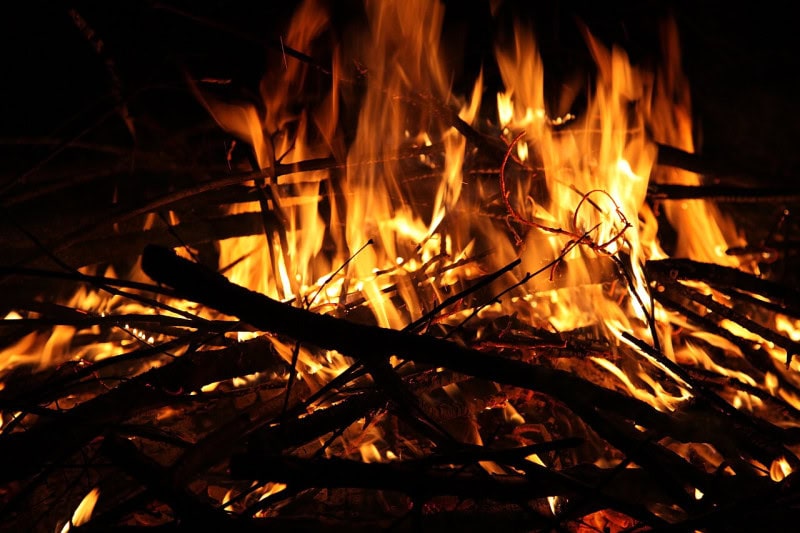
Fire is the one entry on this list that nobody invented, and it belongs at the top because everything else depends on it. The oldest generally accepted evidence of hominins deliberately using fire comes from Wonderwerk Cave in South Africa, where a team led by Francesco Berna reported in 2012 that burnt bone and plant ash in a layer dated to about one million years ago had been burnt inside the cave, not washed in; the users would have been Homo erectus. Regular, habitual fire use is younger, and archaeologists put the point at which hearths become common at somewhere between 400,000 and 300,000 years ago.
What fire changed is the body. Cooked food gives up far more of its energy than raw food, and the anthropologist Richard Wrangham has argued that cooking is the reason humans have small guts, small teeth and large brains relative to other apes. Fire also extended the day, kept predators off, hardened wooden tools and, much later, baked clay and smelted metal. No invention below would have been possible without it, which is why a campfire, rather than a laboratory, is the right picture here.
2. The wheel (about 3500 BC)
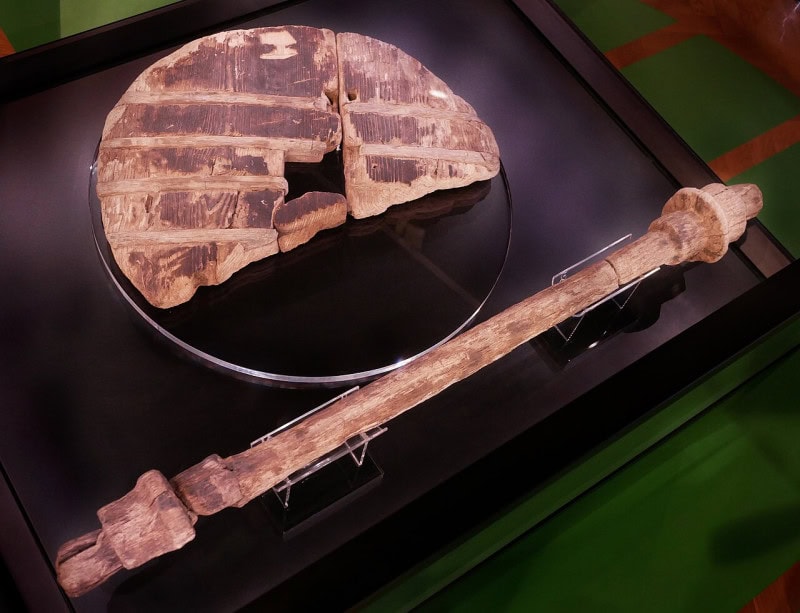
The wheel is younger than agriculture, pottery and the sailing boat, and it did not begin as transport: potters’ wheels seem to have come first. Wheeled vehicles appear in the archaeological record in the second half of the fourth millennium BC, at roughly the same time in Mesopotamia, the Caucasus and central Europe, and nobody can say where the idea started. The oldest wooden wheel yet found is the one in the photograph, excavated from the Ljubljana Marshes in Slovenia in 2002 with its axle beside it and radiocarbon-dated to about 5,150 years old, which puts it around 3150 BC. It is an ash-wood disc, about 72 centimetres across, built from two boards held by oak battens.
The trick was never the wheel itself but the axle: a wheel that turns freely on a fixed axle, or a fixed wheel on a turning axle, needs a round hole and a round shaft that fit closely without seizing, and that means good woodworking tools, which is why the wheel arrives after the copper age begins. Once it existed, every later machine on this list has one somewhere inside it, from the clock to the steam engine to the disc drive.
3. Writing (about 3200 BC)
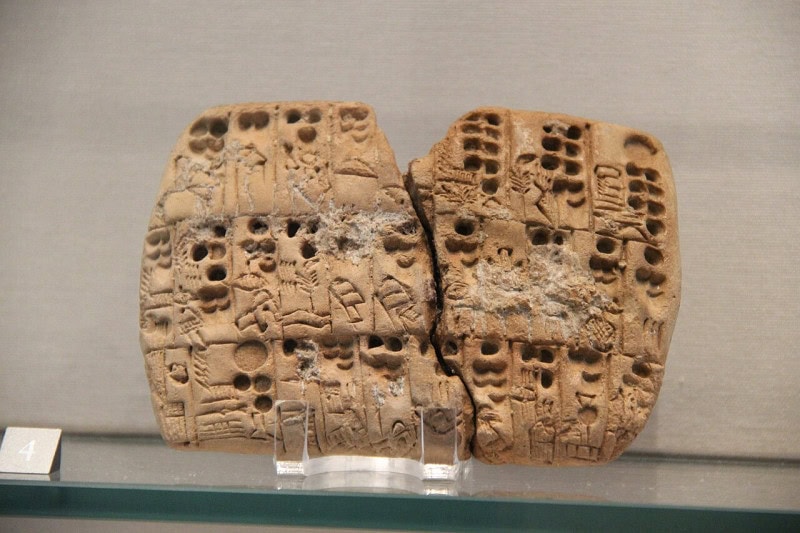
The earliest writing that can be read is cuneiform, pressed into wet clay with a cut reed in the city of Uruk in southern Mesopotamia in about 3200 BC, and its first use was not poetry but accounting: the oldest tablets are lists of rations, livestock and grain. Egyptian hieroglyphs appear at almost the same date, and Chinese and Mesoamerican writing were invented independently later. The tablet in the photograph is Sumerian, from the third millennium BC, and the wedge-shaped marks that give cuneiform its name are visible across its face.
Writing is the invention that makes every other invention on this list knowable. It turned memory into property that could be stored, copied, carried and checked, it allowed laws and contracts to outlive the people who made them, and it is the reason we know the names of inventors at all. It also took three thousand years to reach ordinary people, which is the point of the printing press further down.
4. Paper (AD 105)
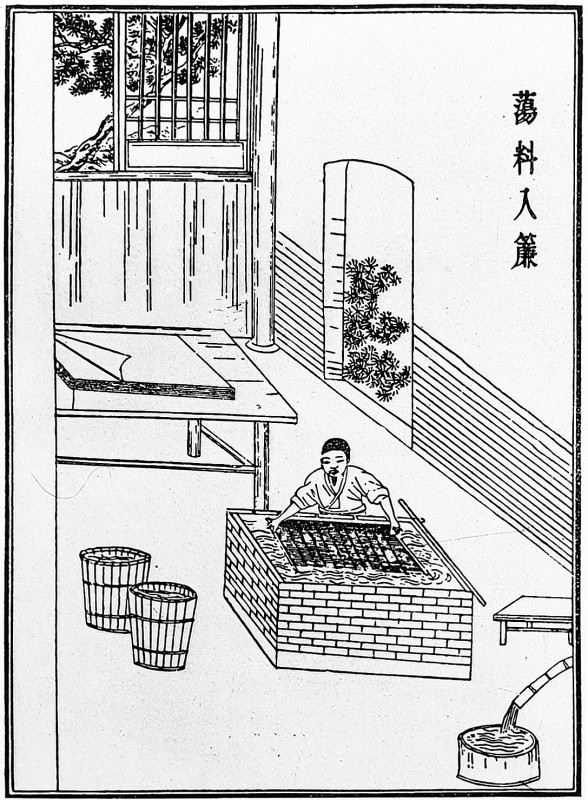
The Chinese court official Cai Lun is credited in the official history of the Han dynasty with presenting a method of making paper from tree bark, hemp, rags and fishing nets to the emperor in AD 105. Fragments of earlier paper have been found in China, so Cai Lun improved and standardised a process rather than inventing it from nothing, but his is the name the record kept. The woodcut shown here is from the Tiangong Kaiwu, a Chinese encyclopaedia of technology published in 1637, and shows the step that has not changed since: lifting a screen mould from a vat of pulp so that a sheet forms on it.
Paper travelled slowly. It reached the Islamic world by the eighth century, with paper mills in Samarkand and Baghdad, and Europe by the twelfth century through Spain, with Italian mills following in the thirteenth. Its importance is easy to underrate because it is so ordinary, but the printing press, the newspaper, paper money, the postal system and the office all needed a cheap, flat, plentiful surface, and papyrus and parchment were neither cheap nor plentiful.
5. Gunpowder (9th century)
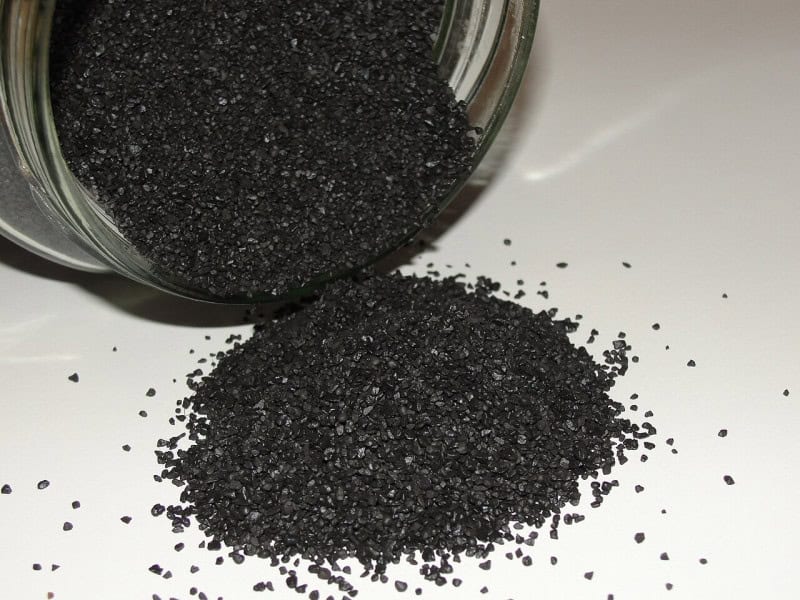
Gunpowder was found by Chinese alchemists looking for something else. A ninth-century Taoist text warns that mixing saltpetre, sulphur and charcoal had burned the hands and faces of experimenters and their house down, and the earliest written formulas for the mixture appear in the Wujing Zongyao, a Chinese military manual completed in 1044. Fire arrows, bombs and rockets followed in China over the next two centuries; guns that fired a projectile from a metal tube appear in China in the thirteenth century and in Europe in the early fourteenth. The photograph shows black powder, the same three-ingredient mixture, as it is still made.
Gunpowder ended the castle, the armoured knight and, eventually, the idea that a wall could keep an army out. It also gave Europe the guns that its ships carried around the world after the compass showed them the way, and for the better part of a thousand years it was the only explosive anyone had, until the nitrated explosives of the 1840s and after, the most famous of which, Alfred Nobel’s dynamite of 1867, has its own entry on our inventors page.
6. The magnetic compass (11th century)
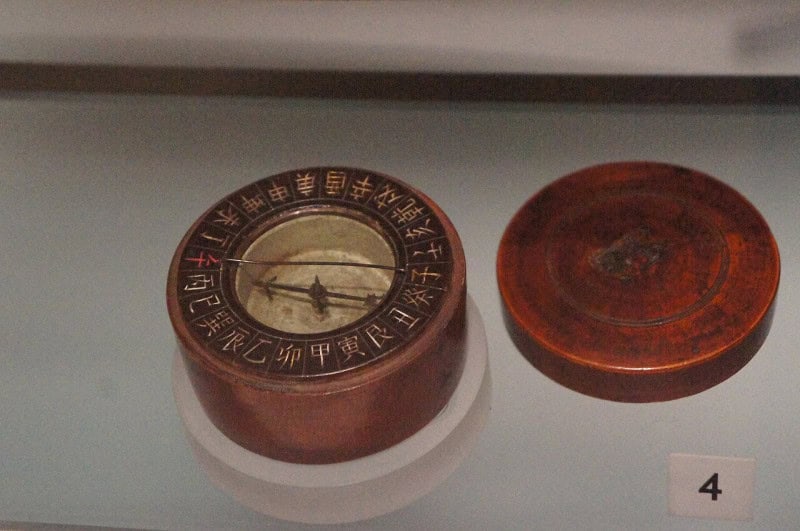
The first clear description of a magnetised needle used to find direction is Chinese: the scholar Shen Kuo, writing in his Dream Pool Essays of 1088, describes a needle rubbed with lodestone that points south, and Chinese texts of the early twelfth century describe its use aboard ships. Britannica dates the discovery by mariners in both China and Europe, apparently independently, to the twelfth century, which is when the compass appears in European sources too. The instrument in the photograph is a Chinese mariner’s compass of about 1760 in the National Maritime Museum in London, a dry needle in a lacquered wooden case.
Before the compass, ships hugged coasts or waited for clear skies. After it, they could hold a course out of sight of land, in fog and at night, and the open-ocean voyages of the fifteenth century, Chinese and European alike, were built on it. It is also the first instrument on this list that works by a force nobody could see, which makes it the ancestor of every dial and gauge that came after.
The medieval and early modern world
Five inventions from the thousand years in which Europe caught up with, and then overtook, the workshops of China and the Islamic world. The first two are about time and text; the last three are about seeing, moving and surviving.
7. The mechanical clock (late 13th century)
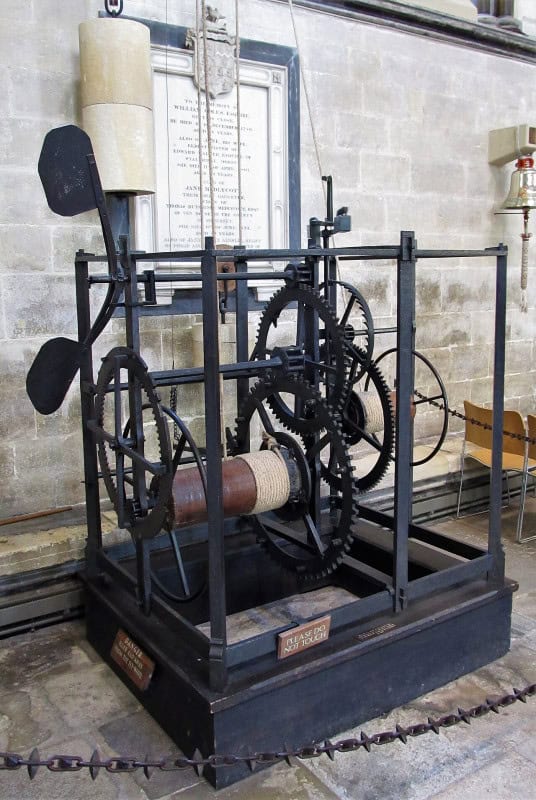
Water clocks and sundials are ancient, but the mechanical clock, driven by a falling weight and regulated by an escapement that lets the gear train advance one tooth at a time, is a European invention of the late thirteenth century. No one knows who built the first; the earliest records are payments in cathedral and monastery accounts in the 1280s and 1290s for clocks whose mechanism is not described. The oldest surviving examples date from the late fourteenth century, and the one in the photograph, in Salisbury Cathedral, is traditionally dated to 1386 and is usually described as the oldest working mechanical clock in the world. It has no face: it struck a bell.
The clock changed the shape of the day. Hours had been longer in summer than in winter, because they were fractions of daylight; a mechanical clock counts equal hours whatever the sun is doing, and from the fourteenth century towns, then workshops, then factories ran on them. Every later precision instrument, from the marine chronometer to the computer’s oscillator, descends from the idea that a machine can measure time better than the sky.
8. The printing press (about 1450)
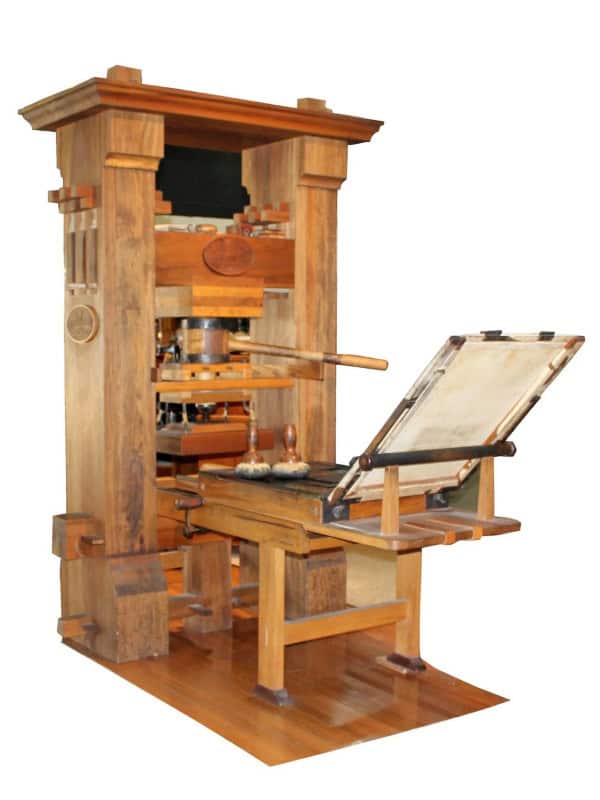
Johannes Gutenberg, a goldsmith from Mainz, put together three existing things in the 1440s and 1450s: a screw press adapted from the wine and paper trades, oil-based ink that would stick to metal, and the real invention, a hand mould for casting identical pieces of type in a lead alloy, quickly and in quantity. His 42-line Bible, finished in about 1455, is the first major book printed in Europe with movable type, and roughly 180 copies were made where a scribe would have produced one. Printing with movable type had been done in China and Korea centuries earlier, but with thousands of characters it never became cheap; with an alphabet of a few dozen letters, it did. The press in the photograph is a modern replica of the type.
By 1500, presses in some 250 European towns had printed millions of volumes, a figure historians of the book put at around twenty million. Cheap print made the Reformation, the scientific journal, the newspaper and mass literacy possible, and it turned the inventor from an anonymous craftsman into a name, which is why our famous inventors list starts with him.
9. The telescope (1608)
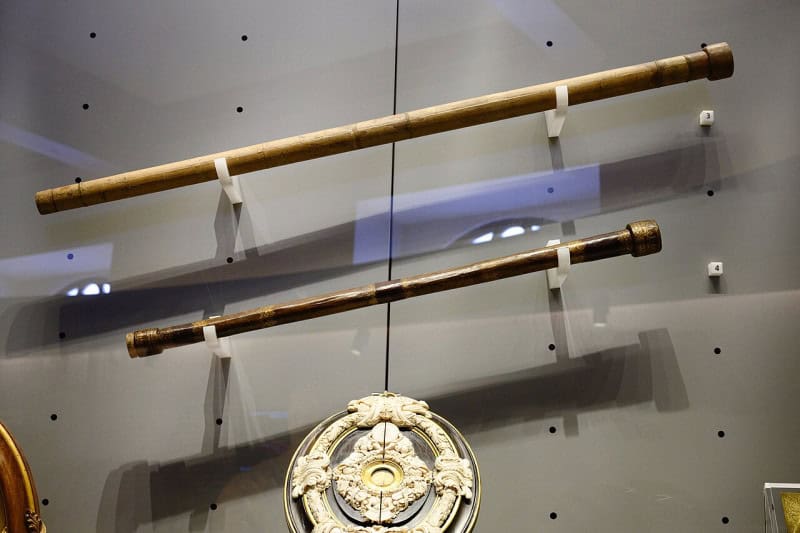
The telescope has a birthday. In October 1608 Hans Lipperhey, a spectacle-maker in Middelburg in the Netherlands, applied to the States General for a patent on an instrument “for seeing things far away as if they were nearby”; the patent was refused: another Dutchman, Jacob Metius, applied for one within weeks, and the States General decided the device was too easy to copy to be worth protecting, which tells you how simple the idea was once good lenses existed. Galileo heard of it the following year, built his own with a magnification of about twenty times, and in 1609 and 1610 turned it on the Moon, Jupiter and the Milky Way. The two telescopes in the photograph are his, in the Museo Galileo in Florence.
What Galileo saw, mountains on the Moon, four moons circling Jupiter, phases on Venus, ended the idea that the heavens were perfect and the Earth was the centre of everything, and started modern astronomy. The same optics, turned around, gave the microscope within a few decades, and the two instruments between them are the beginning of the modern habit of trusting a machine over the naked eye.
10. The steam engine (1712 and 1769)
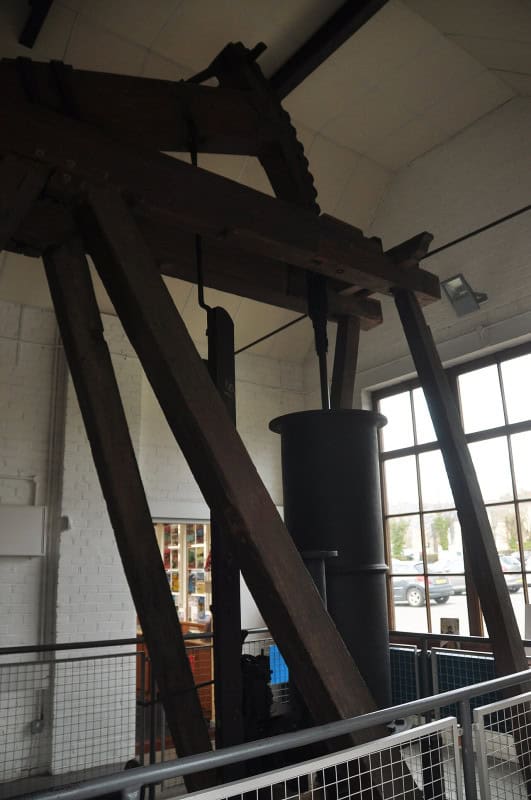
Thomas Newcomen’s atmospheric engine, first installed at a coal mine near Dudley in the English Midlands in 1712, was the first practical machine to turn heat into work: steam filled a cylinder, cold water condensed it, and air pressure pushed the piston down. It was enormous, thirsty and used only for pumping water out of mines, and it ran for sixty years before James Watt found the flaw. Watt’s separate condenser, patented in 1769, kept the cylinder hot and condensed the steam elsewhere, cutting the coal used by around three-quarters, and his later engines geared the rocking beam to a turning shaft so that it could drive machinery as well as pumps. The engine in the photograph is a Newcomen-type atmospheric engine built in about 1725 for a colliery near Nuneaton; it pumped water into the Coventry Canal until 1913, and in 1963 the Newcomen Society re-erected it at Dartmouth in Devon, where Newcomen was born. It is one of the oldest steam engines in existence.
The steam engine is the invention that made the Industrial Revolution mechanical: mills that had to stand beside rivers could stand anywhere there was coal, and within a generation steam was driving locomotives, ships and looms. Watt has his own entry on our inventors page; the locomotive is on the 19th-century list.
11. Vaccination (1796)
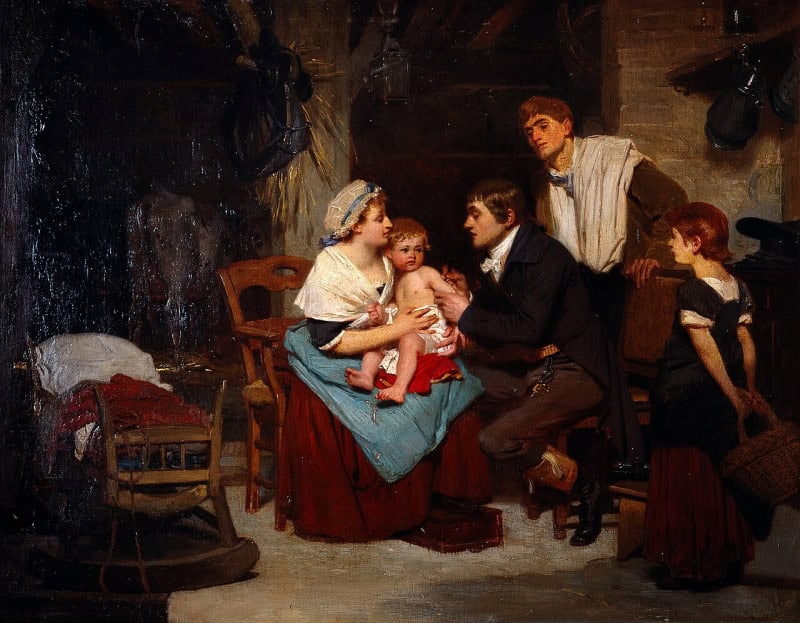
On 14 May 1796 Edward Jenner, a country doctor in Gloucestershire, scratched material from a milkmaid’s cowpox sore into the arm of an eight-year-old boy, James Phipps, and later showed that the boy could not be given smallpox. Inoculation with smallpox itself, a risky practice from Asia and Africa, had been used in Europe for decades; Jenner’s contribution was a safe disease that protected against a deadly one, and the word “vaccine” comes from the Latin for cow. He published in 1798, and the painting shown here, by the French painter Eugène-Ernest Hillemacher, shows the scene as a later century imagined it.
Smallpox killed an estimated 300 million people in the twentieth century alone before the World Health Organization declared it eradicated in 1980, the only human disease ever to be wiped out, and it was wiped out with Jenner’s method. Every vaccine since, including the last entry on this list, is a descendant of a milkmaid’s scratch, which is why this one belongs on a list of things that changed the world rather than on a list of medical firsts.
The age of steam and wire
Eight inventions from the century that built the modern world’s plumbing: electricity, instant communication, pictures, painless surgery, the engine and the wireless. Every one of them has a fuller entry on our list of the greatest inventions of the 19th century, and the links below go there.
12. The electric battery (1800)
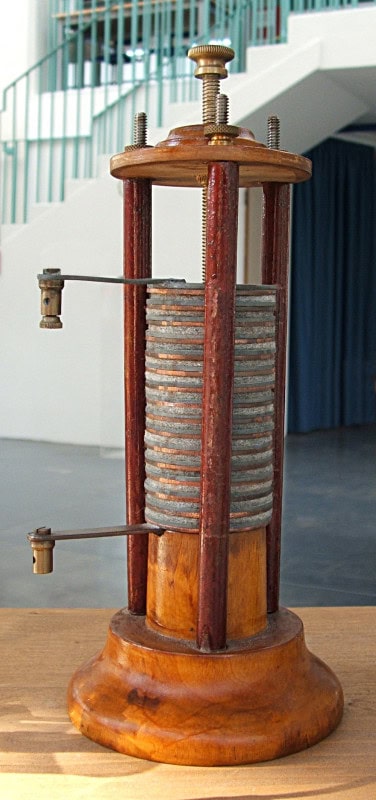
Alessandro Volta announced his pile in a letter to the Royal Society in London dated 20 March 1800: a stack of discs of zinc and silver or copper, separated by cloth soaked in brine, that produced a steady electric current for as long as the metals lasted. It was the first source of continuous electricity anyone had made, and within weeks of the letter two Englishmen had used one to split water into hydrogen and oxygen. The pile in the photograph is of the kind Volta built, a column of discs in a wooden frame. The volt is named after him.
Before Volta, electricity was a spark from a rubbed glass or a Leyden jar, gone in an instant. After him it was something you could keep on a bench and experiment with, and the electric telegraph, the electric motor, electroplating and the whole of electrochemistry followed within forty years. The battery is the first entry on our 19th-century inventions list, and Volta has his own entry among our famous inventors.
13. The electric telegraph (1837)
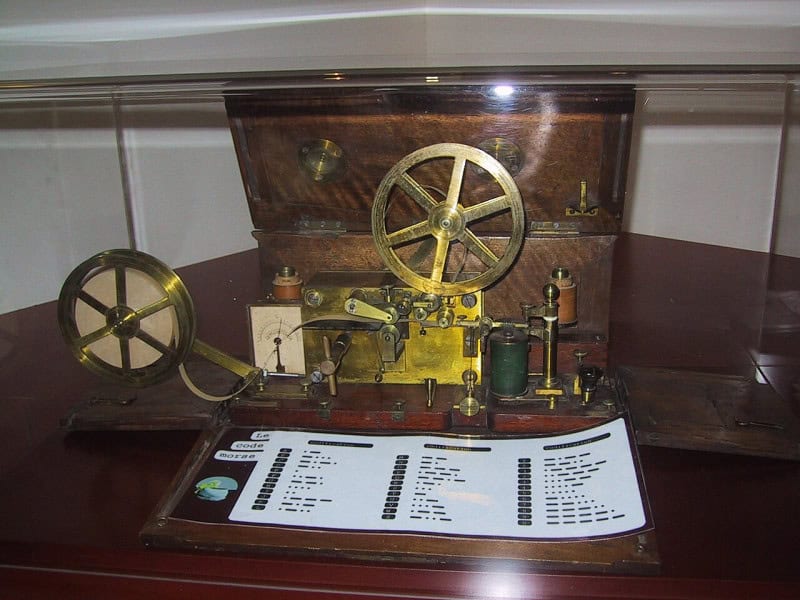
Two telegraphs arrived in 1837. In England, William Cooke and Charles Wheatstone patented a five-needle instrument and installed it on the London and Birmingham Railway; in New York, Samuel Morse demonstrated a single-wire machine that recorded dots and dashes on a moving paper tape, and the register in the photograph is a later production model of the same design. Morse’s advantage was the code, which needed one wire where Cooke and Wheatstone’s needed several, and on 24 May 1844 he sent “What hath God wrought” over a line from Washington to Baltimore that Congress had paid for. The first lasting transatlantic cable followed in 1866.
The telegraph is the first invention on this list that separated communication from transport. Before it, a message travelled as fast as a horse or a ship; after it, news, prices, train timetables and declarations of war moved at the speed of electricity, and the world’s time zones, its news agencies and its stock exchanges were organised around the wire. It is on our 19th-century list, and Morse is on the inventors page.
14. Photography (1839)
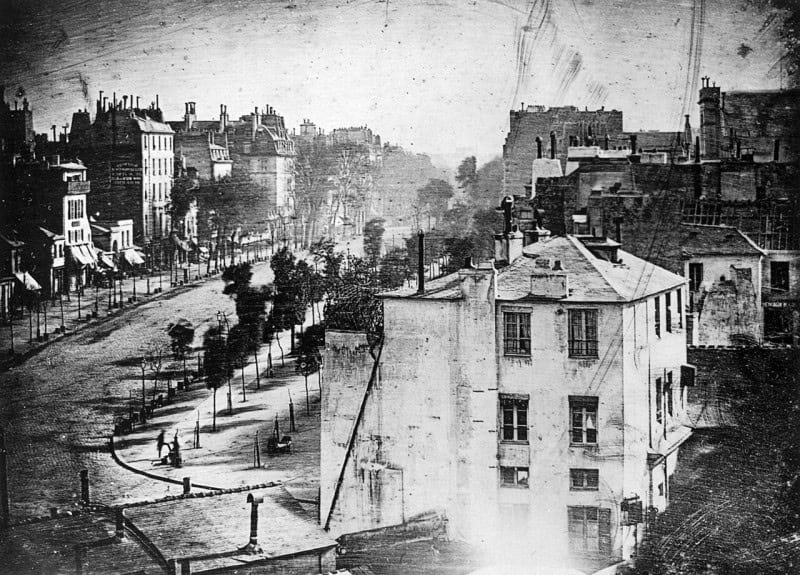
Nicéphore Niépce made the oldest surviving photograph from nature in about 1826 or 1827, a view from his window that needed an exposure of many hours. His partner Louis Daguerre carried on after Niépce’s death, and the daguerreotype, a sharp image on a silvered copper plate that needed minutes rather than hours, was announced to the French Academy of Sciences in January 1839 and its method published that August, free to the world except England, where Daguerre’s agent had taken out a patent a few days before. The photograph here is Daguerre’s own view of the Boulevard du Temple in Paris, taken in 1838: the street was full of traffic, but only a man having his boots polished stood still long enough to register, which makes him, probably, the first person ever photographed.
In the same year William Henry Fox Talbot in England announced a paper negative from which any number of prints could be made, and that, not the one-off daguerreotype, is the ancestor of every photograph since, including the ones on this page. Photography changed what evidence looked like, what a portrait cost and what people knew of places they would never visit. The fuller story is on our 19th-century list.
15. Anaesthesia (1846)
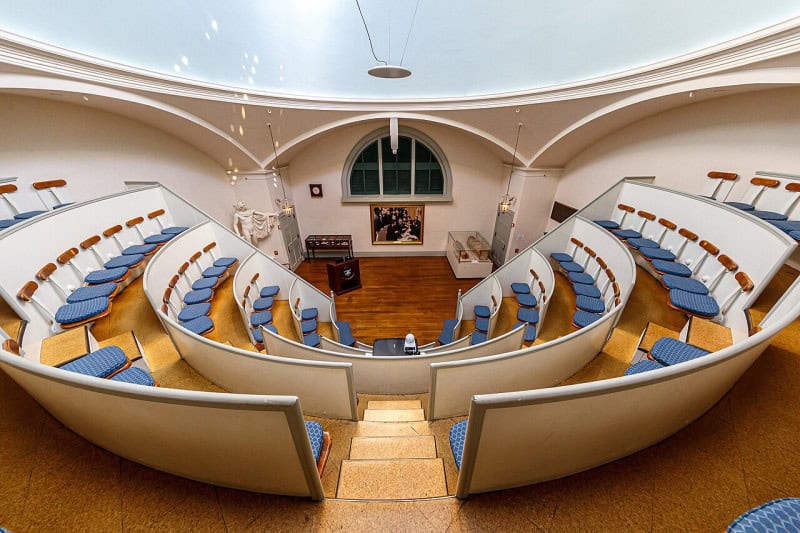
On 16 October 1846, in the operating theatre at Massachusetts General Hospital that has been called the Ether Dome ever since, a Boston dentist named William Morton put a patient to sleep with ether while the surgeon John Collins Warren removed a tumour from his neck. The patient felt nothing, and Warren is recorded as telling the audience, “Gentlemen, this is no humbug.” Others had used ether and nitrous oxide before, including Crawford Long in Georgia in 1842, but Morton’s public demonstration, reported within weeks in Europe, is the moment the practice spread. The photograph shows the theatre as it is today.
Before anaesthesia, surgery was a race against pain, and the best surgeons were the fastest. After it, operations could take hours, which made the abdomen, the chest and eventually the brain reachable, and together with antiseptic surgery twenty years later it turned an operation from a last resort into a treatment. Anaesthesia has its own entry on the 19th-century list.
16. The telephone (1876)
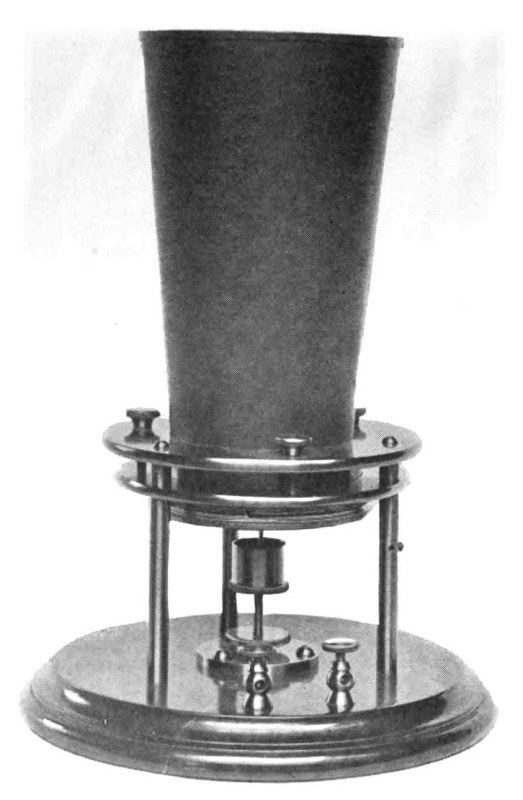
Alexander Graham Bell’s patent, number 174,465, was granted on 7 March 1876, and three days later, on 10 March, he spoke the first intelligible sentence over a wire to his assistant in the next room: “Mr Watson, come here, I want to see you.” The instrument in the photograph is a liquid transmitter of the kind he used, a device in which a needle attached to a diaphragm dipped into a cup of acidulated water, so that the voice varied the resistance of the circuit. Elisha Gray had filed a description of a similar device at the patent office on 14 February 1876, the day Bell’s application went in, and the dispute over who was first has never entirely closed; the box on disputed firsts below takes it up.
Within two years the first telephone exchange had opened in New Haven, and within a generation the telephone had done to conversation what the telegraph had done to the message. It is the nineteenth entry on our 19th-century list, and Bell has an entry on the inventors page.
17. The incandescent light bulb (1879)
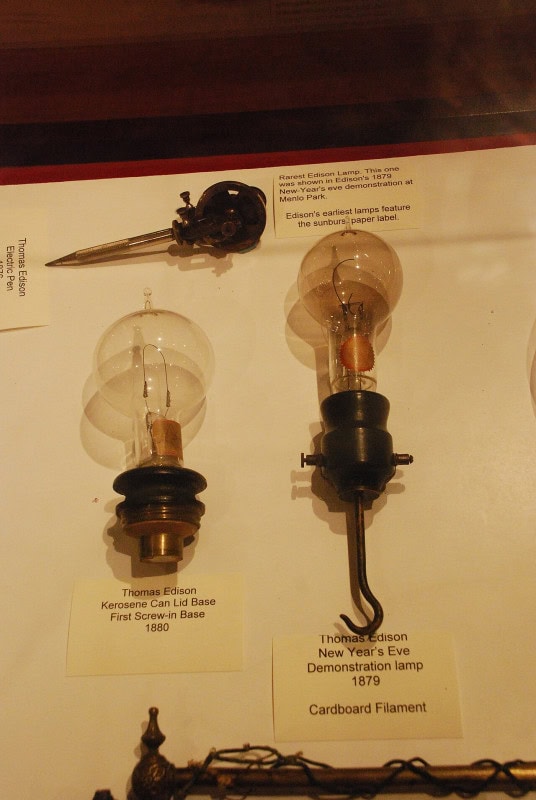
More than twenty people had made electric light from a glowing filament before Thomas Edison, and the one who came closest was Joseph Swan in Newcastle, who showed a carbon-filament lamp in 1878 and 1879. What Edison and his Menlo Park laboratory did in October 1879 was make a lamp that lasted: a carbonised cotton filament in a good vacuum that burned for more than thirteen hours, then filaments of carbonised bamboo that ran for over a thousand. His patent was granted in January 1880. The bulbs in the photograph are Edison lamps of 1879 and 1880.
The bulb alone would not have changed much. Edison’s real invention was the system around it: generators, wiring, meters, sockets and the Pearl Street station in Manhattan that lit the first customers in 1882. Electric light ended the working day’s dependence on the sun, made factories, streets and homes safe after dark, and created the demand that built the power grid every other twentieth-century invention plugs into. The bulb is on the 19th-century list, and Edison is on the inventors page.
18. The automobile (1886)
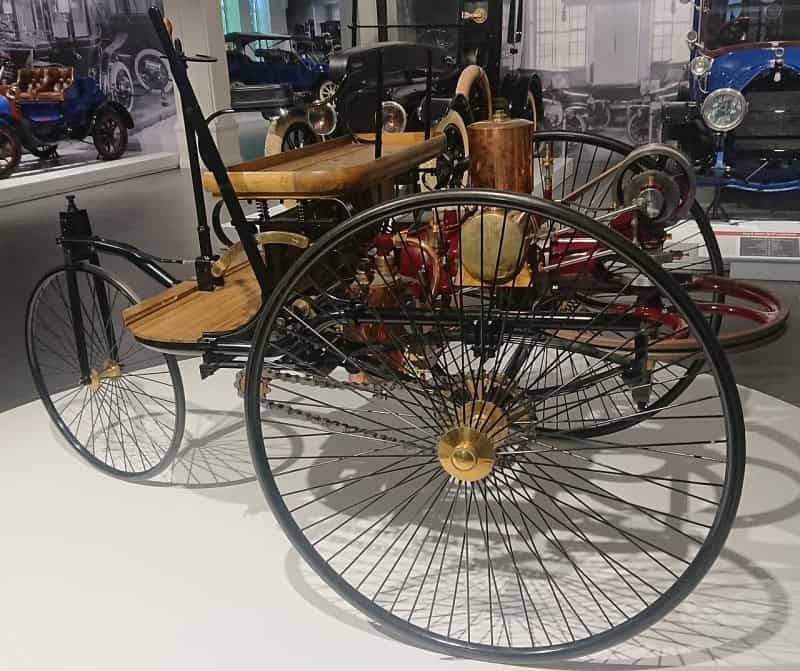
Karl Benz applied on 29 January 1886 for a German patent on a “vehicle powered by a gas engine”, number 37435, granted on 2 November that year, and the Patent-Motorwagen it describes, a three-wheeler with a single-cylinder four-stroke engine mounted at the back, is generally counted as the first automobile: a vehicle designed around its engine rather than a carriage with a motor bolted on. Gottlieb Daimler and Wilhelm Maybach built a four-wheeled motor carriage the same year, a few hours’ ride away. In August 1888 Benz’s wife Bertha drove the Motorwagen about 100 kilometres from Mannheim to Pforzheim without telling him, buying fuel at a pharmacy on the way, and the publicity sold the car. The one in the photograph is a replica of the Motorwagen in a museum.
The car remade the twentieth century’s cities, its countryside and its air, and it is the reason for the assembly line, the motorway, the suburb and the oil industry as we know it. Benz has an entry on our inventors page, and the automobile is on the 19th-century list.
19. Radio (1895)
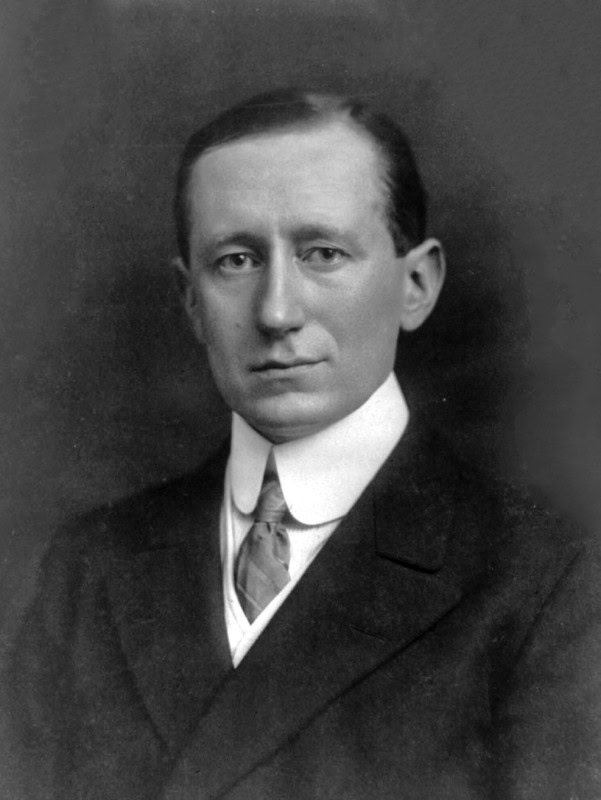
Heinrich Hertz proved in 1887 that the electromagnetic waves James Clerk Maxwell had predicted were real, and Guglielmo Marconi, a twenty-one-year-old experimenting on his father’s estate near Bologna in 1895, was the first to send them a useful distance and to think of them as a way to send messages without a wire. Refused support in Italy, he took the apparatus to England, applied for a patent there in 1896, and on 12 December 1901 reported receiving the letter S in Morse code at St John’s, Newfoundland, transmitted from Cornwall across the Atlantic; nobody outside his own party heard it and the claim has been questioned ever since, but a regular transatlantic service between Ireland and Nova Scotia was running by 1907. He shared the Nobel Prize in Physics in 1909. The photograph is a portrait of him from 1908.
Marconi’s radio was wireless telegraphy, dots and dashes between ships and shore; voice and music broadcasting came in the 1920s and turned it into the first mass medium that reached people who could not read. Radar, television, mobile phones and Wi-Fi all use the same physics. Radio is on our 19th-century list, and Marconi is on the inventors page.
The electric century
Eight inventions from the century that shrank the world and then wired it together. Seven of the eight have a fuller entry on our list of the greatest inventions of the 20th century (the pill is the exception and is here on its own account), and several of their inventors are on the famous inventors page.
20. The aeroplane (1903)
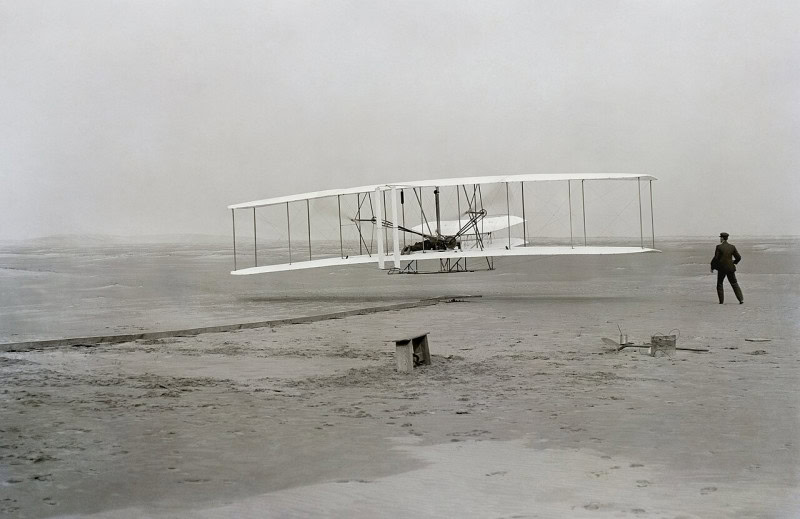
At 10:35 on the morning of 17 December 1903, on the sand at Kill Devil Hills near Kitty Hawk, North Carolina, Orville Wright flew the Wright Flyer for twelve seconds and about 120 feet, the first sustained, controlled flight of a powered, heavier-than-air machine with a person aboard. The photograph, taken by John Daniels of the local lifesaving station with Orville’s camera, shows the moment of take-off with Wilbur running alongside; the brothers made three more flights that day, the longest 59 seconds. What they had solved, after three years of gliders and a home-built wind tunnel, was not lift or power but control: the wing-warping and rudder that let a pilot steer in three axes.
Within fifteen years aircraft were crossing the Channel, fighting a war and carrying mail; within fifty they were carrying the public across oceans. It is the first entry on our 20th-century inventions list, and the Wrights are on the inventors page.
21. Television (1926)
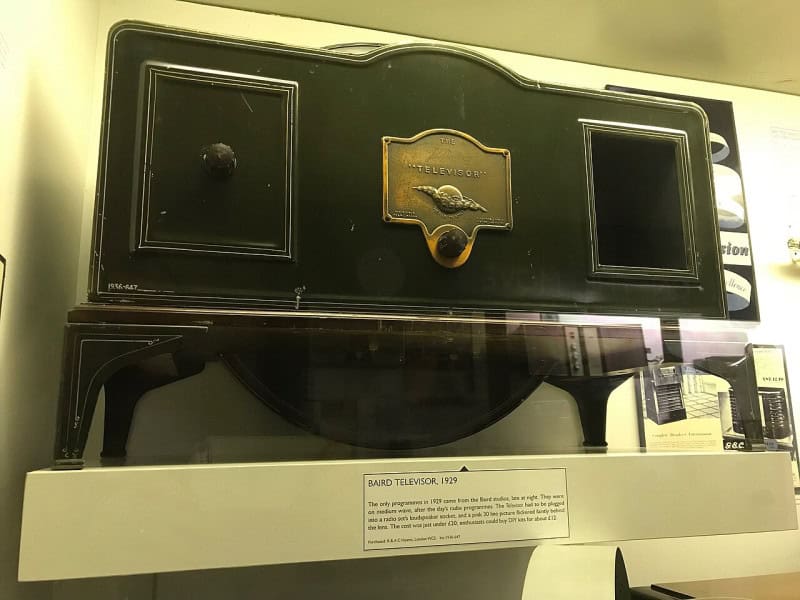
John Logie Baird gave the first public demonstration of true television, moving images with tone and shading rather than silhouettes, to members of the Royal Institution in his Soho attic on 26 January 1926, using a mechanical system built around spinning discs. Philo Farnsworth transmitted the first all-electronic television image in San Francisco on 7 September 1927, and it was his kind, with no moving parts, that won. The set in the photograph is a Baird Televisor of 1929, sold to the public for the BBC’s experimental broadcasts, with a viewing window a few centimetres across.
Regular broadcasting began in the 1930s and mass ownership after the Second World War, and for the rest of the century television was where most people got their news, their politics and their evenings. Television is on our 20th-century list; Farnsworth has an entry on the inventors page.
22. Penicillin (1928)
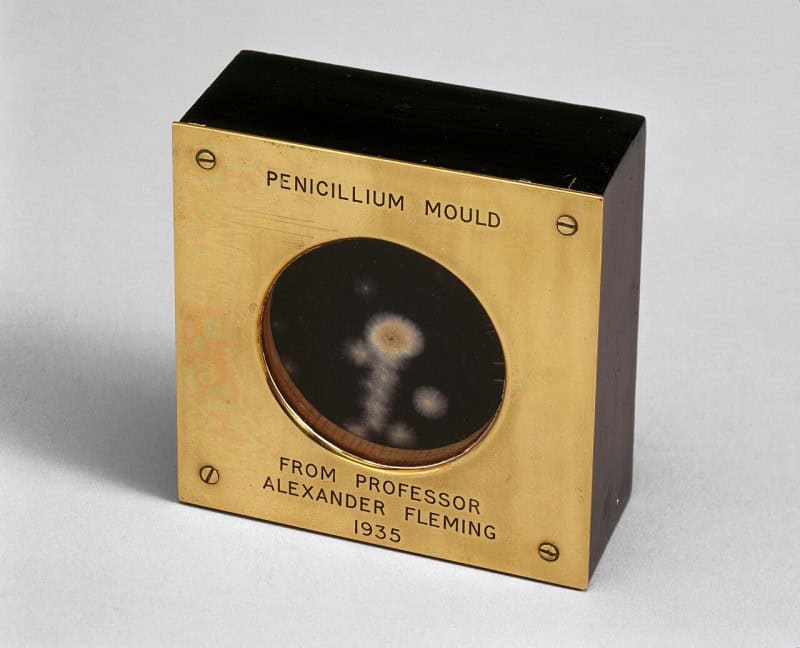
In September 1928 Alexander Fleming, back from holiday at St Mary’s Hospital in London, noticed that a mould contaminating one of his culture plates had killed the staphylococci around it. He named the substance penicillin, published in 1929, and could not purify it. That took Howard Florey, Ernst Chain and Norman Heatley at Oxford in 1940 and 1941, who treated the first patient in February 1941, and then American industrial chemists who worked out how to make it by the ton in time for D-Day. Fleming, Florey and Chain shared the Nobel Prize in 1945. The photograph shows a sample of the mould that Fleming himself mounted and gave away in 1935.
Penicillin was the first antibiotic, and it turned bacterial infections that routinely killed, from pneumonia to an infected cut, into things a course of tablets cured. Penicillin is on our 20th-century list; Fleming is on the inventors page.
23. The transistor (1947)
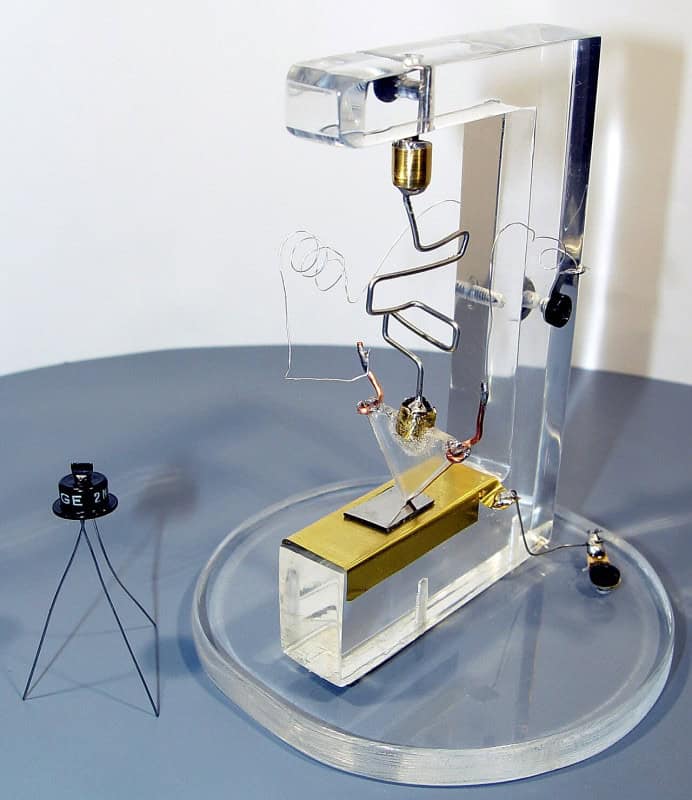
On 16 December 1947 John Bardeen and Walter Brattain, working under William Shockley at Bell Laboratories in New Jersey, made a device from a slab of germanium, a plastic wedge and two strips of gold foil that amplified an electrical signal, and demonstrated it to the laboratory’s managers a week later. It was the first transistor. Shockley’s junction transistor of 1948 was the practical version, and the three shared the Nobel Prize in Physics in 1956. The object in the photograph is a replica of the original point-contact device.
The transistor does what a vacuum tube did, switching and amplifying, in a speck of solid material that does not heat up, wear out or break. Every computer, phone, radio and screen since is made of them, and the integrated circuit, next on this list, is what happened when engineers learned to make them smaller and put them together. There is a longer entry on our 20th-century list.
24. The integrated circuit (1958)
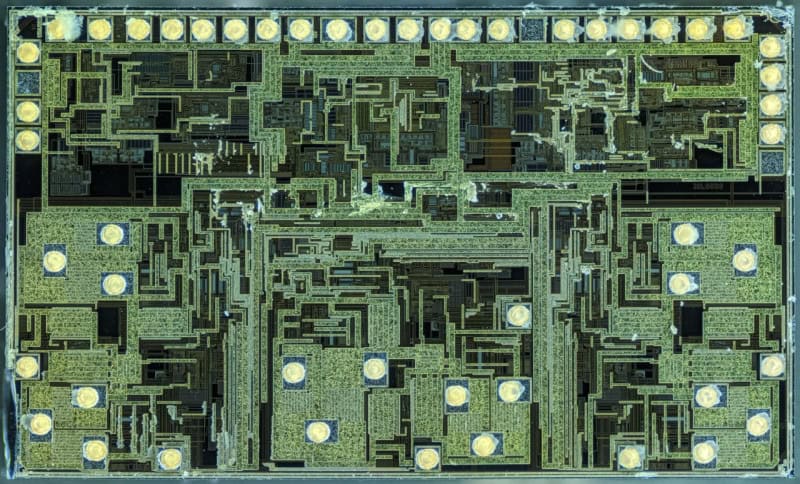
Jack Kilby, a new employee at Texas Instruments who had not yet earned holiday leave, spent the summer of 1958 alone in the laboratory and on 12 September demonstrated a circuit in which all the components, transistor, resistors and capacitor, were made from one piece of germanium. Robert Noyce at Fairchild Semiconductor independently designed a more practical version in silicon a few months later, with the connections laid down as a metal film rather than wired by hand, and the two are jointly credited. Kilby received the Nobel Prize in Physics in 2000; Noyce had died in 1990. The photograph is a magnified die of a modern chip, the descendant of both.
A chip is a circuit that can be printed rather than assembled, which means it can be made by the million, and made smaller every year. Gordon Moore’s 1965 observation that the number of components on a chip doubled roughly every year, later every two, held for half a century and is the reason the personal computer and the smartphone below exist. Kilby and Noyce’s chip is on our 20th-century list.
25. The contraceptive pill (1960)
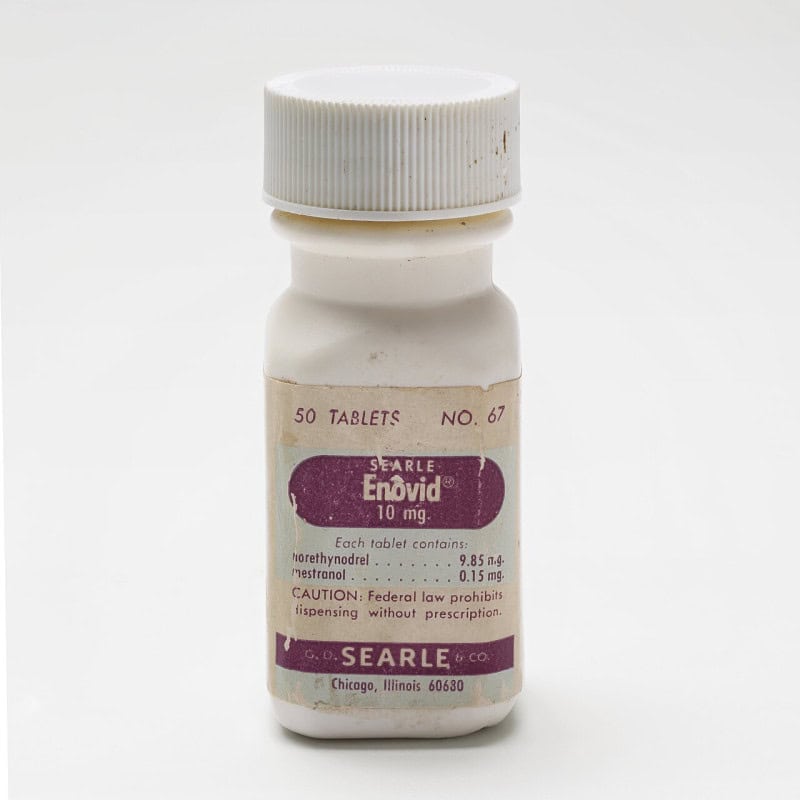
The oral contraceptive was the work of a small group: the biologist Gregory Pincus and the physician John Rock, who ran the trials; the chemists Frank Colton at Searle, who made the progestin in Enovid, and Carl Djerassi at Syntex, who had synthesised a rival one; and the two women who paid for it, the birth-control campaigner Margaret Sanger and the philanthropist Katharine McCormick. Enovid, made by G. D. Searle and the product in the photograph, had been approved in 1957 for menstrual disorders; the United States Food and Drug Administration approved it as a contraceptive in 1960, and within five years millions of American women were taking it.
The pill separated sex from pregnancy for the first time in a reliable, reversible way that a woman controlled herself, and the changes that followed in education, work, marriage and family size were as large as any on this list. It is the one entry here that is a medicine rather than a machine, and it is here because of what it did to the world outside the pharmacy.
26. The internet (1969 and 1989)
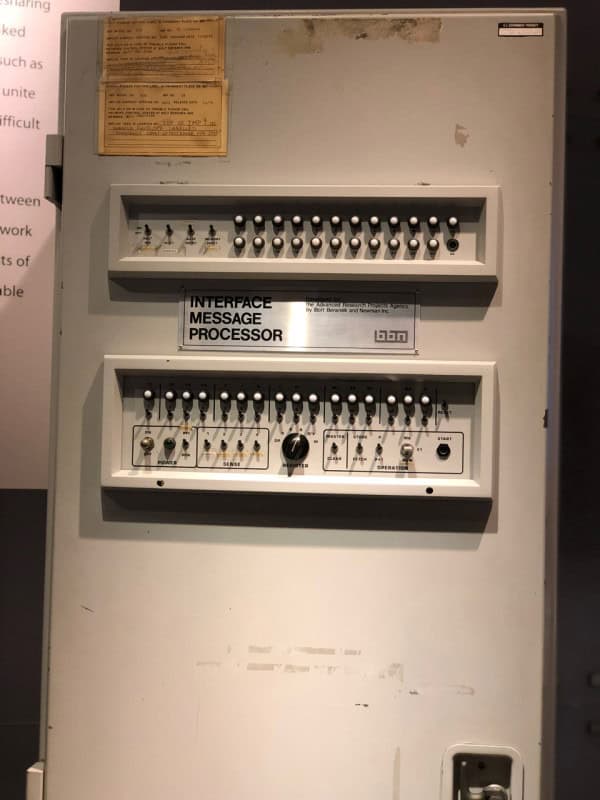
The internet has two birthdays. On 29 October 1969 a computer at the University of California, Los Angeles sent the first message over ARPANET to one at the Stanford Research Institute; the system crashed after two letters of the word “login”. The machines that did the routing were Interface Message Processors built by Bolt Beranek and Newman, and one of them is in the photograph. ARPANET grew into a network of networks, and on 1 January 1983 it switched to the TCP/IP protocols, designed by Vint Cerf and Bob Kahn, that still carry every packet. The second birthday is March 1989, when Tim Berners-Lee at CERN proposed the system of pages and links that became the World Wide Web; he released it to the public in 1991.
Nothing on this list has spread faster or changed more. The internet absorbed the telegraph, the telephone, the post, the newspaper, the record shop and the library, and the smartphone below is the device that put it in most human hands. ARPANET is on our 20th-century list, and Berners-Lee is the last entry on the inventors page.
27. The personal computer (1975 to 1981)
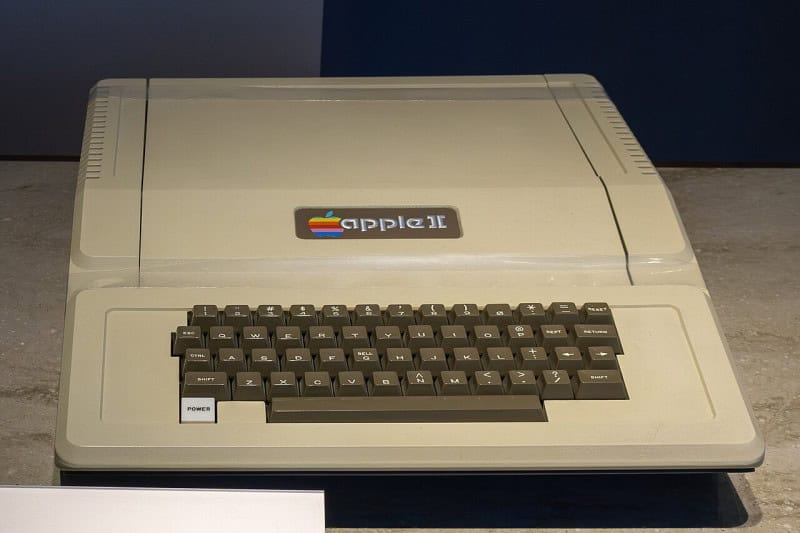
Nobody invented the personal computer on a single day. The MITS Altair 8800, sold as a kit from January 1975, is usually counted as the first, a box with switches and lights that a hobbyist programmed by hand and for which a young Bill Gates and Paul Allen wrote their first product. The Apple II of 1977, in the photograph, was the first that a family could take out of a box, plug into a television and use, with a keyboard, colour graphics and a spreadsheet that gave businesses a reason to buy it. IBM’s Personal Computer of August 1981 made the machine respectable and set the standard most of the world still runs.
The personal computer put the machine that had filled a room at a university onto a desk in a bedroom, and then, with the smartphone below, into a pocket. The longer entry is on our 20th-century list.
The century so far
Three inventions from a century that is only a quarter over, each with a fuller entry on our list of the greatest inventions of the 21st century. Two of the three are biology, which is a fair guess at where the next thirty will come from.
28. The smartphone (2007)
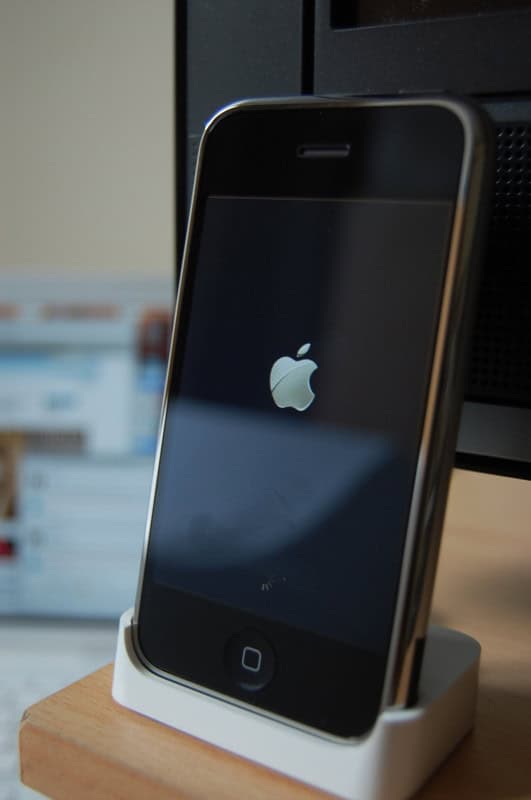
Phones that could browse the web, take pictures and run programs existed before 2007: IBM’s Simon of 1994 had a touchscreen, and BlackBerry and Nokia devices had put email in millions of pockets. What Apple showed on 9 January 2007 and sold from 29 June was a phone whose whole face was a screen, worked by fingers rather than a stylus or keys, running a real browser, and the App Store that followed in 2008 turned it into a general-purpose computer. Google’s Android, announced the same year and on sale from 2008, put the same idea on every other manufacturer’s hardware. The device in the photograph is an original iPhone in its dock.
By the early 2020s more than half the people on Earth carried one, and for most of them it is the only computer, camera, map, bank and newspaper they own. The smartphone is on our 21st-century inventions list.
29. CRISPR gene editing (2012)

CRISPR is a bacterial immune system, a way bacteria keep snippets of viral DNA and use them to recognise and cut the virus next time. In a paper published in Science in June 2012, Jennifer Doudna and Emmanuelle Charpentier and their colleagues showed that the Cas9 enzyme could be programmed with a short piece of guide RNA to cut any DNA sequence chosen, which made it a tool for editing genes cheaply and precisely in any organism. The two shared the Nobel Prize in Chemistry in 2020. The picture is a molecular model of Cas9 holding its guide RNA and a strand of DNA.
In November and December 2023 the first CRISPR-based medicine, a treatment for sickle cell disease, was approved in the United Kingdom and then the United States, and CRISPR-edited crops, livestock and laboratory organisms are now routine. It is the second entry on our 21st-century list.
30. mRNA vaccines (2020)
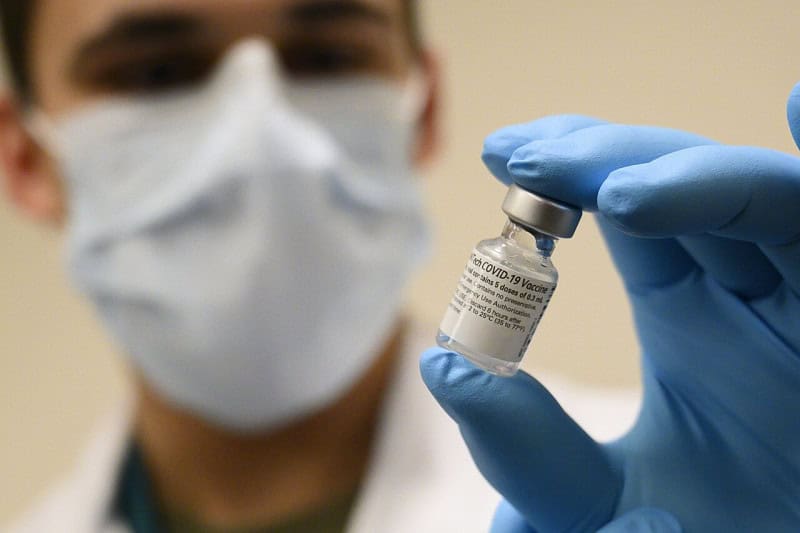
Messenger RNA is the molecule a cell uses as a working copy of a gene; an mRNA vaccine hands the cell the instructions for one viral protein and lets the immune system learn from what the cell makes. The idea is decades old, and the discovery that made it usable was Katalin Karikó and Drew Weissman’s finding, published in 2005, that modifying one of the RNA’s building blocks stopped the immune system from destroying the molecule on sight; they shared the Nobel Prize in Physiology or Medicine in 2023. When the genome of the new coronavirus was published in January 2020, a vaccine was designed within days, and the Pfizer-BioNTech vaccine in the photograph received emergency authorisation in the United Kingdom on 2 December 2020 and in the United States on 11 December.
A vaccine that took a year from a sequence to an arm, where the previous record had been about four years, is the change; the platform can be pointed at other diseases by changing the sequence. The vaccine is on our 21st-century list, and it closes a line that began on this page with a milkmaid, a cow and a boy in Gloucestershire.
Disputed firsts
Four of the entries above carry an argument that will not go away, and the honest answer in each case is that “inventor” means different things. The telephone: Bell’s application was filed on 14 February 1876, the day Elisha Gray filed a caveat for a similar device, and Bell’s patent was granted on 7 March; Antonio Meucci had demonstrated a voice-transmitting apparatus in the 1850s and 1860s and was recognised by a resolution of the United States House of Representatives in 2002. The light bulb: Joseph Swan showed a working carbon-filament lamp in Newcastle in 1878 and 1879 and Edison patented his in 1880; the two ended up as partners in the Edison and Swan United Electric Light Company, which is as good a verdict as any. The telegraph: Cooke and Wheatstone’s needle telegraph went into commercial service in England in 1837, the year Morse demonstrated his in New York; what Morse added was the code and the long line. And television: Baird demonstrated a mechanical, spinning-disc system in London in January 1926; Farnsworth transmitted an all-electronic image in San Francisco in September 1927, and every television since is Farnsworth’s kind. The pattern in all four is the same: the first person to make it work is rarely the first person to make it matter.
Sources
Berna, F. et al., “Microstratigraphic evidence of in situ fire in the Acheulean strata of Wonderwerk Cave”, Proceedings of the National Academy of Sciences, 2012 (fire at about one million years). Wrangham, R., Catching Fire: How Cooking Made Us Human, 2009 (the cooking hypothesis). City Museum of Ljubljana, the Ljubljana Marshes wheel (found 2002; about 5,150 years old; ash disc and oak axle; about 72 centimetres). British Museum and Penn Museum, cuneiform collections (Uruk, about 3200 BC; the earliest tablets as administrative records). Hou Hanshu (Book of the Later Han), biography of Cai Lun (AD 105); Song Yingxing, Tiangong Kaiwu, 1637. Shen Kuo, Mengxi Bitan (Dream Pool Essays), 1088; Encyclopaedia Britannica, “compass” (the twelfth-century discovery by mariners in China and Europe). Wujing Zongyao, 1044 (the earliest written gunpowder formulas); Needham, J., Science and Civilisation in China, vol. 5 part 7 (the ninth-century Taoist warning; Chinese guns of the thirteenth century). Salisbury Cathedral, the medieval clock (traditionally dated 1386). Gutenberg Museum, Mainz, and the British Library, the 42-line Bible (about 1455; about 180 copies); Febvre, L. and Martin, H.-J., The Coming of the Book (about twenty million volumes by 1500). Museo Galileo, Florence, Galileo’s telescopes; the States General of the Netherlands, Lipperhey’s patent application of October 1608 and Jacob Metius’s rival application. Science Museum Group, Newcomen’s engine of 1712 and Watt’s separate condenser patent of 1769; The Newcomen Society, the Newcomen Memorial Engine at Dartmouth (built about 1725; pumped for the Coventry Canal until 1913; re-erected at Dartmouth in 1963). Jenner, E., An Inquiry into the Causes and Effects of the Variolae Vaccinae, 1798 (James Phipps, 14 May 1796); World Health Organization, smallpox eradication (declared 1980; about 300 million deaths in the twentieth century). Volta, A., letter to Sir Joseph Banks, 20 March 1800, Philosophical Transactions of the Royal Society. Académie des Sciences, 7 January and 19 August 1839 (the daguerreotype); Fox Talbot’s announcement to the Royal Society, January 1839; Daguerre’s English patent of 14 August 1839. Library of Congress, Samuel Morse papers (“What hath God wrought”, 24 May 1844); Cooke and Wheatstone’s patent of 1837. Massachusetts General Hospital, the Ether Dome and the operation of 16 October 1846. United States Patent 174,465, 7 March 1876 (Bell); Bell’s laboratory notebook, 10 March 1876; Resolution 269 of the United States House of Representatives, 2002 (Meucci). Edison’s patent 223,898, 27 January 1880; the Menlo Park test of October 1879 (Thomas Edison National Historical Park); Pearl Street station, September 1882. Deutsches Reichspatent (DRP) 37435 (Benz), applied for 29 January 1886, granted 2 November 1886; Mercedes-Benz archive, Bertha Benz’s journey of August 1888. Nobel Prize in Physics 1909 (Marconi and Braun); Marconi’s reported transatlantic signal of 12 December 1901 (Science Museum Group; the reception was not independently witnessed); the Clifden to Glace Bay service of 1907. Smithsonian National Air and Space Museum, the Wright Flyer (17 December 1903; four flights, 12 to 59 seconds). Royal Institution, Baird’s demonstration of 26 January 1926; Farnsworth’s transmission of 7 September 1927. Nobel Prize in Physiology or Medicine 1945 (Fleming, Florey, Chain); Fleming, A., British Journal of Experimental Pathology, 1929; the Oxford treatment of February 1941. Nobel Prize in Physics 1956 (Shockley, Bardeen, Brattain); Bell Laboratories, 16 and 23 December 1947. United States Food and Drug Administration, Enovid approvals of 1957 and 1960; Searle, Frank Colton’s norethynodrel (1952); Syntex, Carl Djerassi’s norethindrone (1951); Planned Parenthood Federation of America, history of the pill. Nobel Prize in Physics 2000 (Kilby); Texas Instruments, 12 September 1958; Moore, G., Electronics, 1965. Computer History Museum, the Altair 8800 (1975), the Apple II (1977) and the IBM Personal Computer (August 1981). UCLA and SRI, the first ARPANET message of 29 October 1969; the TCP/IP transition of 1 January 1983; Berners-Lee, T., “Information Management: A Proposal”, CERN, March 1989. Apple, the iPhone announcement of 9 January 2007 and release of 29 June 2007; Google, Android’s announcement of 2007; GSMA, The State of Mobile Internet Connectivity 2023 (smartphone ownership past half the world’s population). Jinek, M. et al., Science, June 2012; Nobel Prize in Chemistry 2020 (Charpentier and Doudna); MHRA and FDA approvals of the first CRISPR medicine, November and December 2023. Karikó, K. and Weissman, D., Immunity, 2005; Nobel Prize in Physiology or Medicine 2023; MHRA authorisation of 2 December 2020 and FDA emergency use authorisation of 11 December 2020 for the Pfizer-BioNTech vaccine.
Image credits
Images are public domain, CC0 or Creative Commons licensed, via Wikimedia Commons, and every file page was checked for its licence before use. Attribution where the licence requires it: campfire, Marc Lautenbacher (CC BY-SA 4.0). Ljubljana Marshes wheel, Petar Milošević (CC BY-SA 4.0). Chinese mariner’s compass, Victoria C (CC BY-SA 4.0). Black powder, Lord Mountbatten (CC BY-SA 3.0). Salisbury Cathedral clock, Rwendland (CC BY-SA 3.0). Galileo’s telescopes, Zde (CC BY-SA 4.0). Newcomen Memorial Engine, Nilfanion (CC BY-SA 4.0). Edward Jenner vaccinating a boy, Wellcome Collection (CC BY 4.0). Voltaic pile, Luigi Chiesa (CC BY-SA 3.0). Morse telegraph register, Zubro (CC BY-SA 3.0). Ether Dome, Kenneth C. Zirkel (CC BY-SA 4.0). Edison light bulbs, HumanisticRationale at English Wikipedia (CC BY 3.0). Benz Patent-Motorwagen, Stas Kozlovskiy (CC BY-SA 4.0). Baird Televisor, Matt Brown (CC BY 2.0). Penicillin mould sample, Science Museum London / Science and Society Picture Library (CC BY-SA 4.0). Replica of the first transistor, Mister rf (CC BY-SA 4.0). Enovid bottle, G. D. Searle & Co., via the Digital Public Library of America (CC BY 4.0). Integrated circuit die, cole8888 (CC BY-SA 2.0). Apple II, The wub (CC BY-SA 4.0). Interface Message Processor, ArnoldReinhold (CC BY 4.0). Original iPhone, Andrew from London (CC BY-SA 2.0). Cas9 structure, Elena I. Leonova (CC BY 4.0). The cuneiform tablet (Gary Todd) and the Gutenberg press replica (International Printing Museum) are CC0. The papermaking woodcut, the Boulevard du Temple daguerreotype, Bell’s liquid transmitter, the Marconi portrait (Pach Brothers, 1908), the Wright Flyer photograph (John T. Daniels, 1903) and the vaccine vial (United States Department of Defense) are public domain.