

A VHS to digital converter does one narrow thing: it takes the analogue video and audio coming out of a VCR, a camcorder or an old games console and turns it into a file. What it cannot do is play the tape. Every converter on this page, from the cheapest USB dongle to the recorder with the five-inch screen, needs a working VCR or camcorder plugged into it, and the honest first line of any guide to these devices is that no company has built a new VCR since 2016, so the machine you need is already in your attic, at a thrift store, or in a listing marked “renewed”. If you do not have one and do not want to hunt for one, skip to the section on mail-in services; the converters are not for you.
With a VCR in hand, the choice is between two kinds of device. A standalone recorder has a screen, a slot for a USB stick or memory card, and no need of a computer: you plug the VCR into it, press record, press play on the VCR, and two hours later there is an MP4 on the stick. A USB capture device is a cable with a chip in it: it plugs the VCR into a laptop, and free software on the laptop does the recording. The standalone units cost roughly six to fifteen times what the cheapest capture dongles do, and what the money buys is the absence of a computer, a preview screen and, on the better ones, a remote and an auto-stop timer. Both kinds work in real time, so a two-hour tape takes two hours either way.
Ten picks, checked live on the day of writing: six standalone recorders and four USB capture devices, with the price and stock under each heading coming from Amazon’s own data rather than from this text. Then the accessories that most tape jobs turn out to need, a buyer’s guide that explains what “1080p” means on a device fed by a 1980s tape, and the question of whether to do this at all or post the box to a service. The tapes are rarely the only format in the cupboard; the cassette players with USB output on this site do the same job for audio tapes, and the portable DVD players are where the discs you burned in 2006 can still be watched.
Disclosure: As an Amazon Associate I earn from qualifying purchases. Product links in this guide are affiliate links.
The ten at a glance
“Computer needed” is the dividing line. The resolution column is the figure each listing claims for its recordings, which the buyer’s guide explains is mostly a statement about the file, not the picture; the two ClearClick recorders are the only ones that say so themselves.
| Pick | Best for | Computer needed | Screen (listed) | Recording resolution the listing claims | Price | Stock | |
|---|---|---|---|---|---|---|---|
 | 1. Portta VD10 VHS to Digital Converter | The standalone recorder most people buy | No | 3.0 inch | Up to 1080P at 30 Hz | $119.99 | In stock |
 | 2. Portta VD20P with 5-inch Screen | The one with the big screen and 60 fps | No | 5 inch | 1080p at 60 fps | $179.99 | In stock |
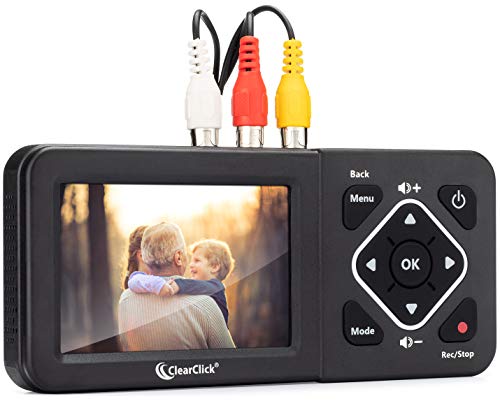 | 3. ClearClick Video to Digital Converter 2.0 | The honest one, from a US small business | No | 3.5 inch | 640x480 or 720x480; the listing says it does not upscale to HD | $129.95 | In stock |
 | 4. ClearClick Video to Digital Converter 3.0 | The one that also records cassettes and records | No | 5 inch | 720x480 or 640x480 | $189.95 | In stock |
 | 5. Lvrzng 4-inch VHS to Digital Converter | The cheapest standalone with a screen | No | 4 inch | Up to 1080P | $99.79 | In stock |
 | 6. DigitPro V121 HD Video to Digital Recorder | The standalone with the most recording modes | No | 4 inch | Up to 1080P at 30 Hz | $98.79 | In stock |
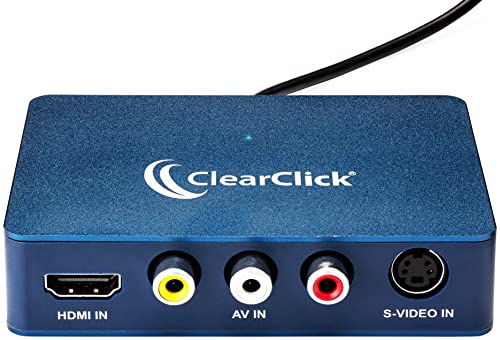 | 7. ClearClick Video to USB 1080P Capture Device | The USB capture device that also takes HDMI | Yes | None | Up to 1080P; the listing says it upscales analogue sources | $69.95 | In stock |
 | 8. Diamond Multimedia VC500 | The USB capture device with the longest track record | Yes | None | 720x480 NTSC or 720x576 PAL (product photographs) | $39.99 | In stock |
 | 9. VIXLW USB Video Capture Card | The cheapest way in | Yes | None | 720P | $12.99 | In stock |
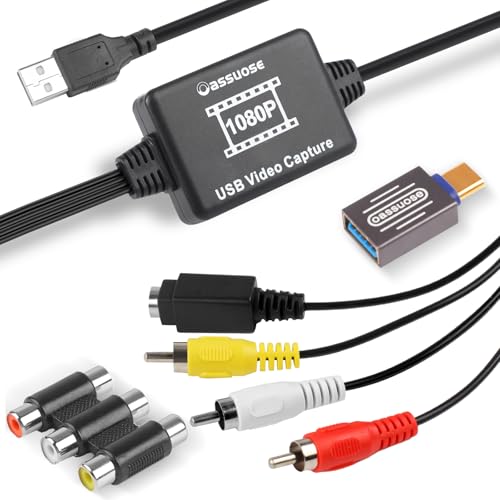 | 10. Oassuose USB-A/USB-C 1080P Capture Card | The cheap USB-C option | Yes | None | 1080P at 30 fps | $16.99 | In stock |
Prices and availability as of 16:08 EDT — details
Standalone recorders: no computer needed
1. Portta VD10 VHS to Digital Converter
The Portta VD10 carries the biggest past-month sales badge of the six standalone recorders here, and its listing reads like a spec sheet rather than a sales pitch, which for this category is a compliment. It records to MP4 at up to 1080P and 30 Hz, takes composite video (the yellow RCA plug, which Portta calls CVBS) with left and right audio, S-Video, and an auxiliary audio input, and needs no PC and no software: plug in, press record. A three-inch preview screen and a built-in speaker let you see and hear what is going onto the card, and recordings play back on the unit itself. It stores to a USB drive or a TF (microSD) card, neither included, with what the listing calls no capacity limitation; audio can be recorded on its own as MP3, and the listing quotes an audio sampling rate of up to 48 kHz with two-channel LPCM output.
The listing’s title ends by saying the VHS, the tapes and the DVD player are not included, its first bullet says the box cannot play tapes or discs by itself, and its what-you-get bullet repeats that the players are not included, which is the right thing for a listing to shout. It supports the NTSC and PAL standards (the North American and European tape formats), ships with a power adapter on a USB A-to-C cable, an AV cable, a 3.5 mm audio cable and a remote that takes two AAA batteries (not included), weighs six and a half ounces, and carries a two-year warranty in its details table. If you want a recorder that does the job without a decision to make, this is the one; the two below exist for buyers who want a bigger screen or a plainer promise.
2. Portta VD20P with 5-inch Screen
The VD20P is Portta’s larger recorder, and three things in the listing set it apart from the VD10. The screen is five inches, tied for the largest on this page, which matters more than it sounds when you are checking whether a thirty-year-old tape is tracking properly. The recording is listed as Full HD 1080p at 60 frames per second rather than 30, a figure the buyer’s guide below will put in context. And it saves not only to USB sticks and TF cards but, the listing says, to portable hard drives and SSDs, which is the right answer for a family with forty tapes. Brightness, contrast and saturation can be adjusted on the screen before you commit a tape to a file.
It takes composite and S-Video with stereo audio and handles PAL, NTSC and SECAM, the last being the French and Eastern European standard that most converters ignore; if your tapes came from those countries, that line alone decides it. Two-year warranty, under eight ounces, and, like the VD10, a title that ends by reminding you the VCR is not in the box. It is the most expensive recorder here apart from the ClearClick 3.0, and its rating rests on fewer than two hundred ratings, so it has a shorter track record than the one above. The listing’s comparison chart also marks an external battery slot on this model, which is not the built-in battery the ClearClick 3.0 has.
3. ClearClick Video to Digital Converter 2.0
ClearClick’s listing is the most honest on this page and the reason this guide puts it third rather than first is only that honesty costs it a spec. The first bullet states the recording resolution as SD, 640×480 or 720×480 pixels, and adds that it does not upscale to HD and does not record from modern HDMI sources. The second bullet says, in capitals, that a working VCR or camcorder and working tapes are required and that the converter does not play tapes by itself. No other listing here is that plain, and since 720×480 is roughly what a VHS tape actually holds, the ClearClick is not recording less than the “1080p” units; it is declining to pretend.
What you get is a recorder with a 3.5-inch preview screen that writes MP4 files straight to a USB flash drive or SD card (required, not included, 512 GB or smaller), with no computer or software, an auto-stop timer at 60, 90, 120 or 150 minutes so you can leave the room while a tape runs, and what the listing calls improved audio and video sync protection over the first version. A three-plug RCA cable and a power adapter are in the box. ClearClick describes itself as a USA small business and backs the unit with a one-year warranty and tech support. With more than five thousand ratings it has the longest track record of any standalone recorder here.
4. ClearClick Video to Digital Converter 3.0
The third-generation ClearClick is the only device on this page whose listing names LP records and turntables as sources alongside cassette tapes and the usual VCRs and camcorders; it records audio as WAV or MP3 and video as MP4 at 720×480 or 640×480. It also has, uniquely here, a built-in rechargeable battery, which is more useful than it sounds when the VCR, the TV and the recorder are all competing for the same two sockets behind a cabinet. The preview screen grows to five inches, the auto-stop timer can be set to an exact number of minutes rather than four presets, and a microSD slot joins the USB port; either card is required and neither is included, 512 GB or smaller.
The same warnings as the 2.0 appear in the same capitals: a working player and working tapes are required. The warranty doubles to two years with ClearClick’s tech support. It is the most expensive device on this page, and the case for it over the 2.0 is specific: buy it if you also have a box of cassettes or records to digitise, or if the battery solves a real problem in your setup; otherwise the 2.0 does the video job for less.
5. Lvrzng 4-inch VHS to Digital Converter
The Lvrzng is one of the two cheapest standalone recorders on this page, from a brand name that is a string of consonants, and it is here because its listing is detailed enough to check and its buyers are numerous enough to matter. It records MP4 at up to 1080P with no computer, software or drivers, previews on a four-inch LCD with a speaker, and has an HDMI output so the preview or a finished recording can be watched on the TV. Video comes in by S-Video or composite and audio by stereo RCA or an AUX jack, and the two can be recorded independently; there is a screenshot function and a timed-recording mode. Storage is a USB drive or TF card up to 512 GB.
The box is unusually complete by the listing’s account: a 5V/1A power adapter, a USB-A to Type-C cable, an AV cable, an AUX cable, a manual and a remote. Two-year manufacturer warranty, a plastic shell, and at 1.26 pounds it is the heaviest recorder here. Buy it as the budget route to a screen and a remote; buy a Portta or a ClearClick if the brand matters to you.
6. DigitPro V121 HD Video to Digital Recorder
The DigitPro is a near-twin of the Lvrzng on paper, a four-inch screen, 1080P at 30 Hz in the bullets (its own comparison chart says 60; this page quotes the bullet), composite and S-Video in, HDMI out, storage up to 512 GB, no computer, at about the same money, and it earns its own entry for the recording modes its listing describes: separate video and audio recording, a long-press screenshot, automatic pause and resume when the tape’s signal drops out, a time watermark on the recording, and scheduled recording. Auto pause on signal loss is the useful one, because an old tape with a blank stretch in the middle otherwise gives you ten minutes of snow in the file. The listing promises US-based, bilingual customer support and describes the warranty as lifetime, which is a claim to read in the listing before you rely on it.
Two things to know. Power is by Type-C and the listing says an external supply is required, so you will be using a phone charger; the two AAA batteries mentioned are for the remote. And the listing lists a Type-C cable, an AV cable, an adapter and a manual in the box but no S-Video cable, so if your VCR has an S-Video output, which gives a cleaner picture than composite, add the one in the accessories table.
USB capture devices: for a laptop and free software
These plug the VCR into a computer and leave the recording to software. Three of the four listings name free software they expect you to use, OBS Studio in every case and PotPlayer or QuickTime Player on two of them; the ClearClick says its own software is included. The trade is obvious: a fraction of the price, no screen, and your laptop is tied up for the length of every tape.
7. ClearClick Video to USB 1080P Capture Device
ClearClick’s USB device is the only capture device here with an HDMI input as well as the analogue ones, so it will also record a modern games console or a camera, up to 1080P from sources up to 4K at 30 frames per second, with the listing noting that it will not record copyright-protected HDMI sources, which rules out streaming boxes. For tapes, it takes composite and S-Video from VCRs, camcorders, Video8 and Hi8 and, the listing says, automatically upscales analogue sources to HD; set against the company’s own recorder above, which refuses to upscale, that is a marketing choice rather than a different picture. It connects by USB-C with a full-size USB-A adapter in the box, is plug and play, and comes with capture and live-streaming software and step-by-step instructions.
Compatibility is the widest stated on the page: Windows 10, 11 and 12, OS X 11.0 or later, and Ubuntu 14.04 or later. One-year warranty and the same US-based tech support as the recorders. It costs several times what the two cheap dongles below do; the HDMI input and the included software are what you are paying for, and if the only source you will ever plug in is a VCR, the dongles do the tape job.
8. Diamond Multimedia VC500
The VC500 has nearly seven thousand ratings, more than any other product on this page; it also has the lowest rating here, at 3.8 stars. The listing is plain: it transfers VHS, Hi8, Video8 and Mini DV recordings to a computer over USB, takes composite RCA or S-Video, needs a working player and a computer, saves MP4 files, and records with the free OBS Studio on Windows 10, Windows 11 or macOS 13 and later (the product photographs name Windows 11 and macOS Tahoe). Diamond backs it with US-based support and a one-year warranty.
The listing’s product photographs state the capture resolution plainly, 720×480 at 30 frames per second for NTSC tapes and 720×576 at 25 for PAL, which are the native standard-definition figures and, after the resolution arms race on the rest of this page, almost refreshing; the same photographs say a USB adapter may be needed on a computer with only USB-C ports. Buy it if you want a capture device from a named company with its own support line rather than a white-label dongle; read the recent reviews first for your operating system, because the rating says that not everyone has had an easy time.
9. VIXLW USB Video Capture Card
This is the converter with the biggest past-month sales badge of the ten and the lowest price, and the two facts are related. It is a USB dongle that takes composite RCA input and, the listing says, S-Video, and converts it to a 720P USB stream while capturing the audio without needing a sound card. The driver installs itself when you plug it in, it draws no external power, and it works on Windows and Mac with NTSC and PAL tapes. The listing is clear that it is used with acquisition software and recommends OBS Studio or PotPlayer for Windows and QuickTime Player for a Mac, all free downloads.
Two-year manufacturer warranty, three ounces, and a 4.3-star rating on more than a thousand ratings. For a reader with a laptop, a spare afternoon and a dozen tapes, this is the rational purchase: the recorders above cost many times more and the file that comes off a VHS tape will look much the same from either. The 720P figure is, if anything, closer to the truth than the 1080P claims around it.
10. Oassuose USB-A/USB-C 1080P Capture Card
The Oassuose is the same idea as the VIXLW with two differences its listing states: it outputs 1080P at 30 frames per second rather than 720P, and it is listed for both USB-A and USB-C computers, with a small USB-C adapter shown beside the USB-A plug in the listing’s photographs. It takes RCA or S-Video sources, needs no driver, runs on Windows and Mac with NTSC and PAL, and lets you adjust brightness, contrast, hue and saturation in the capture software, which the listing says you must supply, recommending the same OBS Studio, PotPlayer and QuickTime as the VIXLW. One-year warranty, under four ounces.
It is last because its track record is thinner: a few hundred ratings against the VIXLW’s thousand-plus, though at a higher score. If your laptop has only USB-C ports, this is the one whose listing shows an adapter for it; otherwise the two are interchangeable, and the 1080P versus 720P difference is a difference in the size of the file, not in what a VHS tape can give either of them.
Buyer’s guide: how to choose a VHS to digital converter
You still need a VCR, and nobody makes them
Every device here is a recorder, not a player. The last manufacturer of new VCRs stopped production in 2016, and the VCRs sold on Amazon today are refurbished units at prices that often exceed the converter’s; the Sony transfer bundle that appears in the search results is one of them, which is why it is not on this list. So before buying anything, find the VCR: the one in the loft, a relative’s, a thrift store’s. Test it with a tape you do not care about, because a VCR that has sat for fifteen years may eat the first thing you put in it, and run the head cleaner from the accessories table through it before the tape that matters. A camcorder with an AV output does the same job for the tapes it was built for, and for VHS-C camcorder tapes a motorised adapter, also in the table, lets a full-size VCR play them.
Standalone recorder or USB capture device
If you have a laptop and patience, a USB capture device and free software will produce a file as good as the recorders do for a fraction of the money; the VIXLW and the Oassuose are the two cheapest converters on this page. What a standalone recorder buys is independence: no computer tied up, a screen to watch the tape on, a remote, and on the better ones a timer that stops the recording at the end of the tape so you can leave the room. Six tapes or fewer, buy the dongle. A cupboard of them, or a parent who will be doing this alone, buy the recorder.
What “1080p” means when the source is a VHS tape
Not much. A VHS tape stores a standard-definition picture with roughly 240 lines of usable detail; the signal a VCR sends out is standard definition, 480 lines in North America and 576 in Europe. A converter that records at 1080p is taking that picture and writing it into a larger frame, which makes a larger file and does not add detail that was never on the tape. Four of the six standalone recorders here claim 1080P and three of the four USB devices claim 1080P or 720P; the two ClearClick recorders record at 720×480 and say in their listings that they do not upscale, and they are not recording a worse picture. Choose by screen, storage, timer and brand, not by this number, and if you want the recordings to look their best, feed the converter S-Video rather than the yellow composite plug where your VCR has it, because S-Video keeps the colour and brightness signals separate.
Real time, storage and the auto-stop timer
There is no fast way to do this. The tape plays at the speed it plays, so a two-hour tape takes two hours, and a shoebox of thirty takes the best part of a week of evenings. That makes two features worth paying for: a timer that stops the recording by itself (the ClearClick 2.0 lists four presets, the 3.0 an exact minute count, the DigitPro scheduled recording), and plenty of storage. A standard-definition MP4 is small, so a 128 GB stick holds a great many tapes, but check the listing’s limit; four recorders here state 512 GB as the largest card or drive they accept. Label the files as you go. Nothing is more dispiriting than forty files called VIDEO_001.
Time base correctors, PAL and the tapes that will not play
Old tapes wobble: the picture tears at the top, colours drift, the recorder loses sync. The professional fix is a time base corrector, a box that re-times the signal before it is digitised, and none of the listings here mentions one; a tape that wobbles badly is a job for a service with that equipment, not for a consumer converter. The other common failure is a standards mismatch. Tapes from Europe, Australia and much of Asia are PAL; from North America and Japan, NTSC; from France and Eastern Europe, SECAM. Seven of the ten listings here name PAL and NTSC (the two Porttas, the Lvrzng, the DigitPro, the VC500, the VIXLW and the Oassuose), and only the Portta VD20P lists SECAM; but the VCR has to match too, since a North American VCR will not play a PAL tape whatever you plug it into.
Or send them away
Mail-in digitising services, the kind advertised at the top of any search for this subject, will take the box of tapes, return files on a drive or in the cloud, and charge by the tape. For a handful of tapes with no VCR in the house, a service can cost about what a converter does and saves the hunt for a player. For a large collection it costs many times more, and you are posting the only copy of your wedding to a stranger; some people are comfortable with that and some are not. The converters on this page are for the people who are not, or who have the VCR already.
Accessories worth adding to the basket
None of these is a pick. They are the four things a tape-transfer afternoon most often stops for: the cable that gives a cleaner picture, the adapter for camcorder tapes, the cleaner for a VCR that has sat in a loft, and somewhere to put the files.
| Pick | Best for | What the listing says | Price | Stock | |
|---|---|---|---|---|---|
 | HTDYOO S-Video cable | For a cleaner picture from a VCR with an S-Video output | 4-pin S-Video cable, male to male, gold-plated connectors; carries video only, so keep the red and white audio plugs | $6.59 | In stock |
 | Motorised VHS-C to VHS cassette adapter | For VHS-C camcorder tapes | Motorised adapter that lets a standard VCR play VHS-C tapes; takes one AA battery, not included | $28.99 | In stock |
 | Arsvita VCR head cleaner, dry type | For a VCR that has sat for years | Dry-type head cleaning cassette for VHS players | $9.99 | In stock |
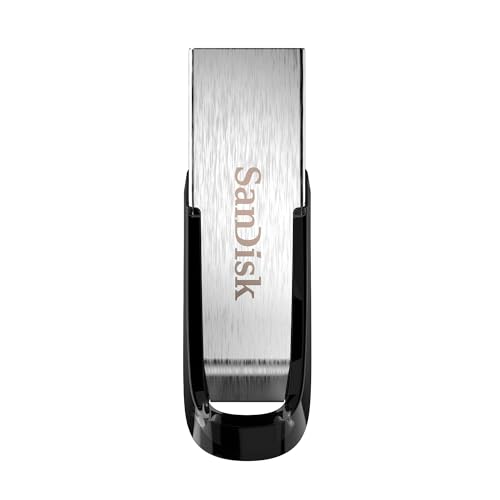 | SanDisk 128GB Ultra Flair USB-A flash drive | Somewhere to put the files | 128 GB USB-A drive, up to 150 MB/s read | $24.74 | In stock — low |
Prices and availability as of 16:08 EDT — details
Frequently asked questions
Can I convert VHS to digital without a VCR?
Not with any of these. A converter records whatever a player sends it, and nothing on this page plays a tape; the ClearClick and Portta listings say so in their titles. Without a VCR your options are to find one second-hand or refurbished, or to use a mail-in service, which is the only “no VCR needed” route that exists.
What is the best VHS to digital converter for home use?
For most households, a standalone recorder with a screen, because nobody has to supervise a laptop: the Portta VD10 if you want the most-bought one, the ClearClick 2.0 if you want the most honest listing and a US company behind it. For a reader with a laptop and a few tapes, the VIXLW dongle and free software do the same job for a fraction of the money.
Does a 1080p converter give a better picture than a 720p or 480p one?
No. The tape holds a standard-definition picture, and a recorder that writes it into a 1080p file is scaling it up, not finding more detail. The ClearClick listings say as much. A bigger file is the only difference; use S-Video instead of composite if you want a visibly better recording.
Will these work with Hi8, MiniDV and camcorder tapes?
Every listing here names Hi8 and camcorders, and most of the ten name Mini DV in their titles, but in each case the camcorder itself is the player: the converter records from its AV output. For VHS-C tapes the alternative is the motorised adapter in the accessories table, which lets a full-size VCR play them.
What file format do these converters produce?
All six standalone recorders state MP4 for video; the ClearClick 3.0 and the DigitPro add WAV or MP3 for audio, and the Portta VD10 MP3. None of the ten writes a DVD: if the search that brought you here said “VHS to DVD”, what any of these gives you is an MP4 file, and burning that to a disc is a separate step on a computer with a DVD writer. For most people a file on a drive, backed up twice, is the better end state anyway. The USB devices produce whatever the capture software you choose saves, which for OBS Studio is MKV or MP4 depending on the setting. MP4 plays on everything, including the TV.
What about the rest of the cupboard?
The other obsolete formats have their own guides on this site: cassette players, several with a USB output that digitises audio tapes the same way, home CD players for the discs that still play fine, portable Bluetooth CD players for the car, and portable DVD players for the home-burned DVDs that an earlier generation of this hobby produced.
Product prices and availability are accurate as of the date/time indicated and are subject to change. Any price and availability information displayed on Amazon.com at the time of purchase will apply to the purchase of this product.