
An omnidirectional TV antenna (omni directional, omni-directional, 360°, UFO: the listings and the searches use all of them) is the one you buy when you do not want to think about where the broadcast towers are. A directional antenna has to be pointed, and if your local stations transmit from two or three different hills it has to be pointed at one of them and give up on the rest. A 360° antenna, the flying-saucer or dome shape you see on RV roofs and suburban eaves, takes a weaker signal from every direction at once and asks nothing of you after the install. That trade, reach for convenience, is the whole subject of this guide, and it is why the right answer for a lot of households is still a directional antenna, which is covered in its own section below.
This is a full rewrite of a guide first published in 2020. When it was rewritten, nine of the twelve antennas it recommended could no longer be bought on Amazon and two of the twelve were the same product listed twice, so the list is new from top to bottom. Every antenna below was checked live on the day of writing, and the price and stock under each heading come from Amazon’s own data, refreshed on a schedule, rather than from this text. The figures in each entry, miles of range, amplifier, cable in the box, weight, come from that antenna’s own listing and are presented as the maker’s claims; what those claims are worth is the subject of the buyer’s guide.
Two groups of picks and one group of alternatives. First, six outdoor and attic omnis, from the one with the most buyers to a premium model built for wind and NextGen TV. Second, two RV antennas, because “omnidirectional” is a near-universal spec on a vehicle that parks facing a different way every night. Third, two antennas that are not what this guide means by omnidirectional, a directional attic model and an indoor flat panel, for the reader who reaches the end of the buyer’s guide and realises that is what they need. If the antenna is for a vehicle or a cabin, the portable DVD players on this site are the other half of the same setup.
Disclosure: As an Amazon Associate I earn from qualifying purchases. Product links in this guide are affiliate links.
The eight at a glance
The range column is the figure each listing claims, not a measurement; read the buyer’s guide before you take any of them at face value. “Amplifier” and “in the box” are each listing’s own words, and where a listing is silent the cell says so.
| Pick | Best for | Range the listing claims | Amplifier (listed) | In the box (listed) | Price | Stock | |
|---|---|---|---|---|---|---|---|
 | 1. 1byone 360° Omni-Directional Outdoor TV Antenna | The one most people buy | 100+ miles | Built-in pre-amplifier with 4G LTE filter | RG6 coaxial cable (32 ft in the bullets, 39 ft in the title) | $59.99 | In stock |
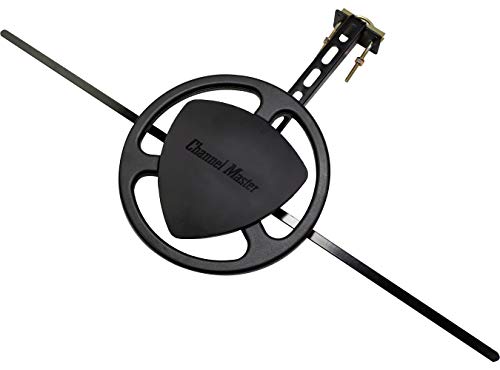 | 2. Channel Master Omni+ 50 | The brand pick with an honest range figure | 50+ miles | None; the description says it has no built-in amplification | Mounting bracket for wall, mast or an existing satellite mount | $69.00 | In stock |
 | 3. ANTOP AT-415B 720° UFO | The amplified UFO with a range switch | 105,000 metres, about 65 miles (details table) | Smartpass amplifier with a short/long range switch, 4G LTE filter | 33 ft coaxial cable | $99.99 | In stock |
 | 4. ANTOP AT-414B 360° | The cheaper ANTOP | 65 miles | Smartpass amplifier, switchable, 4G LTE filter | Outdoor bracket, mast clamp kit and 33 ft coaxial cable (product description) | $79.80 | In stock |
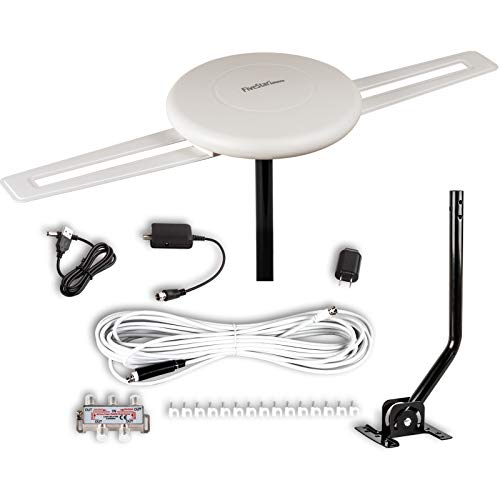 | 5. Five Star FSA-5818 360° Kit | The kit with the mounting pole | Up to 150+ miles, with a note that 40 to 60 miles is the ideal | Amplified (title); no filter listed | Installation kit and J-pole mounting pole | $89.95 | In stock |
 | 6. Winegard Elite 360 MS-6000 | The premium pick for wind and NextGen TV | 55 miles | Integrated Boost amplifier, 1.0 dB typical noise | The listing mentions an Elite 360 mounting kit; no cable listed | $131.20 | In stock — low |
 | 7. Winegard Air 360 A3-2035 | The RV dome from the RV brand | Not stated; the title says long-range | None listed | Nothing listed beyond the antenna | $112.91 | In stock — low |
 | 8. HIDB 360° RV Roof Antenna | The budget RV dome | 120 miles (details table) | Amplified, per the product description | Roof base with four screws and a 16.4 ft cable | $66.49 | In stock |
Prices and availability as of 04:09 EDT — details
Outdoor and attic omnidirectional antennas
1. 1byone 360° Omni-Directional Outdoor TV Antenna
The 1byone has more ratings than the other seven antennas here put together, which is not a reason to buy it but is a reason to list it first: it is the omnidirectional antenna most people end up with. The listing describes a 360° reception pattern for UHF and VHF with no rotation and no remote, a built-in pre-amplifier with a 4G LTE filter to strip interference from mobile-phone towers, a moisture-proof and flame-retardant housing, and a tool-free install for home, RV, attic or marine use. It is one of three antennas on this page whose listing states both an amplifier and an LTE filter.
Two things in the listing deserve a slower read. The range is given as “100+ miles”, which the buyer’s guide below will tell you to treat as a ceiling for an ideal site, not a promise. And a bullet headed “One TV Output” says the antenna is designed to feed one television and that adding a splitter may cost you channels, which is unusually candid and worth taking seriously if you planned to run it to three rooms. The coaxial cable in the box is listed as 32 feet in the bullets and 39 feet in the title; plan on the shorter figure. Two-year warranty in the details table, and at 3.94 pounds it is in the middle of this list for weight.
2. Channel Master Omni+ 50
Channel Master is the antenna brand your parents’ installer used, and the Omni+ 50 reads like a product from a company that expects to be held to its numbers: the listing claims a 50-mile range, the lowest figure among the eight picks, and ties the highest rating of the eight with the Winegard Air 360 at 4.4 stars. It is a passive antenna: the listing’s description says plainly that the Omni+ does not have built-in amplification, so that the user can add a more robust external amplifier if one is needed, and no filter or cable is listed, so if you are a long way from your towers you will be adding an amplifier yourself. What is in the box is a mounting bracket that the listing says fits a wall, a mast pole or an existing satellite-dish mount, which makes this the easiest antenna here to put where an old dish used to be.
At 2.27 pounds it is the lightest of the eight, and the listing rates it for indoor or outdoor use on a roof, in an attic or on an RV. The honest 50-mile figure is the point of this pick: an antenna that claims less and delivers it is a better purchase than one that claims 150 miles and is quietly limited to 60. If your towers sit within that radius in more than one direction and you do not want to fiddle with amplifier gain, this is the pick.
3. ANTOP AT-415B 720° UFO
ANTOP’s “720°” is marketing arithmetic, 360° horizontal plus 360° vertical, but the antenna behind it is the one the Bing Copilot answer puts first, and it was one of only three of the 2020 list’s twelve picks still buyable when this rewrite began. The listing’s two real features are a built-in 4G LTE filter and what ANTOP calls a Smartpass amplifier: an amplifier with a switch, so you can run it boosted if your towers are far away and switch the boost off if you live close enough that a strong signal overloads the tuner. That switch is the most useful thing on this page for a reader who does not yet know how far away their towers are, because it lets you find out by trying both.
The listing promises a tool-free setup in five minutes, 33 feet of coaxial cable in the box, 720p, 1080i and 1080p support, and a one-year warranty. The range figure appears in the details table as 105,000 metres, which is about 65 miles. Two cautions. At 5.19 pounds only the Five Star among the six outdoor picks is heavier, which matters on a thin mast. And at 3.9 stars it is one of three antennas here sharing the lowest rating on the page, so read the recent reviews before buying; a UFO with an amplifier has more to go wrong than a passive disc.
4. ANTOP AT-414B 360°
The AT-414B is the AT-415B’s plainer sibling: the same 360° reception claim, the same Smartpass amplifier described in the listing as switched on to boost a weak signal and off to avoid overload, the same built-in 4G LTE filter, and a 65-mile range claim written as a round number rather than in metres. It weighs a little less at 4.89 pounds. Both ANTOP listings say the antenna can feed several TVs through a splitter, the 414B in a bullet and the 415B further down its page, so that is not a difference between them; the difference is that the 414B costs less for what reads as the same reception hardware, and its product description itemises an outdoor bracket, a mast clamp kit and a 33-foot coaxial cable in the box.
What it lacks is a track record. It has the fewest ratings of any antenna on this page, under a hundred at the time of writing, and no past-month sales badge, so its 4.1-star score rests on a thin base. It is here because it is an in-stock ANTOP omni that costs less than the 415B, and that is a real choice to offer; it is fourth rather than third because the evidence behind it is thinner.
5. Five Star FSA-5818 360° Kit
Five Star’s listing is the one to read if you want to understand how antenna marketing works, because it argues with itself. The title claims reception “up to 150 miles”, a bullet adds a plus sign, and it is the largest headline figure among the eight picks; only the HIDB’s product description, with its 180, goes higher. A later bullet headed “Reminder” says the antenna ideally works for locations 40 to 60 miles from towers in multiple directions, and that reception will be limited if the towers are all in one direction. The second statement is the true one, and it is the same statement this guide makes about every omni here: the honest working range of this class of antenna is tens of miles, not hundreds, and an omni is the wrong shape when everything comes from one bearing.
With that understood, the FSA-5818 is a sensible kit. It is amplified, the listing says it supports four TVs, and the details table describes the package as the standard kit plus a J-pole, so unlike most of the antennas here you are not buying the mount separately. Five Star claims a tool-free, three-minute setup and rates it for outdoor, attic and RV use, and the listing shows 4.0 stars on about 1,150 ratings, the same score as the 1byone on a fraction of the count. At 5.29 pounds it is the heaviest of the six outdoor picks, and the listing does not state a warranty term, so check the box or the seller before you buy. The listing closes with a line calling it a gift for parents at Thanksgiving and Christmas; make of that what you will.
6. Winegard Elite 360 MS-6000
The Winegard Elite 360 is the premium pick and one of three antennas among the eight whose listing mentions ATSC 3.0, the NextGen TV broadcast standard (the Channel Master’s description and a legal-disclaimer line on the ANTOP AT-415B’s page are the others), and the only one that makes it a headline feature. It is designed, the listing says, for areas with multiple broadcast towers in different directions, with a 55-mile range claim for VHF and UHF and no aiming or rotors. Its two distinguishing claims are physical: a low-profile housing that Winegard says was wind-tunnel tested to 100 mph, for rooftops, railings and exterior mounting points, and an integrated Boost amplifier with what the listing calls Clear Circuit Technology at a typical 1.0 dB noise figure. Noise figure is the number that matters in an amplifier, because an amplifier adds its own hiss to whatever it boosts, and 1.0 dB is a low figure to be able to print.
Three cautions, and they are why it is sixth rather than first. The listing’s warranty line reads 90 days limited, the shortest stated term among the eight picks against one and two years elsewhere. It shares the lowest rating here at 3.9 stars on fewer than a hundred ratings. And when this guide was written the listing read “only 14 left”, so it may not be in stock when you read this; the live price and stock line above will tell you. At 2.4 pounds it is the second-lightest of the eight picks, and the US-based design the listing mentions is, for a product category dominated by white-label imports, part of what you are paying for.
Omnidirectional antennas for an RV
Five of the six antennas in the first group are rated by their listings for RV use (the Winegard Elite’s listing talks about rooftops, railings and exterior mounts instead), so if you want an amplified UFO on a camper you can buy one of those. These two are different: low domes designed to be screwed to a roof and left there, with the vehicle driving under them.
7. Winegard Air 360 A3-2035
Winegard makes most of the crank-up batwing antennas on older RVs, and the Air 360 is its fixed omnidirectional replacement: a 360° dome for VHF and UHF that the listing says needs no pointing or adjusting, in a low-profile black housing chosen to cut roof wind resistance, with weather-resistant construction and a stated fit for RVs, motorhomes, travel trailers and campers. It is listed under Automotive rather than Electronics, which tells you who it is for. Its 4.4 stars tie the Channel Master for the best rating of the eight picks.
The listing gives no mileage figure in its bullets, only “long-range” in the title, which after the Five Star entry you may find refreshing. It lists no amplifier, no filter and nothing in the box beyond the antenna, and at 5.49 pounds it is the heaviest product here, which on a roof is a feature rather than a problem. If you want an amplifier in an RV dome, the HIDB below describes itself as amplified; this page does not list a separate inline preamplifier.
8. HIDB 360° RV Roof Antenna
The HIDB is the budget version of the same idea, from a brand you will not have heard of. The listing describes a 360° omnidirectional dome with an included base that mounts to an RV roof with four screws, a weather-resistant build, a 16.4-foot cable in the box, and a claim the Winegard does not make: that it is built for mobile use and keeps receiving while the vehicle is moving. It needs a TV with a built-in tuner and a standard 75-ohm coaxial input, which every modern set has, and it comes with a two-year manufacturer warranty in the details table, longer than the Winegard Elite’s stated term.
Why it is last: it shares the lowest rating on the page at 3.9 stars; its details table claims a 120-mile range and its product description, which also describes the signal as amplified, claims 180, and no dome of this size will deliver either; and the listing itself asks you to check the government’s reception map before buying, which is good advice this guide repeats below. At 2.66 pounds, only the Channel Master and the Winegard Elite among the eight picks are lighter. Buy it for a trailer that visits campgrounds near towns; buy the Winegard for one that goes further.
When an omnidirectional antenna is the wrong answer
Two antennas that are not omnidirectional, included because a fair share of the readers who search for an omni should buy one of these instead. The GE is a directional attic antenna with more past-month buyers than any of the eight picks; the FLATenna is an indoor panel from Channel Master with more still. The GE’s listing never uses the word omni or the figure 360°. The FLATenna’s comparison chart does call its reception pattern omnidirectional, but an indoor panel is a different purchase from the roof and attic antennas above, and this guide keeps it apart.
| Pick | Best for | What the listing says | Price | Stock | |
|---|---|---|---|---|---|
 | GE 29884 Outdoor and Attic Long Range Antenna | If every tower is in one direction: the directional attic antenna | Not described as omni or 360°; 70+ mile claim, VHF and UHF; attic or outdoor on roof or mast; J-mount included; NextGen TV ATSC 3.0; assembles in about 20 to 30 minutes with standard tools; limited lifetime replacement pledge | $38.98 | In stock |
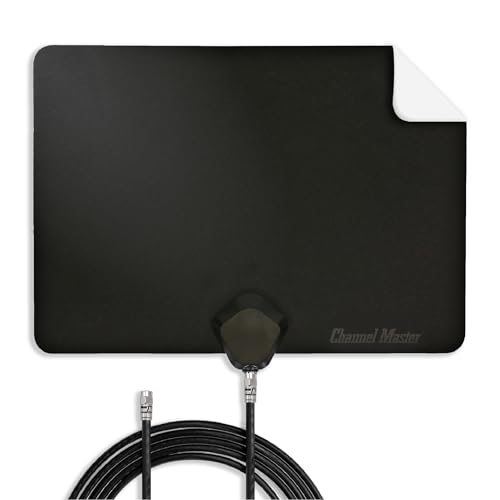 | Channel Master FLATenna Indoor Antenna | If you are in a city and want nothing on the roof: the indoor panel | Indoor flat panel with a 35-mile claim the listing calls realistic for urban and suburban areas; reversible black and white; wall, window or tabletop; 12 ft RG6 cable included; ATSC 3.0; one-year warranty | $35.00 | In stock |
Prices and availability as of 04:09 EDT — details
The GE is the antenna this guide would send most rural readers to. If the reception map shows your stations clustered on one bearing, a directional antenna pointed at them will pull in more of them, more reliably, than any omni on this page, and the GE’s listing describes exactly the install an omni buyer is trying to avoid: a kit that takes twenty to thirty minutes and tools to assemble, then a mast or attic rafter to fix it to. That is the price of the extra reach. The FLATenna is for the other extreme, a city apartment within a few miles of the towers, where the listing’s claimed 35 miles is plenty and nothing has to go outside.
Buyer’s guide: how to choose an omnidirectional TV antenna
Look up your towers before you buy anything
Broadcast television is line of sight. The signal travels from a transmitter mast to your antenna in more or less a straight line, and what sits between them, hills, buildings, trees in leaf, the curve of the earth, decides what you receive far more than which antenna you bought. So the first step is not shopping; it is the FCC’s DTV reception map, which takes an address and returns every station you can expect to receive, with its distance, bearing and predicted signal strength. RabbitEars does the same with more detail. Ten minutes with either tells you the two things that decide this purchase: how far your towers are, and whether they sit on one bearing or several.
Omnidirectional or directional
If the map puts your stations in two or more directions, an omni is the right shape, because the alternative is a directional antenna on a rotor or two directional antennas joined with a combiner, and both are more trouble than most people want. If the map puts them all on one bearing, buy a directional antenna and point it: it concentrates its sensitivity in one direction and so reaches further than an omni of the same size, which has to spread the same sensitivity around a full circle. That physics is why an omni’s working range is tens of miles and a good directional antenna’s can be more. Motorised “360°” antennas, the ones that rotate on a remote-controlled motor, are directional antennas with a turntable, not omnis; they are a fair answer to the two-directions problem, but you have to re-aim them each time you change channel group, and they are not on this list.
What a mileage claim is worth
Not much. The headline range figures among the eight picks run from 50 miles to 150 (a bullet makes it “150+”, and one product description goes to 180), and the sponsored listings around them claim thousands, which should tell you how the number is produced. There is no standard test behind it, and the physics does not cooperate: beyond roughly sixty or seventy miles the earth’s curvature puts most transmitters below the horizon of a roof-mounted antenna, so a figure above that is describing a mountaintop, not a suburb. The useful information in a listing is the smaller number, where one is given: Five Star’s 40-to-60-mile reminder, ANTOP’s 55-to-65 ideal range further down the AT-415B’s page, Channel Master’s 50, Winegard’s 55. Use the FCC map’s predicted strength for each station instead of any of them, and if a station shows as weak at your address, no omni on this page will make it strong.
Amplified or passive, and the overload problem
Six of the eight listings here state an amplifier and two do not. An amplifier does not make a weak signal cleaner; it makes everything that reaches the antenna louder, noise included, so it helps when the problem is a long cable run or a splitter between the antenna and the TV, and it hurts when the problem is that you live within a few miles of a strong transmitter, where the boosted signal can overload the tuner and you lose channels you would have received with a passive antenna. That is why the two ANTOP listings make a point of a switchable amplifier, and why a passive antenna like the Channel Master Omni+ 50, or the Winegard Air 360, whose listing states no amplifier, is the safer buy in a city. If you are far from your towers, buy amplified; if you are close, buy passive, or buy switchable and try both.
LTE filters and NextGen TV
Mobile-phone networks now transmit on frequencies next door to the UHF television band, and a strong phone tower nearby can swamp an antenna’s amplifier. Three of the eight picks’ listings, the 1byone and both ANTOPs, state a 4G LTE filter that blocks those frequencies; if the FCC map shows your stations as strong and you still get break-up, an inline LTE filter is a cheap thing to try before replacing the antenna. NextGen TV, the ATSC 3.0 standard, is a different matter: only three of the eight, the Winegard Elite 360, the Channel Master and the ANTOP AT-415B, mention it anywhere on their pages, but an antenna does not know or care which broadcast standard it is receiving, since the signal arrives on the same channels. “ATSC 3.0 ready” on a listing means the antenna covers the same bands it already covered. Whether you can watch NextGen TV depends on the tuner in your television, not on the antenna.
Installing it: height, cable and the ground block
Height beats everything. An omni in the attic will usually outperform the same omni on a window sill, and one on the roof will outperform both, because each step up clears more of what is between you and the tower; the trade is that attic installs lose some signal through the roof and outdoor installs need a mount, a weatherproof cable run and a grounding block where the cable enters the house. Four of the eight listings put a mount of some kind in the box (the Channel Master’s bracket, the AT-414B’s bracket and mast clamps, the Five Star’s J-pole, the HIDB’s roof base) and the Winegard Elite’s listing mentions a mounting kit; four list a cable (the 1byone, both ANTOPs and the HIDB); so a good share of readers will be buying one or both, and the accessories table below has a J-mount, a 50-foot quad-shielded RG6 cable and a ground block. Keep the cable run as short as you can and use a single splitter only if you must; if the antenna has to feed three or four TVs, a powered distribution amplifier at the splitter point is the right tool, not a bigger antenna, and the one in the table is listed for non-amplified antennas, so do not stack it on an amplified pick. One more thing: once the antenna is up, the TV’s channel scan has to be re-run, and a universal remote that can run it from the sofa saves a trip up the ladder every time you want to try a new position.
Accessories worth adding to the basket
None of these is a pick. Most of the antennas above ship without a mount, a cable or both, and the one thing every outdoor install needs that none of the antenna listings above mentions is a grounding block. The distribution amplifier is for the reader feeding more than two TVs; everyone else should skip it.
| Pick | Best for | What the listing says | Price | Stock | |
|---|---|---|---|---|---|
 | GE 50 ft quad-shielded RG6 coaxial cable | The cable most installs need | 50 ft RG6 with F-type connectors, quad shielded | $22.43 | In stock |
 | Philips universal steel J-mount | The mount most antennas lack | Adjustable steel J-mount for outdoor antennas | $22.42 | In stock |
 | THE CIMPLE CO single-port coaxial grounding block | The part every outdoor install needs | Single-port grounding block rated to 3 GHz | $8.97 | In stock |
 | GE 2-way coaxial splitter | For a second TV | 2-way splitter, 5 to 2500 MHz, RG6 compatible | $7.00 | In stock |
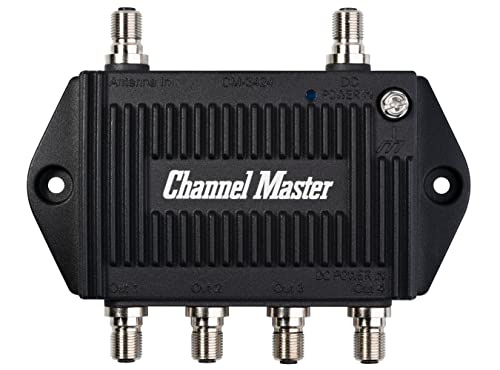 | Channel Master 4-port distribution amplifier | For three or four TVs | Powered 4-port amplifier for splitting an antenna signal to several TVs | $55.00 | In stock |
Prices and availability as of 04:09 EDT — details
Frequently asked questions
Are omnidirectional TV antennas any good?
Yes, for the job they are built for, which is receiving stations that transmit from several directions within a few tens of miles without anyone having to aim anything. They are not good at reaching distant transmitters, because spreading sensitivity around a full circle costs reach, and a directional antenna of the same size will always pull in a far-off station better. If the FCC map shows your stations strong and scattered, an omni is the right buy; if it shows them weak and clustered, it is not.
Omnidirectional or directional: which is better?
Neither; they answer different maps. Directional is better for distance and for a single bearing, omnidirectional for convenience and for towers on several bearings. The GE in the alternatives table is the directional answer for an attic, and the buyer’s guide above explains how to tell which map you are looking at.
Do I need an amplified antenna?
Only if your signal is weak or your cable run is long, and not if you live close to a strong transmitter, where an amplifier can overload the tuner and cost you channels. Six of the eight antennas here are amplified by their listings’ account; the two ANTOPs let you switch the amplifier off, which is the safest way to buy if you do not know which case you are in.
Can one omnidirectional antenna feed several TVs?
Physically yes, with a splitter, but every split halves the signal to each TV. Three of the eight picks’ listings say so in their own way: both ANTOPs say they can feed multiple TVs through a splitter and the Five Star says it supports four, while the 1byone warns that a splitter may cost you channels. For more than two sets, a powered distribution amplifier at the split point is the standard fix and is in the accessories table.
Indoor, attic or outdoor?
Outdoor on a mast is best, an attic is the compromise most people should try first, and indoors on a window sill is for a city flat close to the towers, which is what the FLATenna in the alternatives table is for. Five of the six outdoor picks are rated by their listings for attic use (the AT-414B’s listing does not mention one), and an attic usually works: higher than a window, out of the weather, no mount or ground block needed. Expect some loss through the roof, more under metal roofing or foil-backed insulation, and put the antenna as high in the space as you can.
What else is on this site for a cord-cutter’s living room?
The other guides in this corner of the site cover the rest of the setup: cordless phones without an answering machine for the landline you kept, shortwave radios for the reader who likes pulling signals out of the air for its own sake, portable Bluetooth CD players and alarm clock docks for the bedroom, and Verizon flip phones for the family member who wants a phone that is only a phone.
Product prices and availability are accurate as of the date/time indicated and are subject to change. Any price and availability information displayed on Amazon.com at the time of purchase will apply to the purchase of this product.