
A cordless phone without an answering machine is not a lesser phone. It is the phone for a house where voicemail already lives somewhere else: on the carrier’s server, in a cable box, or on the mobile everyone actually answers. Take the answering machine out and you lose a menu, a blinking light and a base station the size of a paperback, and you keep the part that matters, which is a handset that rings in the kitchen, sounds clear, and blocks the calls you did not want.
Finding one is harder than it should be. Search Amazon for a phone without an answering machine and the results are sorted by relevance rather than by feature, the accessory handsets that need a base you do not own are mixed in with complete systems, and the specification table that should settle the question says “Answering System Type: Digital” on models that have no answering system at all. All three of the Panasonic phones below are in exactly that position, and the entries say so, with the manufacturer’s own manual as the source.
This guide sorts nine phones into three groups: two-handset systems for a house, single handsets for a flat or a desk, and a big-button handset for anyone who wants the keys and the screen larger. Every listing was read on the day this was written, every claim about a phone comes from that phone’s own Amazon page or its maker’s operating instructions, and the price and stock under each pick are pulled live rather than typed in and left to go stale. Complete systems only: a base and at least one handset in the box. No accessory handsets, no corded desk phones, and nothing that needs a mobile to work.
If the same household also needs a mobile phone for the same reader, this site’s guide to Verizon cell phones for seniors applies the same big-button, works-out-of-the-box test.
Disclosure: As an Amazon Associate I earn from qualifying purchases. Product links in this guide are affiliate links.
The nine at a glance
Talk time is the listing’s own figure; the buyer’s guide below explains why the standby figures are the ones to compare. Every phone here is DECT 6.0, by its listing or, for the Panasonic KX-TGD810B, by Panasonic’s own specification page, and every one takes a standard telephone line cord.
| Pick | Best for | Handsets | Talk time (listed) | Price | Stock | |
|---|---|---|---|---|---|---|
 | 1. VTech CS6719-2 | The two-handset system most people buy | 2 | 12 hours | $39.58 | In stock |
 | 2. VTech VG131-21 | The two-handset system that says it in the name | 2 | Not stated | $38.95 | In stock |
 | 3. Panasonic KX-TGC352B | The Panasonic system with the record | 2 | 9 hours | $52.99 | Available later |
 | 4. Panasonic KX-TGC202B | The Panasonic two-handset system with the longer talk time | 2 | 10 hours | $37.31 | In stock — low |
 | 5. VTech VG131-11 | The cheapest way to put a good handset on a desk | 1 | Listed as 1 day | $23.25 | In stock |
 | 6. VTech CS6919-16 | The plain single handset, in red | 1 | 12 hours | $25.95 | In stock |
 | 7. AT&T EL51103 | The single handset with the biggest record | 1 | Not stated | $27.07 | In stock |
 | 8. Panasonic KX-TGD810B | The single handset that fights robocalls hardest | 1 | 10 hours | $37.99 | Available later |
 | 9. VTech VG231 | Big keys, big screen, no fuss | 1 | 10 hours | $26.95 | In stock |
Prices and availability as of 04:09 EDT — details
Two-handset systems
A two-handset system is one base plugged into the phone line and one charging cradle that only needs power, so the second handset lives in a bedroom or an office with no line socket. All four below show caller ID on both handsets and the two Panasonics keep a block list. On expansion, the CS6719-2 and the KX-TGC352B say on their listings that more handsets from the same family can be added, the KX-TGC202’s operating instructions say up to six can be registered, and the VG131-21’s listing does not say. What separates them is the display, the talk time, and how many people have bought them before you.
1. VTech CS6719-2
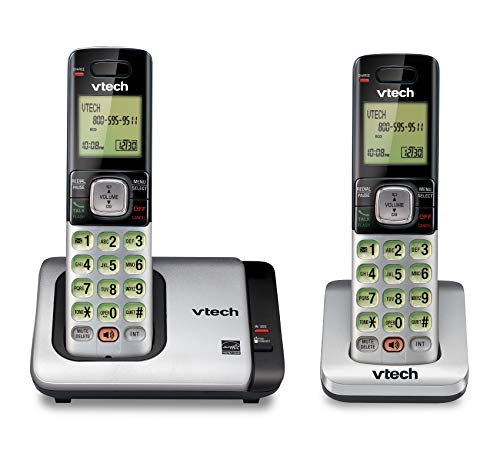
This is the cordless phone Amazon shoppers actually buy: close to forty thousand ratings, a “bought in past month” figure in four figures, and a listing whose specification table says “Answering System Type: NO” in capital letters, which is the sentence this whole page is looking for. It is a two-handset DECT 6.0 system with a full-duplex speakerphone on the handset, so both ends of a call can talk at once instead of taking turns, caller ID and call waiting that show the name, number, time and date of each call, and a keypad that lights up along with the screen for dialling in the dark. A handset intercom is in the product name, and the listing notes any key answers a call.
The specification rows give twelve hours of talk time and four days of standby, which ties the best talk figure on this page, and the box holds the base, two handsets, two battery packs, two mains adapters, a charging stand, a line cord and a guide. That is everything, and the only thing to add later is a third handset from the CS6709 accessory line in the table at the bottom. Its listing says nothing about the screen beyond that it is backlit; it is the one with the record, and in this category that is worth more than a feature.
2. VTech VG131-21
The VG131-21 is the only listing on this page that puts “No Answering Machine” in the product title, and the specification row agrees. It is VTech’s newer two-handset design: a white lighted display and a fully backlit keypad, caller ID that stores thirty calls, a thirty-name phonebook and last-five redial, and the same full-duplex speakerphone as the CS6719-2. The two handsets share one phonebook, one caller ID log and one set of settings, so a number saved in the kitchen is in the bedroom too. The listing also states it is hearing aid compatible and wall-mountable with no extra bracket needed.
Two things the listing does not do: it gives a standby figure (four days) but no talk-time figure, and it has a few hundred ratings against the CS6719-2’s tens of thousands. What it has instead is the plainest statement of what it is, a bullet that spells out why DECT 6.0 is harder to eavesdrop on than the older 2.4 and 5.8 GHz phones, and a box with the base, both handsets, both battery packs, both adapters and the line cord. Between the two VTech systems there is nothing to choose on features; buy this one if the phrase in the title reassures you, the CS6719-2 if the record does.
3. Panasonic KX-TGC352B
First, the thing that will confuse you on the listing. Amazon’s specification table for this phone says “Answering System Type: Digital”. Panasonic’s own operating instructions, which cover the KX-TGC350 and KX-TGC352 alongside the KX-TGC360 series in one booklet, put the answering system under the heading “KX-TGC360 series”, and nothing in the listing’s bullets mentions messages. The 352 is the two-handset model of the series without one; the 362 is the same phone with one. That is the manufacturer’s word against a database field, and this page takes the manufacturer’s.
Its own comparison chart further down the listing also gives “Answering System: No” for the KX-TGC352B. What the listing does claim is a 1.6-inch amber backlit display on both the base and the handset, a silent mode that lets you set a period during which neither will ring for outside calls, call block for up to thirty numbers, an eco mode that manages battery consumption, and caller ID compatibility with the usual note that the service is a subscription. The listing gives nine hours of talk and four days of standby; Panasonic’s own specification page says the same and adds that the system takes up to six handsets. The box holds the base, two handsets, a mains adaptor, four AAA NiMH batteries and two handset covers, which is Panasonic’s way of saying the batteries are ordinary AAA rechargeables rather than a sealed pack, a small thing that matters in year three. With close to thirteen thousand ratings it is the Panasonic most people have bought, and the one to buy if you want the brand.
4. Panasonic KX-TGC202B
The same confusion applies, and the same answer: the Amazon row says “Digital”, and Panasonic’s operating instructions for the KX-TGC200 and KX-TGC202 describe no answering system at all. What the listing claims is the longer battery of the two Panasonic systems, up to ten hours of talk and 144 hours of standby with an eco mode, a 1.6-inch amber backlit handset display, call block for thirty numbers, and a speakerphone. Two handsets, two chargers, a mains adaptor, four rechargeable batteries and a line cord are in the box.
What argues against it is the record: a couple of hundred ratings and, on the day this was written, an “available to ship in one to two days” note rather than plain stock. It is here because it is the newer Panasonic design with the longer battery claim of the two, and because its handset display is the same 1.6-inch amber backlit type as the 352’s. If those two things matter to you, it is the pick; if the record matters more, the 352 is the same brand with a decade of buyers behind it.
Single handsets
One base, one handset, one phone socket. These are the phones for a flat, a home office, a workshop or a second line, and they are the cheapest way to get a DECT handset with a real speakerphone. The Panasonic, the CS6919-16 and the AT&T say on their listings that they can be expanded; the two VG-series VTechs do not say. Either way, if you know you want two handsets now, buy a system above rather than a phone plus an accessory handset.
5. VTech VG131-11
The single-handset version of the VG131 above, and by the “bought in past month” figure the fastest-selling single handset on this page. The listing claims a DECT 6.0 range of up to a thousand feet outdoors, a blue-white backlit display with a green backlit keypad, caller ID with name, number, time and date, the full-duplex speakerphone, a one-touch volume control and a mute button that silences the phone for a single call, and a base that mounts on a standard wall plate without a bracket. The specification row says “Answering System Type: No”, and the title says it is hearing aid compatible.
The battery figures in its specification rows are the one place the listing is odd: two days of standby and a talk time given as “1 days”, which is either a typo for a very long figure or a very short standby, and the entry above it from the same family gives four days. Read that as “the listing does not say” and buy it for what it is: the least expensive phone on this page on the day this was written, and not a compromise, with a base, a handset, an adapter, a battery pack and a line cord in the box.
6. VTech CS6919-16
The CS6919 is the single-handset cousin of the CS6719-2, and the -16 is the red one, which is either the reason to buy it or the reason not to. Its listing claims the full-duplex handset speakerphone, a backlit keypad and display, caller ID and call waiting that store thirty calls, a quiet mode that mutes the ringer on both handset and base for a set period, and an ECO mode for battery life. The specification rows say “Answering System Type: No”, twelve hours of talk time and five days of standby, on two AAA batteries that come in the box along with the base, the handset, the adapter, the line cord and a wall-mount bracket.
It is a plain phone in a loud colour, and there is nothing else to say about it, which is a compliment. If you would rather have silver, the plain CS6719 single handset is the same family with a far larger record; this page lists the one whose listing it read in full.
7. AT&T EL51103
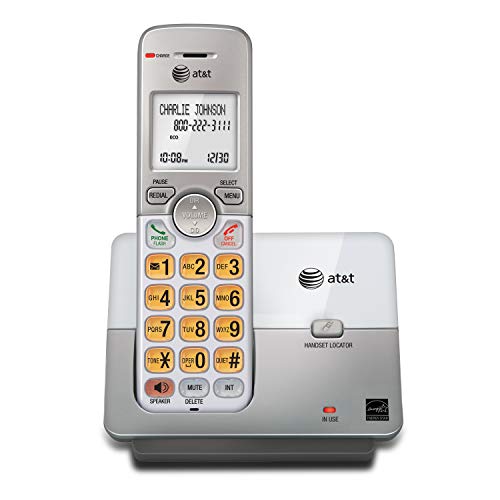
Nearly nineteen thousand ratings make this the most-reviewed single handset on the page, and the reason is a listing that reads like a checklist of what a plain phone should do. DECT 6.0 with a range of up to a thousand feet, a full-duplex handset speakerphone, caller ID and call waiting for up to fifty calls, a fifty-name phonebook, an ECO mode, a quiet mode for the ringer, mute, redial, any-key answer and trilingual prompts. The title adds an extra-large backlit display and a lighted keypad. AT&T’s user’s manual for the EL51103 family describes it as a cordless telephone with caller ID and call waiting, says voicemail is a service you subscribe to from your provider, and has no answering-system section, which is what “without an answering machine” looks like in a manual.
Two details worth knowing. The listing’s bullets name a voicemail key, so a carrier’s voicemail is one press away, which is the point of buying a phone without a machine of its own. And the listing gives no talk or standby figure at all, so the table above says “not stated” rather than guessing. Two AAA batteries are included, and the box list is the phone and its adapters.
8. Panasonic KX-TGD810B
Once more on the answering machine: Amazon’s row says “Digital”, and Panasonic’s operating instructions, which cover the KX-TGD810 and KX-TGD813 together with the KX-TGD830 series, mark the answering system “available for KX-TGD830 series”. The 810 is the one-handset model without it, and the listing’s own comparison chart further down its page gives “Answering System: No” for the KX-TGD810B, as does Panasonic’s specification page for the model. What it has instead is the most serious call blocking on this page: an automated block that pre-blocks robocalls, a telemarketing block for callers who announce themselves, a one-touch block button on the handset for a thousand more numbers, and a one-ring scam alert that shows a confirmation screen before you return a call that rang once and hung up.
The rest of the listing claims an illuminated keypad with large characters, bilingual caller ID, a large high-contrast display, nine speed-dial numbers, a wall-mountable design, and a full-duplex speakerphone that also lets the handset and base work as an intercom; the listing suggests keeping a handset in a child’s room as a monitor, which is a use rather than a feature. The listing gives ten hours of talk and 120 hours of standby. The box holds the adaptor, a line cord, a wall-mounting adaptor, rechargeable batteries, a handset cover and a charger. If the reason you are buying a landline phone in 2026 is the calls you do not want, this is the one.
Big buttons and a big screen
One phone here is built around the screen and the keys rather than the feature list. It is the one to buy for a parent, a grandparent, or anyone who has ever dialled a wrong number on a handset in a dark hallway, and it gives up nothing on the phone side to get there except call blocking, which its own listing says it does not include.
9. VTech VG231
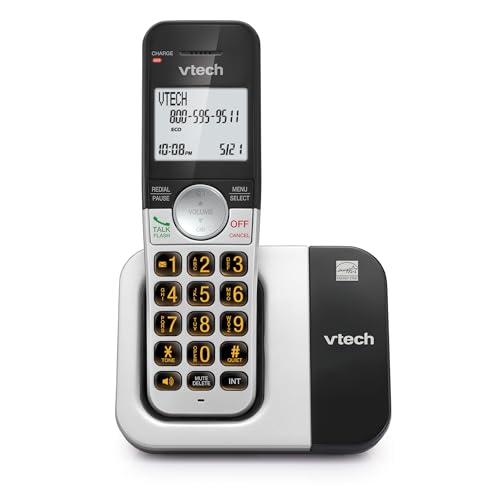
The VG231 is the phone to buy for anyone who finds the others fiddly. The listing claims a two-inch high-contrast white display and an oversized lighted keypad, caller ID for up to fifty calls with name, number, time and date, the full-duplex speakerphone, a quiet mode for the ringer, and an ECO mode that turns the transmit power down when the handset is near the base. The specification row says “Answering System Type: No”, the listing’s description says outright that the VG231 does not include an answering machine or call blocking, and the listing gives up to ten hours of talk and seven days of standby, the longest standby figure on this page.
One bullet on this listing is worth more than it looks. It says the phone works with a traditional landline, a cable phone service and VoIP services including Ooma, Vonage and Google Voice, which is true of every DECT phone with a line cord but which almost no listing bothers to say, and it answers the question most people have before they buy. Base, handset, adapter, line cord and battery pack are in the box. It is a large-print phone, not a medical device, and it is a good phone on its own terms.
Two things worth buying with the phone
An expandable system is only expandable if the accessory handset is still on sale, and a cordless phone’s battery is the only part of it that wears out. For the CS6719-2 the matching accessory is the CS6709, which the listing says works with the CS6719, CS6729, CS6829 and CS6859 series and takes a system to five handsets on one phone jack; on the day this was written its listing showed only a handful left, so check the stock line. The VTech and AT&T handsets here that list “product specific batteries” take a small pack sold under a part number, and the BT183342/BT283342 pack below is the common one, sold four at a time; check the battery code in your handset’s specification rows against the pack’s listing before buying. The Panasonic handsets take ordinary AAA NiMH cells, which is one of the better arguments for them.
| Pick | Best for | What it is | Price | Stock | |
|---|---|---|---|---|---|
 | VTech CS6709 Accessory Handset | The third handset for the CS6719-2 | Accessory handset with caller ID; needs a CS6719, CS6729, CS6829 or CS6859 series base | $51.99 | In stock — low |
 | BT183342 / BT283342 NiMH Battery Pack, 4-Pack | A replacement pack for handsets that take the BT183342 / BT283342 battery | 2.4 V 800 mAh Ni-MH pack for VTech and AT&T handsets, four packs | $9.89 | In stock |
Prices and availability as of 04:09 EDT — details
How to buy a cordless phone without an answering machine
What you are giving up, and what replaces it
An answering machine records messages on the base. Without one, missed calls go to whatever voicemail your line already has: a landline carrier’s voicemail service, the voicemail built into a cable company’s phone service, or the voicemail of a VoIP provider. All of those are retrieved by dialling a number, and most of the handsets above have a key or a speed-dial slot to store it; the AT&T lists a dedicated voicemail key. If your line has no voicemail service at all and you want messages, you want the other kind of phone. If it does, an answering machine is a second mailbox you have to check. The honest alternative, if the phone you like only comes with a machine, is that most answering models let you switch the machine off in the base’s menu; the phones on this page simply never make you find that setting.
How to tell from the listing
Look for three things. The specification table row “Answering System Type”, which on the VTech listings here reads “No” and which is reliable for VTech. The title, which sometimes says it. And the model number, which for Panasonic is the only reliable guide: Panasonic sells each design in a version with an answering system and one without, under neighbouring model numbers (the KX-TGC352 has none, the KX-TGC362 has one; the KX-TGD810 has none, the KX-TGD830 has one; the KX-TGC202 has none), while Amazon’s table says “Digital” for the ones without. Panasonic’s operating instructions, which it publishes, settle it, and the entries above cite them.
DECT 6.0, and why every phone here has it
DECT 6.0 is the digital cordless standard in North America, on a band of its own away from Wi-Fi and microwave ovens, which is why the listings can claim interference-free calls and ranges of a thousand feet outdoors. Two practical consequences: a DECT handset from one maker will not register to another maker’s base, so an accessory handset must come from the same family as the base, and the range figure is an outdoor line-of-sight number that walls reduce. Every phone on this page is DECT 6.0 (the KX-TGD810B’s listing does not say so; Panasonic’s specification page for it does), so it is not a point of comparison between them.
Talk time versus standby, and which to read
Listings quote talk time (hours on a call) and standby (days sitting off the cradle). Standby is the one that describes real life, because a handset that lives in a bedroom spends most of its week not on a call and not on the charger. The standby figures here run from two to seven days, the talk figures from nine to twelve hours where one is given; two listings give no talk figure and one gives a figure this page does not trust. Every handset here charges on its cradle. The specification row “Number of Batteries” says what is inside: the Panasonics and some of the VTech and AT&T handsets take AAA NiMH cells, the rest a small pack sold under a part number.
Call blocking is the feature that changed
Ten years ago a cordless phone’s selling point was range. Now it is the block list. Every phone above shows caller ID, which needs the caller ID service from your provider, but only the three Panasonics list a block list, and they differ: the two Panasonic two-handset systems store thirty numbers, and the KX-TGD810B pre-blocks robocalls and takes a thousand more. The VTech and AT&T listings here describe screening calls by caller ID rather than blocking them. If unwanted calls are the reason for the purchase, read the call-block bullet before the battery one.
Expandable, and what that costs
The phones here whose listings say they are expandable can take more handsets from their own family. But an accessory handset usually costs more than the difference between the one-handset and two-handset versions of the same phone, so decide how many handsets you want before you buy rather than after. For the VTech CS6719 family, the two-handset system costs a fraction of a single handset plus the CS6709 accessory. A second handset also gives you an intercom between them, which the CS6719-2 names in its product title; the Panasonic KX-TGD810B describes the same thing between its handset and base.
What this page leaves out, and why
Accessory handsets, which are sold as if they were phones and are not; the previous version of this page listed five of them, and every one needs a base from a specific family to work. Phones with an answering machine, which are a different search and a different page. Panasonic’s big-button KX-TGU430, which would have been the easiest phone here to recommend except that Panasonic’s own manual gives it an answering system. Corded desk phones. And the cell-to-home bridges that ring a landline handset from a mobile, which are clever and are not what anyone searching this page wants. If the rest of the living room needs sorting too, our guides to touch-screen universal remotes and omni-directional TV antennas were written the same way, and for a radio that works when the phone line does not, the shortwave guide is the companion piece.
Frequently asked questions
Why buy a cordless phone without an answering machine?
Because your line already has voicemail, and a second mailbox on the base is one more thing to check. It also makes the base smaller and the phone simpler, and it usually costs less.
Can I still get messages?
Yes, from your provider’s voicemail, which you reach by dialling it or by a stored key. What you cannot do is record messages on the phone itself.
Which is the best cordless phone without an answering machine?
For a house, the VTech CS6719-2 or the Panasonic KX-TGC352B, both two-handset systems with tens of thousands of ratings between them. For one room, the VTech VG131-11 or the AT&T EL51103. For unwanted calls, the Panasonic KX-TGD810B. For large keys, the VTech VG231.
Will it work with my cable or internet phone service?
Yes. Every phone here plugs into a standard telephone socket, and a cable box or VoIP adapter provides exactly that socket. A line cord is in the box for seven of the nine; the Panasonic KX-TGC352B and the AT&T EL51103 box lists do not include one, so keep the old cord or buy one. The VTech VG231 listing says so by name for Ooma, Vonage and Google Voice.
Why does Amazon say my Panasonic has a digital answering system?
Because the specification row is wrong for the models without one. Panasonic’s operating instructions restrict the answering system to the KX-TGC360 and KX-TGD830 series, and the KX-TGC200 series manual has no answering system in it at all; the KX-TGC352, KX-TGC202 and KX-TGD810 on this page are the versions without it.
The short version
Buy the VTech CS6719-2 if you want two handsets and the safest choice, the VG131-21 if you want the same thing with “No Answering Machine” printed on the box, and the Panasonic KX-TGC352B if you want the Panasonic. For one handset, the VG131-11 is the cheapest good phone here and the AT&T EL51103 the most-reviewed. Buy the Panasonic KX-TGD810B if robocalls are the problem you are solving, and the VTech VG231 if the problem is reading the screen. None of them will take a message, and that is the point.
Sources
Panasonic, Operating Instructions for the KX-TGC350, KX-TGC352 and KX-TGC360 series (the answering system section is headed “KX-TGC360 series”), and the Features and Specifications page for the KX-TGC350/KX-TGC352 (talk time up to 9 hours, standby up to 4 days, up to 6 handsets, call block 30 numbers), both on help.na.panasonic.com. Panasonic, Operating Instructions for the KX-TGD810, KX-TGD813 and KX-TGD830 series (answering system “available for KX-TGD830 series”), and the Features and Specifications page for the KX-TGD810/KX-TGD813 (DECT 6.0; answering system: no), both on help.na.panasonic.com. Panasonic, Operating Instructions for the KX-TGC200 and KX-TGC202 (read via ManualsLib; no answering system; up to six handsets can be registered). Panasonic, Operating Instructions for the KX-TGU430, KX-TGU432 and KX-TGU433 (the reason the KX-TGU430 is not listed). AT&T, User’s manual for the EL51103, EL51203, EL51253, EL51303, EL51353, EL51403, EL51453 and EL51503 (a DECT 6.0 cordless telephone with caller ID/call waiting; caller ID history 50 calls; directory 50 entries; voicemail as a subscribed service), att.vtp-media.com. Every other claim is from the product’s Amazon listing on the day of writing.
Product prices and availability are accurate as of the date/time indicated and are subject to change. Any price and availability information displayed on Amazon.com at the time of purchase will apply to the purchase of this product.