
The creatures of Greek myth were never a bestiary; they were obstacles. Almost every one of the thirty below exists in the stories because a hero had to get past it, and the Greeks measured their heroes by the quality of their monsters: Heracles by the Hydra and the lion, Perseus by Medusa, Theseus by the Minotaur, Odysseus by a Cyclops, a pair of sea monsters and a choir. That is the way this list is arranged. Each entry gives the creature, the hero who faced it, which ancient text names it, and a picture, because the Greeks and everyone since have drawn these things, and the pictures are often the best way to tell a Hydra from a Chimera.
Where this list says a creature is “named in” the Theogony, the Odyssey, Apollodorus’ Library, the Argonautica or a tragedy, that is the earliest or best-known source that tells the story as given here; the myths vary by author and city, and an entry that says a source is silent on a point means exactly that. The images are public-domain vase paintings, Renaissance and Victorian paintings and one bronze, chosen because each shows the creature named rather than a decorative stand-in. The gods behind these monsters have their own pages on this site: the male Greek gods, the gods of death and the underworld and the famous statues of the Greek gods, and the Norse have their own monsters on the Norse mythology creatures list.
The great monsters: Typhon’s brood and the labours of Heracles
Hesiod’s Theogony gives most of the famous monsters one family. Typhon, the last and worst child of the earth, and Echidna, half woman and half serpent, are the parents of Cerberus, the Hydra, the Chimera and the two-headed hound Orthrus; the Sphinx and the Nemean lion are Orthrus’s children in the same genealogy. Heracles killed or captured most of them in his twelve labours, which is why the first third of this list reads like his résumé.
1. Typhon
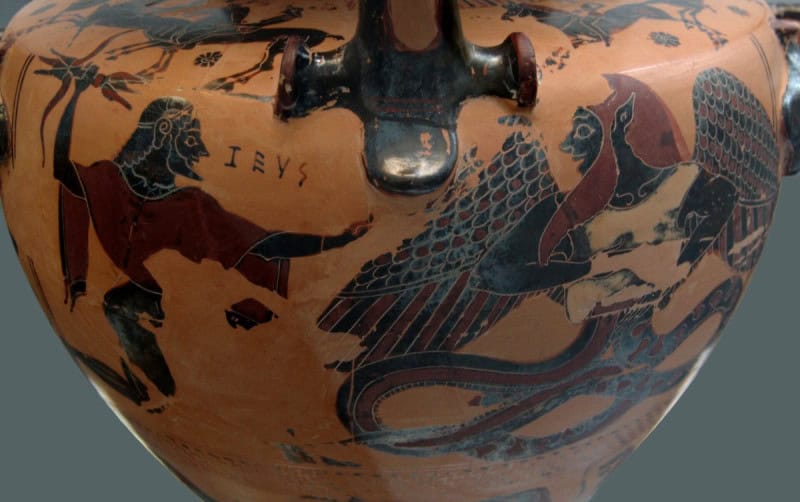
The biggest monster in Greek myth and the father of most of the others. The Theogony describes Typhon as a child of Gaia and Tartarus with a hundred serpent heads, each speaking in a different voice, and tells how Zeus fought him with thunderbolts and buried him under the earth; later authors put him under Mount Etna and made the volcano his breathing. He is the one creature on this list that a god, not a hero, had to deal with, and the vase painters loved him for his wings and snake legs. In modern retellings he is the final boss of more than one video game, which is roughly the role he plays in Hesiod.
2. The Lernaean Hydra
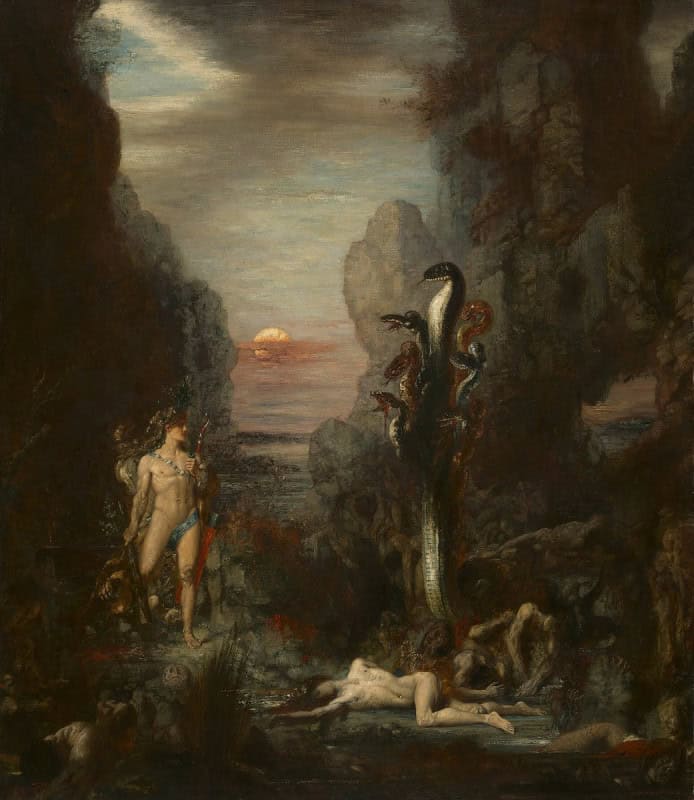
Heracles’ second labour. The Hydra was a water serpent of the marsh at Lerna with many heads (the number varies by author; Apollodorus says nine, one of them immortal), and the detail everyone remembers, that two heads grew back for each one cut off, is in Apollodorus’ Library along with the solution: Heracles’ nephew Iolaus cauterised each neck with a torch, and the immortal head was buried under a rock. Heracles dipped his arrows in the Hydra’s venom, which is how several later stories end, including his own. Moreau’s painting is the great nineteenth-century image of the fight, and “hydra” has been the word for a problem that multiplies when attacked ever since.
3. The Chimera
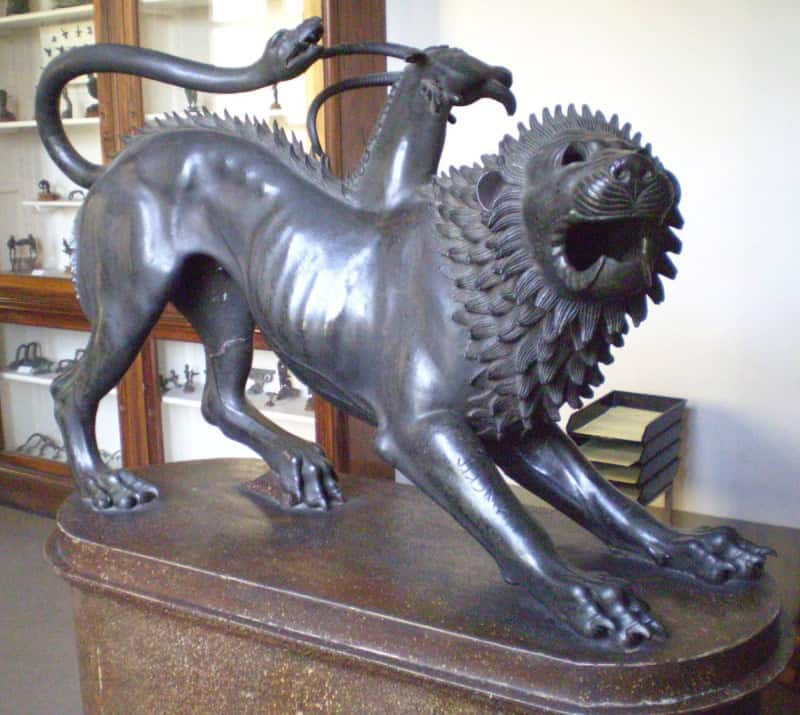
A lion in front, a goat in the middle and a serpent behind, breathing fire: the Iliad’s description, in Book 6, is the oldest in Greek literature and the bronze from Arezzo follows it exactly, goat’s head rising from the lion’s back. The Chimera ravaged Lycia until the hero Bellerophon killed it; the Iliad tells the fight, and Hesiod’s Theogony and Pindar put him on the winged horse Pegasus to do it from the air. Because the creature is an impossible assembly of parts, “chimera” became the biologists’ word for an organism made of genetically different cells, and the everyday word for a thing hoped for that cannot exist.
4. Cerberus
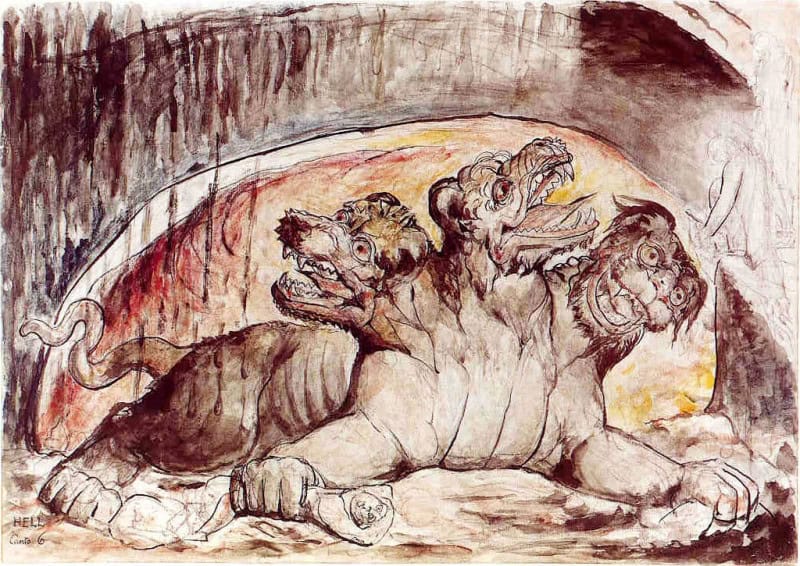
The hound of Hades, who lets the dead in and nobody out. Hesiod gives him fifty heads; the three that art settled on come from later writers, and Blake adds the serpent mane that Apollodorus mentions. Fetching Cerberus from the underworld was Heracles’ twelfth and last labour, and Apollodorus says Hades allowed it on condition that Heracles used no weapons, so he wrestled the dog into submission and carried him up to Eurystheus, whom the vase painters show hiding in a storage jar. Cerberus also appears in the Aeneid, drugged with a honey cake, and in Dante, where Blake found him. On this site he guards the entry on Hades in the gods of the underworld.
5. The Nemean Lion
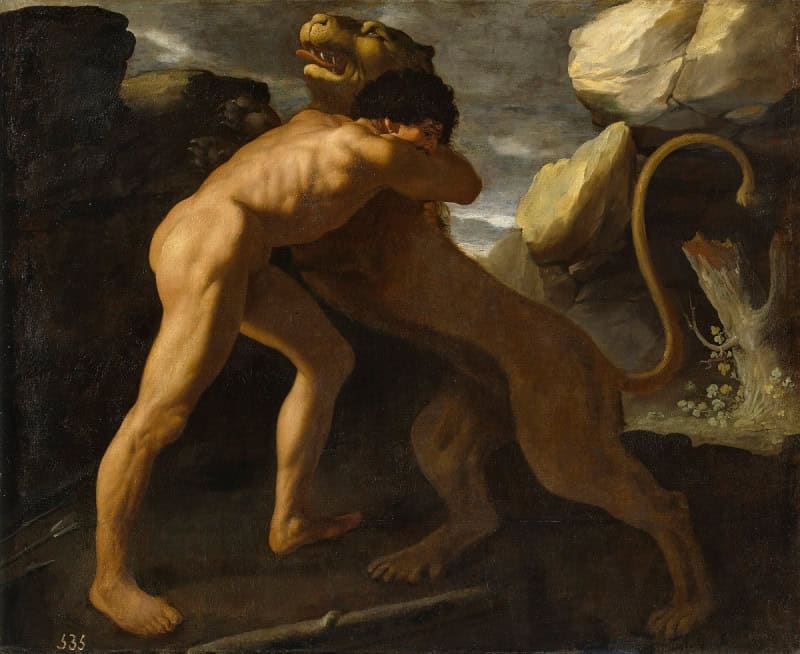
The first labour. The lion’s hide could not be cut by any weapon, so Heracles, after his arrows bounced off, strangled it with his arms, a scene the vase painters repeated for centuries and Zurbarán painted for the king of Spain. Theocritus, in an idyll on the labour, adds the detail that makes the story: Heracles skinned the lion with its own claws, and he wore the pelt as armour afterwards, which is why nearly every statue of him shows a lion’s head over his shoulder. Hesiod makes the lion a child of Orthrus and Echidna and says Hera raised it. The constellation Leo is the lion placed in the sky.
6. The Sphinx
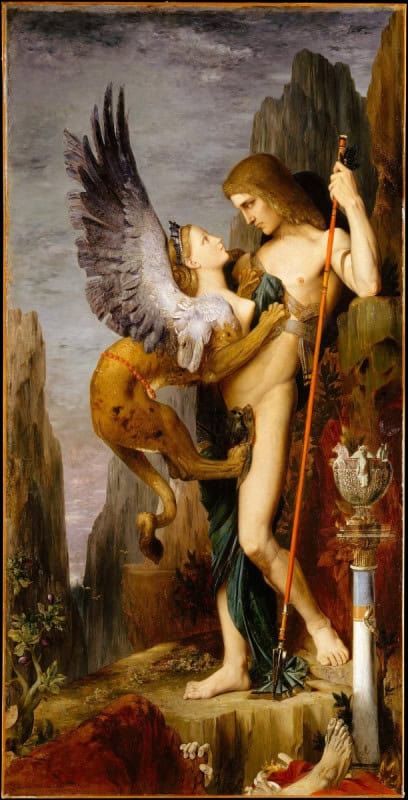
The Greek Sphinx is not the Egyptian one. She is female, winged, a lion below and a woman above, and she sat outside Thebes asking a riddle and eating those who answered wrongly. Apollodorus gives the riddle (what goes on four legs in the morning, two at noon and three in the evening) and Oedipus’s answer (a person, crawling, walking, then leaning on a stick), after which the Sphinx threw herself from her rock. Sophocles’ Oedipus the King takes the riddle as already solved and builds a tragedy on what Oedipus did not know. Moreau’s painting, with the Sphinx clinging to the hero’s chest, made him famous at the Salon of 1864.
7. The Erymanthian Boar
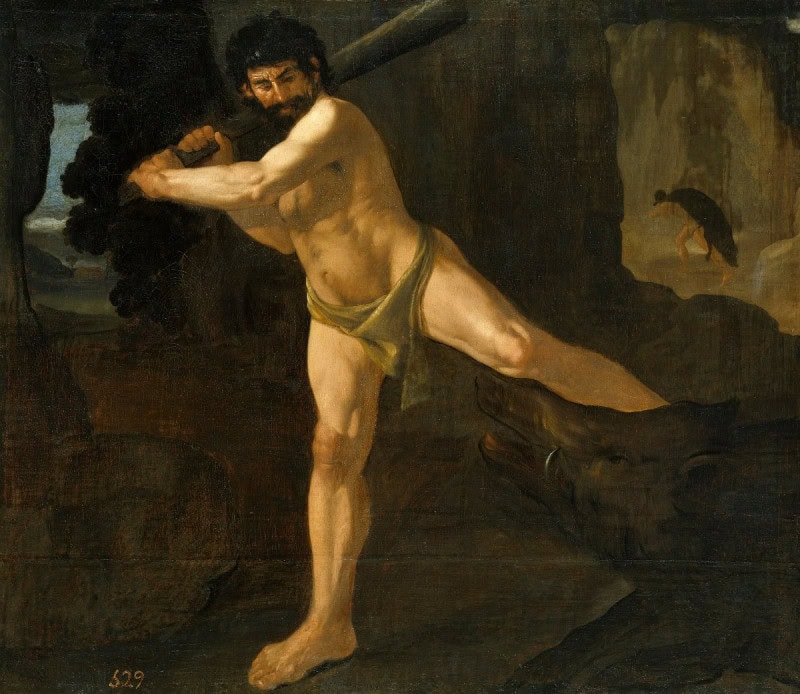
The fourth labour was a capture, not a kill: Heracles had to bring the giant boar of Mount Erymanthos back alive. Apollodorus tells how he drove it into deep snow, netted it and carried it on his shoulders to Eurystheus, who again hid in his jar, a joke the vase painters never tired of. On the way, Apollodorus adds, Heracles stopped with the centaur Pholus, opened the centaurs’ communal wine and started the brawl in which Chiron (entry 12) was accidentally wounded. The boar is the least monstrous creature on this list, just a very large pig, which is why the story is remembered for the snow and the jar.
8. The Stymphalian Birds
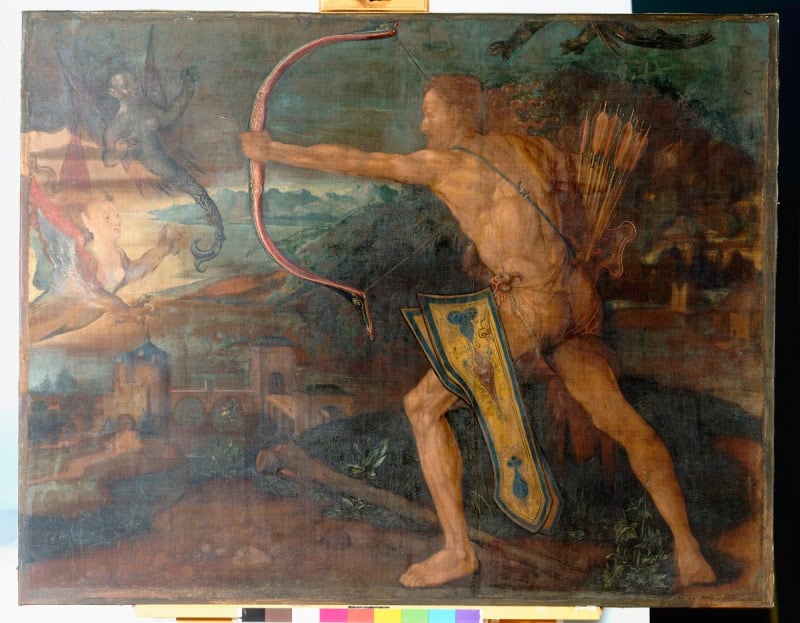
The sixth labour. A flock of man-eating birds infested the marsh of Stymphalos in Arcadia; Apollodorus says Heracles could not get at them until Athena gave him a bronze rattle made by Hephaestus, whose noise flushed the birds into the air where he shot them. Pausanias, writing a travel guide centuries later, describes birds whose beaks could pierce armour. The Argonautica has the survivors nesting on an island in the Black Sea, where the Argonauts drive them off by banging their shields. Dürer, who painted them as harpy-like women, is following a Renaissance confusion of the two; the Greeks made them birds.
9. The Cretan Bull
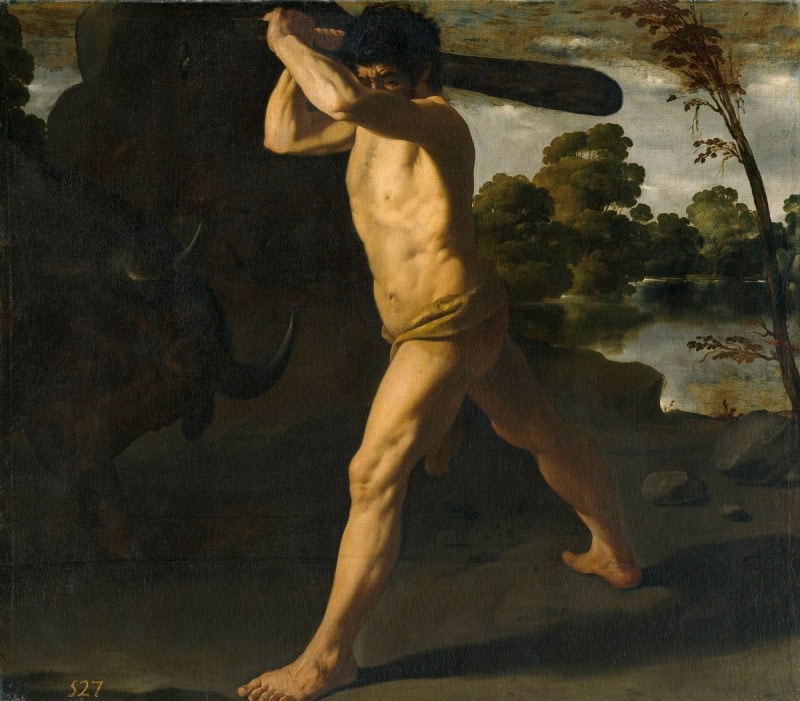
The seventh labour, and the bull with the longest afterlife. Apollodorus says Poseidon sent a magnificent bull from the sea for King Minos of Crete to sacrifice; Minos kept it, and in revenge Poseidon made the bull wild and made Minos’s queen Pasiphae fall in love with it, which is how the Minotaur (entry 15) came to be. Heracles wrestled the bull, shipped it to the mainland and let it go; it wandered to Marathon, where Theseus later caught it as the first of his own exploits. Zurbarán’s series of Heracles paintings, four of which appear on this list, was made for the Hall of Realms in Madrid in 1634.
10. Geryon and Orthrus
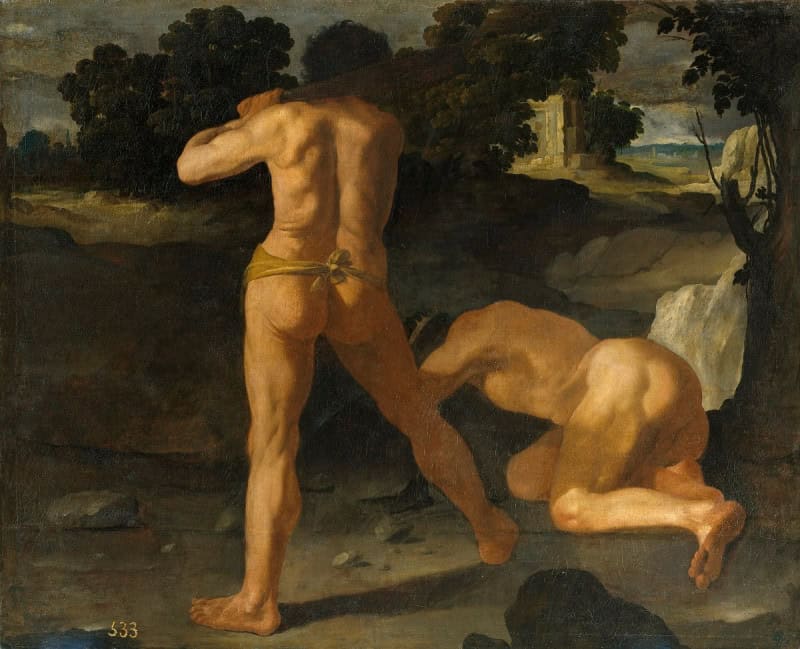
The tenth labour took Heracles to the far west to steal the cattle of Geryon, a giant whom the Theogony calls three-headed and Apollodorus three-bodied, and whose herd was guarded by the two-headed dog Orthrus, brother of Cerberus. Apollodorus has Heracles kill Orthrus and the herdsman with his club, then shoot Geryon with an arrow as he came to the rescue; on his way out he set up the Pillars of Heracles at the Strait of Gibraltar. Archaic vase painters drew Geryon as three warriors joined at the waist, three shields and three helmets; Zurbarán, more cautiously, paints a single fallen king.
11. Ladon, the dragon of the Hesperides
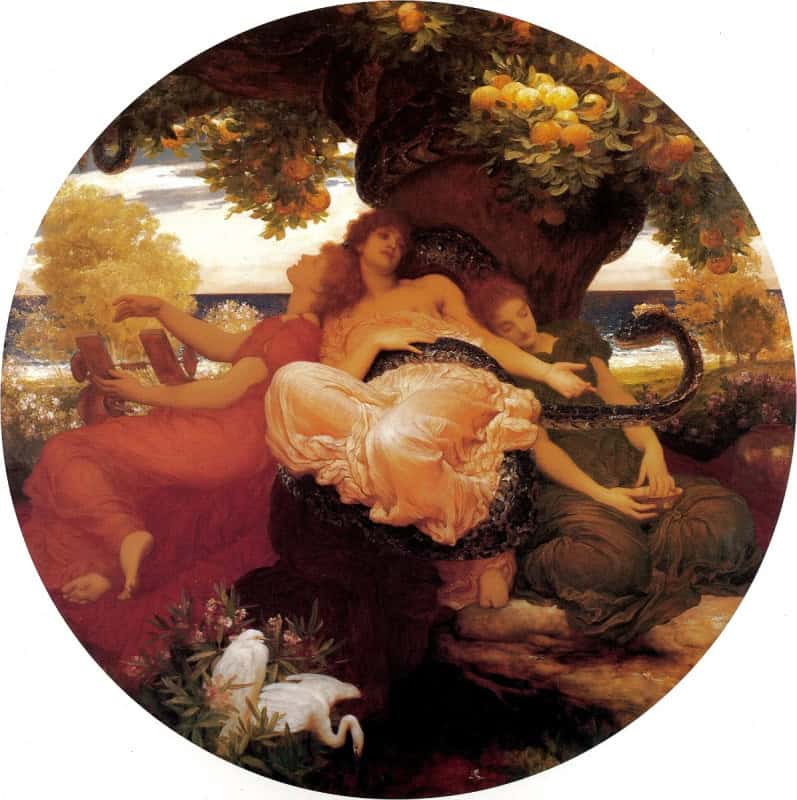
The serpent who coiled around the tree of golden apples at the edge of the world, guarding it with the three Hesperides. The Theogony names the serpent as a child of Phorcys and Ceto; Apollodorus names him Ladon and gives him a hundred heads; in the Argonautica the Argonauts find him dying of Heracles’ arrows, though the better-known version, in Apollodorus, has Heracles hold up the sky while Atlas fetches the apples instead. Leighton paints the garden in its sleepy afternoon, with Ladon wound through the sisters like a pet. The constellation Draco, in some accounts, is Ladon placed in the sky by Hera.
Hybrids and half-humans
12. The Centaurs and Chiron
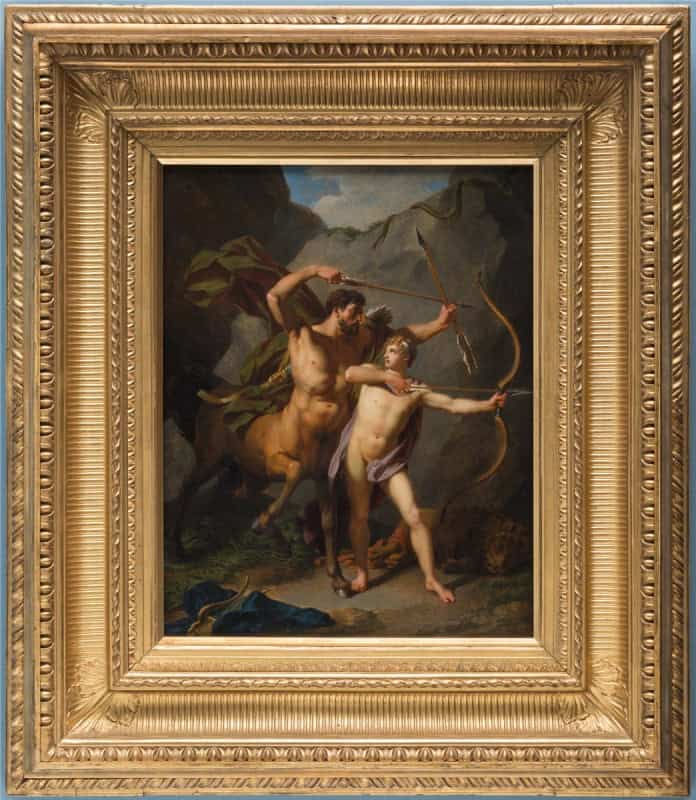
Half man and half horse, the centaurs are two different ideas wearing one body. Most of them are wild: the Centauromachy, the drunken brawl at the wedding of Pirithous in which the centaurs tried to carry off the bride and the Lapiths fought them, was carved on the Parthenon and is told in Ovid’s Metamorphoses. Chiron is the exception, the wise and immortal centaur who, in the Iliad, taught Achilles medicine, and who in later tradition tutored Jason, Asclepius and other heroes in his cave on Mount Pelion. Apollodorus tells how he was wounded by one of Heracles’ poisoned arrows during the brawl with Pholus (entry 7), could not die and could not heal, and gave up his immortality. Regnault’s painting is the eighteenth century’s favourite version of the classroom.
13. Satyrs
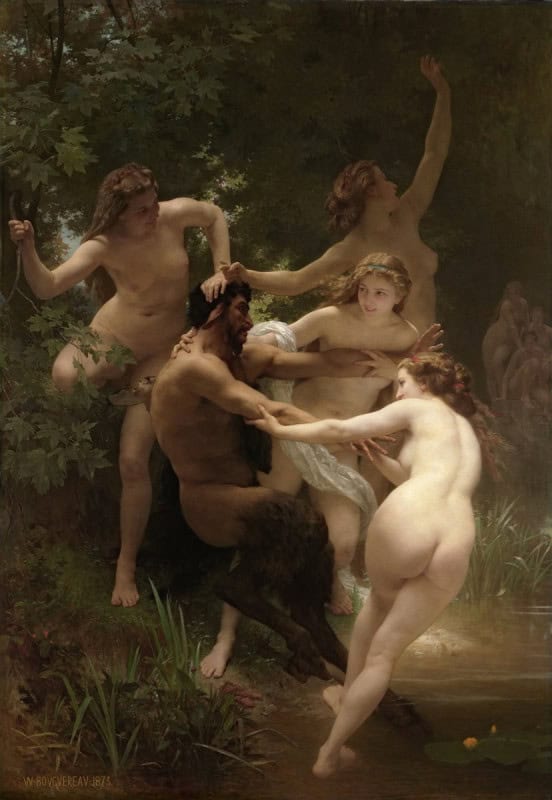
The followers of Dionysus: men with the ears, tails and later the legs of horses or goats, drunk, lustful and comic. On Athenian vases they are horse-tailed and, by convention, drawn aroused; the goat legs belong to the Roman faun and to Pan, and painters from the Renaissance onward merged the two, which is what Bouguereau’s satyr shows. Satyrs had their own genre of theatre, the satyr play, performed after a set of tragedies at the Athenian festival, and Euripides’ Cyclops, the one that survives complete, has a chorus of them enslaved by Polyphemus (entry 17). They are the ancestors of every goat-footed sidekick in fantasy, Mr Tumnus included.
14. Medusa and the Gorgons
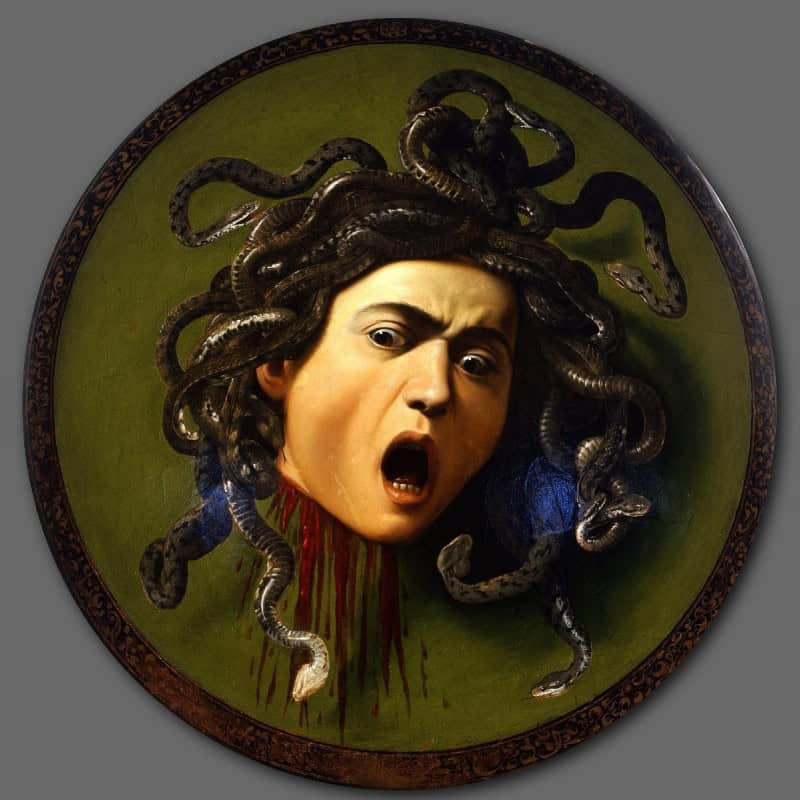
Three Gorgon sisters, daughters of the sea gods Phorcys and Ceto in the Theogony, with snakes for hair and a gaze that turned the onlooker to stone; Stheno and Euryale were immortal, Medusa was not, and so Medusa is the one with a story. Perseus, sent to fetch her head, used a mirrored shield from Athena to approach her without looking, winged sandals and a cap of invisibility from the nymphs, and a sickle from Hermes, as Apollodorus tells it; from her neck sprang Pegasus (entry 16) and the giant Chrysaor. Ovid adds that Medusa had once been beautiful and was transformed by Athena. The severed head went on Athena’s shield, which is why Caravaggio painted his on one.
15. The Minotaur
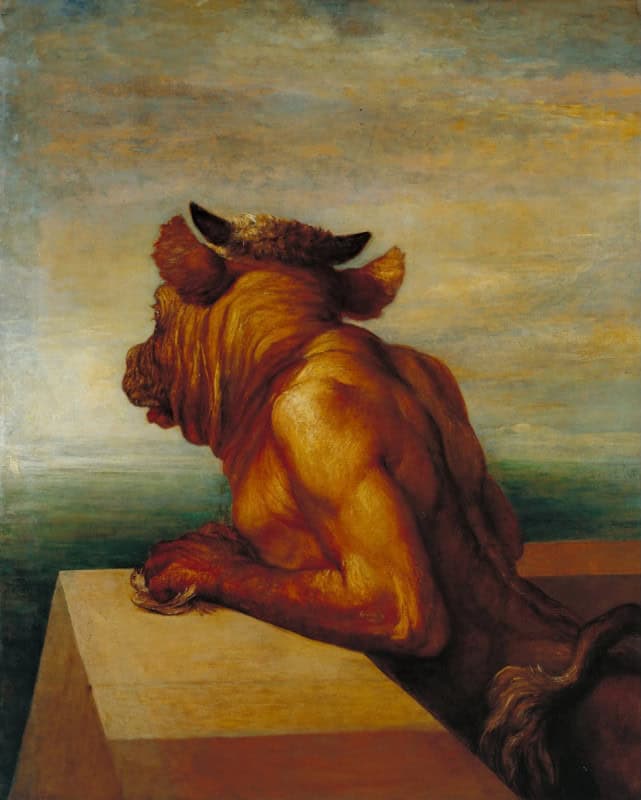
A man with a bull’s head, born to Queen Pasiphae of Crete after Poseidon’s curse (entry 9), and shut by King Minos in the Labyrinth that Daedalus built. Apollodorus and Plutarch’s Life of Theseus tell how Athens had to send seven youths and seven maidens to be fed to it, until Theseus went as one of them, was given a ball of thread by Minos’s daughter Ariadne, killed the Minotaur and followed the thread back out. The fight is one of the commonest scenes on Athenian vases. Watts, in 1885, painted the monster not fighting but waiting at a parapet for the ship of victims, a bird crushed under its hand, as a protest against the exploitation of children in London.
16. Pegasus
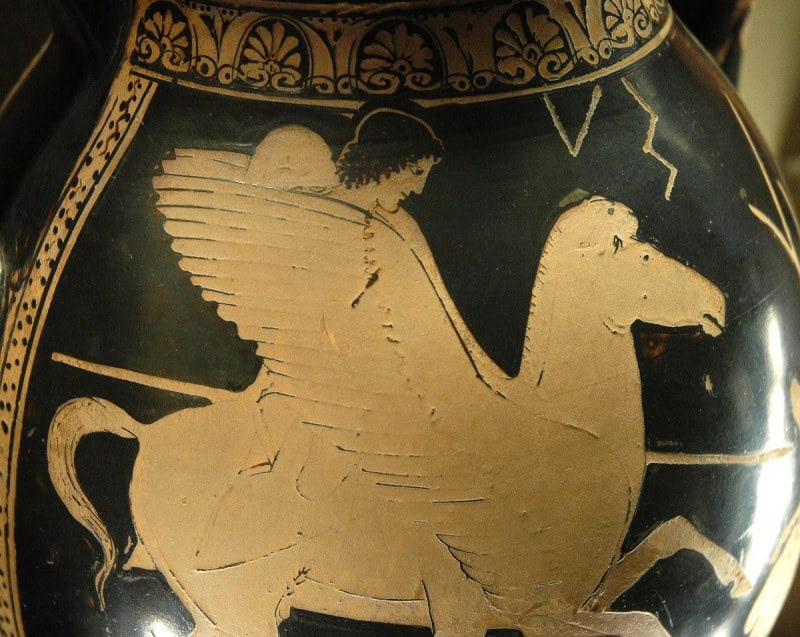
The winged horse, born from the neck of Medusa when Perseus beheaded her, according to the Theogony, which also says he flew to Olympus and carries Zeus’s thunder and lightning. His rider was Bellerophon, who in Pindar’s Thirteenth Olympian ode tamed him with a golden bridle from Athena and in the Theogony rode him against the Chimera (entry 3). Pindar tells elsewhere how Bellerophon tried to fly to Olympus and was thrown; Pegasus went on alone and became a constellation. The flying horse is the one creature here that is wholly good, which is why every airline, oil company and fantasy film has borrowed him.
17. The Cyclopes and Polyphemus
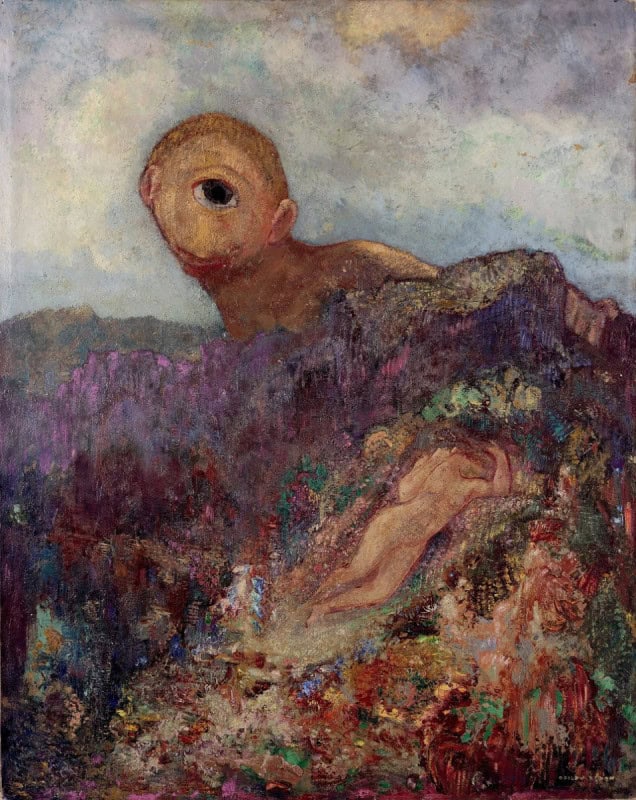
Two kinds of one-eyed giant share the name. In the Theogony the Cyclopes are three smiths, Brontes, Steropes and Arges, who forge Zeus’s thunderbolts. In the Odyssey, Book 9, they are shepherds, and Polyphemus, son of Poseidon, traps Odysseus and his men in his cave and eats several of them before Odysseus gets him drunk, blinds him with a sharpened stake and escapes under the bellies of the sheep, having told the giant his name is Nobody. Poseidon’s anger over the blinding is why Odysseus takes ten years to get home. Redon’s Cyclops is the gentler Polyphemus of Theocritus and Ovid, hopelessly in love with the sea nymph Galatea.
18. Argus Panoptes
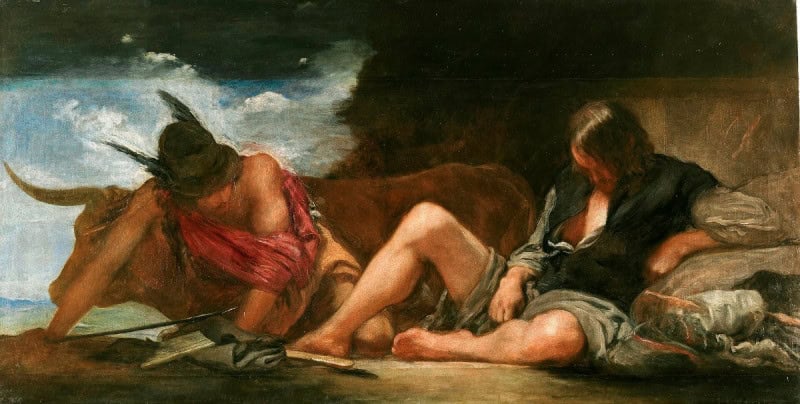
The giant with a hundred eyes, some of which were always awake, whom Hera set to guard Io, a priestess Zeus had turned into a heifer to hide her. Ovid’s Metamorphoses, Book 1, tells how Hermes lulled all hundred eyes to sleep with stories and the music of his pipes and then cut off Argus’s head, and how Hera set the eyes in the tail of her peacock. Apollodorus calls him Panoptes, “all-seeing”, and gives him a career killing monsters before his own death. Velázquez painted the moment of the kill for the royal palace in Madrid, with Io as an ordinary cow in the shadows. The hundred-eyed watchman is where “Argus-eyed” comes from.
19. The Gigantes
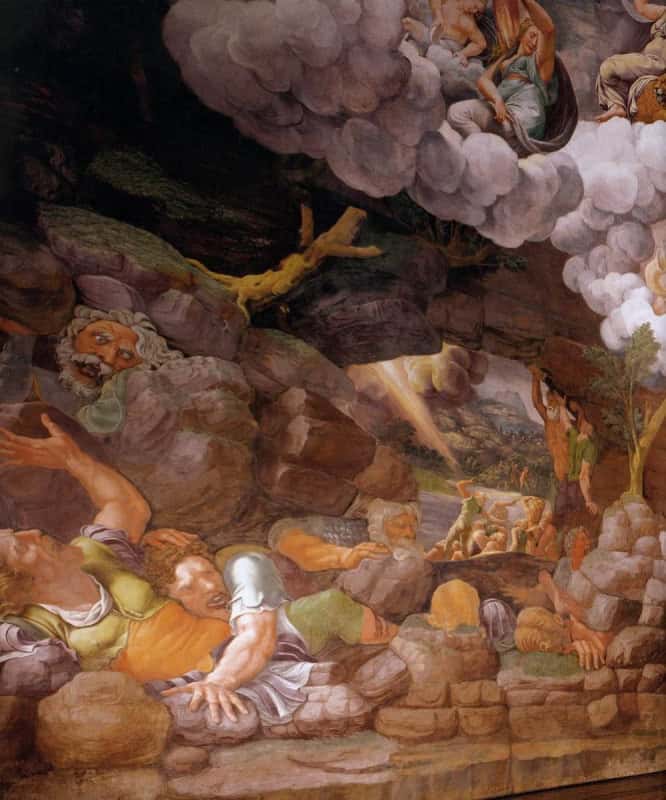
The Giants were born, in the Theogony, from the blood that fell on the earth when Cronus castrated Uranus; Apollodorus tells the Gigantomachy, their war on the gods, in which an oracle said no giant could die unless a mortal fought alongside the gods, so Heracles was brought in to finish each one with an arrow. The battle was the Greeks’ favourite subject for temple sculpture, covering the Pergamon Altar and a side of the Parthenon’s metopes, and Giulio Romano painted it across an entire room in Mantua so that the visitor stands among the collapsing columns. Later art gave the Giants serpent legs, borrowing from Typhon; Hesiod’s are simply enormous warriors.
20. Talos
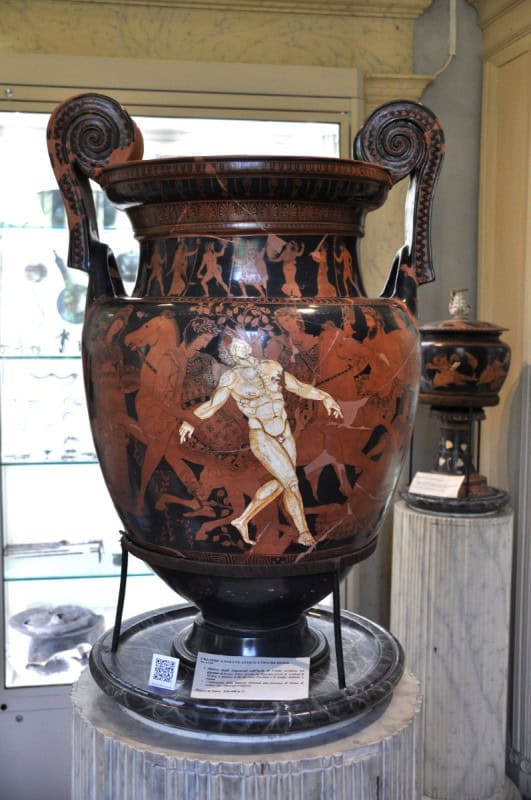
The bronze man who guarded Crete, running round the island three times a day and throwing rocks at ships. Apollodorus says he was made by Hephaestus and given to Minos, and that his one vein ran from neck to ankle and was stopped with a bronze nail; Apollonius’ Argonautica, Book 4, tells how Medea, as the Argo tried to land, bewitched him from the deck until he grazed his ankle on a rock and the ichor ran out “like molten lead”. The vase from Ruvo shows exactly that moment, the giant pale and falling between Castor and Pollux. Talos is the first robot in Western literature, and Ray Harryhausen’s stop-motion version in Jason and the Argonauts (1963) is still the one most people picture.
Monsters of the sea and the voyage home
21. Scylla
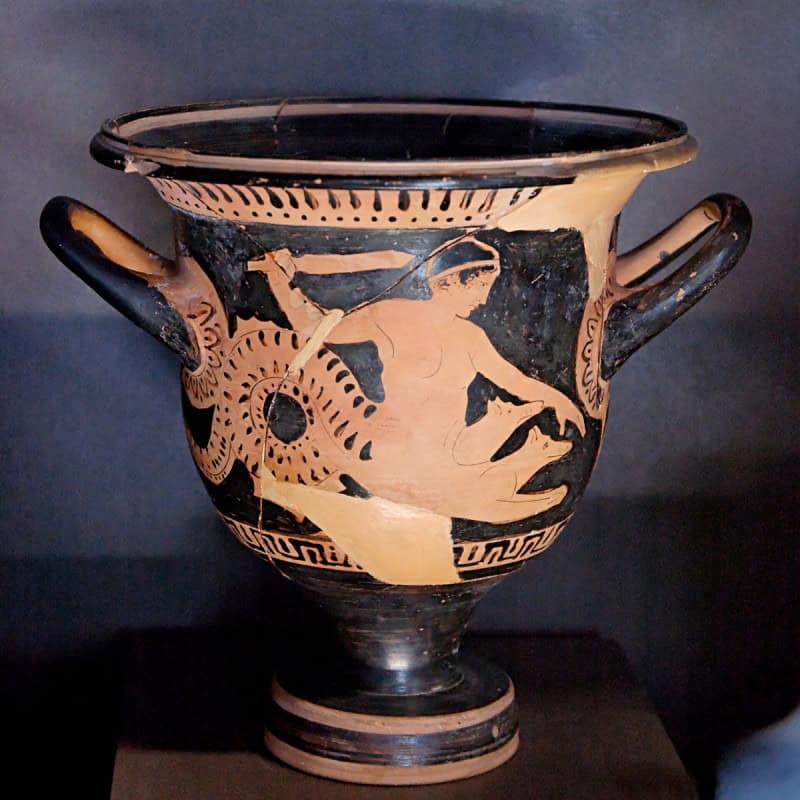
In the Odyssey, Book 12, Circe warns Odysseus of a monster in a cliff-side cave with twelve feet, six long necks and six heads each with three rows of teeth, who snatches sailors from any ship that passes; Odysseus loses six men to her. Later art and Ovid gave Scylla the form on this krater, a woman to the waist with a fish tail and a ring of dogs’ heads at her hips, and Ovid tells how she had been a nymph until the sorceress Circe, jealous, poisoned her bathing pool. The strait she haunts was identified in antiquity with Messina, between Sicily and the toe of Italy, and the town of Scilla on the Calabrian side still carries her name.
22. Charybdis
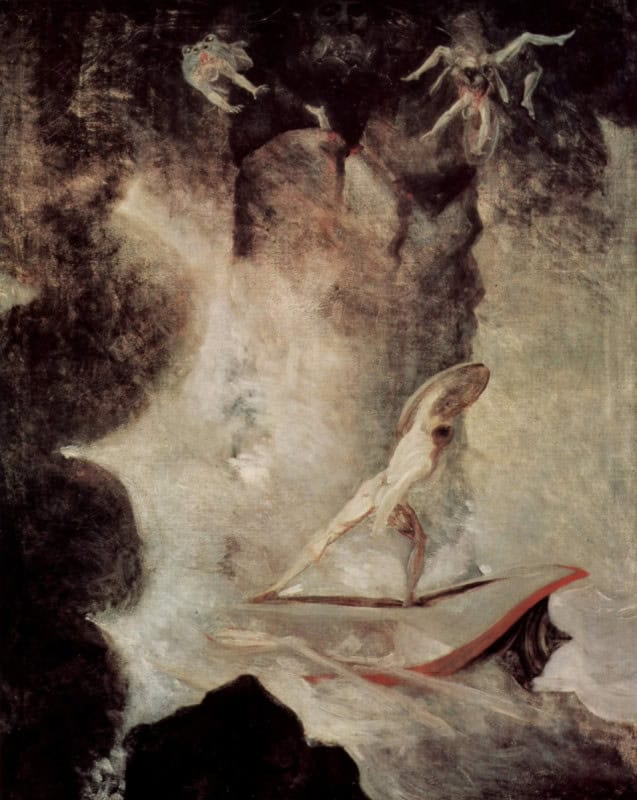
Scylla’s partner across the strait is not a body at all but a mouth: Charybdis, who in the Odyssey sucks down the sea three times a day and spews it up again, under a fig tree on a low rock. Circe’s advice is to hug Scylla’s cliff and lose six men rather than risk the whole ship in the whirlpool, and that is the choice Odysseus makes; on his second pass, alone on a raft, he survives Charybdis by hanging from the fig tree until the wreckage comes back up. Later writers make her a daughter of Poseidon and Gaia, hurled into the sea by Zeus. “Between Scylla and Charybdis” has meant a choice between two evils for centuries, and Fuseli painted the moment of choosing.
23. The Sirens
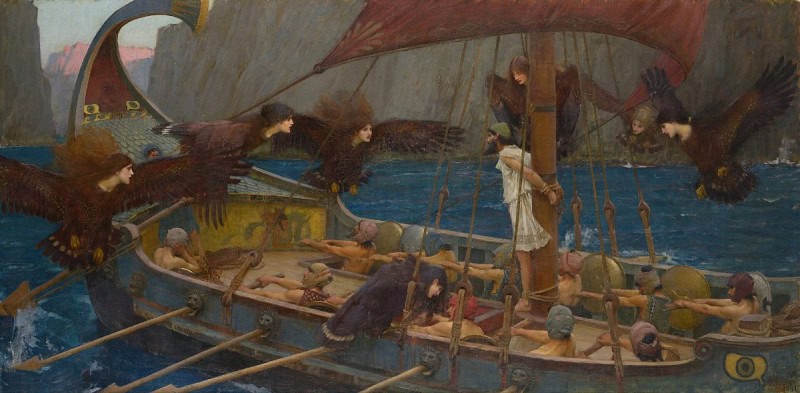
The Sirens of the Odyssey are voices first: they sit in a meadow heaped with the bones of sailors and sing a song that promises knowledge, and Odysseus, on Circe’s advice, has his crew stop their ears with wax and tie him to the mast so that he can hear it and live. Homer never describes their bodies; the vase painters made them birds with women’s heads, which is the form Waterhouse borrowed from a vase in the British Museum, and the mermaid Siren is a medieval invention. The Argonautica has Orpheus drown them out with his lyre. Only one creature on this list is more famous for its sound than its shape, and it is this one; the word has meant a warning wail since the nineteenth century.
24. Cetus, the sea monster of Andromeda
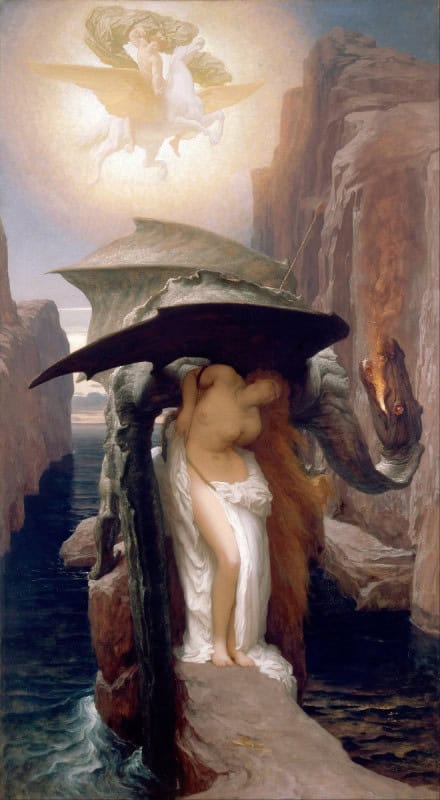
Queen Cassiopeia of Ethiopia boasted that she was more beautiful than the sea nymphs, so Poseidon sent a flood and a sea monster, and an oracle said only the sacrifice of her daughter Andromeda would end it. Apollodorus and Ovid’s Metamorphoses, Book 4, tell how Perseus, flying home with Medusa’s head, found Andromeda chained to the rock, killed the monster and married her. Ovid has him fight with a sword; later painters, Leighton among them, put him on Pegasus. The Greek word for the monster, ketos, simply means a large sea beast, and the constellation Cetus, next to Andromeda, Perseus and Cassiopeia in the sky, is the whole story drawn in stars.
25. The Colchian Dragon
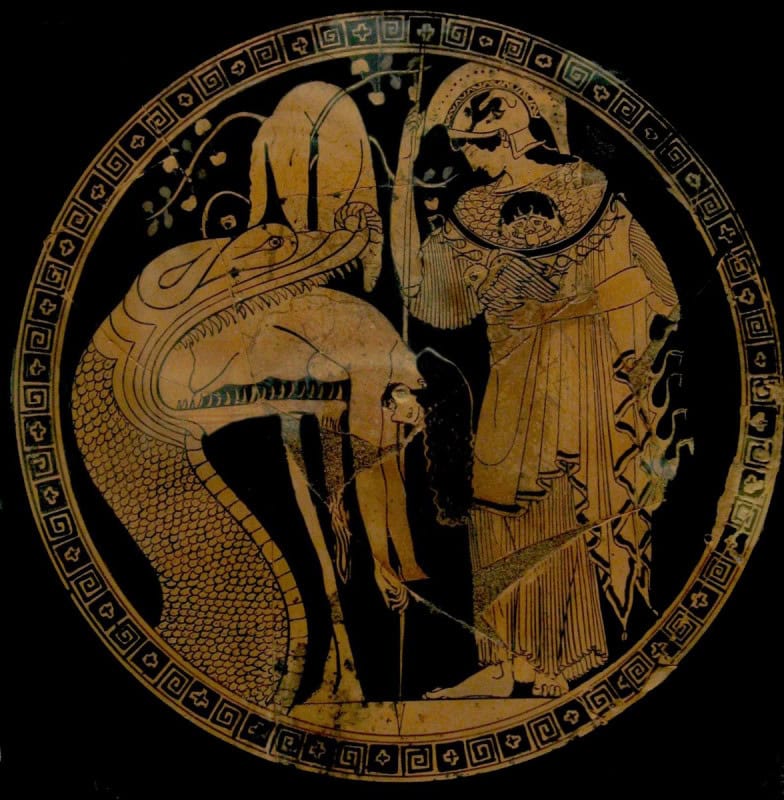
The sleepless serpent that guarded the Golden Fleece in the grove of Ares at Colchis, on the far shore of the Black Sea. In the Argonautica, Book 4, Medea sings it to sleep and sprinkles a drug on its eyes so that Jason can lift the fleece from the oak; Apollodorus agrees. The cup by Douris shows a stranger version that survives only in art, with the dragon disgorging Jason as Athena looks on, as if he had been swallowed and spat out. The dragon’s teeth Jason had already sown, to raise an army of armed men as one of King Aeetes’ tasks, were in Apollodorus half of those from the dragon Cadmus killed at Thebes, not this serpent’s. It is the ancestor of every dragon guarding a treasure, Smaug included.
26. The Harpies
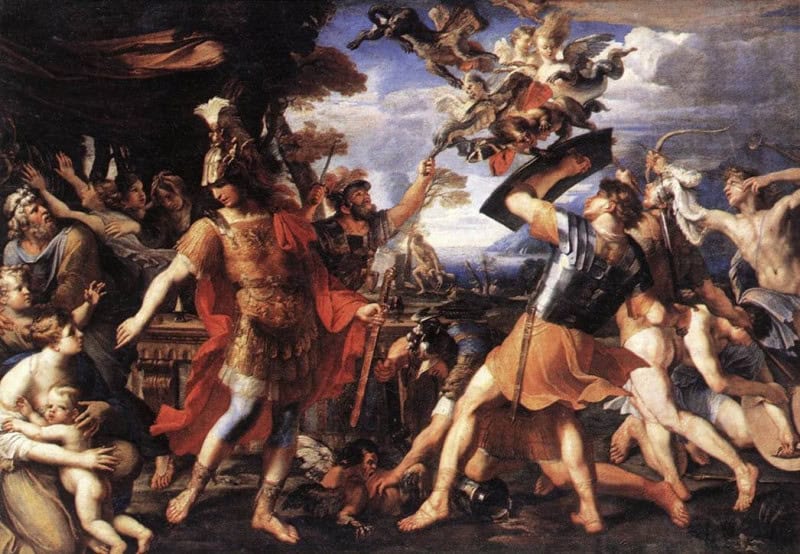
Hesiod’s Harpies are two fair-haired wind spirits, Aello and Ocypete, as fast as birds; the foul bird-women everyone pictures come from the Argonautica, Book 2, where they snatch and befoul the food of the blind king Phineus every day until the winged sons of the North Wind, sailing with the Argonauts, chase them off. Virgil’s Aeneid, Book 3, repeats the trick on Aeneas and his men, which is the scene Perrier painted. “Harpy” means “snatcher”, and the creatures are the origin of the word’s use for a grasping person, which Shakespeare was already making in the 1590s.
Spirits, serpents and the gentler kind
27. Nymphs
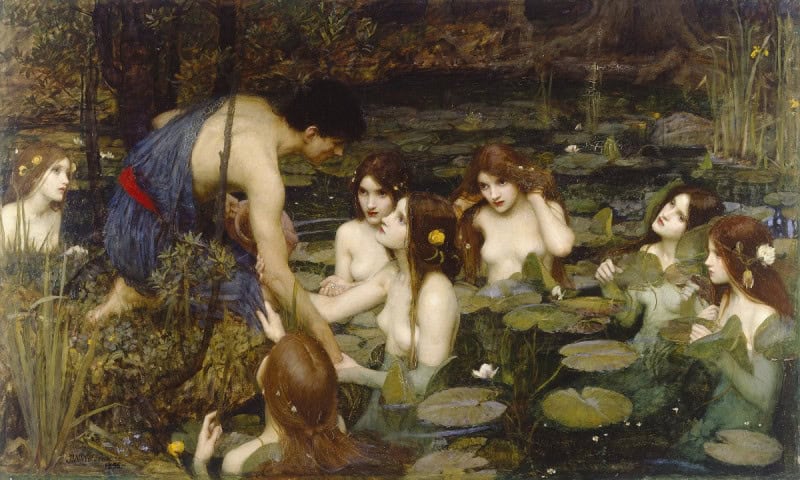
Not monsters, but on every list of Greek mythical creatures because they are everywhere in the myths: the minor goddesses of springs (naiads), trees (dryads), mountains (oreads) and the sea (nereids), young women who are long-lived rather than immortal. In the Iliad they are the daughters of Zeus; the Theogony catalogues the fifty Nereids by name. They are dangerous in their own way, and the story Waterhouse painted is the one that shows it: in the Argonautica, Book 1, the Argonauts’ youngest crew member, Hylas, goes to fetch water, the nymphs of the spring fall in love with him and pull him under, and the Argo sails without him and without Heracles, who stays behind searching. Theocritus tells the same story.
28. Python
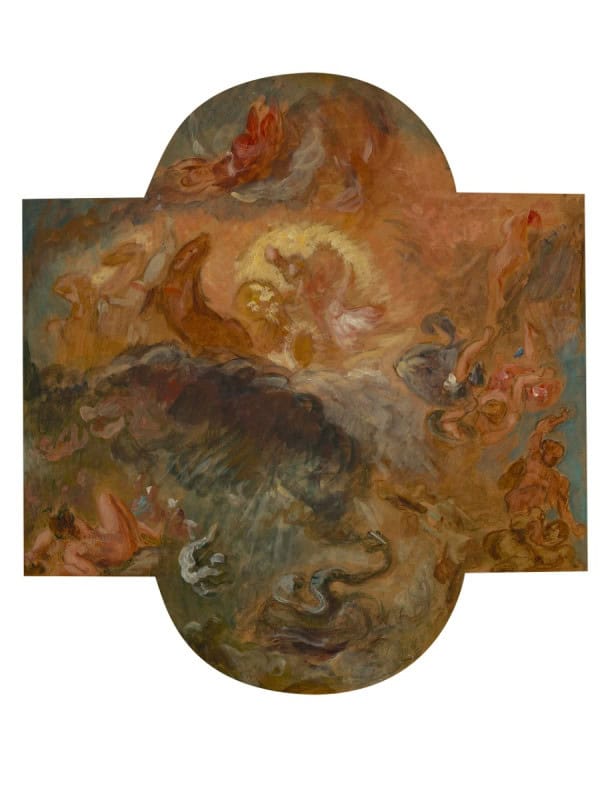
The great serpent that lived at Delphi before the oracle did. The Homeric Hymn to Apollo tells how the young god shot the she-dragon that guarded the spring and left her to rot in the sun, and derives the name Pytho from the Greek for “rot”; later authors call the serpent Python and make him male. Ovid, in Book 1 of the Metamorphoses, has Python born from the mud after the flood and founds the Pythian Games on his death. Apollo’s priestess at Delphi was the Pythia, and the snake has lent its name to a family of constrictors. Delacroix put the fight on the ceiling of the Louvre’s Galerie d’Apollon.
29. Lamia
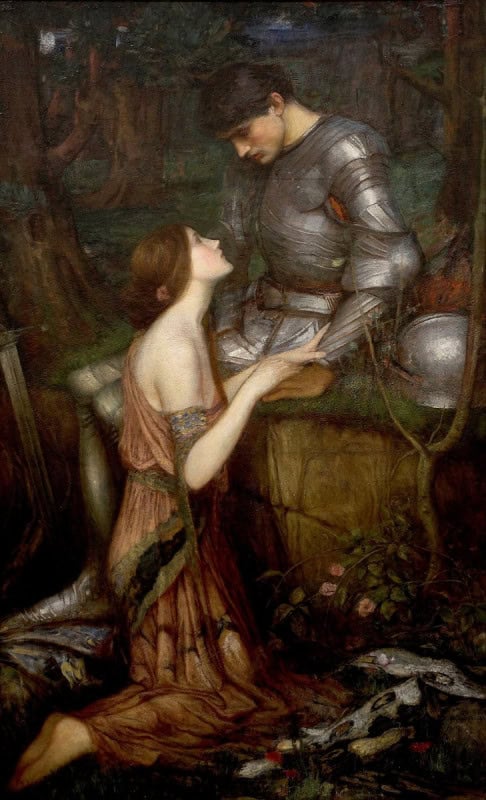
A child-devouring monster used, in antiquity, to frighten children: Diodorus Siculus tells how Lamia was a queen of Libya loved by Zeus, whose children Hera destroyed, and who in her grief took to killing other people’s. Horace, in the Ars Poetica, uses a lamia swallowing a child as his example of the unbelievable thing a poet should not show on stage. Later tradition made the lamia a seductive half-serpent who preys on young men, and that is the figure in Keats’s poem Lamia (1820), which Waterhouse painted with the shed snakeskin across her knees. She is one of the ancestors of the vampire and the succubus in later European folklore.
30. The Furies
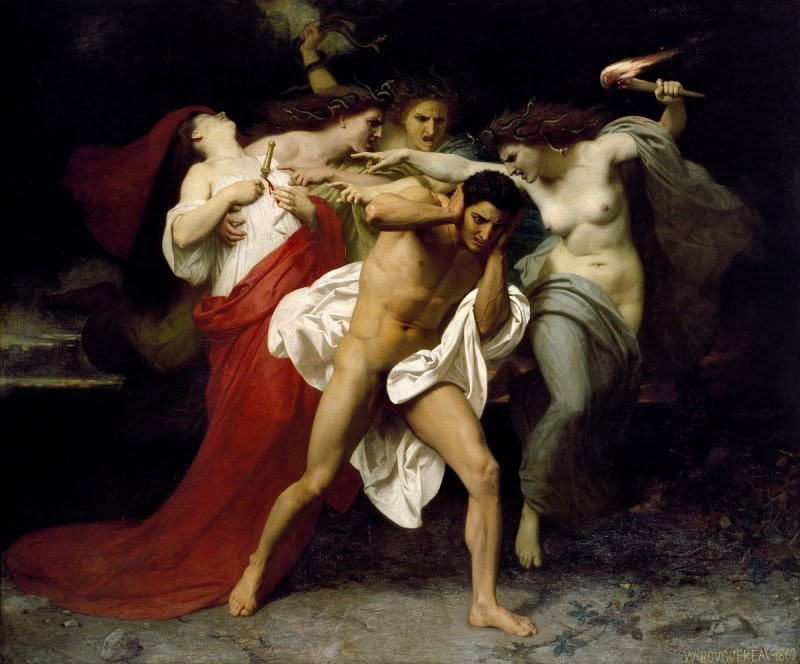
The Erinyes, born in the Theogony from the blood of Uranus, are the spirits who punish crimes within the family, above all the killing of kin. Aeschylus’s Eumenides, the last play of the Oresteia, puts them on stage as a chorus so hideous, with snakes in their hair and blood dripping from their eyes, that ancient tradition claimed women in the audience miscarried; they hound Orestes for killing his mother Clytemnestra until Athena convenes the first jury trial at Athens and, after his acquittal, persuades them to become the Eumenides, the Kindly Ones, guardians of the city. Bouguereau painted the pursuit with Clytemnestra’s body in the foreground. Of all the creatures on this list, they are the only ones who end the story employed.
Greek and Norse monsters compared
The two great European mythologies built their monsters for different jobs. Greek creatures are mostly obstacles for heroes, and the heroes win; Norse creatures are mostly agents of the end of the world, and at Ragnarök they win. Fenrir swallows Odin, where Cerberus is dragged up to Mycenae on a leash; Jörmungandr kills Thor, where the Hydra is a labour completed before lunch. The Norse mythology creatures list on this site is the companion to this one, and the Viking warriors page shows what the people who told those stories were like. Where the two traditions agree is on dragons guarding gold and serpents in the deep, which may be the oldest stories of all.
Frequently asked questions
What are the top 10 creatures in Greek mythology?
By how often they are told and painted: Medusa, the Minotaur, Cerberus, the Hydra, the Cyclops Polyphemus, the Sirens, Pegasus, the Chimera, the Sphinx and the centaurs. All ten are above, with the hero who faced each.
What is the most powerful creature in Greek mythology?
Typhon. In the Theogony he is the only creature who fights Zeus himself to a standstill before losing, and most of the other monsters on this list are his children.
Are nymphs mythical creatures?
They are minor nature goddesses rather than monsters, but they belong in any list of Greek mythical beings: they are in more myths than any monster, and the story of Hylas shows they could be as deadly as Scylla.
Which Greek monsters appear in Percy Jackson?
Most of this list: the Minotaur, Medusa, the Furies, the Chimera, the Hydra, Cerberus, Scylla and Charybdis, the Sirens, Polyphemus, Talos and the Nemean lion all turn up in the first five books, usually doing what they do in the ancient sources with a modern disguise.
Where do the images on this page come from?
Museum collections and Wikimedia Commons: Greek vases of the sixth to fourth centuries BC, an Etruscan bronze, and paintings from Caravaggio to Redon, all in the public domain except one photograph credited below.
Image credits
All images are public domain or CC0 via Wikimedia Commons, except: the Talos krater (entry 20), photograph by TONIODELBARRIO6464, CC BY-SA 4.0, via Wikimedia Commons. Vase photographs by Bibi Saint-Pol (Typhon), Marie-Lan Nguyen / Jastrow (Scylla, Pegasus) and Shii (the Colchian dragon), and the Chimera of Arezzo by Lucarelli, were released into the public domain by their photographers.
Related guides
Mythology on this site: the male Greek gods, the gods of death, destruction and the underworld, the famous statues of the Greek gods, the Norse gods and the Norse mythology creatures.