
Shortwave radio is the one broadcast medium that never needed the internet, a subscription or a mobile signal, and it is still there. Turn on a receiver after dark, extend the antenna, and you can hear the BBC World Service, Radio New Zealand, China Radio International, Radio Romania, the time signal from Fort Collins, aircraft crossing the Atlantic and, if the radio has the right mode, amateur operators talking to each other across oceans. None of that needs an account.
The problem is that “shortwave radio” on Amazon means three different products. It means a serious receiver with single side band and selectable filters, built for people who tune by frequency. It means a small travel radio with weather alerts that happens to cover shortwave too. And it means a plastic kitchen radio with an SW position on the band switch that will find two or three of the strongest stations and nothing else. All three are useful. They are not interchangeable, and the listings do not tell you which one you are looking at.
This guide sorts twelve radios into four groups: portable receivers with single side band, travel and emergency radios, tabletop world receivers, and a budget tier that is honest about what it is. Every listing was read on the day this was written, every claim about a radio comes from that radio’s own Amazon page, and the price and stock under each pick are pulled live rather than typed in and left to go stale. Receivers only: no transceivers, no software-defined radio dongles, and nothing that streams over the internet, because listening online is a different hobby with a different search.
Disclosure: As an Amazon Associate I earn from qualifying purchases. Product links in this guide are affiliate links.
The twelve at a glance
Live prices and stock below. The “Best for” and “Type” columns are our read; the “SSB?” column is read from each listing.
| Pick | Best for | Type | SSB? | Price | Stock | |
|---|---|---|---|---|---|---|
 | 1. Tecsun PL330 | The first real receiver to buy | Portable receiver | Yes | $84.98 | In stock |
 | 2. Tecsun PL880 | Filters and fine tuning in a portable | Portable receiver | Yes | $179.99 | In stock |
 | 3. XHDATA D808 | Air band and SSB for the least money here | Portable receiver | Yes | $90.10 | In stock |
 | 4. Tecsun PL990 | The portable with a proper speaker | Portable receiver | Yes | $289.99 | In stock |
 | 5. C. Crane CC Skywave 2 | The travel radio | Travel and emergency | No | $109.99 | In stock |
 | 6. C. Crane CC Skywave SSB 2 | The travel radio with SSB | Travel and emergency | Yes | $189.99 | In stock — low |
 | 7. Kaito KA500 | The crank radio with the track record | Crank and solar | No | $49.99 | In stock |
 | 8. Eton Odyssey | Crank radio with Bluetooth and a big battery | Crank and solar | No | $52.05 | In stock — low |
 | 9. Sangean ATS-909X2 | The most radio on this page | Tabletop world receiver | Yes | $347.89 | In stock |
 | 10. Sangean ATS-405 | Simple world receiver with a charger built in | Tabletop world receiver | No | $115.63 | In stock — low |
 | 11. Retekess V115 | Pocket radio that also records | Budget | No | $22.99 | In stock |
 | 12. DreamSky Portable AM/FM/SW Radio | The kitchen radio with a shortwave band | Budget | No | $27.99 | In stock |
Prices and availability as of 16:08 EDT — details
Portable receivers with single side band
These four are what most people mean by a shortwave radio once they have owned one for a month. They tune by frequency rather than by a dial, they hold hundreds of memories, three of the four list an external antenna socket, and all four decode single side band, which is the mode amateur, maritime and aviation voice traffic uses. Everything in this group also plays FM and AM perfectly well, so none of them is a single-purpose object. What separates them is how much of the receiver’s guts is analogue, how many bandwidth filters you get, and how big the speaker is.
1. Tecsun PL330
If you buy one radio from this page, this is the one. The listing covers AM, FM, longwave, shortwave and single side band, and it describes DSP demodulation with synchronous detection, which is the feature that matters: synchronous detection locks onto a station’s carrier and takes most of the fading out of a distant broadcast, and it is something you normally only find on receivers that cost a great deal more than this. It has an external antenna input, a 3.5mm audio output, 850 memories, a key lock, an alarm and a sleep timer that runs to 120 minutes, and the listing states the current firmware version, which tells you Tecsun still updates it.
The speaker is the compromise. The listing rates it at 8 ohms and 250 milliwatts, which is loud enough for a desk or a bedside table and not much more, and the earphones in the box are the way most owners will use it. That is the trade for a radio this small. Among the four receivers in this group it and the D808 are the two inexpensive ones, and the D808 below is the only one that comes close on price while offering an air band the PL330 does not have. For tuning the broadcast bands and the ham bands on a budget, start here.
2. Tecsun PL880
The PL880 is the enthusiast’s portable, and the listing explains why in one line: four selectable bandwidth filters on AM and five on single side band, with a 10 Hz tuning step in SSB. Bandwidth filters are what let you narrow the receiver to shut out a strong station sitting next to a weak one, and a 10 Hz step is fine enough to tune a side band voice signal until it sounds natural rather than like a duck. The receiver is a PLL synthesised dual-conversion design, which is the older, more analogue approach compared with the PL330’s DSP, and a lot of listeners prefer the sound of it.
Coverage is AM, FM, longwave and shortwave with SSB, there is an alarm and a sleep timer, and the listing states a one-year USA warranty. The listing’s battery details contradict each other (one AA cell and a 3.7 volt supply in the same table), so check before you buy if that matters to you. It costs roughly twice what the PL330 does, and what the extra buys is the filter set and the tuning step, not more bands. If you already know you want to listen to amateur voice traffic rather than just broadcasters, this is the portable to get.
3. XHDATA D808
The D808 is the radio the PL330 buyer should look at before deciding, because it adds the VHF air band (118 to 137 MHz, per the listing) for only a little more money. The listing states the full coverage: FM 64 to 108 MHz, AM 520 to 1710 kHz, longwave 153 to 513 kHz, shortwave 1711 to 29999 kHz, air band, and single side band, all on a DSP chip. It holds 500 memories, shows a signal-to-noise reading on the display so you can find the best spot in the room, and has an alarm and a temperature readout.
Power is a replaceable rechargeable battery charged over USB-C at 5 volts, with the remaining charge shown on screen, and the listing says a carry bag, an external antenna, a USB cable and an English manual come in the box. XHDATA is a newer name than Tecsun and the review count on this listing is a fraction of the PL330’s, which is the honest reason it sits third. On paper it has the widest band coverage of any radio under the hundred-dollar line on this page; in the hand, the Tecsun has the longer record.
4. Tecsun PL990
The PL990 is the PL330’s big brother and the difference is mostly in the parts you can hear. The listing describes analogue high-IF AM circuitry plus a triple-conversion IF, with the same DSP demodulation and synchronous detection as the PL330 behind it, and a 4-ohm, 3-watt speaker driven by a class AB amplifier. That is twelve times the rated output of the PL330’s speaker, and it is the reason this is the portable to buy if you will listen through the speaker rather than earphones. Memories go up to 3,150.
It also plays music files: the listing describes an MP3 player with a micro-SD slot that handles FLAC, WAV, APE, WMA and MP3, with a 16 GB SanDisk card included, and a USB audio input. If you are also shopping for a dedicated music player, our guide to iTunes-compatible MP3 players covers that job properly; here it is a bonus. Note the listing’s own warning that no standalone lithium battery is sold with the radio. It is the most expensive portable here and costs a little more than three PL330s, so the case for it is the speaker and the triple-conversion front end, not the band list, which is the same.
Travel and emergency radios
This group is for people who want shortwave as one band among several, in a radio that also does NOAA weather alerts and runs for days on AA cells or a crank. The two C. Crane radios are travel radios first: small, well built, with an aviation band. The two crank radios are emergency radios first, with shortwave as a bonus. If you are choosing between the groups, ask whether you will ever tune shortwave deliberately. If yes, buy from the first group and keep a crank radio in the car.
5. C. Crane CC Skywave 2
C. Crane makes radios for people who listen to radio, and the Skywave 2 is its travel model. The listing covers AM, FM, NOAA weather with alert, shortwave from 2300 to 26100 kHz and the VHF aviation band, in a case the listing puts at 4.75 by 3 by 1.1 inches and 6 ounces without batteries. It runs on two AA cells for around 70 hours on earbuds or 60 through the speaker by the listing’s figures, which is the kind of number that makes it a genuine travel radio rather than a gadget. There are 400 memories, ten aviation memories that can be scanned for activity, direct frequency entry, fast and fine tuning on every band except weather, and a shortwave antenna jack.
The box includes CC Buds earphones and a faux-leather case, and the listing states a one-year warranty with US-based support. What it does not have is single side band, and that is the only reason to look at the SSB 2 below. For hotel rooms, camping and the glovebox, this is the one to buy; it costs a little more than a PL330 and well under a PL880, and what you are paying for is the build and the weather band rather than the receiver.
6. C. Crane CC Skywave SSB 2
The same radio with single side band added and the shortwave coverage widened to 1711 to 29999 kHz, which the listing calls one of the smallest multiband radios with SSB. Everything else carries over: the aviation band with ten scannable memories, 400 memories in total, NOAA weather with alert, multiple bandwidth settings, the lighted display, the antenna jack, and roughly 70 hours on earbuds or 60 on the speaker from two AA cells. The listing adds a 23-foot portable reel antenna to the box alongside the earphones and case, which is the accessory the first group’s buyers have to purchase separately.
The listing’s own pitch is that side band is a way to hear long-range information after a hurricane or earthquake when normal communications are down, and it is fair to read that as marketing; what SSB actually gives you day to day is the amateur bands and the utility stations. Between the two Skywaves the SSB 2 costs about eighty dollars more, and if you will never tune below the broadcast bands the plain Skywave 2 is the better buy. If you want one radio that does travel, weather and side band in a shirt pocket, nothing else on this page does all three.
7. Kaito KA500
The KA500 has more reviews than any other radio on this page, and it earned them by being the crank radio that works. The listing describes six ways to power it: the hand crank, a solar panel, a compartment for three AA cells, a 5-volt USB input, a 5-volt AC/DC input with an adapter sold separately, and a built-in NiMH battery pack that can be replaced. It covers AM, FM, two shortwave bands and seven preset NOAA weather channels with the public emergency alert system, and it will charge a phone from a standard USB port. There is a five-LED reading lamp, a flashlight and a red SOS beacon, and the listing says the case is impact- and water-resistant ABS.
Understand what “two shortwave bands” means: this is a radio with a tuning dial rather than a frequency display (the listing describes an LED signal-strength indicator and no digital readout) and a 14.5-inch telescopic antenna, and it will pull in the big international broadcasters and not much of the rest. That is what it is for. It is the cheapest radio in this group and cheaper than every receiver in the first group, and it belongs in a car or a kitchen drawer rather than on a desk next to a logbook. Buy it for the crank and the weather alerts, and treat the shortwave band as a bonus you will be glad of once or twice a year.
8. Eton Odyssey
Eton’s answer to the KA500, and the two are close enough that the choice comes down to two features. The Odyssey has a digital tuner with a large backlit display, which the Kaito does not, so you can see the frequency you are on rather than guessing from a dial. And it has Bluetooth, so it can play music from a phone through its speaker, which turns it into something you might use on an ordinary weekend rather than only in a power cut. The listing covers AM, FM, shortwave and NOAA weather with RDS and both visual and audible alerts, a solar panel and a hand crank feeding a 2000 mAh rechargeable battery, a three-LED flashlight with high, low and flood settings plus an SOS alarm, and a USB output for charging a phone.
The listing does not state how many shortwave bands it covers or the frequency range, so we will not guess; assume it is the broadcaster-only kind of shortwave, like the Kaito. It costs a couple of dollars more than the KA500 and has a small fraction of the reviews. If the digital display and Bluetooth matter, this is the crank radio to buy; if a long track record matters more, the Kaito.
Tabletop world receivers
These two are for a desk or a shelf rather than a pocket. Both come with an AC adapter and a built-in battery charger, and the bigger one is the radio you plug an outdoor antenna into. One of them is the most capable receiver on this page by a distance; the other is a simpler, older design that still does the job for broadcast listening.
9. Sangean ATS-909X2
The ATS-909X2 is the most radio on this page and the listing reads like a specification sheet. It covers FM, mediumwave, longwave, shortwave and the air band from 118 to 137 MHz, with single side band in both upper and lower modes at a 10 or 20 Hz fine step, manual and automatic bandwidth control, a squelch, and dual conversion on shortwave, longwave, mediumwave and air. There are 1,674 station presets in three banks, 42 world time zones, an auto-tuning system on longwave, mediumwave, shortwave and FM, five tuning methods including a rotary knob, RDS on FM, and a 3.33 by 1.95 inch backlit display that shows signal-to-noise and signal-strength figures. Tone controls, three alarms, a sleep timer, a dedicated headphone amplifier, an aux input and a line output round it out.
The listing says the switchable AC adapter, the ANT-60 reel antenna, a carrying pouch and stereo earbuds are in the box, that the built-in charger detects faulty cells, and that there is a 2.5mm jack for switching on an external recorder from the alarm, which tells you who this radio is designed for. It costs about four times what a PL330 does and more than a PL990, and the honest question is whether you will use the filters, the air band and the memory banks. If you will, nothing else here comes close. If you will not, the PL330 receives the same broadcasters for a quarter of the money.
10. Sangean ATS-405
The ATS-405 is Sangean’s simpler world receiver, and it is here for the listener who wants a proper keypad radio with an adapter in the box and no interest in side band. The listing gives full shortwave coverage from 2.3 to 26.1 MHz with the 14 metre bands, mediumwave from 520 to 1710 kHz and two FM ranges, with 1 kHz fine tuning, 108 presets split evenly across FM, AM and shortwave, a squelch, and five tuning methods including direct keypad entry. It runs on four AA cells with a built-in charger and an LED to show it is working, and the pouch and AC adapter are included.
There is no SSB and the listing is quiet on bandwidth filters, so this is a broadcast-band radio, not a utility receiver. It costs a little more than a PL330 and less than a PL880, and at that price the PL330 is the stronger receiver on paper. What the ATS-405 offers instead is the tabletop form, the included adapter and charger, and the Sangean name. Stock on the listing was low when this was written, so if it is the one you want, do not wait.
Budget radios with a shortwave band
Two radios that cost about what a reel antenna for the ones above does, and they sell in very large numbers. Neither is a receiver in the sense the first group uses the word. Both will find the strongest international broadcasters at night, both are fine AM and FM radios, and both are honest value if that is all you want. We have left out the cheapest pocket radios of all, which sell even faster, because a tier of near-identical listings that cannot be told apart is not a recommendation.
11. Retekess V115
The V115 is a pocket AM, FM and shortwave radio that does two things the rest of the budget tier cannot: it records, and it plays music from a card. The listing describes recording the radio or an external source to a TF card at three quality settings, and playing back audio files from the same card with repeat, random and directory modes and direct track-number entry. Tuning is digital, with automatic search and store, manual frequency entry, and an AM step that switches between 9 and 10 kHz for use outside the Americas. It runs on a 1000 mAh BL-5C battery, plays while charging, and the listing puts a full charge at four to five hours for six to eight hours of use at medium volume.
BL-5C is the designation Nokia used for its phone batteries, so replacements are easy to find, which is a quiet advantage on a radio this cheap. It is the least expensive radio on this page and it has more reviews than anything here except the Kaito. Buy it as a second radio, a bedside radio or a first shortwave radio for a child; it will show you whether you want the hobby before you spend real money on the first group.
12. DreamSky Portable AM/FM/SW Radio
The DreamSky is the kitchen radio of the group, and it is the best-selling radio on this page by the listing’s own past-month figure. The listing leads with a large speaker, analogue controls (a big volume knob and a tuning wheel), a high and low tone switch, an earphone jack, and a backlit digital display that shows the station and a 12 or 24-hour clock. It runs from the included AC adapter or from four AA cells, and it covers AM, FM and shortwave from its built-in antenna.
The listing gives no shortwave frequency range, so treat the SW position as a band that will find the biggest broadcasters and nothing subtle. That is exactly what its buyers want, and the review count says they are getting it. It is not the radio for anyone who has read this far with interest; it is the radio for the person you are buying a present for who wants a loud, simple set with a dial. For that job it is the right choice, and it costs a few dollars more than the V115.
The one accessory that changes everything: an antenna
A telescopic whip is a compromise. Shortwave signals are long, and a few feet of wire clipped to the whip or plugged into the antenna jack will bring in stations the whip cannot hear at all. Three of the four receivers in the first group list an external antenna input, both Skywaves list a shortwave antenna jack, and the ATS-909X2 and the Skywave SSB 2 ship with a reel antenna in the box. For everything else, these two are the ones to add. We cover the same principle for television in our guide to omni-directional TV antennas; the physics is the same, the wire is just longer.
| Pick | Best for | What it is | Price | Stock | |
|---|---|---|---|---|---|
 | Sangean ANT-60 Reel Antenna | The wire antenna most receivers want | 23 feet of wire on a reel, 3.5mm plug plus a clip adapter | $26.84 | In stock |
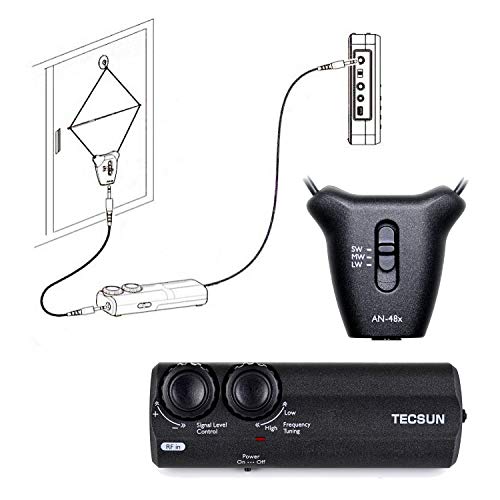 | Tecsun AN-48X Active Loop Antenna | For flats and rooms where you cannot hang a wire | Powered indoor loop for AM, SW 3.5 to 20 MHz and LW, 2 AAA batteries | $44.99 | In stock |
Prices and availability as of 16:08 EDT — details
The ANT-60 is the simple answer: the listing describes 23 feet (7 metres) of wire that winds back into a pocket-sized case, terminated in a 3.5mm plug, with a clip adapter for radios that have no antenna jack. String it across a room or out of a window and plug it in. The AN-48X is for people who cannot run a wire: the listing describes a powered indoor loop covering AM from 520 to 1700 kHz, shortwave from 3.5 to 20 MHz and longwave from 120 to 400 kHz, on two AAA cells, with a set of connection cables for different radios, and it is marked indoor use only. A loop can also be turned to null out interference, which a wire cannot do.
How to buy a shortwave radio in 2026
Single side band, and whether you need it
Broadcasters transmit in ordinary AM, and any radio with a shortwave band will decode them. Amateur operators, ships, aircraft on long ocean routes and most military and utility stations transmit in single side band, which strips out the carrier to save power, and an AM-only radio turns those signals into unintelligible noise. A receiver with SSB (the listings call it “single side band”, “SSB” or “USB/LSB”) can decode them. If your interest is the BBC and Radio Romania, you do not need it. If you want to hear people rather than stations, you do, and it is the one feature you cannot add later.
Sensitivity, selectivity and bandwidth filters
Sensitivity is how weak a signal the radio can hear. Selectivity is how well it can separate that signal from a stronger one next door, and on a crowded shortwave band at night that matters more. Selectable bandwidth filters are the tool for selectivity: a wide filter sounds better on a strong station, a narrow one lets you dig a weak one out from beside a strong one. The PL880 and the ATS-909X2 make a point of their filter sets in their listings; the budget radios have none. Synchronous detection, which the PL330 and PL990 list, is a separate trick that reduces the fading you hear on distant AM broadcasts.
DSP, PLL and the analogue question
Almost every modern portable uses a DSP chip to do the demodulation in software, which is why a radio the size of the PL330 can do things that used to need a desktop set. Older designs like the PL880 use a PLL synthesiser to set the frequency and analogue circuits to process the signal, and the PL990 combines an analogue front end with DSP behind it. None of these is simply better. DSP radios tend to be cheaper for the features; analogue front ends tend to handle very strong signals more gracefully. If you cannot decide, the PL330 is the safe choice and the PL880 is the one you will not want to sell.
Power: AA cells versus built-in packs
The Skywaves, the ATS-405, the ATS-909X2 and the Kaito’s battery compartment all take AA cells, which you can buy anywhere in the world and swap in the dark. The D808, the V115 and the crank radios use rechargeable packs, some of them replaceable and some not, charged over USB. For a radio that lives at home, a rechargeable pack is more convenient. For a radio that travels or sits in an emergency kit, AA cells are the safer bet, and a crank is the safest of all. Check the listing before you buy: several of the radios above ship without a battery.
What you can still hear
Less than there was twenty years ago, and more than people assume. The BBC World Service still broadcasts on shortwave to Africa and Asia and is audible far beyond them after dark. Radio New Zealand Pacific, China Radio International, Radio Romania International, Radio Havana Cuba, NHK World and a dozen religious broadcasters run daily schedules. The time and frequency stations WWV and WWVH transmit around the clock. Aircraft crossing the North Atlantic report their positions in side band, and the amateur bands are busy every evening. A printed or online frequency schedule is the other purchase to make, and it costs nothing.
What this page leaves out, and why
Transceivers, which transmit as well as receive, need an amateur licence and are a different purchase with a different budget. Software-defined radio dongles turn a computer into a receiver and are excellent, but they are a computer accessory, not a radio. Internet radios that stream shortwave stations over Wi-Fi are not shortwave radios at all, however the listing is worded. And the very cheapest pocket radios, which sell in enormous numbers, were left out because a tier of listings that differ only in the brand name printed on the front cannot be recommended one over another. If you want cheap, the V115 is cheap and has a track record.
Frequently asked questions
Is shortwave radio still worth it?
If you want news and music from other countries without the internet, yes, and it is the only medium that still delivers that. The broadcaster list is shorter than it was in 1990 and longer than most people think, and the amateur and utility bands never went anywhere.
Which is the best shortwave radio for a beginner?
The Tecsun PL330. It has single side band, synchronous detection and an antenna socket, so you will not outgrow it in a month, and it costs less than the travel and tabletop radios that lack one or more of those. Add a reel antenna.
Do I need an external antenna?
Not to hear the big broadcasters. To hear anything else, a few metres of wire makes more difference than any upgrade to the radio itself, and it costs a fraction as much.
What is the difference between a shortwave radio and a ham radio?
A shortwave radio receives. A ham radio, properly a transceiver, transmits too, and transmitting needs a licence. Everything on this page is a receiver; a receiver with SSB can listen to ham operators without being one.
Can a shortwave radio pick up NOAA weather alerts?
Only if it has a weather band, which is separate from shortwave. On this page the two Skywaves, the Kaito KA500 and the Eton Odyssey list NOAA weather with alerts; the four portable receivers and the two Sangean tabletops do not.
The short version
Buy the Tecsun PL330 and a Sangean ANT-60 if you want to find out what shortwave is. Buy the PL880 if you already know and want the filters. Buy a Skywave if the radio will travel, the SSB 2 if it will travel and you want side band, and a Kaito KA500 for the car. Buy the ATS-909X2 if you want the most receiver on the page and will use it. And if what you actually want is a loud, simple radio for the kitchen with a shortwave position on the switch, the DreamSky is that radio and there is nothing wrong with it. If the same shelf holds your tapes, our guide to the best cassette players was written the same way.
Product prices and availability are accurate as of the date/time indicated and are subject to change. Any price and availability information displayed on Amazon.com at the time of purchase will apply to the purchase of this product.