
CDs stopped being the default about twenty years ago, and then something odd happened: people kept the discs. Boxes of them, in lofts and garages, ripped once to a hard drive that has since died.
If you want to play them again on something better than a laptop, the market has quietly reorganised around you. The audiophile end still sells separate CD transports for the price of a holiday. The cheap end is full of $30 boomboxes. The useful middle — a proper shelf system with real speakers, a disc tray, and Bluetooth so the rest of the household can still use it — is where almost all the good options now sit, and it is the part of the market nobody writes about carefully.
All ten systems below were checked live on Amazon on 19 August 2026 for rating and availability. Price and stock for each pick update automatically from Amazon.
Disclosure: As an Amazon Associate I earn from qualifying purchases. Product links in this guide are affiliate links.
What Actually Matters When Buying a Home CD Player
Decide first whether you want a system or a component. A component CD player has no speakers and no amplifier; it needs an existing stereo to plug into. A shelf or micro system is the whole thing in one box. Most people searching for a home CD player want the second and buy the first by accident. Nine of the ten below are complete systems; one is a component.
Ignore quoted wattage. Manufacturers of budget audio quote peak or PMPO figures with no agreed definition. A “240W” micro system is not eight times louder than a 30W one in any way you can hear. Cabinet size and driver quality decide how it sounds, which is why some of the lower-powered systems below sound better than higher-rated ones.
Check which direction Bluetooth goes. Almost every system here receives Bluetooth from a phone. Far fewer transmit to wireless headphones, which is the feature people most often assume is present and then discover is not.
A disc changer is a different product. If you want to load five or six albums and leave them, you need a carousel changer, and there are now very few on sale. If you only ever play one album at a time, a changer is a mechanism that can go wrong for no benefit.
Watch for DVD players sold as CD players. Amazon’s results for this search are full of $30–60 DVD players that happen to read CDs. They will play a disc through a television, but they have no speakers and no amplifier, and they are not what this guide covers.
The 10 Best Home CD Players at a Glance
| Pick | Best for | Rating (Aug 2026) | Price | Stock | |
|---|---|---|---|---|---|
 | Philips FX10 | Best all-rounder | 4.3★ | $249.99 | In stock |
 | Onkyo DX-C390-B | Best multi-disc changer | 4.2★ | $290.50 | In stock |
 | Sharp CD-BH950 | Best if you still have cassettes | 4.2★ | — | Unavailable |
 | Panasonic SC-PM700 | Best sound per pound | 4.2★ | $185.17 | In stock — low |
 | Aiwa CD player | Best one-box system | 4.1★ | $159.39 | In stock |
 | Panasonic SC-PM270 | Highest rated here | 4.4★ | $139.99 | In stock |
 | LONPOO 30W | Best gift-ready set | 4.3★ | $126.23 | In stock |
 | Oakcastle HiFi400 | Best solid-wood system | 4.1★ | $84.95 | In stock |
 | 40W Bluetooth system | Best budget all-rounder | 4.2★ | $109.00 | In stock |
 | LP-886 micro system | Cheapest we would recommend | 4.2★ | $85.31 | In stock |
Prices and availability as of 16:07 EDT — details
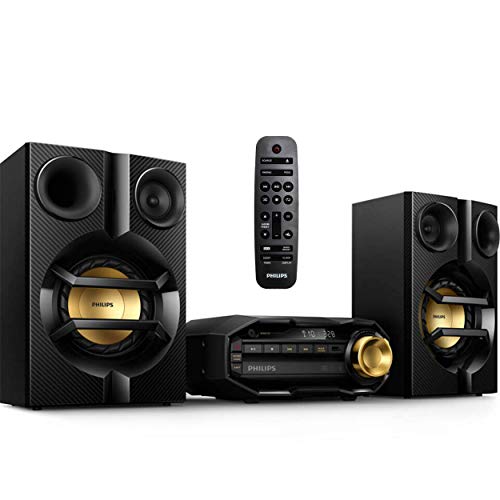
1. Philips FX10 Bluetooth Stereo System with CD Player — Best all-rounder
The FX10 is the one to buy if you want a single box that does everything competently and does not look like a gadget. It is a two-piece system with separate speakers, a front-loading CD tray, Bluetooth streaming, an audio-in socket for anything without Bluetooth, and a digital tuner with presets.
Philips quotes 230W, which as discussed above is a number to ignore. What matters more is the dual-amplifier arrangement, which drives each channel separately rather than splitting one amp, and generally shows up as cleaner separation at volume.
Rated 4.3 stars. It is the most expensive complete system here apart from the Sharp, and the one most likely to satisfy someone replacing a real hi-fi rather than a kitchen radio.
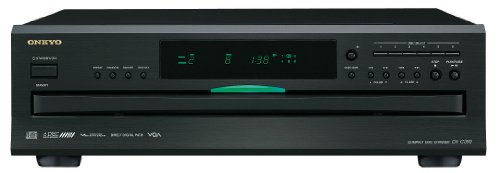
2. Onkyo DX-C390-B 6-Disc CD Carousel Changer — Best multi-disc changer
This is the only true component in the guide. It has no speakers and no amplifier — it is a CD player that plugs into a stereo you already own, and if you do not own one it will make no sound at all.
What it does that almost nothing else still does is hold six discs on a carousel and let you swap five of them without interrupting playback. Onkyo also fits optical and coaxial digital outputs, so you can bypass its internal converter and let a better amplifier handle it. That combination is genuinely rare in 2026.
One thing to check before ordering. This listing quotes two different power specifications. One line reads AC 220–230 V, 50/60 Hz; another states “AC 120 V 60 Hz (North American model); AC 230 V 50 Hz (Other than North American models)”, and advises checking the rating printed on the unit’s rear panel. So a North American 120V version does exist. Confirm which version the seller is actually shipping before you buy — running a 230V unit on a 120V supply will not work properly.
Rated 4.2 stars.
3. Sharp CD-BH950 240W 5-Disc Mini Shelf System — Best if you still have cassettes
If you have a box of cassettes as well as a box of CDs, this is effectively the only current product that plays both without buying two machines.
It holds five CDs on a tray carousel plus a cassette deck, reads CD-R, CD-RW, WMA and MP3 discs, streams over Bluetooth from anything, and has a 40-preset digital AM/FM tuner. The speakers use a 5.12-inch woofer and a 2-inch tweeter per side, which is a real two-way design rather than a single full-range driver, and it includes a headphone output, line-in, USB and a remote.
Sharp quotes 240W. Treat that as marketing. The reason this sounds better than the cheaper systems is the cabinet and driver size, not the number.
Rated 4.2 stars — the most expensive item here, and the only one that solves the cassette problem.
4. Panasonic SC-PM700 80W Compact Stereo System — Best sound per pound
Panasonic quotes 80W (40W + 40W) RMS, and the RMS qualifier is the point. RMS is a measured continuous-power figure with an agreed definition, unlike the peak numbers most of this category advertises. Five of the ten listings here publish an RMS figure; the other five quote peak or unqualified numbers, and those are the ones to discount.
You get a CD player, FM radio and Bluetooth, playback from USB flash drives, and physical bass and treble knobs rather than a menu. Panasonic’s sound-remastering processing attempts to restore some of what Bluetooth compression removes; whether you can hear it is arguable, but the underlying amplifier is honest.
Rated 4.2 stars. If you care most about how it actually sounds and least about features, this is the pick.
5. Aiwa CD Player for Home with Built-in Speakers — Best one-box system
A one-box system: speakers built into the same chassis as the CD player rather than a separate pair. That is a real space saving and a real acoustic compromise — stereo separation from a single cabinet is limited by the width of the cabinet.
Within that limit it is well specified. 30W RMS across dual tweeters and bass units, a CD mechanism, Bluetooth, a 20-preset FM tuner, and — unusually at this price — an optical digital input, which means it can take a direct feed from a television rather than relying on the headphone socket.
Rated 4.1 stars. The optical input is the feature that separates it from everything else near this price.
6. Panasonic SC-PM270 Compact Stereo System — Highest rated here
The PM270 is the PM700’s smaller sibling and carries the highest customer rating in this guide at 4.4 stars.
It is 20W (10W + 10W) RMS — a quarter of the PM700’s output, and the honest reason it costs about $85 less. In a bedroom, a study or a kitchen that is entirely sufficient. In a living room it is not. The rest of the specification mirrors its larger sibling: CD, FM, Bluetooth with Panasonic’s re-mastering processing, USB playback and physical tone controls.
Availability note: when checked on 19 August 2026 this listing showed as usually shipping in 8–9 days rather than in stock immediately. Every other system in this guide was in stock.
Rated 4.4 stars.
7. LONPOO 30W Compact Stereo System with CD — Best gift-ready set
LONPOO sells this explicitly as a gift — it ships as a complete set and the product photography comes with a ribbon on it — and the design follows from that.
15W per channel, 30W total, with DSP processing, a top-loading CD mechanism that reads CD-R and CD-RW, and a 30-preset FM tuner with a full-function remote. LONPOO sells it explicitly as a gift for parents and grandparents, and the interface reflects that — large controls, obvious functions, nothing buried in a menu.
Rated 4.3 stars. Note that the listing describes the finish only as “wood colour”, which is a colour name rather than a material claim — treat it as a wood-effect cabinet unless the seller says otherwise.
8. Oakcastle HiFi400 40W Stereo System with CD Player — Best solid-wood system
The Oakcastle HiFi400 is the one system here whose listing actually states a solid wood build rather than a wood-effect finish, and it is the cheapest of those.
40W output, built-in speakers in a single compact unit, CD playback, FM radio, Bluetooth and EQ control, with a remote in the box. Being a one-box design it has the same stereo-separation limit as the Aiwa above, in a smaller cabinet.
Rated 4.1 stars. A sensible desk or shelf system where floor space is the constraint.
9. 40W Bluetooth Stereo System with CD Player — Best budget all-rounder
Note the wording in this listing: “40W peak power output (2 x 20W RMS)”. It quotes both numbers, which is the honest way to do it — and the gap between them is the point. The headline 40W is peak; the figure that describes what it actually delivers is 20W per channel. Compare it with the Panasonic PM700 on the RMS numbers, 40W per channel against 20W, not on the headline.
Taken on its own terms it is a capable budget system: a top-loading CD mechanism reading CD, CD-R, CD-RW and MP3 discs, Bluetooth 5.0, a USB 2.0 port, and an FM tuner across the full 87.5–108 MHz band, with DSP sound modes.
Rated 4.2 stars.
10. LP-886 30W Compact Stereo System with CD Player — Cheapest we would recommend
The LP-886 is the cheapest system in this guide worth owning, and the line has to be drawn somewhere — below about $85 the category turns into boomboxes and DVD players.
It is a genuine micro shelf system: a main unit with a top-loading CD mechanism and two separate wooden speaker cabinets with rounded corners, 15W per channel for 30W total, DSP processing, and a large physical volume knob.
Rated 4.2 stars. Two separate speaker boxes at this price is the thing to notice; almost everything cheaper puts both drivers in one enclosure and stops being stereo in any meaningful sense.
Which One Should You Actually Buy?
If you want one recommendation: the Panasonic SC-PM700. It publishes a real RMS power figure, it has physical tone controls, and it does not pretend to be more powerful than it is.
If you have cassettes as well as CDs: the Sharp CD-BH950. Nothing else current solves both.
If you already own a stereo: the Onkyo changer — with the voltage caveat above checked before you order.
If you are buying for a parent or grandparent: the LONPOO or the Oakcastle. Large controls, obvious buttons, remote in the box, and the LONPOO ships gift-ready.
If the budget is firm around $100: the LP-886, because it is the cheapest option that still has two separate speaker cabinets.
A Note on Ripping Your Discs
Several of these systems play MP3 CDs and read from USB drives, which raises the obvious question: why not just rip everything and be done with it?
It is a fair question, and for a lot of people the answer is that they already tried, the drive died, and the discs are what survived. If portability rather than a shelf system is the real goal, a portable Bluetooth CD player is a different and cheaper answer. Physical media has an underrated property — it does not require a working account, a subscription, or a company continuing to exist. Anything on this list will still play a disc in twenty years, which is more than can be said for most streaming libraries.
If you do want to move a collection onto something portable, that is a different problem with a different answer, and we have covered it separately in our guide to the best iTunes-compatible MP3 players.
Best Home CD Players — In Conclusion
This is a category the technology press has left alone for fifteen years, which is why so much of what is written about it is wrong or automated. The useful facts are simple.
The wattage numbers on the box often mean nothing: five of these ten listings publish a proper RMS figure and five do not, and a peak number cannot be compared with an RMS one. Cabinet material and speaker separation predict how something sounds far better than any specification. A one-box system saves space and costs you stereo imaging. And the search results are full of DVD players and boomboxes that are not what you are looking for.
Ratings and availability were checked on 19 August 2026; the price and stock shown with each pick update automatically from Amazon. The rest of the advice should hold for as long as anyone is still making these. If your collection is on cassette rather than CD, we have ranked the best cassette players the same way, from pocket players to dual decks.
Product prices and availability are accurate as of the date/time indicated and are subject to change. Any price and availability information displayed on Amazon.com at the time of purchase will apply to the purchase of this product.