
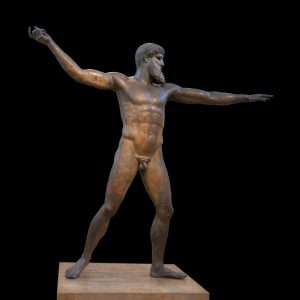
Greek sculptors spent roughly six centuries trying to give a face to beings that, by definition, did not have one. What survives of that effort is scattered, broken and often not even Greek — a great many of the famous “Greek” statues in the world’s museums are Roman marble copies of Greek bronzes that were melted down centuries ago.
This guide collects 17 famous statues of the Greek gods, grouped by the deity they portray rather than by museum or date. Alongside each one you will find the detail that actually matters when you are standing in front of it: how to tell which god you are looking at. Greek sculpture almost never labels its subjects. It identifies them with attributes — a thunderbolt, a crested helmet, a pair of winged sandals — and once you can read those, a room full of anonymous marble becomes legible.
If you want the broader picture first, our guide to the most famous statues in the world covers monuments from the Statue of Liberty to the Terracotta Army. This list goes narrower and deeper, into the Greek pantheon alone.
How To Tell The Greek Gods Apart In Sculpture
Nearly every Greek god has a visual shorthand. Sculptors used it so consistently that the attributes function almost as name tags — which is fortunate, because the inscriptions that once identified many statues are long gone. Here is the decoder for the gods on this list.
| God | Look for |
|---|---|
| Zeus | Thunderbolt, eagle, sceptre, heavy beard, mature muscular body |
| Hera | Diadem or crown, veil, sceptre, peacock, matronly drapery |
| Poseidon | Trident, dolphin, beard — often near-identical to Zeus without the weapon |
| Athena | Crested helmet, spear, and the aegis: a goatskin bib fringed with snakes and a Gorgon’s head |
| Aphrodite | Nude or half-draped, often with a water jar, apple, shell or a small Eros |
| Apollo | Beardless youth, lyre, laurel wreath, bow; long hair tied up |
| Artemis | Short hunting tunic, bow and quiver, a stag or hound at her side, crescent moon |
| Hermes | Winged sandals, broad travelling hat, and the caduceus — a staff with two entwined snakes |
| Nike | Wings — the only major Greek deity regularly shown winged at full scale. Eros and Iris are winged too, but usually appear small or in relief |
| Helios | A radiate crown of sun rays; sometimes a four-horse chariot |
| Dionysus | Ivy or grape-vine wreath, drinking cup, thyrsus (a pine-cone-tipped staff), relaxed or reclining pose |
| Demeter | Sheaf of wheat, torch, veil drawn over the head |
One warning that professional curators still argue about: a god stripped of his attribute can become genuinely unidentifiable. The single most famous example is number two on this list.
17 Famous Statues Of The Greek Gods And Goddesses
1. The Statue of Zeus at Olympia
God: Zeus
Date: c. 435 BC
Material & height: Gold and ivory over a wooden frame; roughly 12–13 m (40 ft) seated
Where it is now: Lost. Known only from descriptions, coins and reconstructions
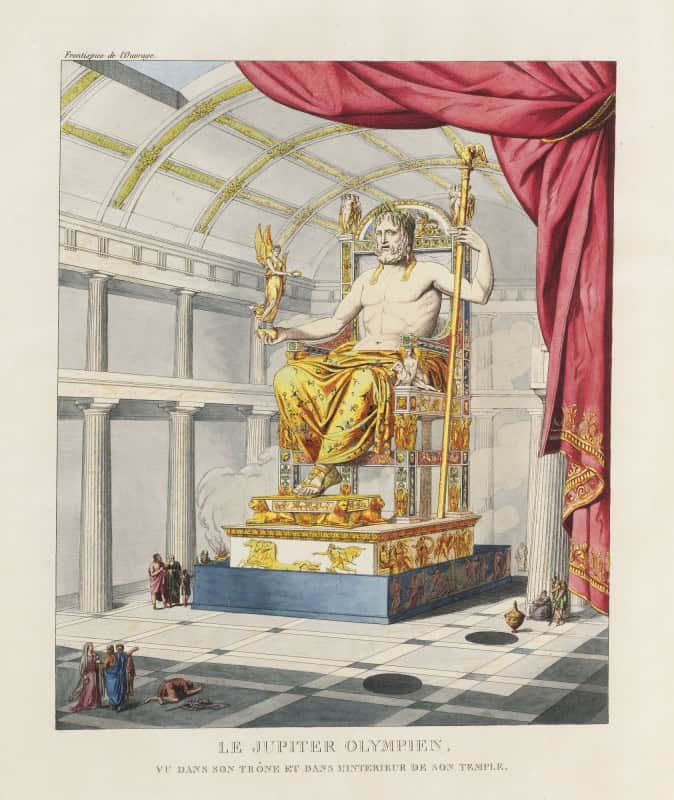
The most famous statue of a Greek god is one that nobody alive has seen. Phidias built his Zeus inside the temple at Olympia as a chryselephantine colossus — ivory for the flesh, hammered gold for the robes — seated on a throne so tall that the ancient travel writer Pausanias remarked the god would have unroofed the building if he stood up. It was counted among the Seven Wonders of the Ancient World.
Its fate is genuinely uncertain. One tradition has it carried off to Constantinople and destroyed by fire in the fifth century AD; another has it perishing at Olympia itself. Either way, the reconstructions you see — including the plate above — are educated guesswork assembled from written descriptions and the small images struck on Elean coins.
2. The Artemision Bronze — Zeus or Poseidon?
God: Zeus, probably — or Poseidon
Date: c. 460 BC
Material & height: Bronze; 2.09 m (6 ft 10 in)
Where it is now: National Archaeological Museum, Athens (X 15161)
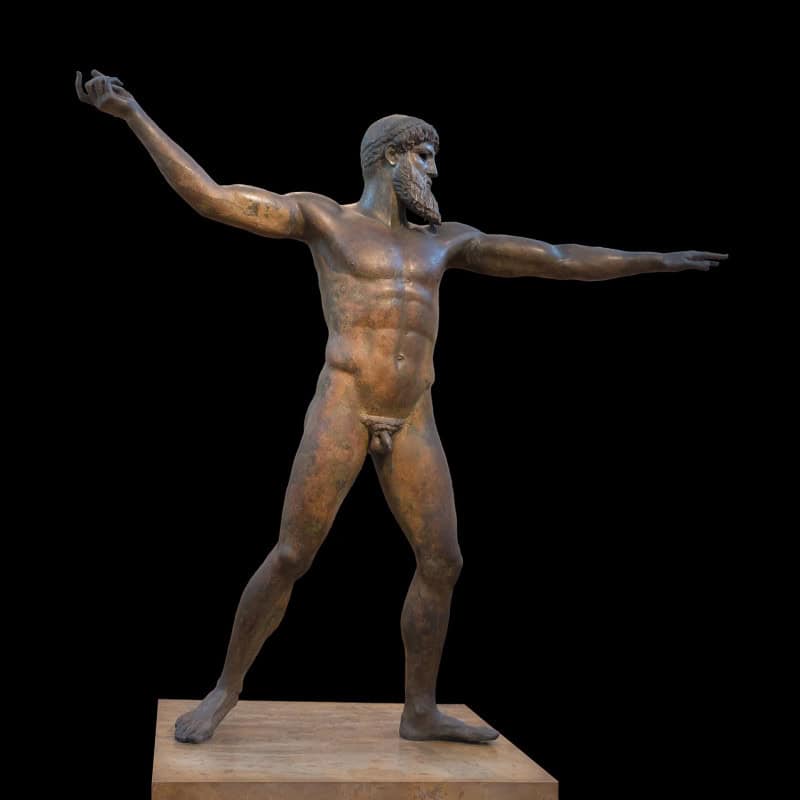
This is the statue that proves the attribute rule by breaking it. Trawled up from a shipwreck off Cape Artemision in the 1920s, the figure stands with his weight on the left foot, left arm extended to sight along, right arm cocked to throw. The weapon he was throwing did not survive, and with it went his identity.
The case for Zeus is largely practical: a trident is long, and held in that throwing position it would have crossed directly in front of the face, which no sculptor of this quality would accept. A thunderbolt is short and would sit neatly in the fist. Most scholars now favour Zeus for that reason, though the museum label has hedged for decades, and you will still find the statue captioned both ways.
3. The Poseidon of Melos
God: Poseidon
Date: c. 125–100 BC
Material & height: Parian marble; about 2.35 m
Where it is now: National Archaeological Museum, Athens
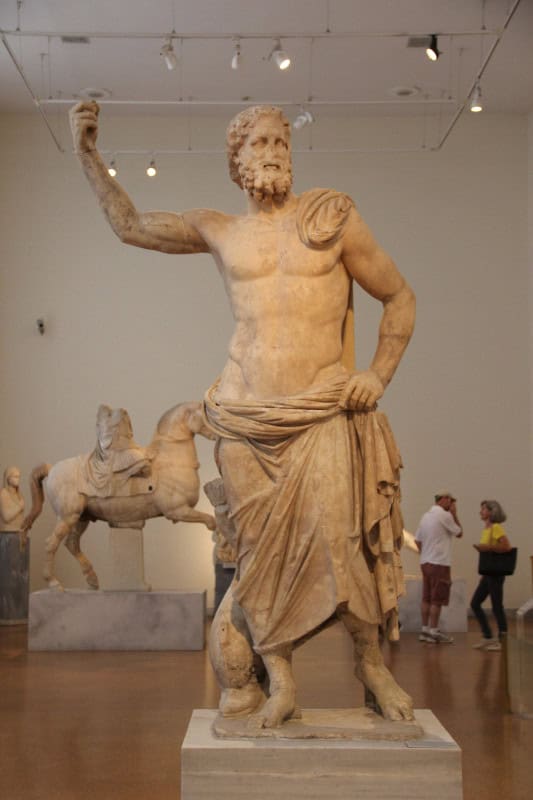
If the Artemision Bronze shows what happens when a god loses his attribute, the Poseidon of Melos shows the opposite. Found on the same island as the Venus de Milo, this over-life-size Hellenistic figure has also lost the object in his raised right hand — but a dolphin survives at his feet, and that single detail removes all doubt.
It is a useful statue to see immediately after the Artemision Bronze, which stands in the same museum. Both are bearded, mature, powerfully built gods in a striding pose. One is identifiable and one is not, and the whole difference is a dolphin.
4. Hera — the Barberini type
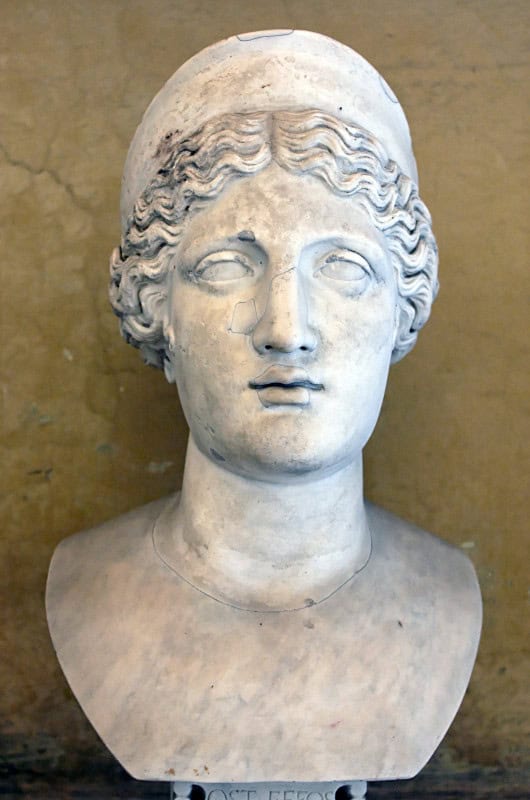
God: Hera
Date: Roman Imperial copy, after a 5th-century BC original
Material: Marble
Where it is now: Vatican Museums, Rome
Hera is the hardest of the twelve Olympians to find in a famous statue, and the reason is telling. She was worshipped intensely — the Heraion at Olympia is older than the Temple of Zeus beside it — but she inspired far fewer celebrated sculptures than Athena or Aphrodite, and most of what does survive comes to us as Roman copies.
The head above is one of them: a Roman Imperial copy after the type known as the Barberini Hera, catalogued in the Vatican’s Museo Chiaramonti as inventory 1210. With the body gone there is no sceptre and no peacock to go on, so the identification rests on the low diadem and on the treatment of the face — severe, mature and deliberately matronly. Hera is almost never sculpted as a young woman, and that alone carries a surprising amount of weight.
5. The Athena Parthenos — and the Varvakeion copy
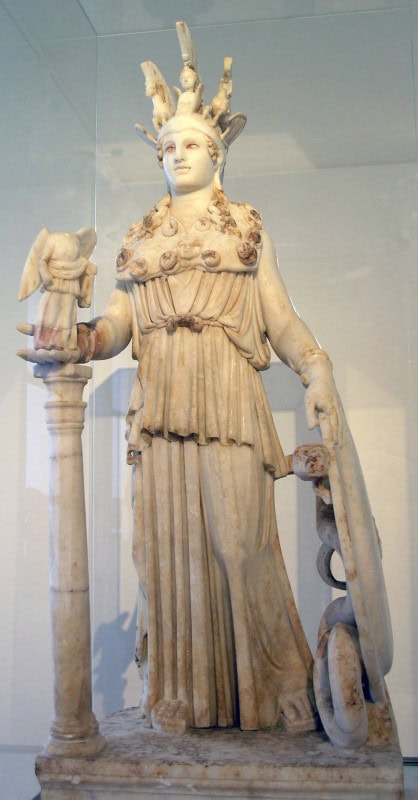
God: Athena
Date: Original c. 438 BC; this copy c. AD 200–250
Material & height: Marble copy, 1.05 m, after a gold-and-ivory original roughly 11.5 m tall
Where it is now: National Archaeological Museum, Athens
Phidias built two colossal chryselephantine statues, and both are lost. The Athena Parthenos stood inside the Parthenon holding a winged Nike on her outstretched right hand — a figure that was itself life-sized. Her shield rested at her left, a serpent coiled behind it, and the whole surface carried enough gold that ancient sources treat the statue partly as the city’s bullion reserve.
The small marble statuette above, found in Athens in 1880 near the Varvakeion school, is a Roman-era copy and the most faithful record we have of what the original looked like. It is startling chiefly for its scale: everything the colossus did in gold and ivory at 11 metres, this does in marble at about one metre.
6. The Mourning Athena
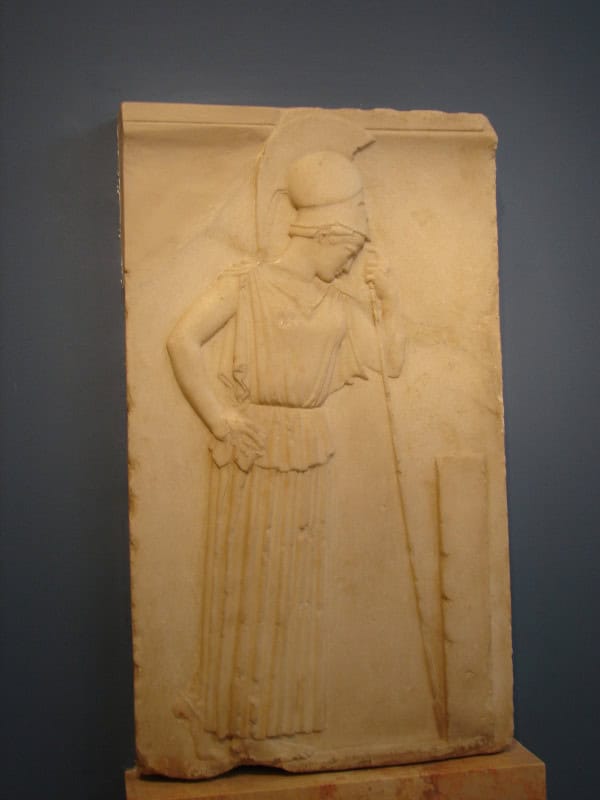
God: Athena
Date: c. 460 BC
Material & height: Marble relief, about 54 cm
Where it is now: Acropolis Museum, Athens
Small, plain, and one of the most affecting objects on the Acropolis. Athena stands in a simple peplos, helmet pushed back, leaning on her spear with her head inclined towards a low stone pillar. What she is doing has never been settled — reading a casualty list, contemplating a boundary marker, or simply pausing — and the ambiguity is much of the appeal.
It is worth seeing immediately after the Varvakeion Athena, because the contrast is the entire range of Greek religious sculpture in two objects: the state goddess in gold and ivory, and the same goddess rendered at half a metre, tired.
7. The Venus de Milo
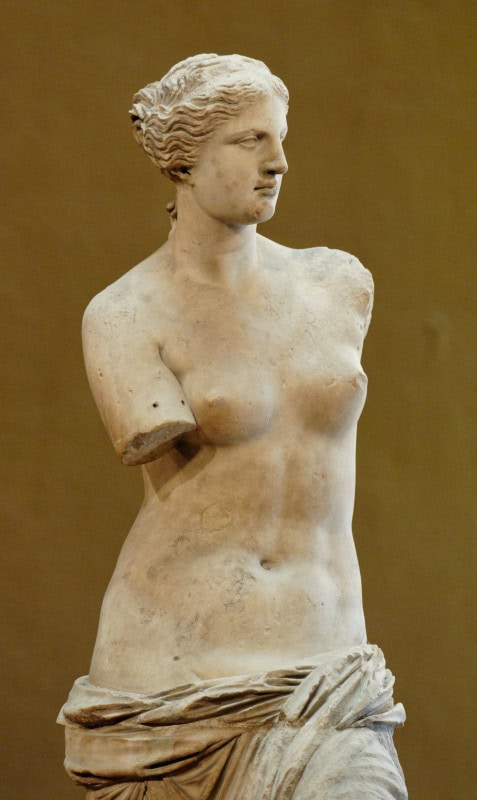
God: Aphrodite
Date: c. 130–100 BC
Material & height: Marble; 2.03 m (6 ft 8 in)
Where it is now: Musée du Louvre, Paris
Found by a farmer on the island of Melos in 1820 and named for it, the Venus de Milo is the most recognised Greek statue in existence — and one of the least understood, because the attribute that would identify her is exactly what is missing. Without her arms there is no apple, no mirror, no Eros, and so the identification as Aphrodite rests mainly on the half-draped pose and the type.
A minority of scholars have argued she is Amphitrite, the sea goddess particularly venerated on Melos. The statue also arrived in Paris at a politically convenient moment, shortly after France had returned the Venus de’ Medici to Italy, and was promoted hard as a replacement masterpiece — which is part of why she is famous at all.
8. The Aphrodite of Knidos
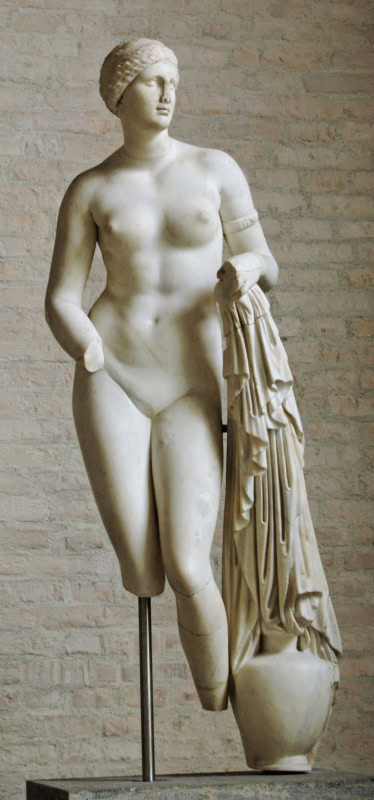
God: Aphrodite
Date: Original c. 4th century BC; this a Roman marble copy
Material & height: Marble
Where it is now: Glyptothek, Munich (Braschi type)
Praxiteles’ Aphrodite was the first monumental female nude in Greek art, and it caused a scandal that shaded quickly into celebrity. The commissioning city of Kos is said to have rejected it and taken a clothed version instead; Knidos took the nude, and the statue became a destination in its own right.
The original is lost. What survives is a large family of Roman copies, of which the Munich figure is one — Aphrodite caught stepping towards her bath, one hand reaching for the drapery over a water jar. The gesture is the point: it gives the nudity a narrative excuse, and every later “modest Venus” descends from it.
9. The Apollo Belvedere
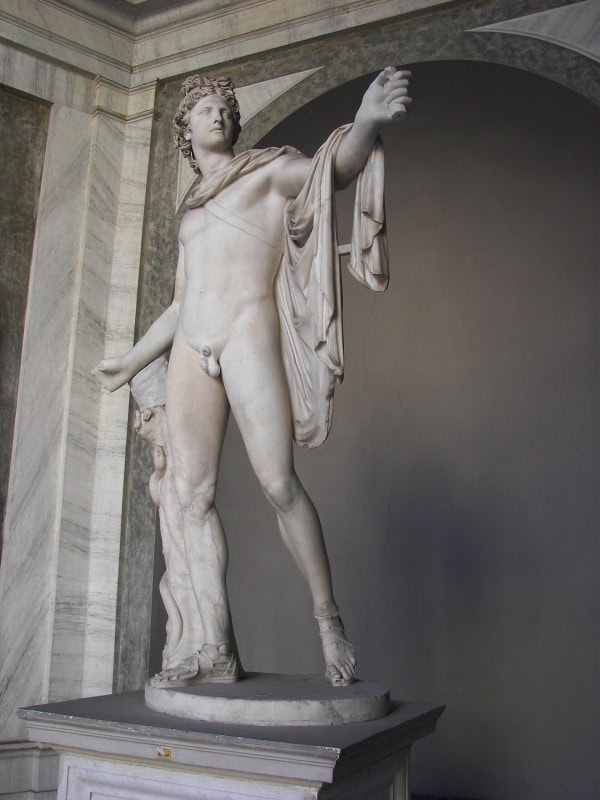
God: Apollo
Date: Roman copy c. AD 120–140, after a bronze of c. 330–320 BC
Material & height: Marble; 2.24 m
Where it is now: Vatican Museums, Rome
No statue on this list has risen and fallen further in critical esteem. Rediscovered in the late fifteenth century, the Apollo Belvedere was treated from the eighteenth century onward as the single greatest surviving work of ancient art — Winckelmann called it the highest ideal of art among all the works of antiquity, and plaster casts of it furnished art schools across Europe.
The twentieth century was less kind, reassessing it as a competent Roman copy of a lost bronze, probably by Leochares, with the mannered polish that copying tends to introduce. Both judgements are worth holding at once: it is not the finest Greek sculpture that survives, and it is nonetheless the one that shaped what several centuries of Europeans thought Greek sculpture was.
10. The Diana of Versailles
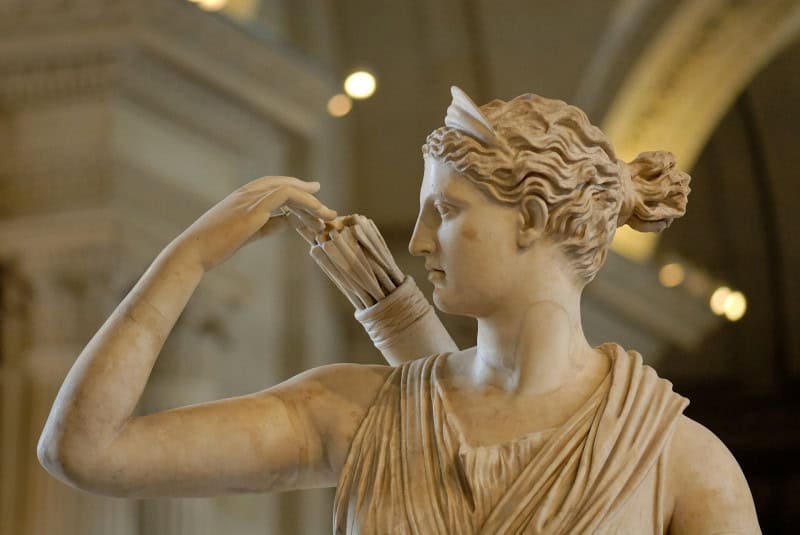
God: Artemis
Date: Roman copy, 1st–2nd century AD, after a Greek bronze
Material & height: Marble; about 2 m
Where it is now: Musée du Louvre, Paris
Artemis strides forward in a short hunting tunic, reaching back over her right shoulder for an arrow, a stag bounding at her side. The full statue carries every attribute in the decoder above at once — tunic, quiver, stag — which makes it one of the easiest identifications in any museum, though the detail shown here crops to the head and drawing arm.
The statue was a diplomatic gift to Henry II of France in the mid-sixteenth century and stood for generations at Versailles, which is how a Roman copy of a Greek original acquired a French name. Like the Apollo Belvedere, the lost bronze behind it is usually attributed to Leochares.
11. The Artemis of Ephesus
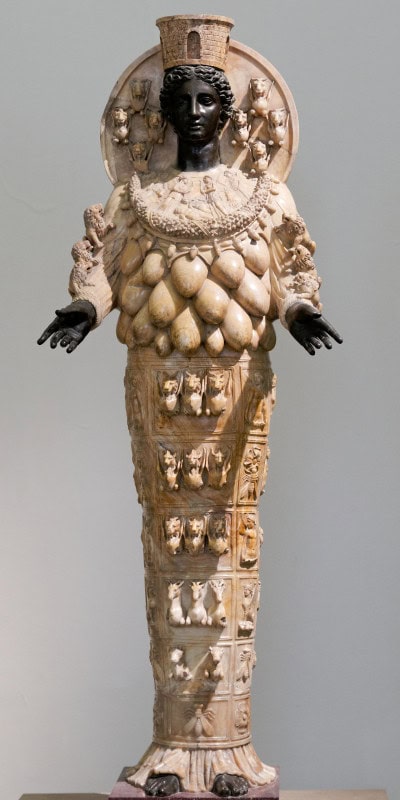
God: Artemis (Ephesian cult form)
Date: Roman period
Material & height: Alabaster, with bronze head, hands and feet (an 18th-century restoration)
Where it is now: Naples National Archaeological Museum
Set this beside the Diana of Versailles and the two have almost nothing in common. The Ephesian Artemis is rigid, frontal, sheathed to the ankles in a skirt carved with tiers of animals, and covered across the chest with rows of ovoid protuberances. She is a fusion of the Greek Artemis with a much older Anatolian mother goddess, and her temple at Ephesus was itself one of the Seven Wonders.
What the protuberances represent is genuinely unresolved. They have been read as multiple breasts, as eggs, as gourds, as amber ornaments, and — in a widely repeated but far from proven suggestion — as bull testicles. Anyone who tells you the answer with confidence is overstating the evidence.
12. Hermes and the Infant Dionysus
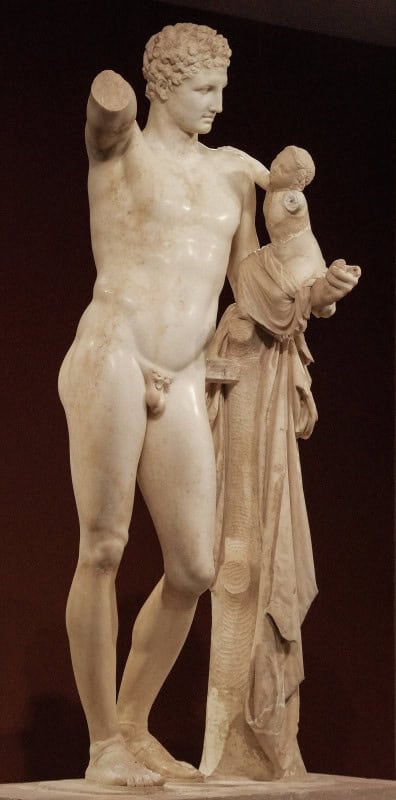
God: Hermes (with the infant Dionysus)
Date: 4th century BC, or a later copy — disputed
Material & height: Marble; 2.1 m
Where it is now: Archaeological Museum of Olympia
Excavators found this in 1877 in the Temple of Hera at Olympia, close to the spot where Pausanias had recorded a Hermes by Praxiteles standing. That coincidence produced an immediate attribution, and for a century the statue was routinely described as the only surviving original by a named great Greek sculptor.
That confidence has eroded. The high polish of the finish and details of the back — which is worked far more summarily than the front — have led many specialists to argue it is a Hellenistic or Roman copy of Praxiteles’ original rather than the original itself. The attribution is still contested, and honest labels now say so. Hermes leans on a tree trunk, dangling something — almost certainly a bunch of grapes, now lost — to catch the baby’s attention.
13. The Winged Victory of Samothrace
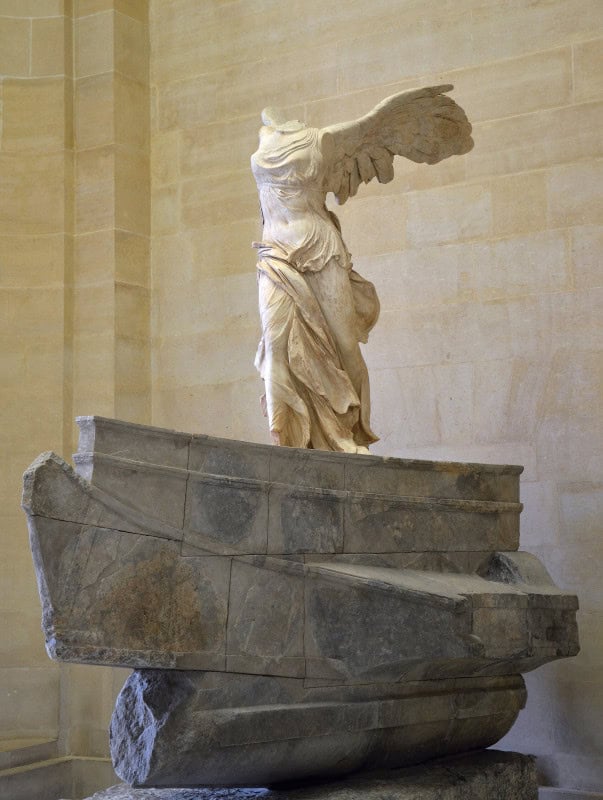
God: Nike
Date: c. 190 BC
Material & height: Parian marble; 2.44 m (5.57 m with the ship’s prow)
Where it is now: Musée du Louvre, Paris
Nike has just landed. Her wings are still back, her right leg carries no weight yet, and the wind coming off the sea has pressed her drapery flat against her body on one side while tearing it loose on the other. Almost no other ancient sculpture attempts this much motion, and none of them lands it as well.
She was found on Samothrace in 1863, in pieces, and the ship’s prow she stands on was reassembled from fragments found nearby. The head has never been recovered. It is worth noticing how little the loss matters — the drapery does all the work.
14. The Nike of Paionios
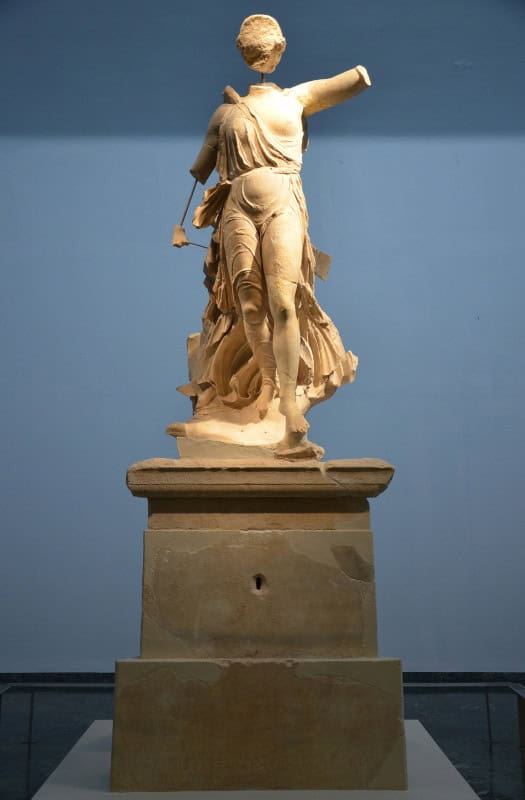
God: Nike
Date: c. 421 BC
Material & height: Marble; about 2.16 m
Where it is now: Archaeological Museum of Olympia
Well over two centuries older than the Samothrace Nike (425–420 BC against c. 190 BC) and attempting something similar with far less to work with. Paionios of Mende set his Victory on a tall triangular pillar so that she appeared to be descending out of the sky, her cloak billowing behind her as a great curved sail. An eagle beneath her feet marks the air she is falling through.
The inscription on the base survives and is unusually informative: the statue was dedicated by the Messenians and Naupactians from the spoils of war, and Paionios names himself as the sculptor — also mentioning, with some pride, that he won the competition to make the temple’s roof ornaments.
15. The Colossus of Rhodes
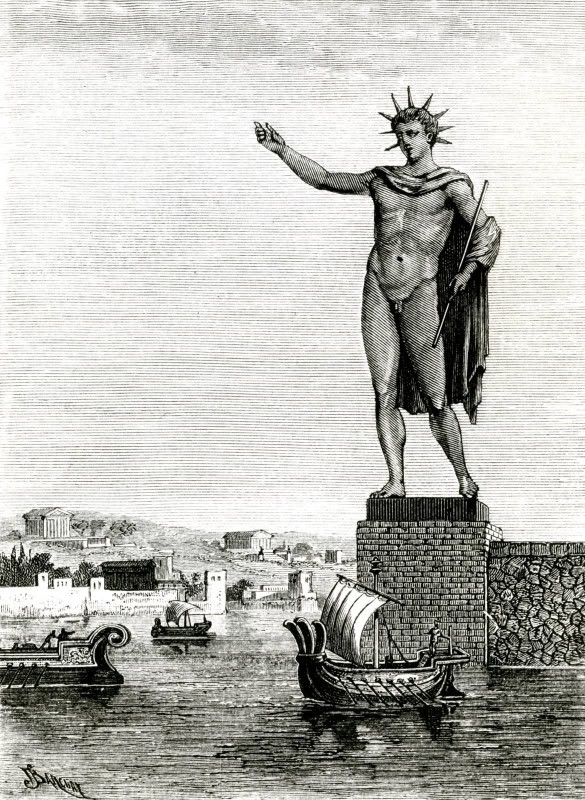
God: Helios
Date: Completed c. 280 BC
Material & height: Bronze over an iron and stone framework; about 33 m (108 ft)
Where it is now: Destroyed by earthquake in 226 BC. Nothing survives
Chares of Lindos spent roughly twelve years building a bronze Helios beside the harbour of Rhodes, funded by selling off the siege equipment abandoned by a defeated invader. At around 33 metres it was the tallest statue of the ancient world, and it stood for barely fifty years before an earthquake snapped it at the knees.
The most famous image of it is a myth. Countless engravings — though not the one above, which sensibly puts him on a single pedestal — show the Colossus straddling the harbour mouth with ships sailing between its legs. That picture was invented in the medieval period and repeated ever since. The engineering makes it implausible, and building it that way would have closed the harbour for over a decade. The ancient sources simply do not describe it. What they do describe is the wreckage: it lay where it fell for some eight centuries, and Pliny noted that few people could wrap their arms around one of its fallen thumbs.
16. Dionysos from the Parthenon
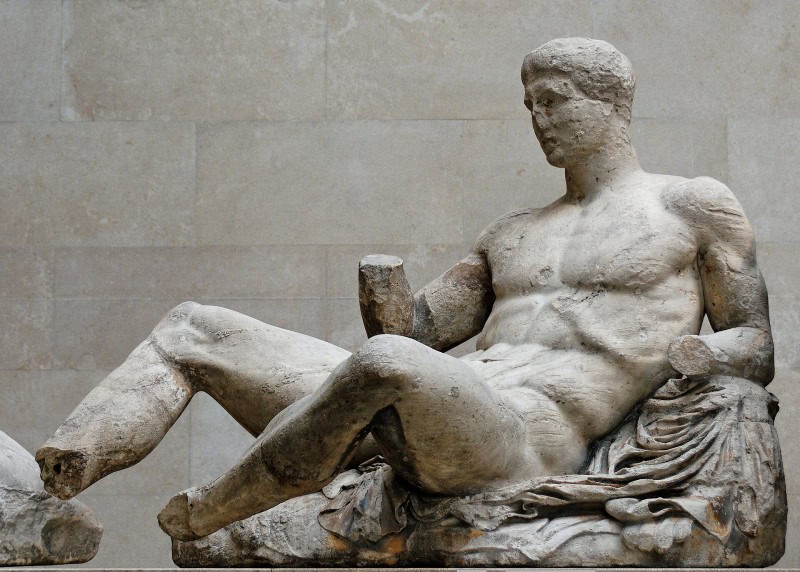
God: Dionysus — probably
Date: c. 438–432 BC
Material & height: Marble
Where it is now: British Museum, London
This reclining male figure occupied the left corner of the Parthenon’s east pediment, which showed the birth of Athena. He lounges on an animal skin, entirely at ease, at the moment the sun is rising at the pediment’s edge — the most relaxed figure in a composition otherwise full of alarm.
He is conventionally identified as Dionysos, but the identification is not secure. The forearms are gone, taking any handheld attribute with them, and a serious body of opinion reads him instead as Herakles on the strength of what looks like a lion skin beneath him — the head survives, and it has been read both ways. Compare him with the gods of death and the underworld, where attributes survive rather better, and the difficulty of identifying a Greek god without his props becomes obvious.
17. The Demeter of Knidos
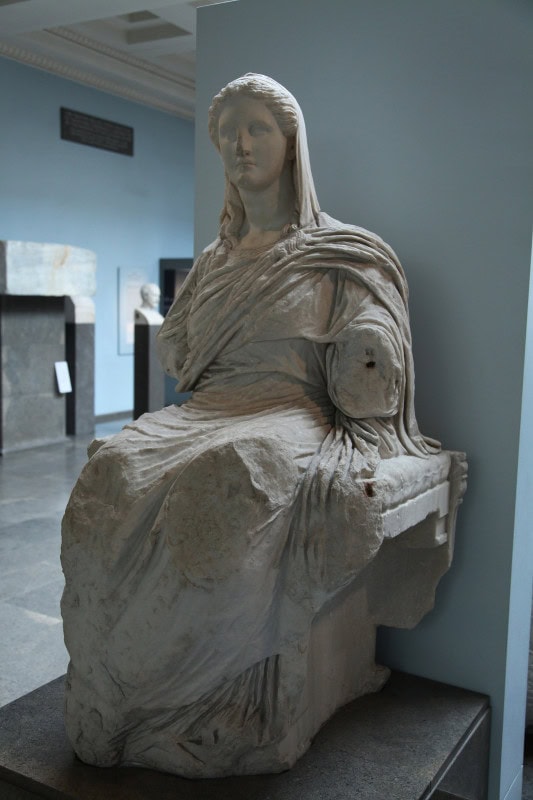
God: Demeter
Date: c. 350 BC
Material & height: Marble
Where it is now: British Museum, London
Recovered in 1858 from a sanctuary at Knidos — the same city that bought Praxiteles’ scandalous Aphrodite — this seated Demeter is carved with a marked difference in finish between the head and the body, the face worked to a much higher polish than the drapery below it.
The subject is the goddess of the harvest in mourning, searching for her daughter Persephone after her abduction to the underworld. Read that way, the downcast expression and heavy veil stop being generic dignity and become the specific story: this is the grief that, in myth, produced winter.
Why So Many “Greek” Statues Are Actually Roman
Nine of the seventeen statues above are either Roman copies or lost originals known only through copies, and that is not an accident of this list — it is the normal condition of Greek sculpture.
The best Greek work was cast in bronze, and bronze is worth melting. Across late antiquity and the medieval period, almost the entire corpus of Greek bronze statuary was recycled into coinage, weapons and church fittings. What survives in bronze survives because it was lost at sea, out of reach — which is precisely why the Artemision Bronze and a handful of shipwreck finds are so disproportionately important.
Marble survived better, and the Romans produced marble copies of admired Greek bronzes on an industrial scale for villas and public baths. Those copies are what fill the Vatican and the Louvre. They come with real costs: a marble figure needs struts and tree trunks to support limbs that bronze could cantilever unaided, and a copyist’s polish is not a sculptor’s judgement. But without them the Aphrodite of Knidos, the Apollo Belvedere and the Athena Parthenos would be nothing but names in a text.
Where To See Them
Four museums hold the bulk of this list. The Louvre has the Venus de Milo, the Winged Victory and the Diana of Versailles. The National Archaeological Museum in Athens has the Artemision Bronze and the Varvakeion Athena. The Vatican Museums hold the Apollo Belvedere and the Chiaramonti head of Hera. The British Museum has the Parthenon Dionysos and the Demeter of Knidos, with the Archaeological Museum of Olympia holding the two statues found on that site.
Two on this list cannot be seen at all. The Zeus of Olympia and the Colossus of Rhodes exist now only as descriptions, coin images and the imaginative reconstructions of much later artists — which is worth remembering when you look at those pictures. They are evidence of what people wanted these statues to have looked like, not records of what they did.
Famous Statues Of The Greek Gods — In Conclusion
The Greek gods survive in stone far better than they survive in bronze, and better in Roman hands than in Greek ones. What comes through the losses and the copying is a way of making divinity legible: give the god an object, carve it well, and let everyone from a Knidian pilgrim to a modern museum visitor work out who they are looking at.
Once you can read a thunderbolt, an aegis or a pair of wings, the sculpture galleries stop being rooms full of anonymous marble. Start with the statues here whose attributes are gone — the Artemision Bronze, the Venus de Milo, the Poseidon of Melos, the Nike of Paionios — and you will see how much work those small objects were doing, and how much rests on the one, like Poseidon’s dolphin, that happens to survive.
For more from the same corner of the collection, see our guides to the most famous statues in the world, the gods of death and the underworld, the 100 most famous paintings of all time and the most beautiful self-portraits by famous artists.
Image Credits
Every image on this page links to its source file page on Wikimedia Commons, where the licence can be checked directly.
- Varvakeion Athena — source, photo by Marsyas, CC BY 2.5
- Mourning Athena relief — source, photo by Roccuz, CC BY-SA 2.5 IT
- Apollo Belvedere — source, photo by Wknight94, CC BY-SA 3.0
- Artemis of Ephesus — source, photo by Marie-Lan Nguyen, CC BY 2.5
- Hermes and the Infant Dionysus — source, photo by Paolo Villa, edited by MenkinAlRire, CC BY-SA 4.0
- Dionysos, Parthenon east pediment — source, photo by Marie-Lan Nguyen, CC BY 2.5
- Nike of Paionios — source, photo by Carole Raddato, CC BY-SA 2.0
- Released under CC0: Artemision Bronze (source, Jebulon), Poseidon of Melos (source, Gary Todd), Winged Victory of Samothrace (source, Shonagon) and Demeter of Knidos (source).
- Public-domain declarations covering the photograph or print itself, not merely the sculpture depicted: the Zeus of Olympia plate (source), Venus de Milo (source), Aphrodite of Knidos (source), Diana of Versailles (source), the Colossus of Rhodes engraving (source) and the Chiaramonti Hera (source, photo by Marie-Lan Nguyen).