
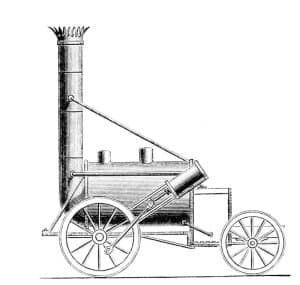
The 19th century is where the modern world starts. Someone born in 1800 travelled at the speed of a horse, worked by daylight and candle, and had no way of sending a message faster than a rider could carry it. Someone dying in 1900 could take a train, read under an electric bulb, telephone another city, listen to a recording of a voice, and have their broken bones photographed from the inside.
Almost nothing on this list was a lone flash of genius. Most were long arguments between several people in several countries, settled by whoever got to a patent office first — and a few of the names below won that race rather than the idea.
They are listed in rough chronological order, from Volta’s stack of metal discs in 1800 to a Bayer laboratory in 1897.
1. The Electric Battery (1800)
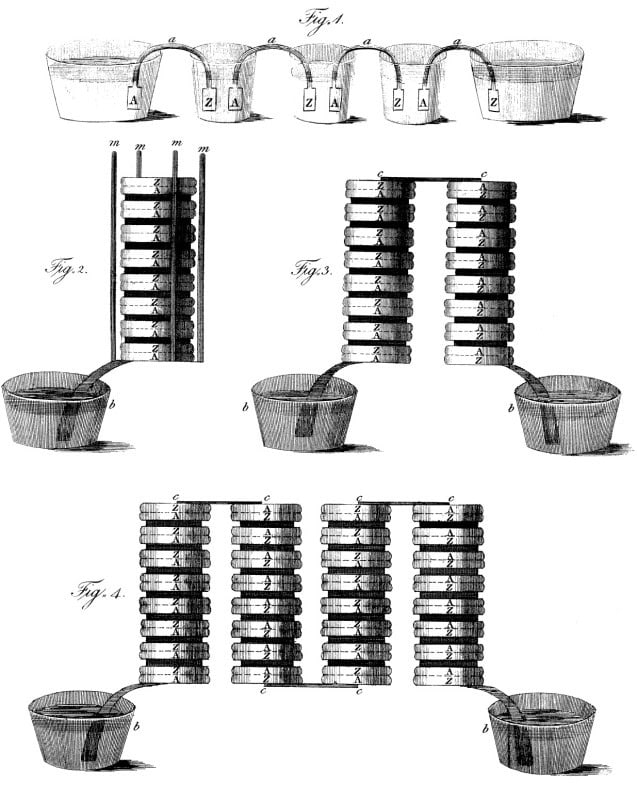
Alessandro Volta’s argument with Luigi Galvani produced the first reliable source of steady electric current. Galvani had made a dead frog’s leg twitch and concluded he had found “animal electricity” — a life force in the tissue. Volta suspected the frog was incidental and that the real cause was the two different metals touching it.
To prove it he removed the animal entirely, stacking discs of zinc and copper separated by brine-soaked cardboard. The pile produced current continuously, which no previous device had managed.
The image above is from Volta’s own 1800 publication. Within weeks other researchers were using piles to split water into hydrogen and oxygen, and within a few years Humphry Davy had used one to isolate sodium, potassium, calcium and magnesium. Every entry on this list involving electricity depends on this one.
2. The Stethoscope (1816)
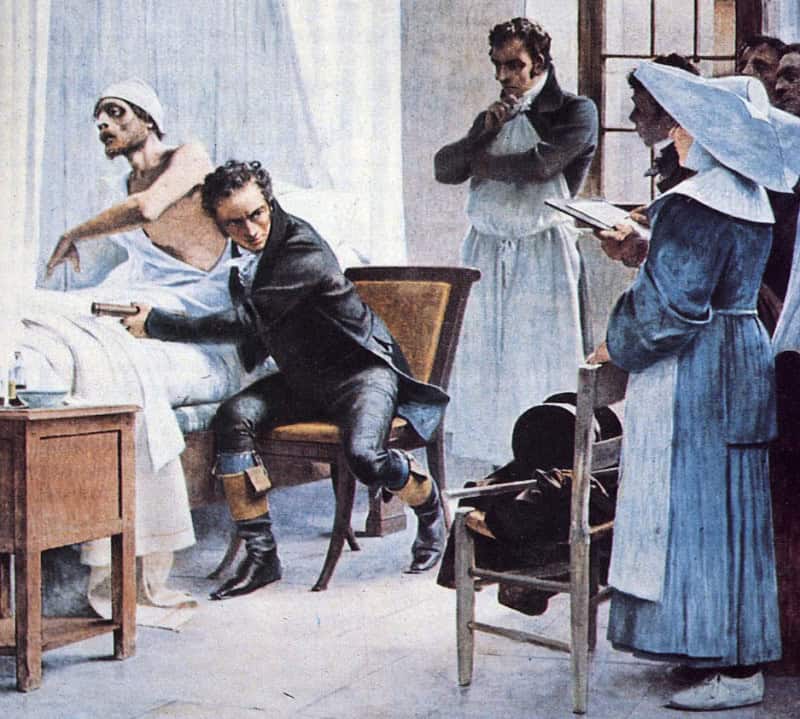
René Laennec, working at the Necker hospital in Paris, was faced with a young female patient whose heart he needed to examine. Placing his ear directly on a woman’s chest was awkward, and she was, in his own account, too stout for percussion to reveal much.
He remembered children playing with a hollow beam, tapping one end and listening at the other, rolled a sheet of paper into a tube, and was startled by how much more clearly he could hear. He replaced the paper with a turned wooden cylinder about a foot long.
More important than the tube was what he did with it: three years of correlating sounds heard in life against what he found in the same patients at autopsy, published in 1819. He effectively invented diagnosis by listening. The painting above, by Théobald Chartran, shows the scene as later imagined.
3. The Difference Engine (1822)
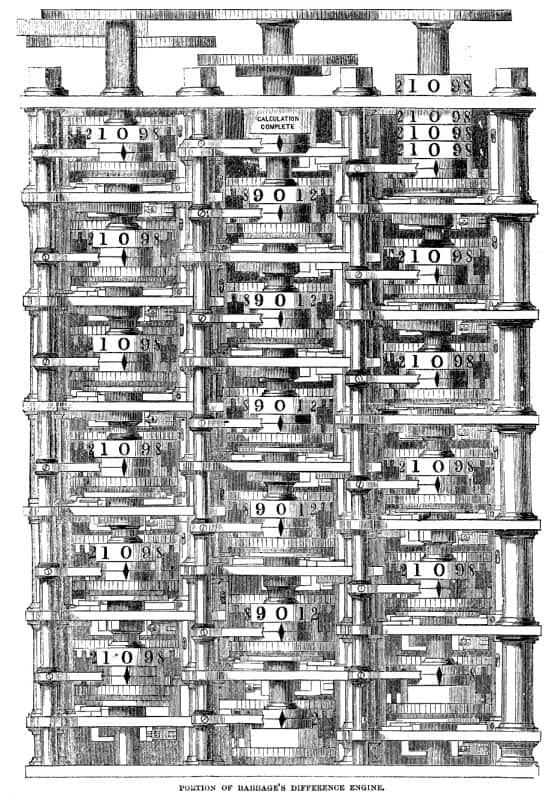
Charles Babbage’s frustration was with mathematical tables — of logarithms, of tides, of navigation — which were calculated and typeset by hand and were riddled with errors that ran ships aground. “I wish to God these calculations had been executed by steam,” he is supposed to have said.
His Difference Engine was designed to compute polynomial values by repeated addition and to set its own results in type, removing human error at both ends. He got government funding, quarrelled with his engineer, and never finished it.
The engraving above shows the working portion he did complete. His later Analytical Engine, never built at all, went further still — punched-card input, a separate store and mill, conditional branching — and Ada Lovelace’s 1843 notes on it observed that such a machine might manipulate any symbols, not just numbers. That is the idea of a computer, a century early.
4. The Steam Locomotive (1804–1829)
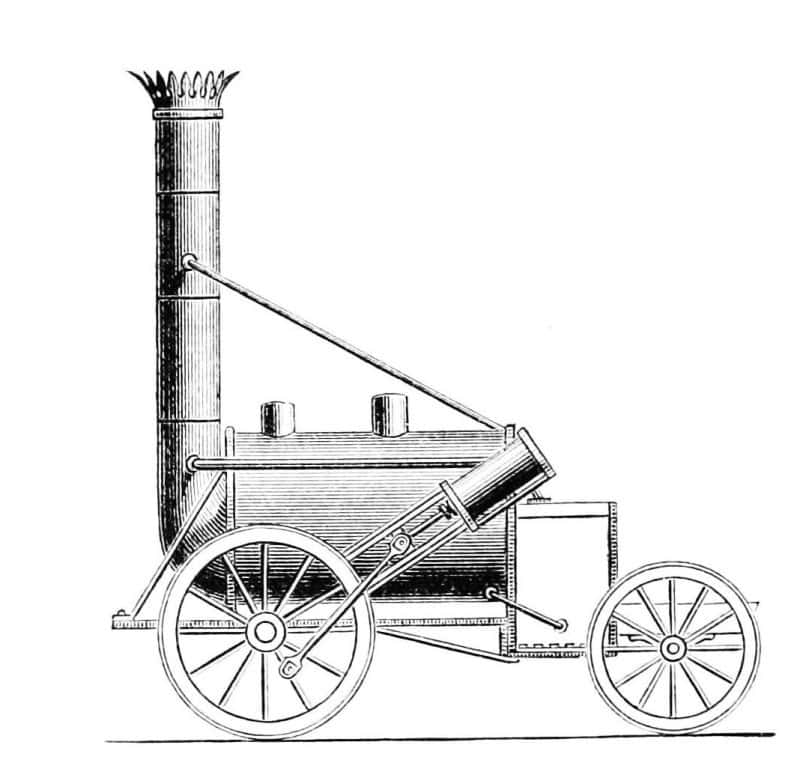
Richard Trevithick ran the first steam locomotive on rails at Penydarren in Wales in 1804, hauling ten tons of iron and seventy men. The engine worked; the brittle cast-iron plateway beneath it did not, and the experiment was abandoned.
The machine that settled the design was Stephenson’s Rocket, which won the Rainhill Trials in October 1829 at a then-astonishing 30 mph. Rocket combined a multi-tube boiler, a blastpipe that used exhaust steam to draw the fire hotter, and cylinders driving the wheels directly.
The railway did something subtler than move goods quickly. It forced Britain to abandon local solar time — every town had kept its own — in favour of a single standard, because timetables could not otherwise be written. Standard time is a side effect of the locomotive.
5. The Revolver (1836)
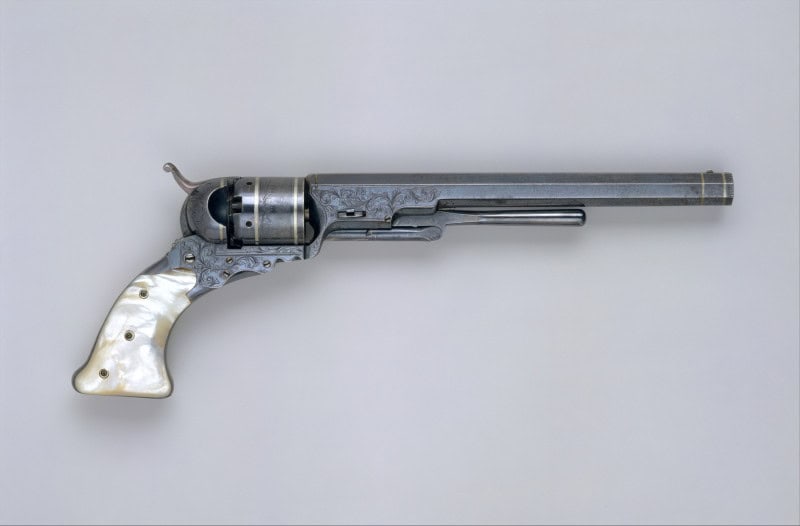
Samuel Colt was sixteen and working as a seaman when, by his own account, he watched a ship’s wheel turn and lock in position and saw how a cylinder of chambers could rotate and align with a single barrel.
His 1836 patent produced the Colt Paterson, and his real innovation was arguably industrial rather than mechanical: Colt’s Hartford factory used interchangeable parts and a division of labour that let unskilled workers assemble complex machines. It became a model for American manufacturing generally.
The consequences were not neutral. The repeating handgun altered the balance of frontier violence in the American West and in the wars against Native nations, and Colt sold enthusiastically to both sides in conflicts abroad. It belongs on a list of the century’s consequential inventions; it does not belong on a list of its happiest.
6. The Electric Telegraph (1837)
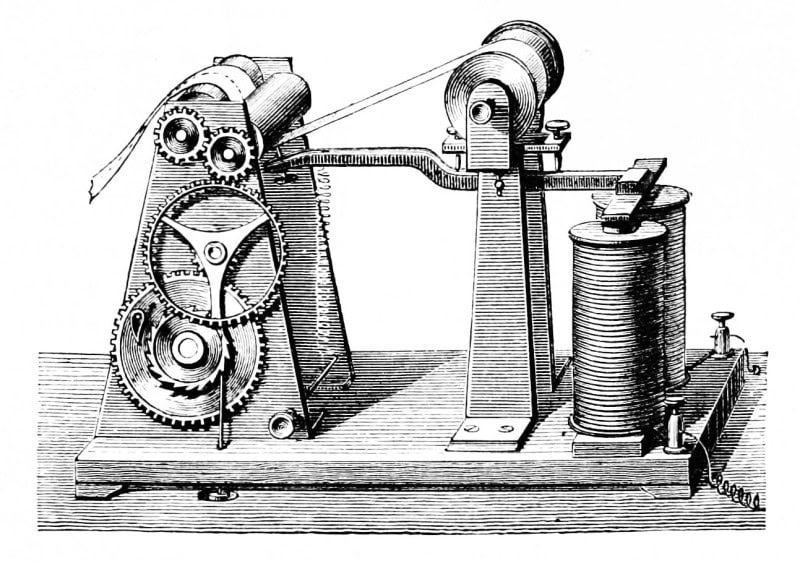
Two working systems appeared in the same year. In Britain, William Cooke and Charles Wheatstone patented a five-needle telegraph that pointed at letters on a grid. In the United States, Samuel Morse, Alfred Vail and Leonard Gale developed a single-circuit system that required a code instead.
Morse’s approach won because it needed only one wire. His 1844 Washington-to-Baltimore demonstration sent the message “What hath God wrought”.
The telegraph is the first technology to break the link between the speed of a message and the speed of a person carrying it — a separation that had held for the whole of human history. By 1866 a working cable crossed the Atlantic, and news that had taken ten days by ship arrived in minutes.
7. Photography (1839)
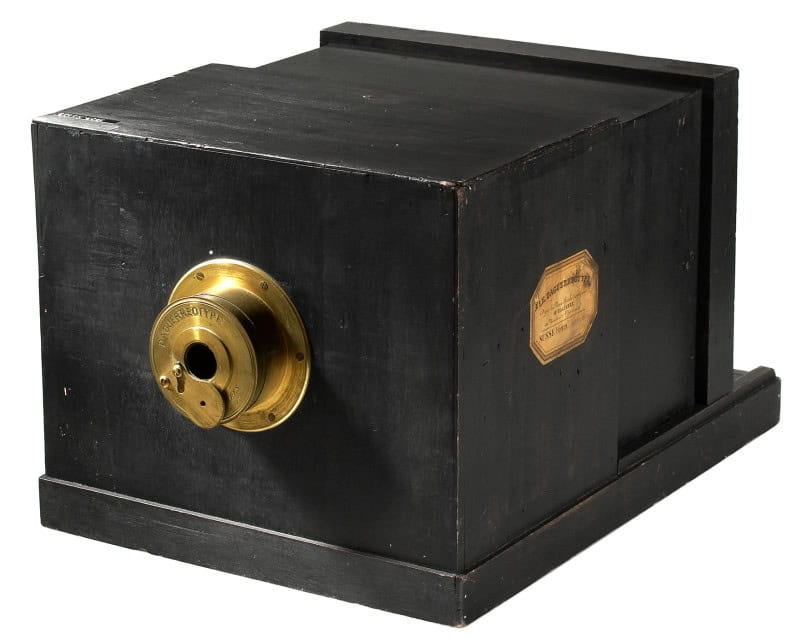
Nicéphore Niépce made the first surviving photograph from nature around 1826, on a pewter plate, with an exposure of many hours. He went into partnership with Louis Daguerre and died in 1833; Daguerre carried on and, in 1839, announced the daguerreotype — a sharp, one-off image on a silvered copper plate.
The French government bought the rights and gave the process to the world, free, in August 1839. In England William Henry Fox Talbot was independently developing the calotype, a negative-positive process which was softer but reproducible — and it is Talbot’s approach, not Daguerre’s, that all later photography descends from.
The camera above is a Susse Frères of 1839, one of the first commercially sold cameras. George Eastman finished the job in 1888 with roll film, the Kodak, and the promise: “You press the button, we do the rest.”
8. Vulcanised Rubber (1844)
Natural rubber was a frustrating material. In summer it turned to foul-smelling glue; in winter it cracked. Fortunes had been lost on rubber goods that failed in the first hot week.
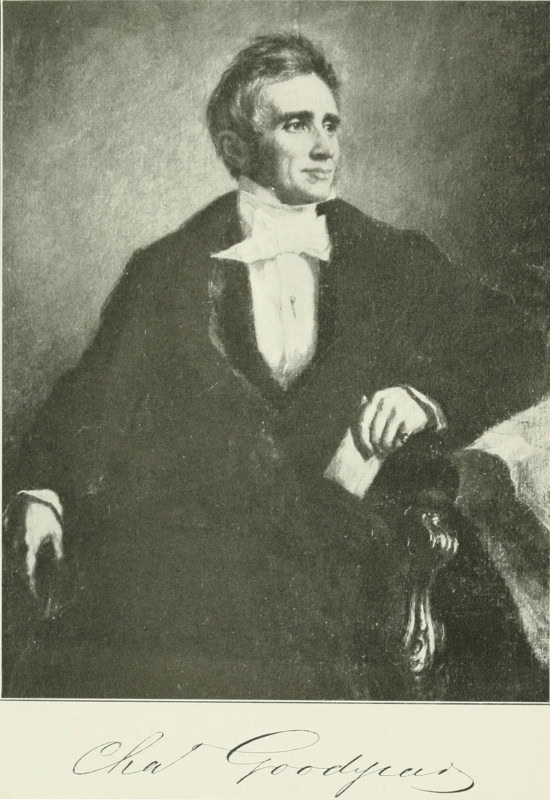
Charles Goodyear spent years, and several stints in debtors’ prison, trying to fix it. The breakthrough in 1839 was accidental — a mixture of rubber and sulphur dropped onto a hot stove charred rather than melted, and he recognised what that meant. He patented the process in 1844.
Goodyear died in 1860 owing around $200,000. The tyre company that bears his name was founded 38 years after his death and never paid his family anything. Without vulcanisation there are no pneumatic tyres, no reliable seals or gaskets, and therefore no practical car — which arrives later on this list.
9. Anaesthesia (1846)
Before 1846, surgery was performed on conscious patients held down by assistants, and speed was the surgeon’s principal virtue. Robert Liston could take a leg off in under thirty seconds.
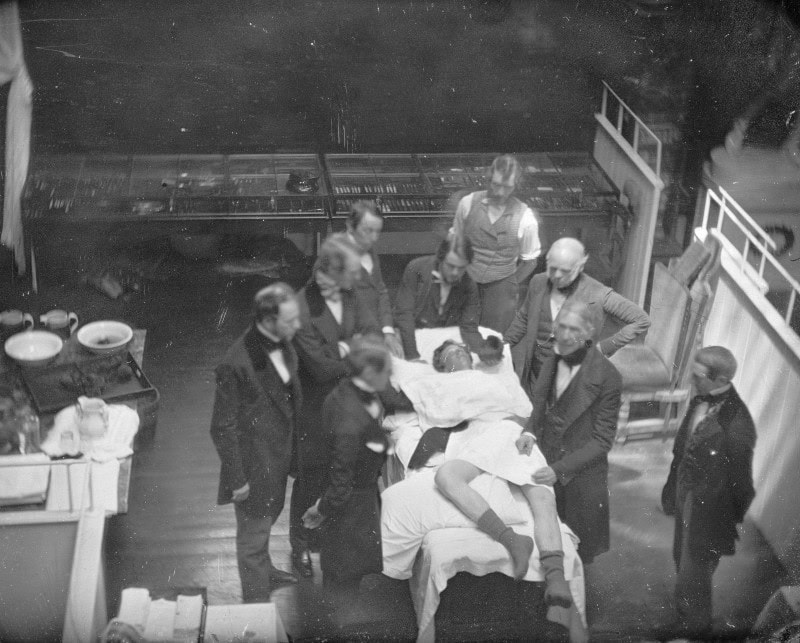
On 16 October 1846, at Massachusetts General Hospital, the dentist William Morton administered ether while John Collins Warren removed a tumour from a patient’s neck. Warren turned to the audience and said: “Gentlemen, this is no humbug.” The room became known as the Ether Dome.
Credit was immediately and bitterly disputed — Crawford Long had used ether privately in Georgia from 1842 without publishing, and Horace Wells had demonstrated nitrous oxide unsuccessfully in 1845. Morton spent the rest of his life litigating and died broke. The daguerreotype above shows an early ether operation in the same theatre, taken in 1847.
10. The Sewing Machine (1846)
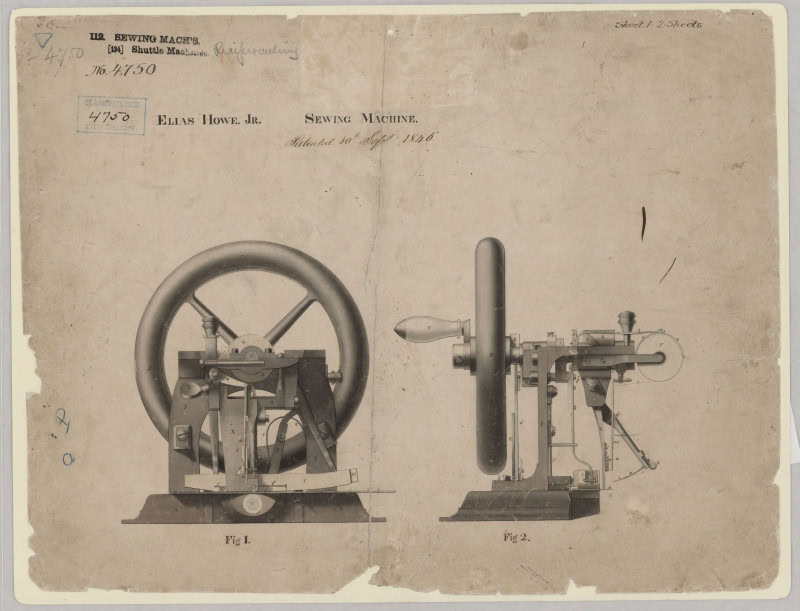
Elias Howe’s 1846 patent solved the problem that had defeated everyone: he put the eye at the point of the needle rather than the blunt end, and used a second thread on a shuttle beneath to lock each stitch. That lockstitch is still how sewing machines work.
Howe could not sell it. He returned from a failed attempt in England to find Isaac Singer selling machines that used his mechanism, and sued. Singer’s machines were better engineered and far better sold — bought on instalment plans, a genuinely novel idea — but Howe won in court in 1854 and collected royalties on every machine sold in America.
Its social effect cut both ways: it removed an enormous burden of hand-sewing from women at home, and it made possible the industrial garment sweatshop.
11. Chewing Gum (1848–1871)
John Curtis was selling spruce-resin gum in Maine by 1848, but the modern product came from an unexpected direction. In the late 1860s the exiled Mexican general Antonio López de Santa Anna was living on Staten Island, New York, and had brought with him a supply of chicle, the latex of the sapodilla tree, hoping to sell it as a cheap rubber substitute.
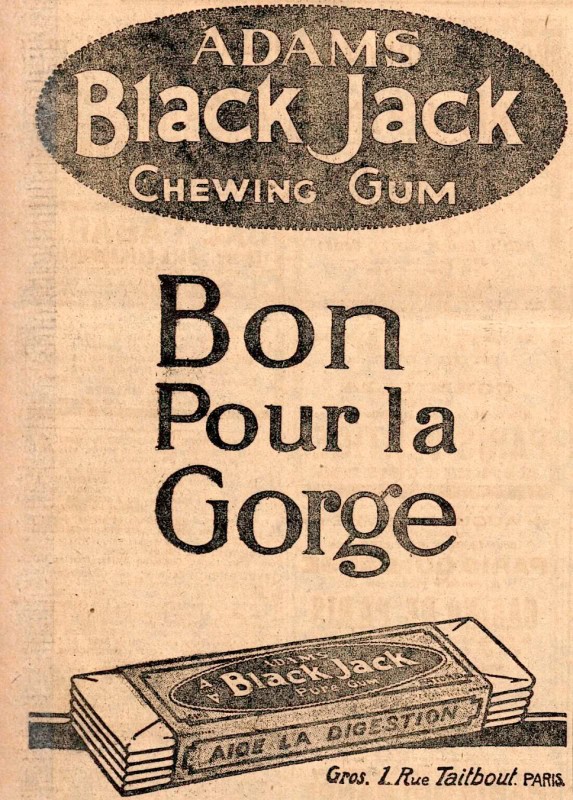
The rubber scheme failed. His American associate Thomas Adams, left with a large quantity of chicle, tried chewing it instead — and in 1871 patented a machine for manufacturing gum. Adams’ Black Jack, flavoured with liquorice, was the first flavoured gum sold in sticks, and the advertisement above is from its long commercial life.
It is on this list because it is the origin of an entire confectionery category, and because the route from failed tyre substitute to chewing gum is a good reminder that inventions rarely arrive where they were aimed.
12. The Mechanical Calculator (1851)
Blaise Pascal and Gottfried Leibniz both built calculating machines in the 17th century, but they were one-off curiosities that did not survive contact with daily use.
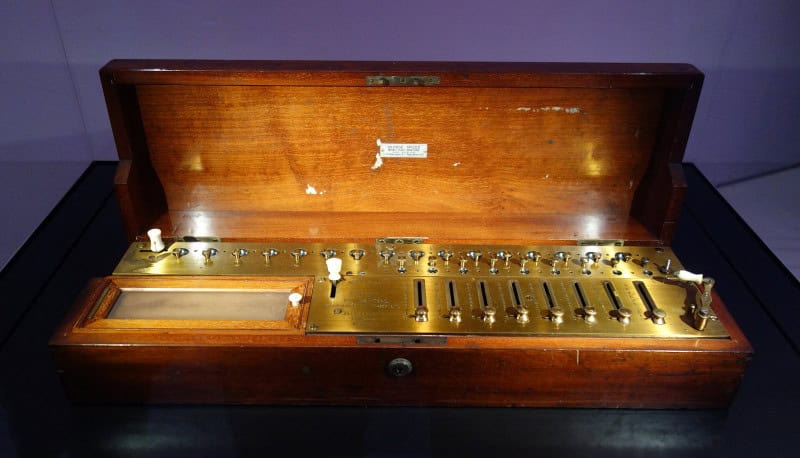
Charles Xavier Thomas de Colmar’s Arithmometer, patented in 1820 and in commercial production from 1851, was the first calculating machine reliable and robust enough to be sold as office equipment. It added, subtracted, multiplied and divided, and it kept working. Insurance companies, engineers and government statisticians bought them for decades — the machine above was custom-built for the Prudential Assurance company around 1885.
The Arithmometer matters because it made calculation a purchasable service rather than a human skill, establishing the market that mechanical then electronic calculators, and eventually computers, would inherit.
13. The Elevator Safety Brake (1852)
Hoists had existed since antiquity. What did not exist was any reason to trust one, because if the rope broke the platform fell.
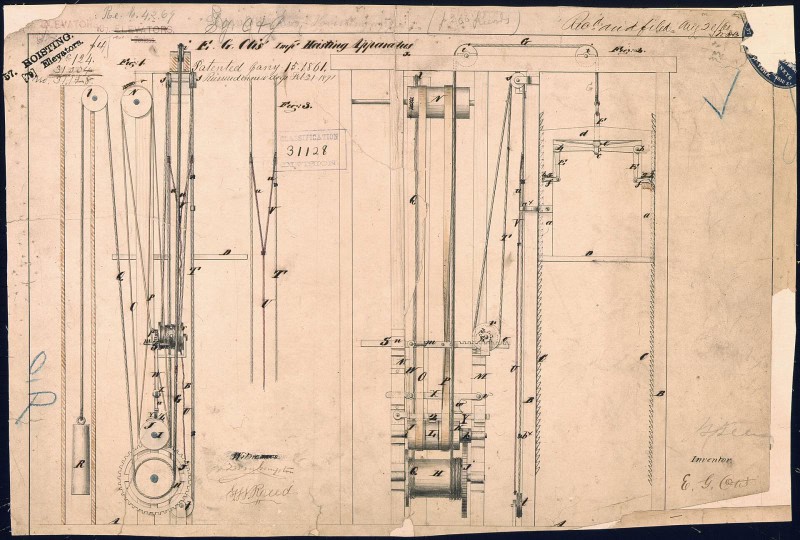
Elisha Otis’s 1852 mechanism used a wagon spring connected to the hoisting rope. While the rope was taut the spring stayed bowed; if it went slack, the spring straightened and drove pawls into toothed guide rails on both sides, locking the car in place. At the 1854 New York Crystal Palace exhibition Otis stood on a raised open platform and had an assistant cut the rope. It dropped a few inches and stopped. “All safe, gentlemen, all safe.” The drawing above is from Otis’s 1861 patent rather than the 1854 demonstration itself.
Its consequence is the skyline. Before the safe elevator, buildings were limited to what people would willingly climb — about six storeys, with the cheapest rooms at the top. Afterwards, the top floor became the most expensive.
14. The Powered Airship (1852)
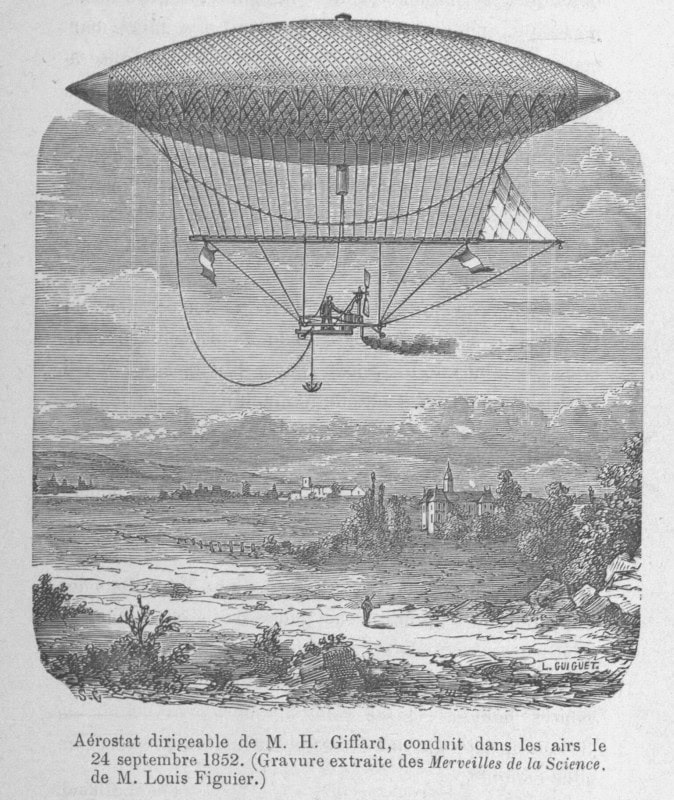
Balloons had flown since 1783 but went wherever the wind went. Henri Giffard’s contribution, on 24 September 1852, was to make one steerable: an elongated, streamlined gasbag with a propeller driven by a small steam engine slung below, flying about 17 miles from Paris to Élancourt.
It was underpowered — it could manage gentle turns but could not make headway against a real wind — and the achievement was a proof of principle rather than a practical vehicle. Practicality waited for the internal combustion engine, and for Ferdinand von Zeppelin’s rigid-framed ships from 1900.
The airship then enjoyed thirty years as the only way to cross an ocean by air in comfort, before the Hindenburg fire in 1937 and the growing range of the aeroplane ended it almost overnight.
15. The Submarine (1864)
Submersibles had been attempted for centuries — Cornelis Drebbel rowed one under the Thames in the 1620s, and the Turtle attacked a British warship in 1776. The 19th century made them lethal.
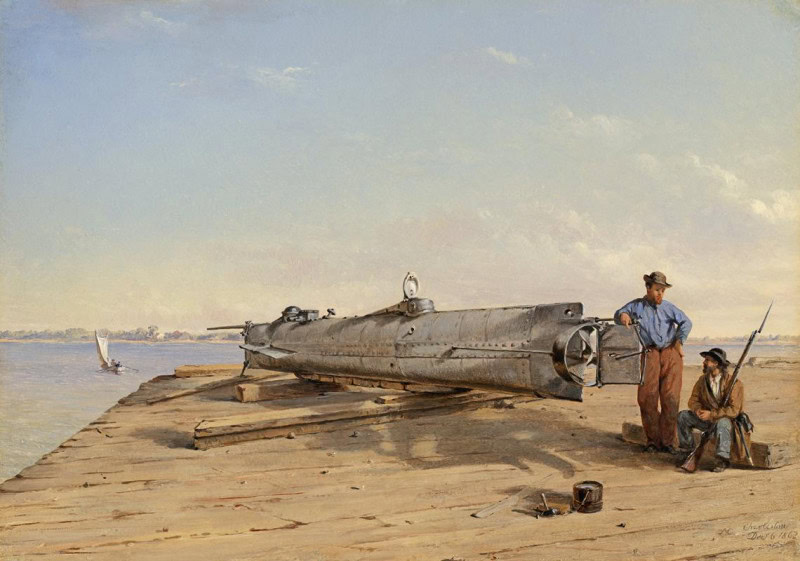
On 17 February 1864 the Confederate H. L. Hunley rammed a spar torpedo into the Union sloop Housatonic off Charleston and sank her: the first submarine in history to sink an enemy warship. The Hunley did not return. She was hand-cranked by a crew of eight and had already drowned two previous crews, including her designer, in trials.
The painting above is by Conrad Wise Chapman, made in 1864 from a sketch drawn at the dockside. The wreck was located in 1995 and raised in 2000. Practical submarines followed once John Philip Holland combined petrol engines for the surface with electric motors for submerged running in the 1890s.
16. Dynamite (1867)
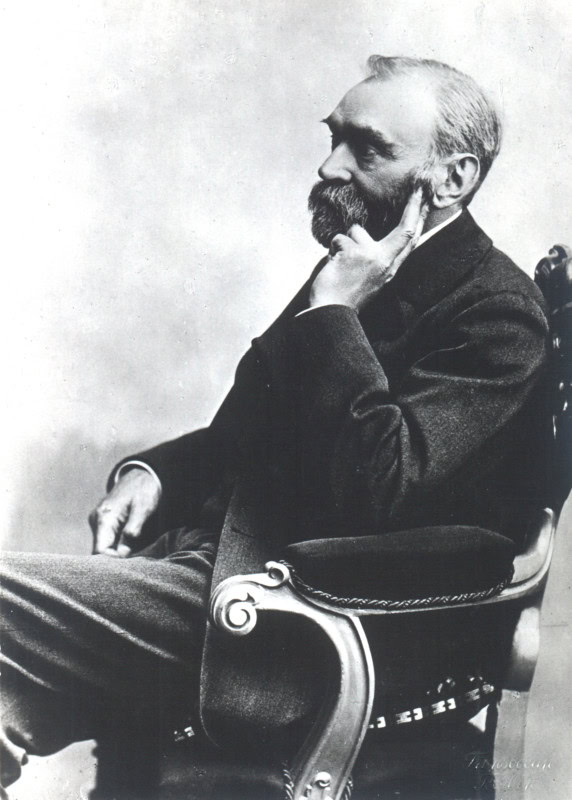
Nitroglycerine was a spectacularly powerful explosive and a spectacularly unreliable one — it detonated if jolted, and had already killed Alfred Nobel’s younger brother Emil in a factory explosion in 1864.
Nobel’s solution was almost embarrassingly simple: absorb the liquid into kieselguhr, a porous diatomaceous earth, producing a stable paste that could be moulded into sticks, carried safely, and fired deliberately with a detonator. He patented it in 1867.
Dynamite made possible the tunnels, canals, railway cuttings and mines of the late 19th century. It also made possible a great deal else, and when a French newspaper mistakenly printed Nobel’s obituary in 1888 under the headline “The merchant of death is dead”, he read it. His will left the bulk of his fortune to establish the Nobel Prizes.
17. Antiseptic Surgery (1867)
Anaesthesia let surgeons operate without inflicting agony, and the immediate result was that more patients died. Surgeons operated more often, and more invasively, in wards where post-operative infection killed between a quarter and a half of them. Instruments were wiped on aprons stiff with old blood.
Joseph Lister, reading Pasteur, reasoned that if decay was caused by airborne micro-organisms then killing them should prevent infection. From 1865 he used carbolic acid on wounds, dressings, instruments and hands, and published his results in The Lancet in 1867. His ward’s mortality fell from around 45% to around 15%.
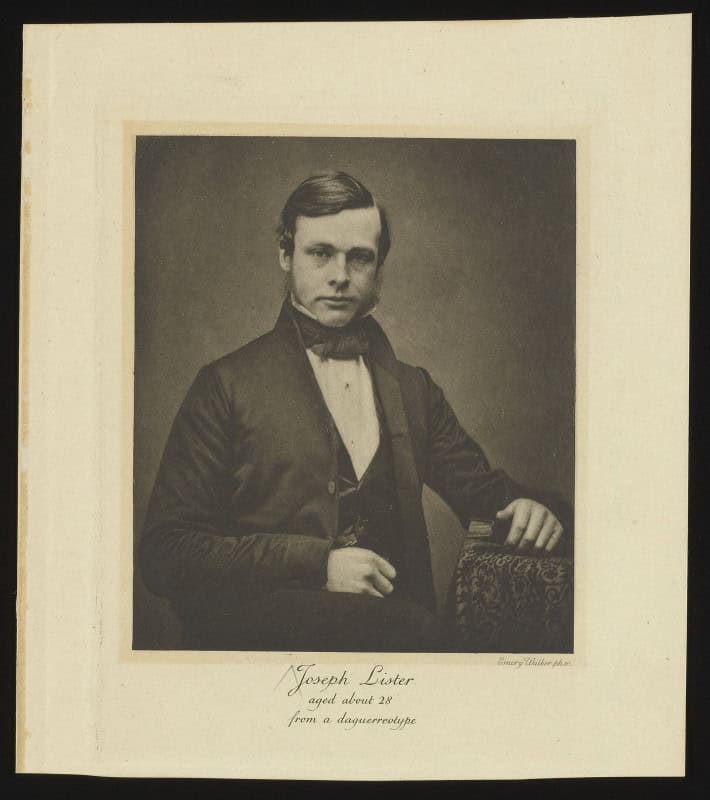
Ignaz Semmelweis had shown something similar with hand-washing in Vienna two decades earlier and had been ignored, dismissed and committed to an asylum. Lister had the advantage of germ theory to explain why it worked. The portrait above shows him at about 28, some twelve years before he introduced antiseptic surgery.
18. The Typewriter (1867)
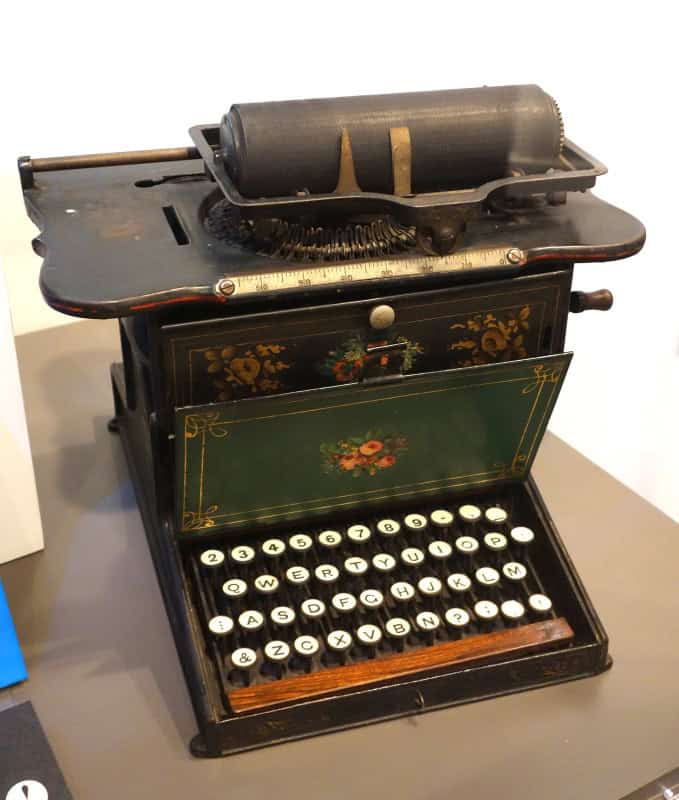
Christopher Latham Sholes, a Milwaukee printer, was not the first to try — dozens of writing machines had been patented since 1714 — but with Carlos Glidden and Samuel Soule he built the first that was faster than handwriting. Remington, a firearms manufacturer with spare capacity after the Civil War, began producing it in 1873.
The QWERTY layout dates from this machine. The common story is that it was designed to slow typists down; the more likely explanation is that it separated letter pairs that were commonly typed in sequence, so their typebars were less likely to clash and jam. Either way it is a solution to a mechanical problem that no longer exists, and it is still on your phone.
The typewriter also opened clerical work to women on a large scale, and the word “typewriter” originally referred to the operator as well as the machine.
19. The Telephone (1876)
Alexander Graham Bell filed his patent on 14 February 1876. Elisha Gray filed a caveat describing a similar liquid transmitter the same day, and the question of who arrived first has been argued ever since, with a fair amount of evidence that Bell’s lawyers benefited from the sequence.
The patent was granted on 7 March, and three days after that Bell transmitted the first intelligible sentence: “Mr. Watson, come here, I want to see you.”
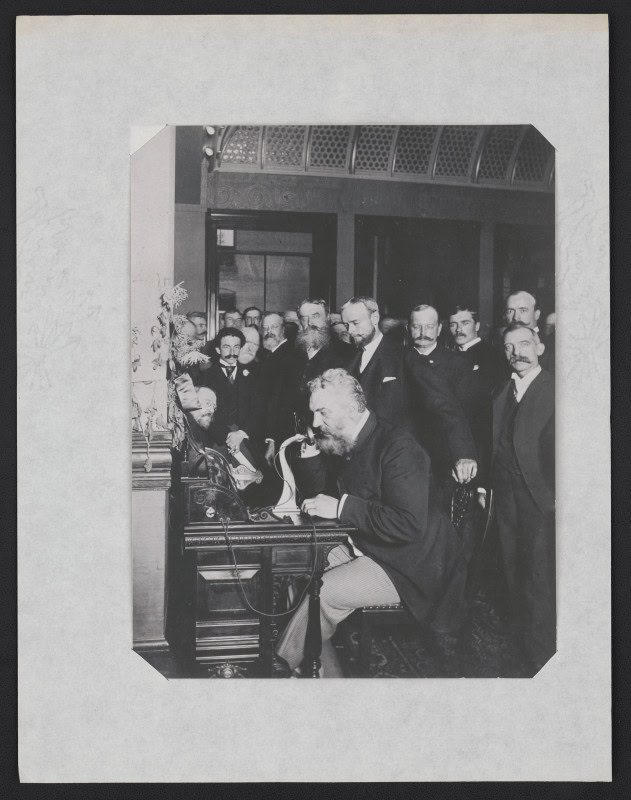
Bell’s own view of it was unusual. He considered the telephone an intrusion, refused to have one in his study, and regarded his work with deaf people — both his mother and his wife were deaf — as his real life’s work. The photograph above shows him opening the New York to Chicago long-distance line in 1892, sixteen years after the patent, by which time the intrusion he disliked had become unavoidable.
20. The Phonograph (1877)
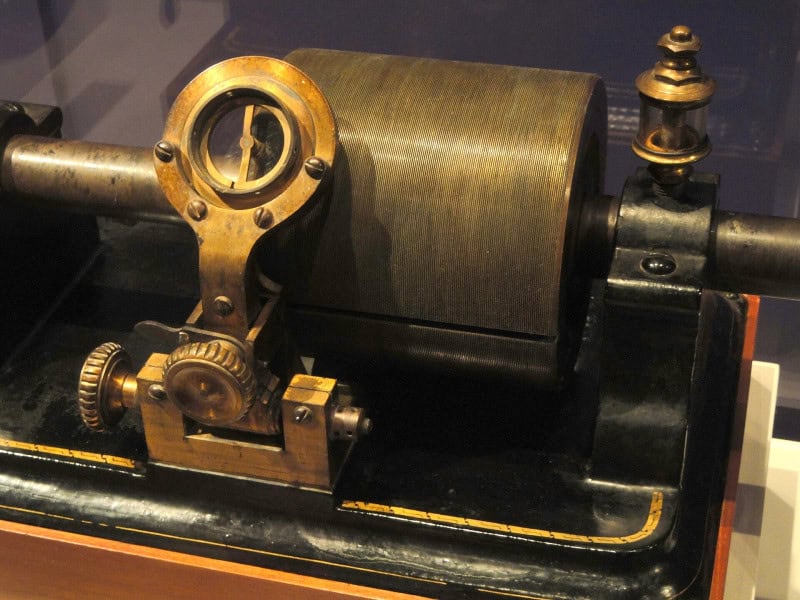
Edison was working on ways of recording telegraph messages when he realised the same principle might capture sound: a diaphragm vibrating a stylus that embossed a groove into tinfoil wrapped on a rotating cylinder. He recited “Mary Had a Little Lamb” into it and, by his account, was startled when the machine spoke back.
It was, uniquely on this list, an invention nobody had asked for and few had imagined. Recording sound had no precedent at all — every other entry here improves on something that already existed in cruder form.
Edison’s own list of proposed uses put “reproduction of music” fourth, behind letter dictation, talking books for the blind, and the teaching of elocution. The machine above is an 1878 tinfoil phonograph.
21. The Incandescent Light Bulb (1879)
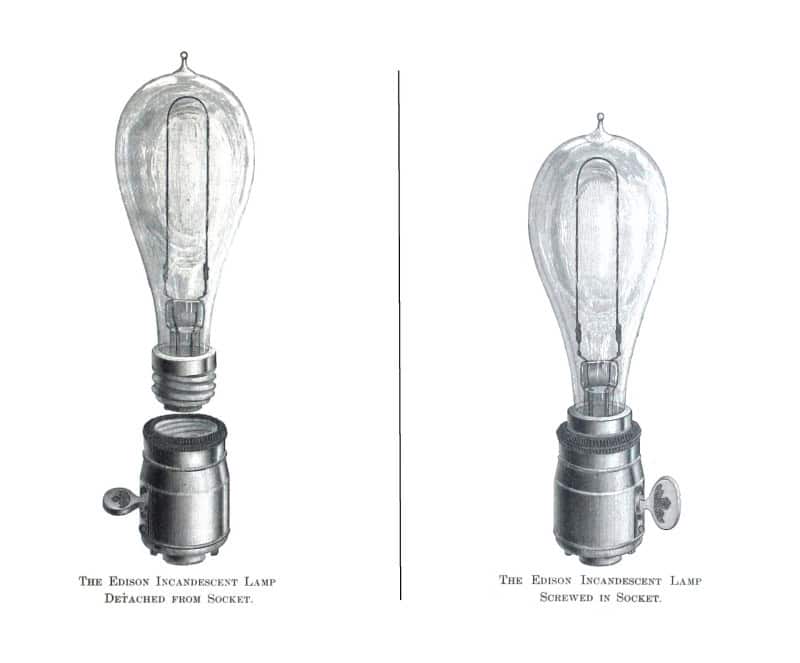
Edison did not invent the light bulb, and knew it — at least twenty inventors had produced incandescent lamps before him. Joseph Swan demonstrated a working carbon-filament bulb in Newcastle in 1878 and had a British patent; the two eventually merged their British interests as Ediswan rather than litigate forever.
What Edison’s Menlo Park team produced in October 1879 was a bulb with a high-resistance carbonised filament that lasted long enough to sell, and — far more importantly — a whole system around it. Generators, meters, switches, sockets, fuses, and the Pearl Street central station that began supplying lower Manhattan in 1882.
Selling a bulb is a product. Selling electricity, and giving people a reason to buy it, is an industry. That distinction is why Edison’s name is the one attached.
22. The Stapler (1879)
Fastening paper was a genuine 19th-century problem. Documents were sewn with thread, pinned, or held with straight pins that rusted and pricked fingers.
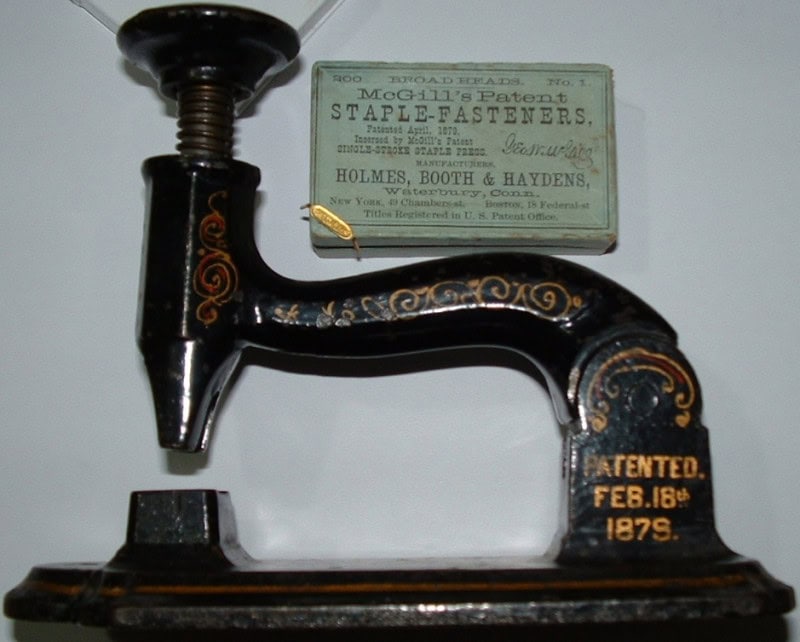
George McGill patented a small bendable brass paper fastener in 1866 and, in 1879, the McGill Single-Stroke Staple Press — a cast-iron machine that loaded one large staple at a time and drove it through the paper in a single motion. It is recognisably the ancestor of the object on your desk, and the machine above still carries its original box.
Loading staples one at a time was slow, and the strip of staples glued together — the innovation that made the stapler genuinely fast — did not arrive until the 1920s. Small inventions are worth including on a list like this precisely because they are invisible: nobody thinks about staplers, and everyone uses one.
23. The Safety Bicycle (1885)
The high-wheeled penny-farthing was fast, because one revolution of that enormous front wheel covered a lot of ground, and dangerous, because the rider sat above and slightly behind the axle and any obstacle pitched them head-first onto the road.
John Kemp Starley’s Rover of 1885 put two equal wheels under a diamond frame and drove the rear wheel by chain, which allowed gearing without a giant wheel. Add John Boyd Dunlop’s pneumatic tyre in 1888 and the machine was fast, safe and comfortable.
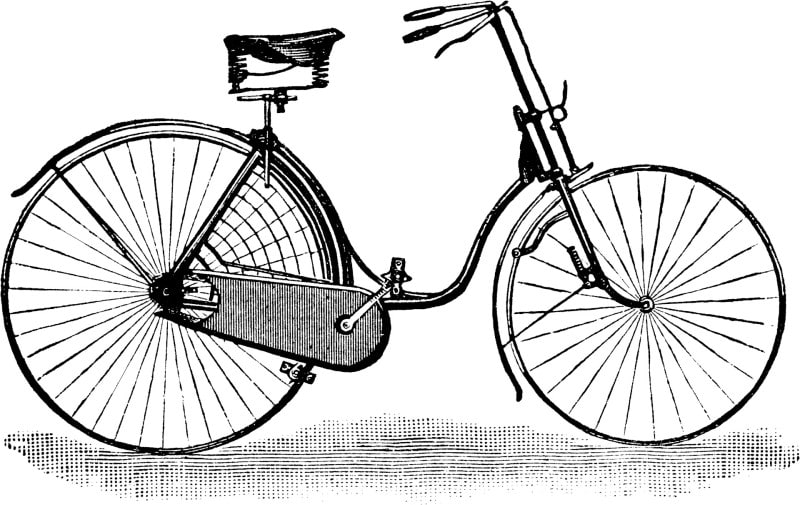
The social consequence was disproportionate. The bicycle was cheap, needed no stabling, and gave ordinary people — women especially — independent mobility for the first time. Susan B. Anthony said it had “done more to emancipate women than anything else in the world”. Dress reform followed, because you cannot ride in a crinoline. The engraving above shows a ladies’ safety bicycle of 1889, the type Starley’s design quickly produced, rather than the Rover itself.
24. The Automobile (1886)
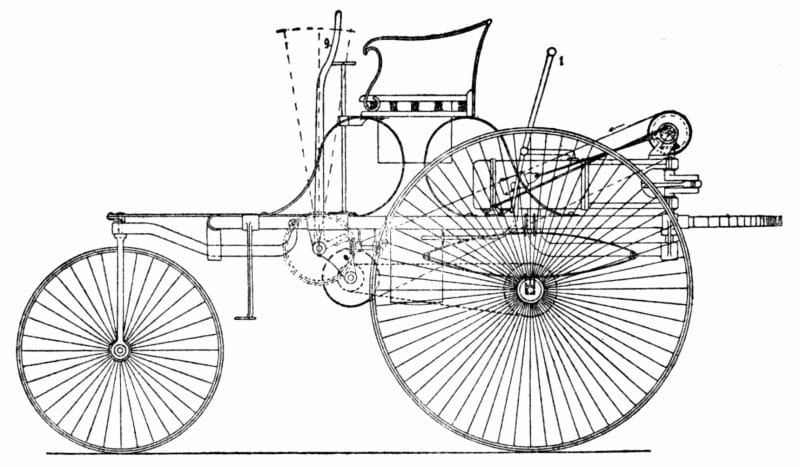
Karl Benz patented his Motorwagen on 29 January 1886: a three-wheeled machine with a single-cylinder four-stroke engine, electric ignition and a differential. It is generally accepted as the first practical automobile, as opposed to a self-propelled curiosity.
Benz had trouble convincing anyone it was useful. The person who solved that was his wife, Bertha Benz, who in August 1888 took the car without telling him and drove roughly 65 miles from Mannheim to Pforzheim with their two sons — buying fuel at a pharmacy, clearing a blocked fuel line with a hatpin, insulating a wire with her garter, and having a shoemaker re-line the brakes with leather, which is how brake linings came to be invented.
The publicity transformed the company’s fortunes. Her route is now a signposted heritage trail in Germany.
25. Coca-Cola (1886)
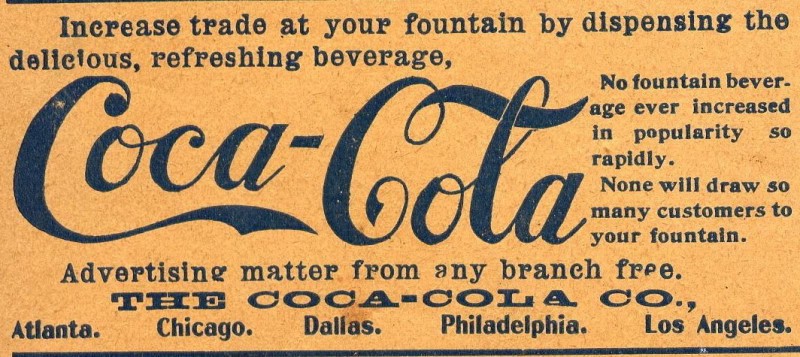
John Pemberton was an Atlanta pharmacist and a morphine addict, wounded in the Civil War, looking for a coca-and-kola tonic he could sell as a patent medicine. Atlanta went dry in 1886, so the alcoholic version became a soda-fountain drink instead. His bookkeeper Frank Robinson named it and wrote the script logo still in use.
Pemberton sold his stake and died penniless two years later. Asa Candler bought the rights for a reported $2,300 and built the company.
It is on this list not for the recipe but for what was built around it: the 1899 bottling franchise, the contour bottle of 1915 designed to be recognised by touch in the dark, and an advertising operation that made a regional syrup into the most widely distributed manufactured product on earth. Coca-Cola is an invention in marketing as much as in chemistry. The trade advertisement above dates from 1900, fourteen years after Pemberton mixed the first batch.
26. The Dishwasher (1886)
Josephine Cochrane was a wealthy Illinois hostess whose servants kept chipping her heirloom china. Told that nobody made a machine to wash dishes, she reportedly said she would build one herself.
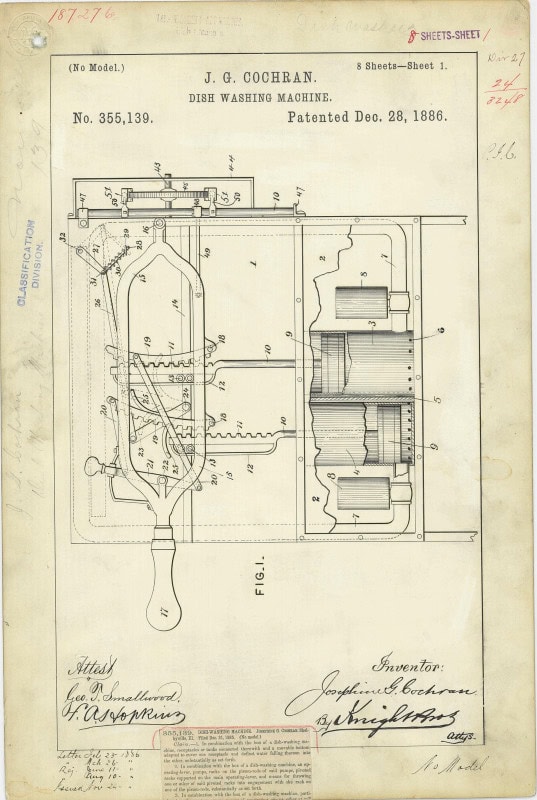
Her design — patented 28 December 1886 and shown above — was the first to get the principle right: wire compartments shaped to hold each plate, cup and saucer, mounted on a wheel inside a copper boiler, with a motor-driven pump spraying hot soapy water over them. Earlier attempts had scrubbed dishes; hers sprayed them, which is how every dishwasher since has worked.
She won the highest award at the 1893 Chicago World’s Fair, and sold successfully to hotels and restaurants. Domestic sales stayed slow until the 1950s — partly because most homes lacked enough hot water, and partly because dishwashing was not regarded as work worth paying to eliminate.
27. The Escalator (1892)
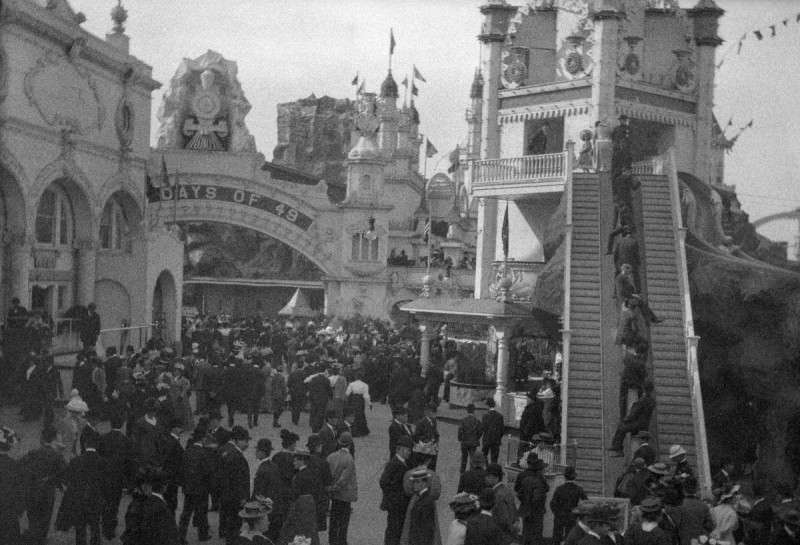
Jesse Reno patented an “endless conveyor for carrying passengers” in 1892 and installed one as a ride at Coney Island in 1896 — a moving inclined belt with cleats, at a gentle 25-degree slope, which about 75,000 people rode for fun in its first two weeks.
Charles Seeberger separately developed a version with flat moving steps and, with Otis, coined the name “escalator” from scala and elevator. The two designs were shown together at the 1900 Paris Exposition, where the Otis-Seeberger machine took first prize.
The photograph above shows a Reno-type inclined elevator at Luna Park, Coney Island, in 1909. The escalator’s commercial significance was quickly understood by department stores: unlike a lift, it moves a continuous stream of people past merchandise, and it never makes anyone wait.
28. Radio (1895)
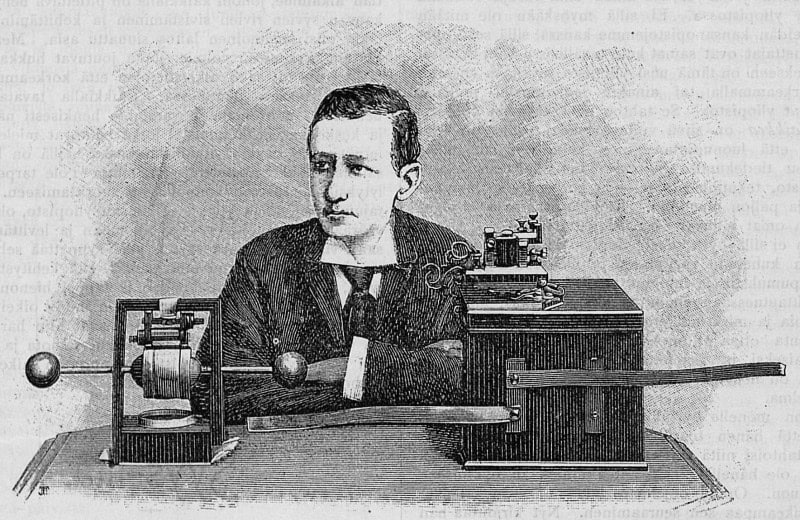
Heinrich Hertz proved in 1887 that the electromagnetic waves James Clerk Maxwell had predicted mathematically actually existed, and reportedly saw no use for them whatsoever.
Guglielmo Marconi, then 21 and working in his father’s attic in Bologna, thought otherwise. In 1895 he sent a signal over a mile and a half, and — critically — worked out that a raised aerial and an earth connection extended the range enormously. He took the idea to Britain, patented it in 1896, and in December 1901 claimed reception of a signal across the Atlantic from Cornwall to Newfoundland.
Priority here is genuinely contested. Nikola Tesla’s earlier patents were held by the US Supreme Court in 1943 to have anticipated Marconi’s, and Jagadish Chandra Bose and Alexander Popov both have strong claims. Marconi built the company.
29. The X-ray (1895)
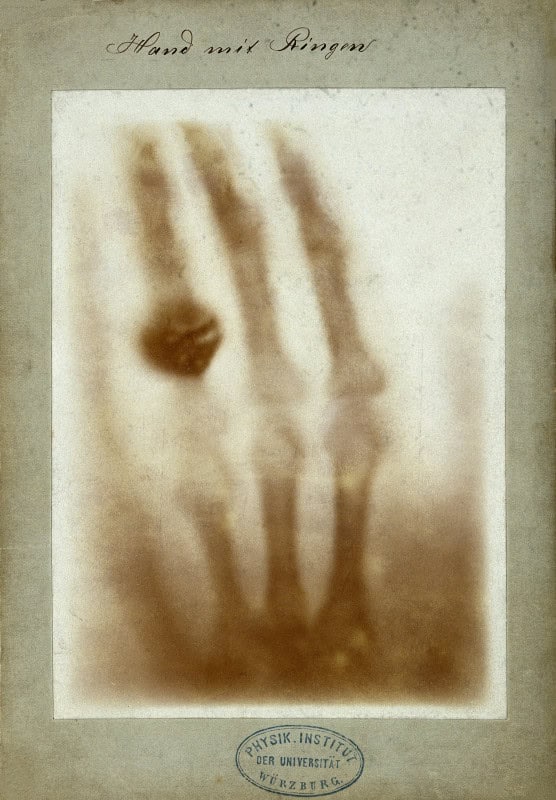
On 8 November 1895 Wilhelm Röntgen was working with a covered cathode-ray tube in a darkened laboratory when he noticed a screen across the room glowing. Something was passing through the cardboard that should have stopped it. He called the unknown rays “X”.
Within weeks he had made the image above — his wife Anna Bertha’s hand, bones and wedding ring clearly visible. She is said to have remarked, “I have seen my death.”
Röntgen refused to patent the discovery, believing it belonged to humanity, and donated his 1901 Nobel Prize money to his university. Within a year of publication, X-rays were being used to locate bullets and set fractures. The dangers took much longer to understand; many early radiologists and shoe-shop fluoroscope operators paid for that ignorance.
30. Aspirin (1897)
Willow bark had been used for pain and fever since antiquity, and salicylic acid had been isolated in the 19th century — but it was so harsh on the stomach that many patients could not tolerate it.
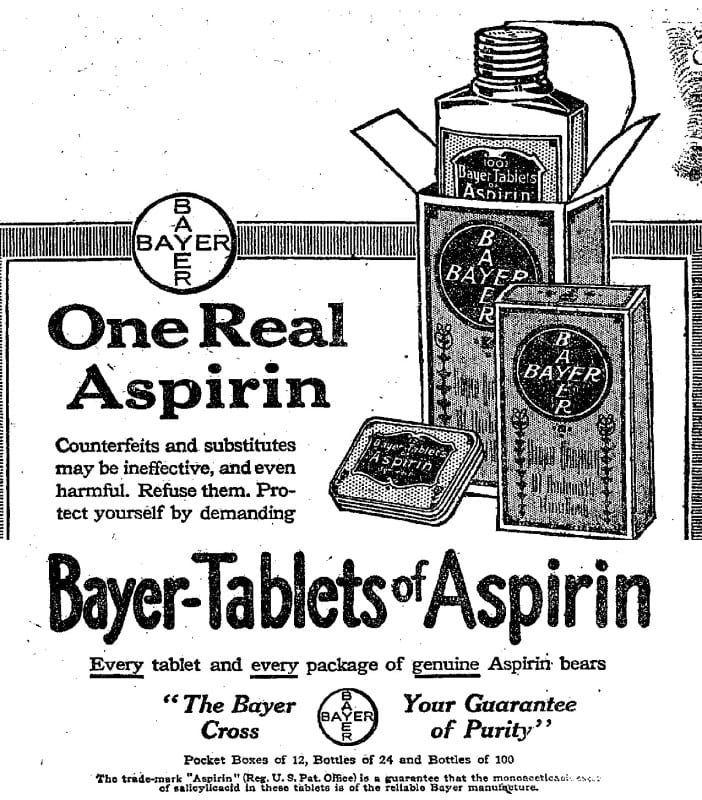
At Bayer in 1897, Felix Hoffmann produced a stable form of acetylsalicylic acid; Bayer trademarked it as Aspirin in 1899 and sold it first as a powder, then from 1900 as one of the earliest mass-market tablets, and over the counter in the United States from 1915. Hoffmann’s colleague Arthur Eichengrün later claimed he had directed the work and been written out of the record under the Nazi regime, and historians still disagree about it.
Aspirin has had an unusually long second life: in the 1970s John Vane worked out how it functions, work that won a Nobel Prize and opened a new understanding of inflammation. It remains one of the most widely used drugs in the world. The advertisement above dates from 1917, twenty years after Hoffmann’s synthesis.
Conclusion
The pattern that runs through this list is how often the person we remember is the one who industrialised an idea rather than the one who had it. Edison did not invent the light bulb; he invented the electricity supply that made it worth owning. Singer did not invent the sewing machine; he invented the instalment plan. Marconi did not discover radio waves; he built the company that sold them.
The other pattern is how badly the century treated its inventors. Goodyear died $200,000 in debt. Morton died broke and litigating. Pemberton sold Coca-Cola for almost nothing and died two years later. Babbage never finished his engine. Nobel is the exception, and only because he read his own obituary and did not like it.
For what all of this turned into, see our list of the 32 Greatest Inventions of the 20th Century — where the battery becomes the transistor, the telegraph becomes the internet, and the Motorwagen becomes the assembly line. And for the monuments the 19th century built to its own heroes, try the Top 32 Most Famous Statues In The World.
If you would rather follow the people than the machines, our list of the 18 famous inventors and the inventions that made them covers Volta, Morse, Nobel, Bell, Edison, Benz, Tesla and Marconi, each linked back to the entries above.
Image credits
All 30 images on this page are in the public domain or released CC0. No attribution is legally required for any of them; sources are listed for transparency.
- Voltaic pile — Volta’s own 1800 published plate (public domain)
- Stethoscope — painting by Théobald Chartran (public domain)
- Difference Engine — engraving from Harper’s New Monthly Magazine (public domain)
- Stephenson’s Rocket — engraving from Popular Science Monthly (public domain)
- Colt Paterson revolver — Metropolitan Museum of Art (CC0)
- Morse telegraph register — engraving from Popular Science Monthly (public domain)
- Susse Frères daguerreotype camera — Liudmila & Nelson (public domain)
- Charles Goodyear — portrait plate, George Iles, 1912 (public domain)
- Ether operation, 1847 — Southworth & Hawes (public domain)
- Howe sewing machine patent — US National Archives (public domain)
- Adams Black Jack gum advertisement — Le Journal (public domain)
- Otis hoisting apparatus patent, 1861 — US National Archives (public domain)
- Giffard airship, 1852 — engraving by L. Guiguet (public domain)
- H. L. Hunley — painting by Conrad Wise Chapman, 1864 (public domain)
- Alfred Nobel — photograph by Gösta Florman / The Royal Library (public domain)
- Joseph Lister — photogravure by Emery Walker (public domain)
- Remington No. 1 typewriter — Daderot, Wisconsin Historical Museum (CC0)
- Arithmometer — Daderot, Science Museum, London (CC0)
- Alexander Graham Bell, 1892 — Library of Congress (no known restrictions)
- Edison tin-foil phonograph — Daderot, National Museum of American History (CC0)
- Edison incandescent lamp — engraving, 1883 (public domain)
- McGill Single-Stroke Staple Press — Mikebartnz (public domain)
- Ladies’ safety bicycle, 1889 — engraving (public domain)
- Benz Patent-Motorwagen — 1886 patent drawing (public domain)
- Coca-Cola advertisement — American Druggist, 22 October 1900 (public domain)
- Cochran dish washing machine patent, 1886 — US National Archives (public domain)
- Luna Park, Coney Island, 1909 — Brooklyn Museum (no known copyright restrictions)
- Marconi and his apparatus — wood engraving, 1897 (public domain)
- Röntgen’s X-ray of a hand, 1895 — Wilhelm Röntgen (public domain)
- Bayer Aspirin advertisement — New York Times, 19 February 1917 (public domain)