
China never had a single bestiary. Its mythical creatures come out of very different kinds of book: a geography of strange mountains, the Shanhaijing or Classic of Mountains and Seas, which took its present form, in eighteen chapters, under the Han dynasty; the ritual classic Liji; the cosmology of the Huainanzi (139 BC); the first great dictionary, the Shuowen Jiezi (about AD 100); the history in the Zuo zhuan; the philosophy of the Zhuangzi; collections of strange tales; and, much later, Ming dynasty novels such as Journey to the West. A creature can be an omen in one and a monster in the next.
This list takes thirty of them and, for each, says which text or period it comes from, what it meant to the people who wrote about it, and where it can still be seen. “Creature” here means a beast, bird, serpent or spirit with a body that is not human. The thirty run in six groups: the four guardians of the sky, the dragons, the auspicious beasts, the guardians of gates and tombs, the shape-shifters and spirits, and the monsters of the early texts. Where a famous story turns out to be recent, or where two old books disagree, the entry says so.
What are the four mythical beasts of China?
The usual answer is the Four Symbols (四象, sixiang): the Azure Dragon of the east, the Vermilion Bird of the south, the White Tiger of the west and the Black Tortoise of the north. Each is a quarter of the night sky, made of seven of the twenty-eight lunar mansions, and each has a season, a color and one of the five phases. The Liji (“Quli”, part 1) arranges an army on the march by them: Vermilion Bird in front, Black Tortoise behind, Azure Dragon on the left, White Tiger on the right.
| Creature | Direction | Season | Color | Phase |
|---|---|---|---|---|
| Azure Dragon (Qinglong) | East | Spring | Blue-green | Wood |
| Vermilion Bird (Zhuque) | South | Summer | Red | Fire |
| White Tiger (Baihu) | West | Autumn | White | Metal |
| Black Tortoise (Xuanwu) | North | Winter | Black | Water |
| Yellow Dragon (Huanglong) | Center | None; it governs the four quarters | Yellow | Earth |
Two other foursomes are sometimes meant. The Liji (“Liyun” chapter) names a different “four spirits” (四靈, siling), often translated as the four benevolent animals: the qilin, the fenghuang, the tortoise and the dragon. And the Zuo zhuan has their opposite, the Four Perils (四凶, sixiong): Hundun, Qiongqi, Taowu and Taotie, banished by the sage ruler Shun (entries 17 and 25 to 27).
What are the five mythical beasts in Chinese mythology?
Five is the Four Symbols plus a center. Han cosmology worked in fives (five phases, five colors, five directions counting the middle), so four sky animals left a gap. The Huainanzi (chapter 3, “Patterns of Heaven”) fills it: the east has the Azure Dragon, the south the Vermilion Bird, the west the White Tiger, the north the Black Tortoise, and the center, which belongs to earth and the Yellow Emperor, has the Yellow Dragon (黃龍, Huanglong).
Are Sun Wukong and the Eight Immortals mythical creatures?
Both turn up on lists of them, but neither is on this one. Sun Wukong, the Monkey King, is the hero of a novel, Journey to the West, whose earliest surviving edition dates from 1592: a stone monkey who learns magic, storms heaven and becomes a Buddhist pilgrim. The Eight Immortals (Zhongli Quan, Lü Dongbin, Li Tieguai, Zhang Guolao, He Xiangu, Lan Caihe, Han Xiangzi and Cao Guojiu) are Daoist xian, people who achieved immortality and are honored in temples. The immortals are people, so they fall outside the definition above. Sun Wukong, though a stone monkey, is the single hero of a novel, and this list leaves him out by choice.
The Four Symbols: guardians of the four directions
1. Azure Dragon (青龍, Qinglong)
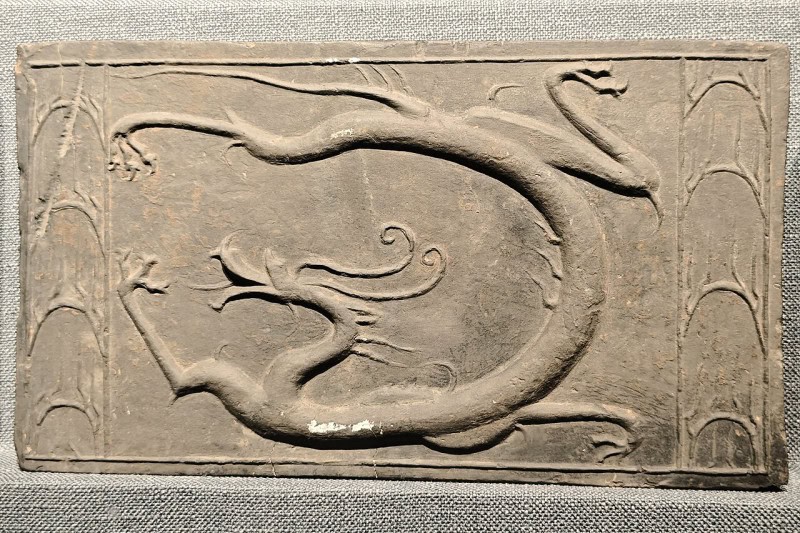
East, spring and wood. The Azure Dragon was a constellation before it was a guardian: seven lunar mansions running from Jiao, the Horn, to Ji, the Winnowing Basket. The Huainanzi (chapter 3) makes it the beast of the east. The pairing of dragon and tiger is far older than either book: tomb M45 at Xishuipo in Puyang, Henan, a Neolithic burial excavated in 1987, held a skeleton flanked by a dragon and a tiger laid out in clam shells. The festival of Longtaitou, “the dragon raises its head”, is still kept on the second day of the second lunar month. See it: a molded tomb brick with the Azure Dragon in relief, dated to AD 398 under the Eastern Jin, from the collection of the Zhenjiang Museum in Jiangsu.
2. Vermilion Bird (朱雀, Zhuque)
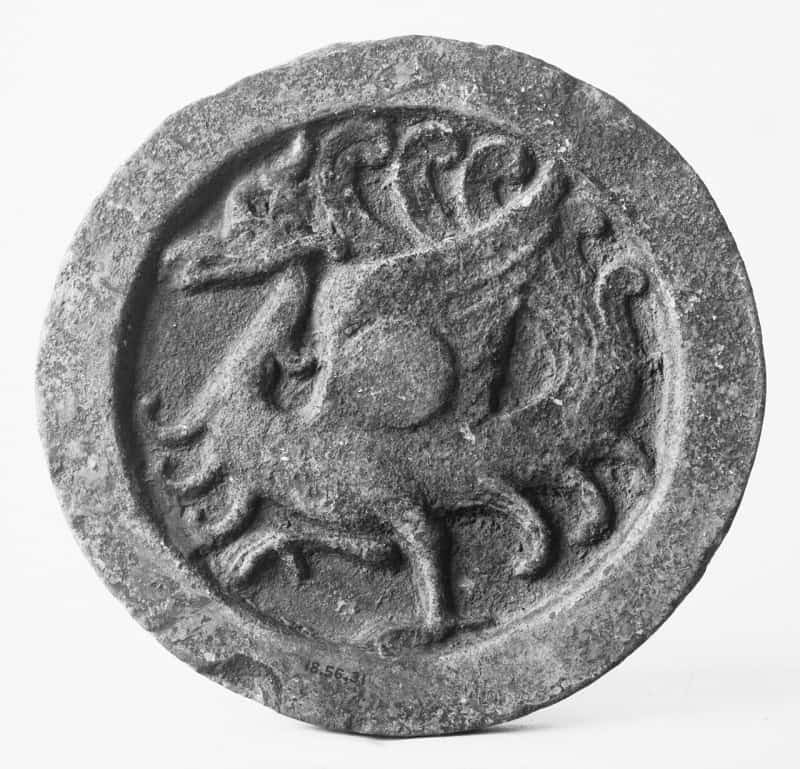
South, summer and fire. The seven southern mansions make a bird. Sima Qian’s Shiji (“Treatise on the Heavenly Offices”, about 100 BC) reads its anatomy off the stars: the mansion Liu is the beak, Xing the neck, Zhang the crop and Yi the wings. It is often confused with the fenghuang (entry 11), but the early texts keep them apart: the Vermilion Bird is a quarter of the sky, the fenghuang an omen that visits the earth. The great southern avenue of Tang dynasty Chang’an was named for it. See it: one of a pair of Western Han roof-tile ends in the Metropolitan Museum of Art (18.56.31), cataloged together as the White Tiger of the West and the Red Bird of the South.
3. White Tiger (白虎, Baihu)
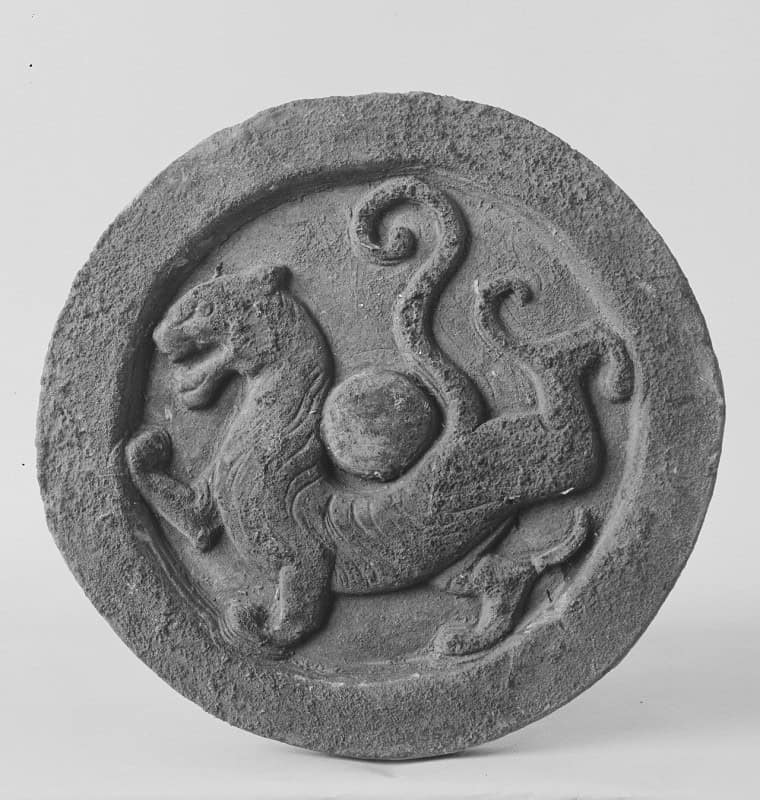
West, autumn and metal. The tiger faced the dragon across the Xishuipo burial long before any text named it. The system took time to settle: the Shiji treatise that describes the other three calls the western palace of the sky Xianchi, and gives the white tiger only the mansion Shen, the stars of Orion. Tigers also kept ghosts away. Ying Shao’s Fengsu tongyi (about AD 200) says the tiger is a creature of yang that devours demons, which is why it was painted on doors. See it: the Western Han roof-tile end with a tiger in the Metropolitan Museum of Art (18.56.30), the partner of the bird tile above.
4. Black Tortoise (玄武, Xuanwu)
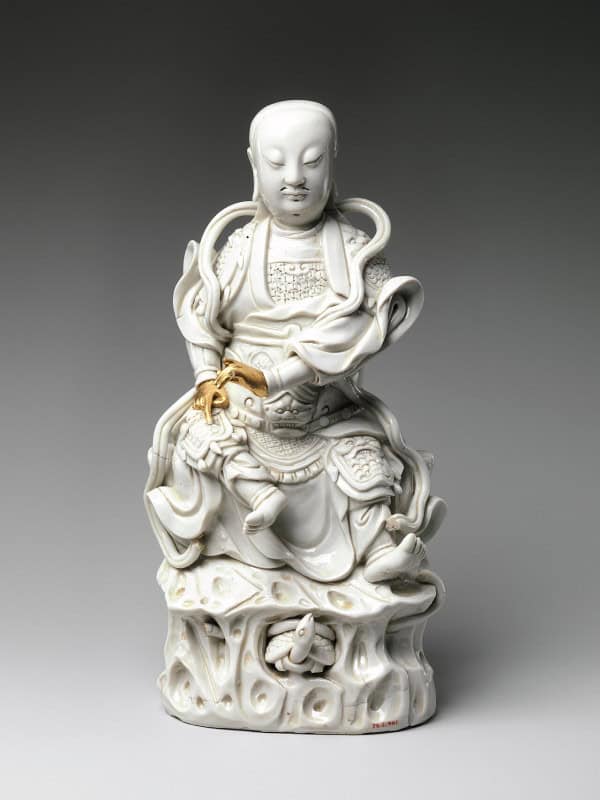
North, winter and water. The fourth guardian is two animals, a tortoise with a snake coiled around it. Its name, Xuanwu, means “Dark Warrior” and appears in the poem “Far Roaming” in the Chuci. Under the Song emperor Zhenzong (reigned 997–1022) the name was changed to Zhenwu, “Perfected Warrior”, to avoid a character in the name of an imperial ancestor, and Zhenwu grew into a major Daoist god in human form. See it: Han tiles and tomb reliefs show the entwined pair; a Dehua porcelain figure of Zhenwu in the Metropolitan Museum of Art (79.2.481, early 18th century) is identified by the tortoise at its base.
Chinese dragons
The dragon is not one creature. The texts distinguish kinds by wings, horns, age and job.
5. The Long, the Chinese dragon (龍, lóng)
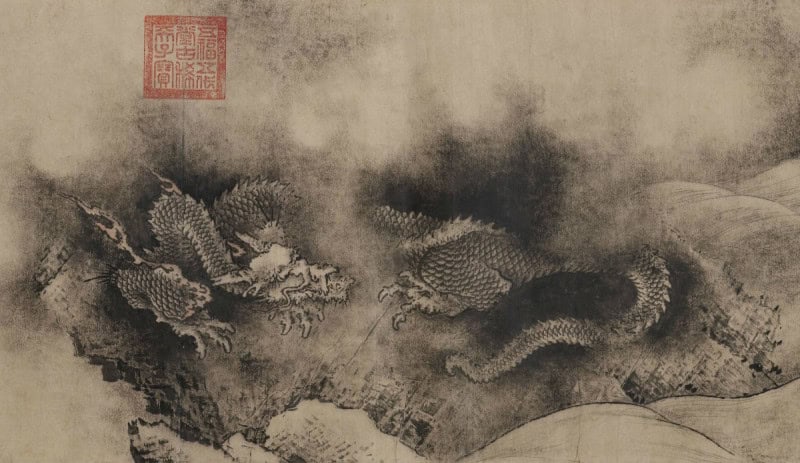
Shang oracle bones onward; a lord of water. The character for long is already on Shang oracle bones, and the coiled jade “pig-dragons” of the Hongshan culture are older still. The Shuowen Jiezi defines it as the chief of the scaled creatures, able to be dark or bright, tiny or huge, rising to the sky at the spring equinox and diving into the deep at the autumn one. It brings rain: Dong Zhongshu’s Chunqiu fanlu (chapter 74) prescribes clay dragons for rain prayers. Unlike Fáfnir, the hoard-guarding dragon on our list of Norse mythology creatures, it is not an enemy to be killed. See it: Chen Rong’s handscroll Nine Dragons, dated 1244, in the Museum of Fine Arts, Boston (17.1697).
6. Yinglong, the winged dragon (應龍)
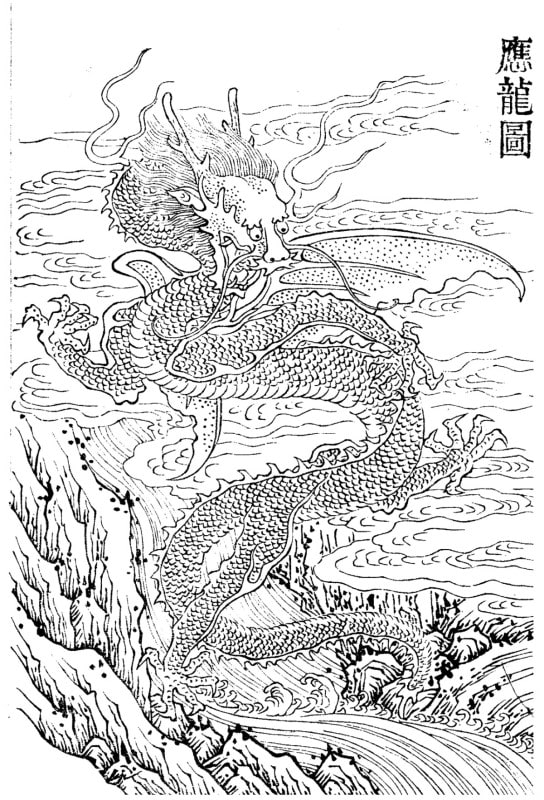
Shanhaijing, chapters 14 and 17; the dragon that fought for the Yellow Emperor. The Shanhaijing (“Great Wilderness: East”) says Yinglong lives at the southern extremity, killed the rebel Chiyou, and could not go back up to the sky, which is why the world below so often has drought. People who make an image of Yinglong in a drought get heavy rain. The Guangya dictionary (third century AD) gives the definition later writers repeat: a dragon with wings is a yinglong. Wang Yi’s Han commentary on the “Heavenly Questions” of the Chuci adds that it drew its tail across the ground to show Yu the Great where to cut channels for the flood. See it: a woodcut titled “Picture of the Yinglong” in the Qing imperial encyclopedia Gujin tushu jicheng (compiled in the early eighteenth century) gives the dragon a pair of wings.
7. Zhulong, the Torch Dragon (燭龍)
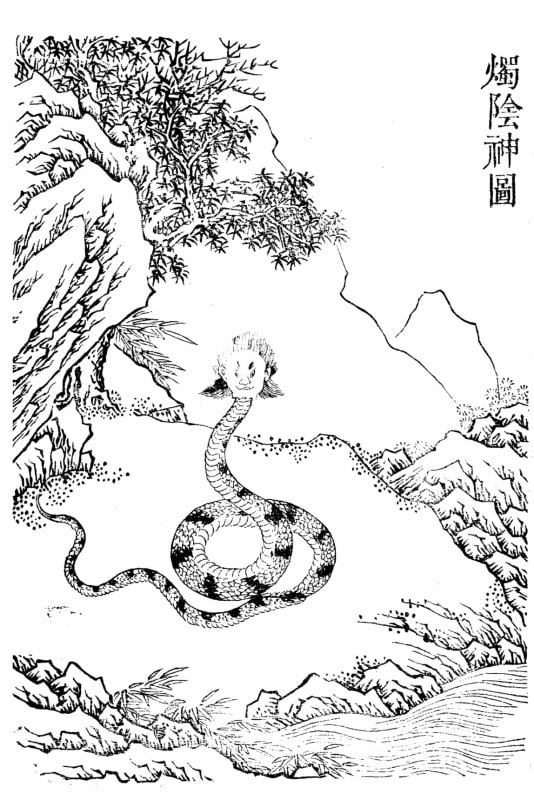
Shanhaijing, chapters 8 and 17; the dragon whose eyes are day and night. Beyond the northwest sea, on Mount Zhangwei, says the Shanhaijing (“Great Wilderness: North”), there is a god with a human face and a red serpent’s body. When it shuts its eyes there is darkness, and when it opens them there is light. An earlier chapter (“Beyond the Seas: North”) calls it Zhuyin, Torch Shade, whose blowing is winter and whose breathing out is summer. The “Heavenly Questions” asks about it directly: where does the sun not reach, and how does the Torch Dragon light it? See it: the same encyclopedia’s woodcut of Zhuyin shows a human head on a coiled snake’s body.
8. The Dragon Kings (龍王, Longwang)
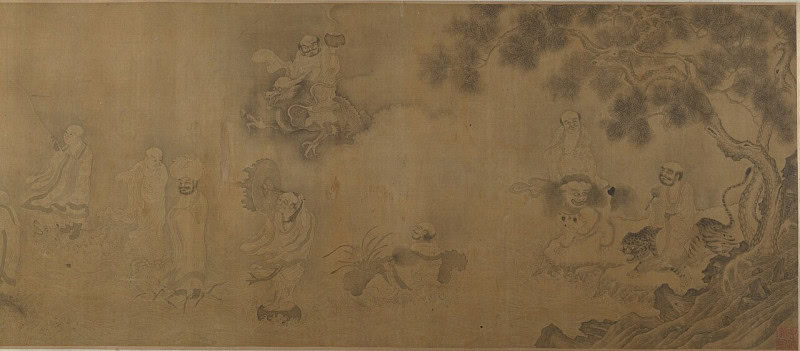
Buddhist sutras, then Tang tales; rulers of seas, rivers and rain. The dragon kings arrived with Buddhism. Chinese translators rendered the Indian nagaraja, serpent king, as longwang, and Kumarajiva’s translation of the Lotus Sutra (AD 406) names eight of them in its opening chapter. They merged with the native rain dragon and acquired palaces, families and official duties. In Journey to the West (chapter 3) Sun Wukong takes his iron staff from Ao Guang, Dragon King of the Eastern Sea. Villagers prayed for rain at dragon king temples. See it: a late Ming handscroll in the Metropolitan Museum of Art (18.25.1) shows Buddhist holy men crossing the sea to the palace of the Dragon King.
9. The Nine Sons of the Dragon (龍生九子)
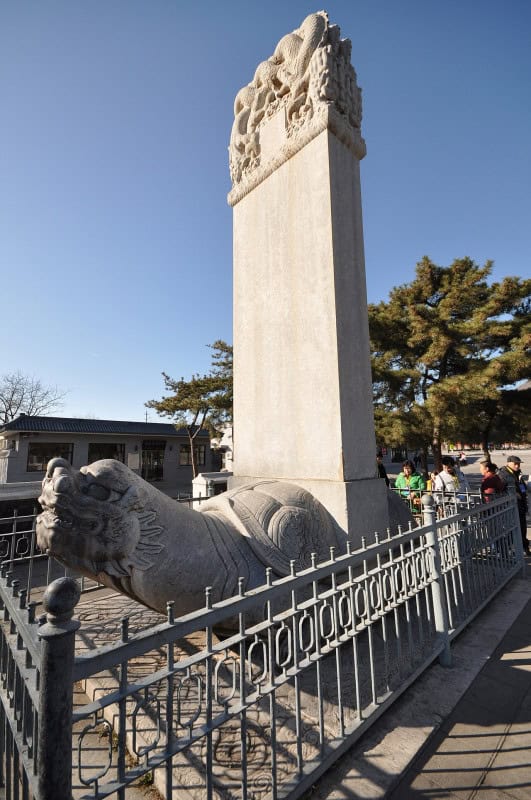
Ming dynasty lists; the beasts on bells, roofs and steles. “The dragon has nine sons” is a saying written down in the Ming, not an ancient myth. Li Dongyang and Yang Shen each gave a list of nine, and their lists differ. In Yang Shen’s version, the one most often repeated, each son’s taste explains where it is carved: bixi likes weight and carries steles on its turtle back, chiwen likes to gaze and sits on roof ridges, pulao likes to roar and tops bells, and bi’an guards prison gates. See it: stone turtles carrying inscribed steles stand at temples and imperial tombs across China.
Auspicious beasts: omens of good government
The qilin and the fenghuang do not do much. Their job is to appear, and their appearing means that a sage is on the throne. The others in this group have work to do: guarding tombs, naming demons, judging lawsuits, living in the sun.
10. Qilin (麒麟)
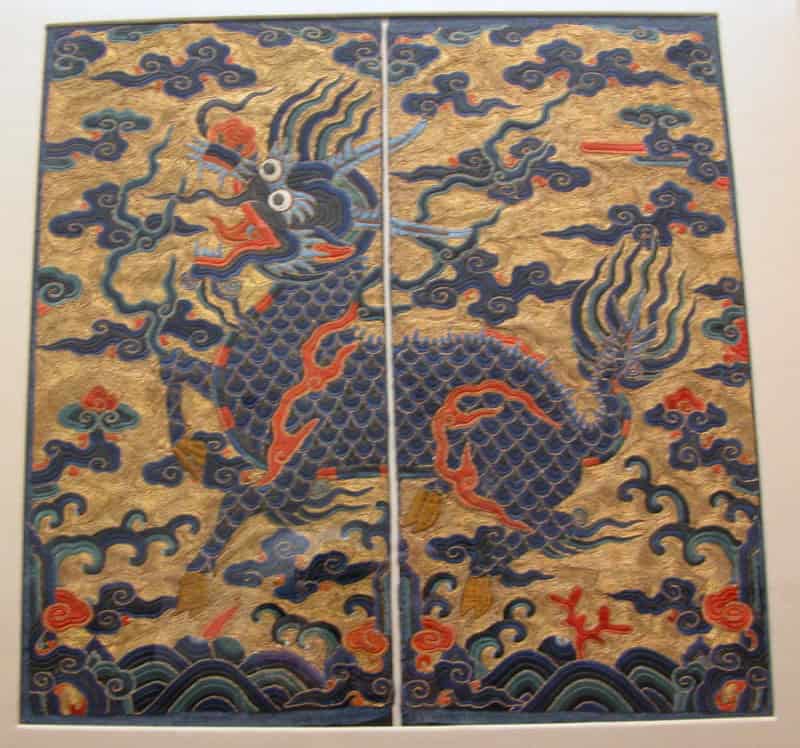
Shijing and the Spring and Autumn Annals; the omen of a just ruler. A lin is praised in the Shijing ode “The Feet of the Lin”, and the Chunqiu annals end with the capture of one in 481 BC, an event that, in the Gongyang commentary, makes Confucius weep. The Shuowen Jiezi calls it a benevolent beast with a deer’s body, an ox’s tail and a single horn. In 1414 a giraffe was presented to the Yongle emperor and praised at court as a qilin. Ming nobles wore the qilin as a badge, and after 1662 it marked the highest military rank. See it: a late seventeenth-century embroidered rank badge with a qilin in the Metropolitan Museum of Art (36.65.6).
11. Fenghuang (鳳凰)
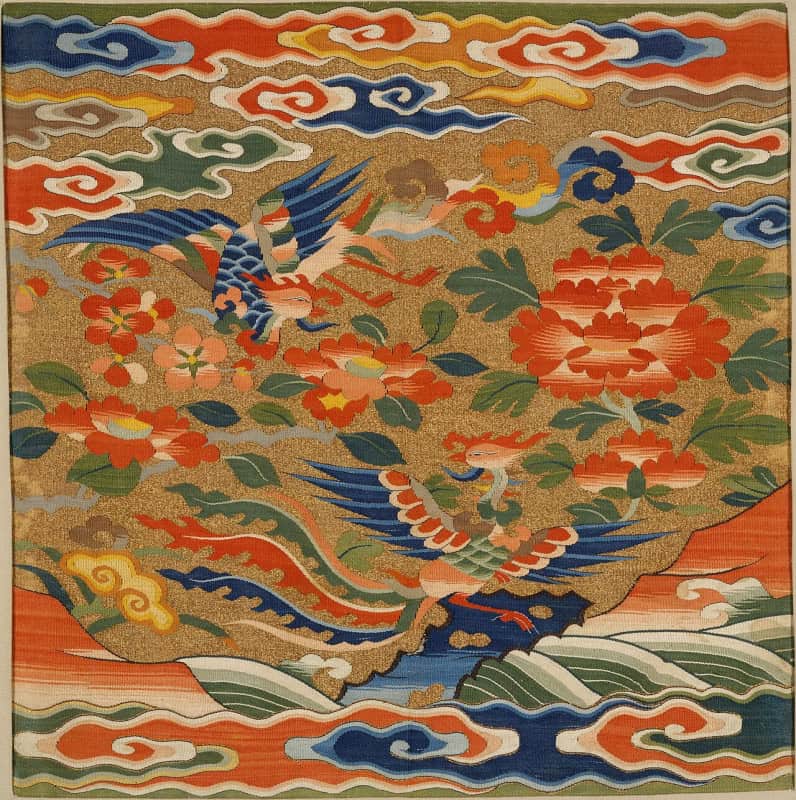
Shanhaijing, chapter 1; the bird that appears in peacetime. On Mount Danxue, says the Shanhaijing (“Southern Mountains”), lives a bird shaped like a chicken with five-colored markings. The patterns on its head read “virtue”, on its wings “righteousness”, on its back “ritual”, on its breast “benevolence” and on its belly “trust”. When it is seen the world is at peace. Confucius complains in the Analects (9.9) that “the feng bird does not come”. In later imperial art the bird became the emblem of the empress, paired with the emperor’s dragon. “Chinese phoenix” is a translation of convenience; nothing in these texts burns or is reborn. See it: a sixteenth-century Ming silk tapestry badge with two phoenixes in the Metropolitan Museum of Art (36.65.31).
12. Pixiu, Bixie and Tianlu (貔貅, 辟邪, 天祿)
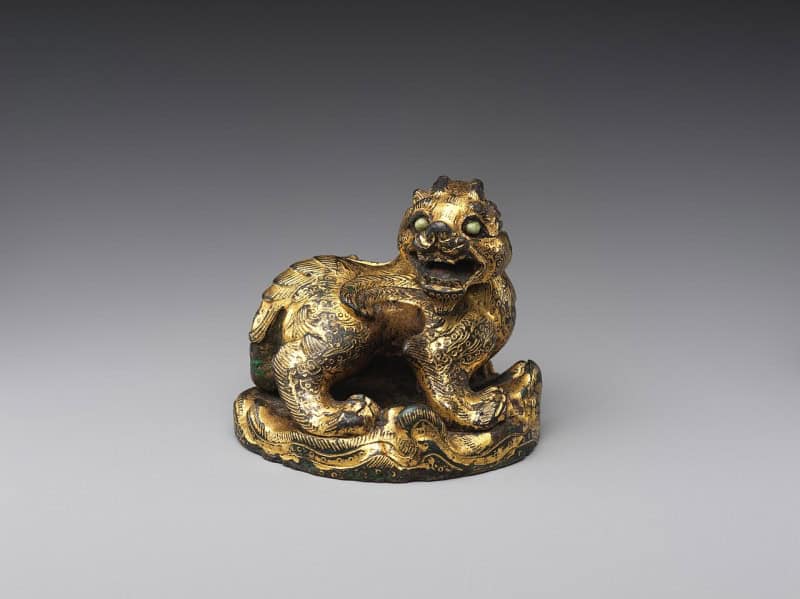
Han shu, chapter 96; winged beasts that guard tombs and, today, savings. The Han shu chapter on the Western Regions lists an animal called taoba, and a commentary ascribed to the third-century scholar Meng Kang explains that the kind with one horn is the tianlu and the kind with two is the bixie, “averter of evil”. From the Eastern Han, stone pairs lined the roads to tombs; the best preserved flank those of the Southern Qi rulers (479–502) near Nanjing. The belief that a pixiu, the modern name for both, swallows gold and cannot pass it, which makes it a charm for wealth, comes from folk tales, not from the Han texts. See it: a gilt bronze weight in the shape of a winged beast of the kind this entry describes, which the Metropolitan Museum of Art titles “Weight in the shape of a chimera” (2019.217). It was made in the second century BC under the Western Han, well before the stone pairs.
13. Bai Ze (白澤)
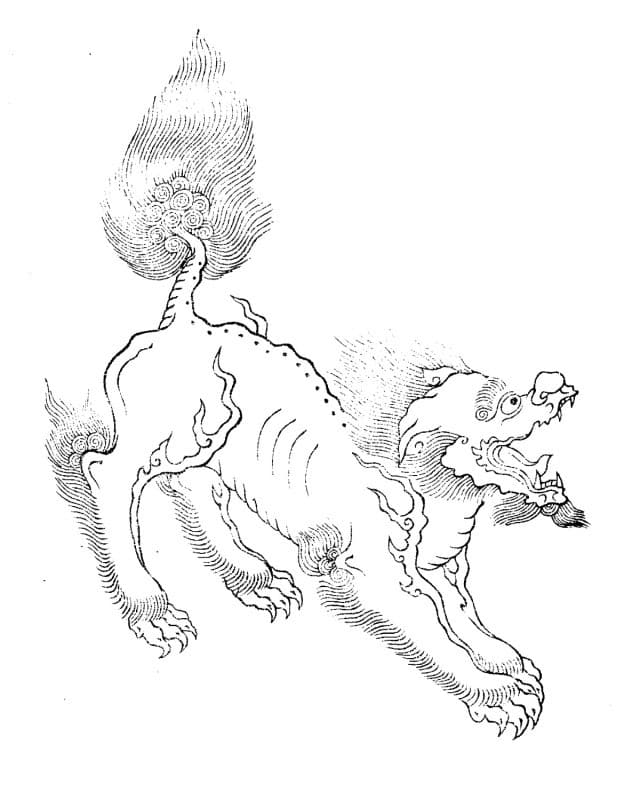
Baopuzi, chapter 13; the beast that knew every demon. Ge Hong’s Baopuzi (about AD 320) says that the Yellow Emperor, to learn about spirits, “recorded the words of Bai Ze”. The Song Daoist anthology Yunji qiqian (chapter 100) tells the story in full: the emperor met a beast that could talk, and it described 11,520 kinds of spirit and prodigy, which he had drawn as the Baize tu, the Bai Ze Diagrams. A fragment of a book in that tradition survives among the Dunhuang manuscripts in Paris (Pelliot chinois 2682). In Japan it is the hakutaku, and during the cholera epidemic of 1858 people in Edo were told to keep its picture by their pillows. See it: the Gujin tushu jicheng, the Qing encyclopedia of entry 6, has a woodcut of Bai Ze as a shaggy, lion-like beast.
14. Xiezhi (獬豸)
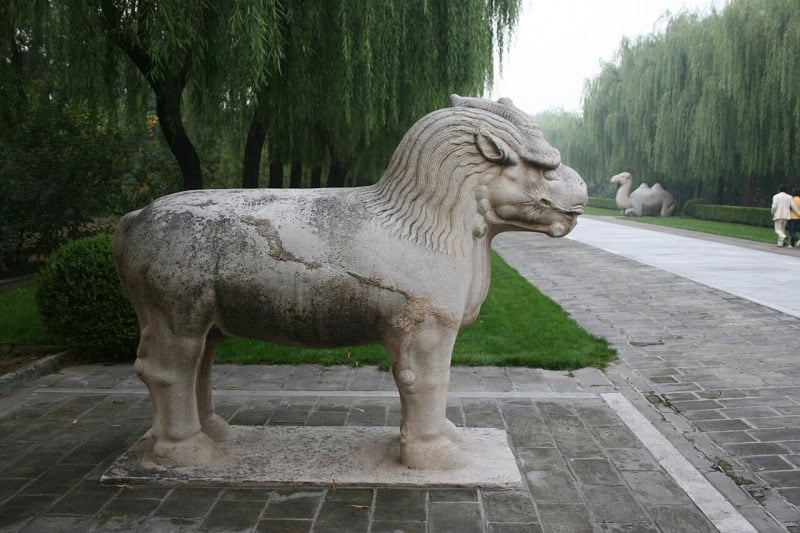
Shuowen Jiezi and Lunheng; the one-horned judge. The Shuowen Jiezi describes an ox-like beast with one horn that in antiquity settled lawsuits by butting the party in the wrong. Wang Chong’s Lunheng (chapter 52, first century AD) gives the story: Gao Yao, minister of justice to the sage ruler Shun, kept a one-horned goat that rammed the guilty and left the innocent alone. The Shuowen even finds the animal inside the old form of the character for “law”, 灋, which it analyses as water (for level), the beast, and “to remove”. Qing censors wore the animal on their badges. In Korea, as the haetae, it guards the Gyeongbokgung palace in Seoul. See it: stone xiezhi stand among the animals that line the Sacred Way of the Ming Tombs near Beijing.
15. Three-legged crow (三足烏, sanzuwu)
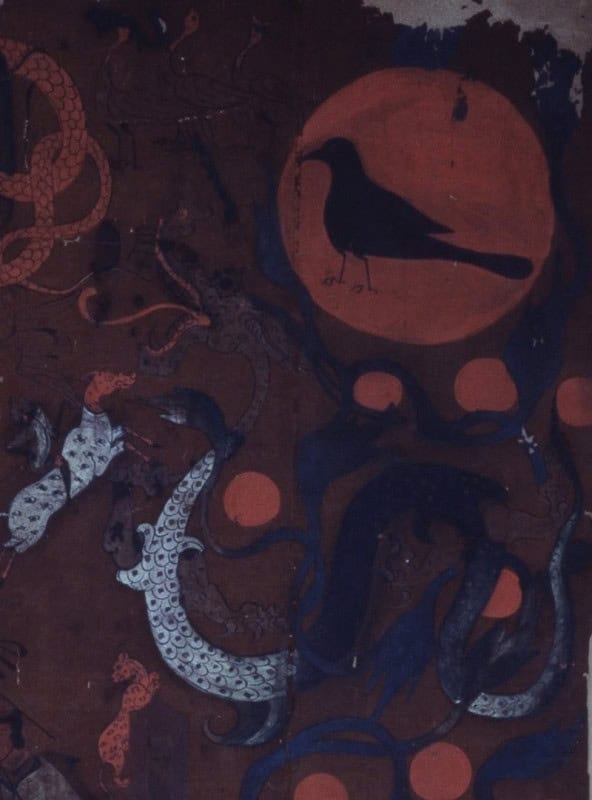
Huainanzi, chapter 7; the bird inside the sun. “In the sun there is a crow, and in the moon a toad,” says the Huainanzi. The bird belongs to the story of the ten suns that roost on the Fusang tree (Shanhaijing, chapter 9). The third leg is on record from the Han: Sima Xiangru’s “Rhapsody on the Great Man” (second century BC) makes a three-legged crow the messenger of the Queen Mother of the West. The ten suns and their mother Xihe have an entry on our sun gods page. See it: the painted silk funeral banner from Mawangdui Tomb 1 (160s BC, Hunan Museum) has a black crow inside its red sun.
Guardians of gates, tombs and bronzes
16. Guardian lions (石獅, shishi)
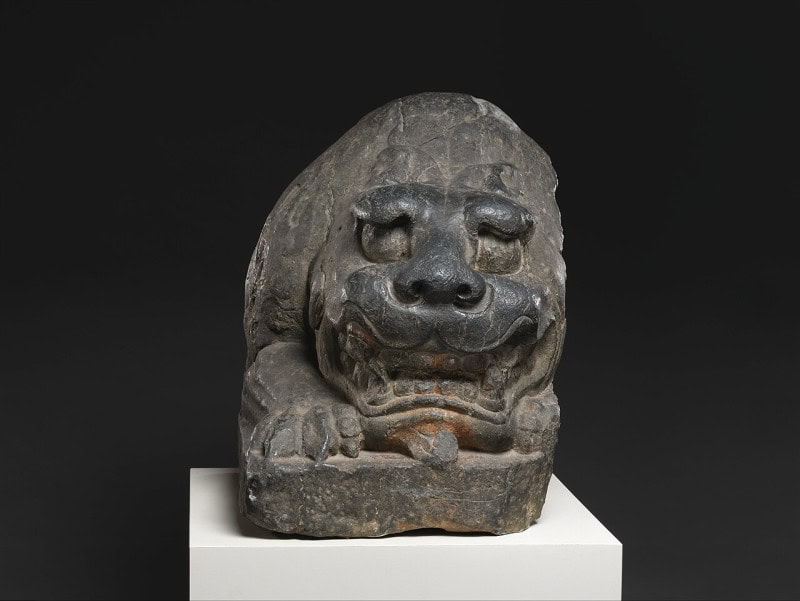
Han dynasty; a real animal that became a mythical one. Lions never lived in China. The Hou Han shu (chapter 88) records live lions sent as tribute from Parthia in AD 87. Paired stone lions guarded Han tombs, and the Metropolitan Museum notes that they spread once lion imagery arrived with the Buddhist cave temples of the fifth and sixth centuries. By the Ming and Qing the convention was fixed: a pair at the gate, the male with a paw on a ball, the female with a cub. The lion dance is at least as old as the Tang; Bai Juyi’s poem “Xiliang ji” describes lion dancers with carved wooden heads. See it: a limestone guardian lion of the Northern Qi dynasty, mid-sixth century, in the Metropolitan Museum of Art (30.66.1).
17. Taotie (饕餮)
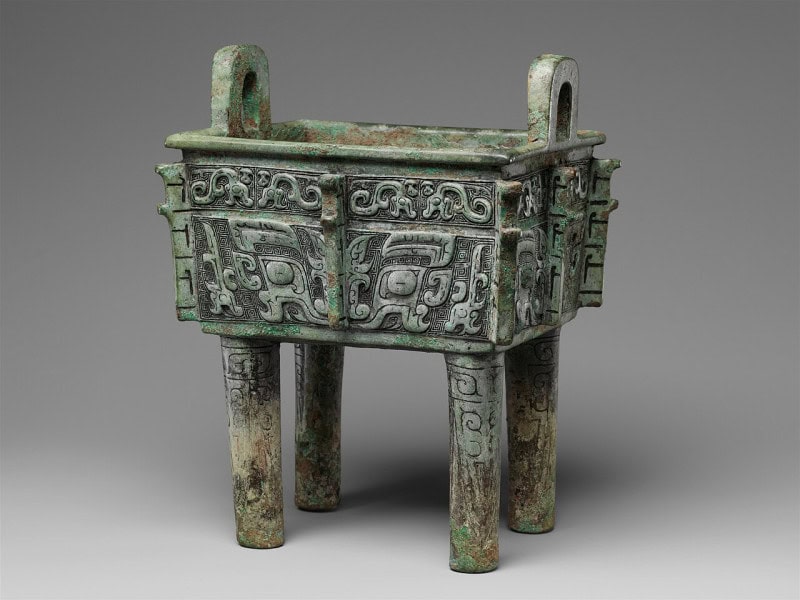
Zuo zhuan and Lüshi chunqiu; the face on the bronzes. Two things share this name. In the Zuo zhuan (Duke Wen, year 18) Taotie is the gluttonous son of the Jinyun clan, one of the Four Perils banished by Shun. The Lüshi chunqiu (about 239 BC, “Foreknowledge”) says that Zhou cauldrons carried a taotie with a head and no body, which ate people and was ruined before it could swallow them. Much later, Song antiquarians cataloging ancient bronzes used the word for the frontal animal mask with staring eyes and horns on Shang and early Zhou ritual vessels. What the mask meant to the people who cast it is not known. See it: a Shang bronze rectangular cauldron (fangding) of the twelfth or eleventh century BC in the Metropolitan Museum of Art (49.135.2).
18. Nian (年獸, nianshou)
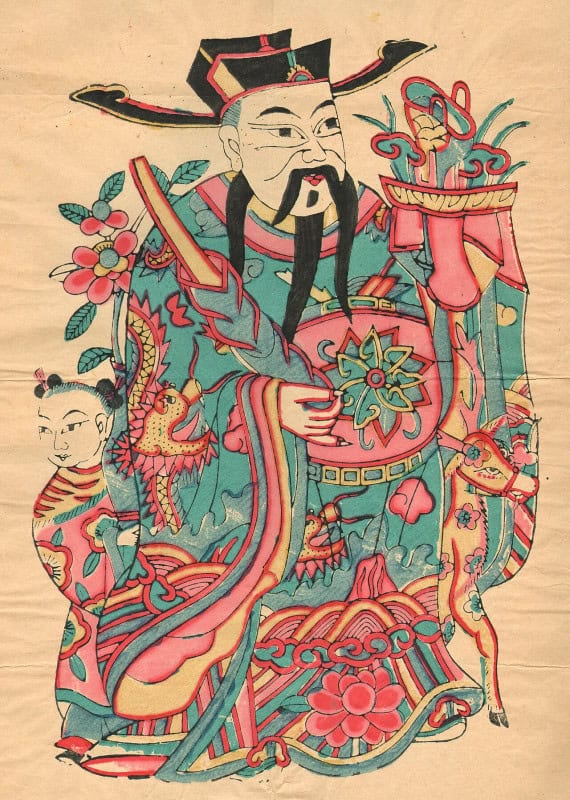
A New Year story first written down in the twentieth century. A beast called Nian came out on New Year’s Eve to eat villagers, until people found that it feared red, fire and noise, hence the red paper and firecrackers. It is not in the old books. In the Shuowen Jiezi the word nian (年) means the ripening of grain, and so a harvest and a year. The sixth-century Jing-Chu suishi ji explains the New Year firecracker as a way to scare off mountain spirits called shansao. No text describes the nian as a beast before the early twentieth century, so the story may be a modern explanation for older customs. See it: there is no antique picture of the nian; what is old is the customs the story explains, such as the woodblock New Year prints (nianhua) pasted up for the festival, like this door spirit printed about 1900.
19. Zhenmushou, the tomb guardian beast (鎮墓獸)
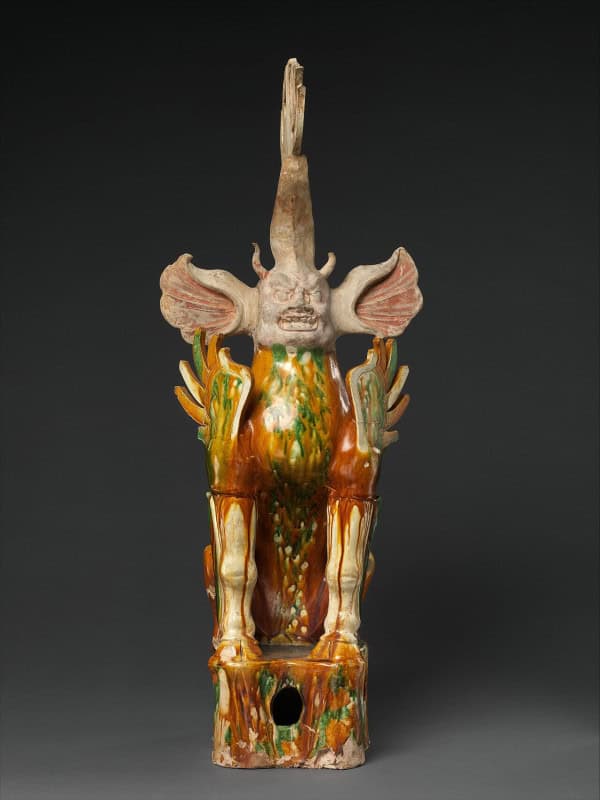
Chu tombs to the Tang; made only for the dead. Zhenmushou, “tomb-quelling beast”, is the archaeologists’ name for figures placed in tombs to protect the occupant. The earliest are lacquered wooden creatures with real deer antlers from tombs of the southern state of Chu (about the fifth to third centuries BC). Under the Tang they became pairs of fired clay monsters, often in three-color sancai glaze, one with a human face and one with a beast’s, set near the tomb entrance with a pair of armored guardian figures. See it: a Tang tomb guardian beast of the late seventh century, earthenware with sancai glaze, 77.5 cm high, in the Metropolitan Museum of Art (11.83.4).
Shape-shifters, spirits and the restless dead
The fox spirit, the jiangshi and the White Snake took their familiar form in a later kind of book, the zhiguai or “records of the strange”, and in fiction. The animals in the moon and the heavenly dog are older.
20. Nine-tailed fox (九尾狐, jiuweihu)
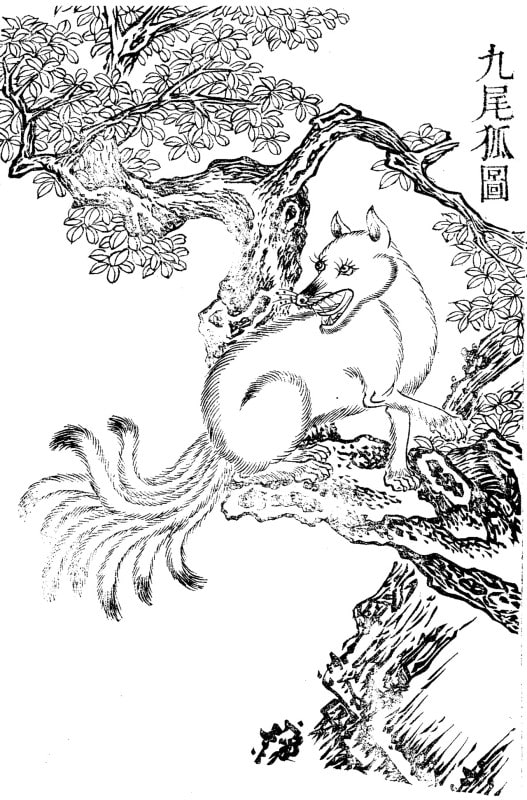
Shanhaijing, chapter 1; an omen first, a seductress later. On Mount Qingqiu, says the Shanhaijing, there is a beast like a fox with nine tails. It eats people, and whoever eats it is safe from gu poison. Under the Han it was a good sign: the Baihu tong (AD 79) lists it among the omens of a virtuous reign. The change came with tales of fox spirits. The Xuanzhong ji, attributed to Guo Pu (276–324), says a fox of fifty can turn into a woman and at a thousand becomes a heavenly fox. In the Ming novel Fengshen yanyi a fox spirit takes the body of Daji and ruins the last Shang king. See it: the nine-tailed fox as drawn in the Qing imperial encyclopedia Gujin tushu jicheng (completed 1725), which pictures many of the Shanhaijing creatures.
21. Jiangshi (殭屍)
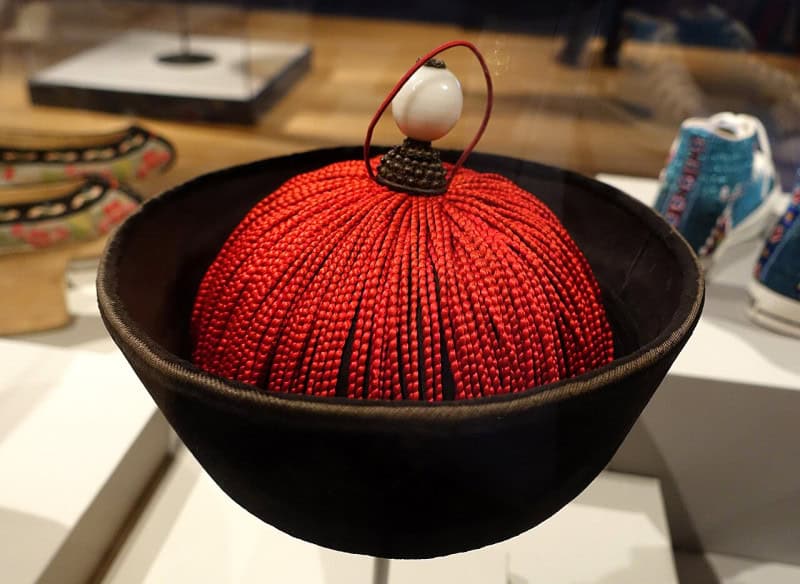
Qing dynasty ghost stories; the corpse that gets up. Jiangshi means “stiff corpse”. The stories come from Qing collectors of the strange: Pu Songling’s Liaozhai zhiyi, Yuan Mei’s Zibuyu and Ji Yun’s Yuewei caotang biji (1789–1798). The hop is often traced to “corpse driving” in western Hunan, the reported practice of carrying the dead home for burial on bamboo poles, though that link is a guess. The Qing official’s robe and hat and the paper talisman on the forehead are film conventions, made famous by the Hong Kong comedy Mr. Vampire (1985). Meng Po and Yama, the judge of the dead known in China as Yanluo, are on our page about gods of death and the underworld. See it: there are no old pictures of jiangshi; the costume is the dress of a Qing official, like this hat of a sixth-rank civil official, late nineteenth or early twentieth century, in the Textile Museum at George Washington University.
22. The White Snake (白蛇, Bai Suzhen)
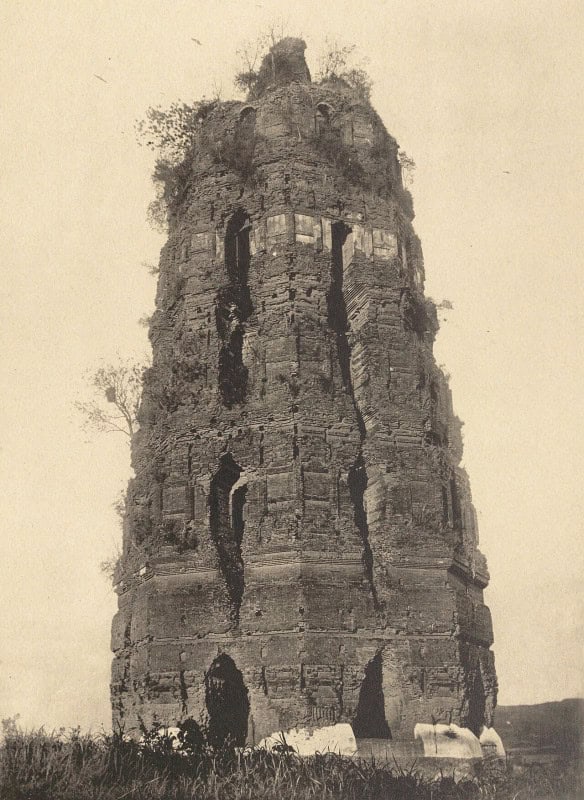
A Ming short story of 1624; the snake who married a man. The legend takes shape in Feng Menglong’s collection Jingshi tongyan (1624), story 28, “Madam White Is Kept Forever under Thunder Peak Pagoda”. In Hangzhou a pharmacy clerk, Xu Xuan, marries Madam White, a white snake spirit whose maid Qingqing is a green fish spirit, and the monk Fahai finally imprisons her under Leifeng Pagoda beside West Lake. Feng’s snake is a danger. Later tellers took her side: Fang Chengpei’s play Leifeng Pagoda (1771) added her theft of a magic herb to revive her husband. The names Bai Suzhen and Xu Xian are later still. The real pagoda collapsed in 1924. See it: photographs of the old Leifeng Pagoda taken before 1924.
23. Jade Rabbit and Moon Toad (玉兔, 蟾蜍)
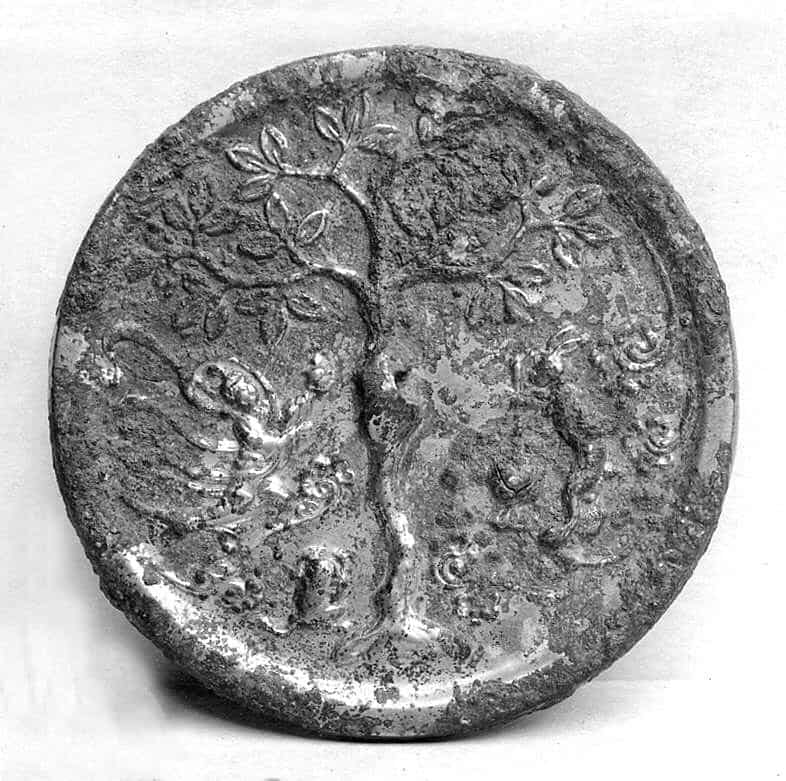
Chuci and Huainanzi; the animals in the moon. The Huainanzi (chapter 7) puts a toad in the moon, and Zhang Heng’s Lingxian (second century AD) says that Chang’e fled to the moon and became the toad. The hare rests on one hard line in the “Heavenly Questions” of the Chuci, which Han commentators read as “a hare in its belly” and the modern scholar Wen Yiduo read as a toad. By the Han both were there: the Mawangdui banner paints a toad and a hare on its crescent moon. The third-century poet Fu Xuan adds the mortar: “What is in the moon? A white hare pounding medicine.” See it: a Tang bronze mirror with the moon goddess and rabbit, eighth or ninth century, in the Metropolitan Museum of Art (25.24).
24. Tiangou, the Heavenly Dog (天狗)
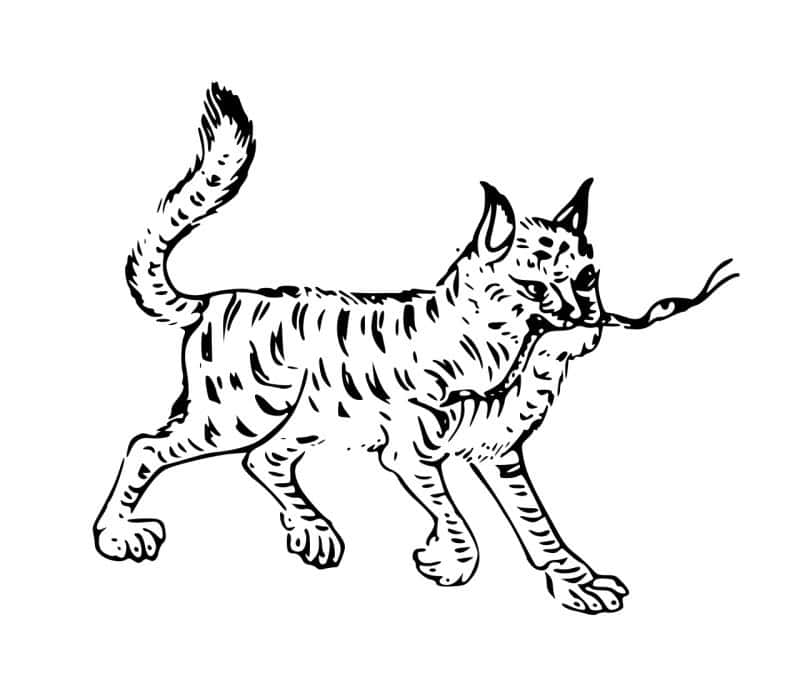
Shanhaijing, chapter 2; from lucky beast to eclipse-eater. In the Shanhaijing the tiangou is harmless. On Mount Yin, says the “Western Mountains” chapter, lives an animal like a wildcat with a white head, which wards off harm. The Shiji (“Treatise on the Heavenly Offices”) uses the name for something else: a noisy meteor, like a great shooting star. In folk belief the tiangou is a dog in the sky that eats the sun or moon at an eclipse. Japan’s Nihon shoki, under the year 637, has a monk identify a thundering meteor as a “heavenly dog”, written with the characters now read tengu in Japanese. See it: the tiangou of the Gujin tushu jicheng is a striped wildcat carrying a snake in its jaws.
Monsters of the early texts: the Four Perils and the Classic of Mountains and Seas
The Zuo zhuan (Duke Wen, year 18) tells how Shun banished four wicked clans, Hundun, Qiongqi, Taowu and Taotie, to the four far borders. There they are bad sons of great houses; other books gave them bodies. The taotie is entry 17.
25. Hundun (混沌) and Dijiang (帝江)
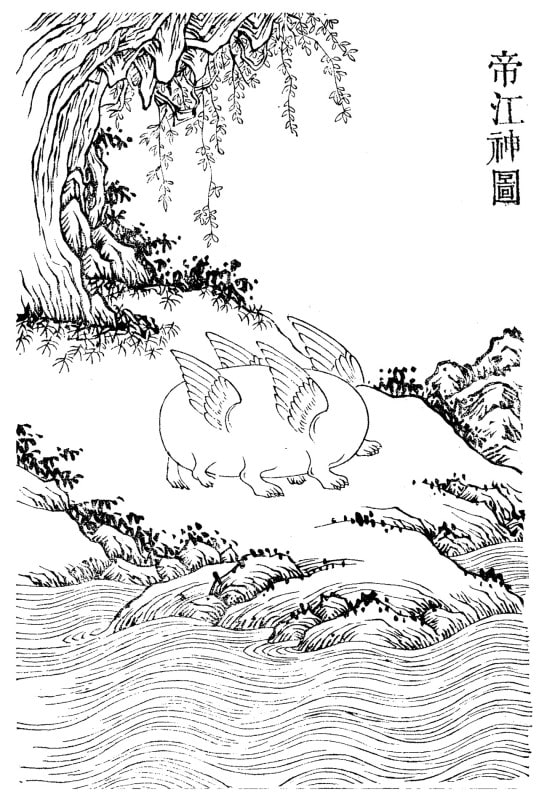
Zhuangzi, chapter 7; chaos without a face. The inner chapters of the Zhuangzi end with a parable. Shu and Hu, emperors of the southern and northern seas, often met in the land of Hundun, emperor of the center. All men have seven openings, they said, and he alone has none. They bored him one a day, and on the seventh day Hundun died. The Shanhaijing (chapter 2) has the creature: on Mount Tian lives a god like a yellow sack, red as cinnabar fire, with six legs and four wings and no face or eyes, who knows how to sing and dance. Its name is Dijiang. In the Zuo zhuan Hundun is the worthless son of Dihong. See it: the Gujin tushu jicheng draws Dijiang as a faceless, four-winged sack on short legs.
26. Taowu (檮杌)
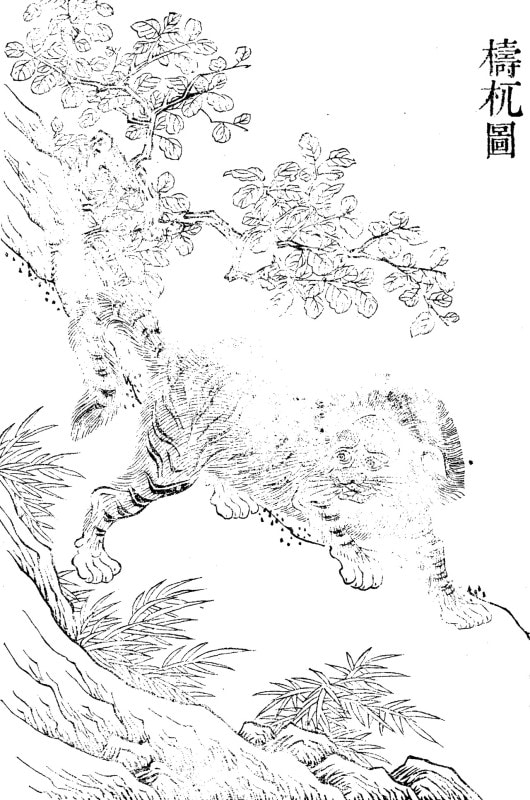
Zuo zhuan, Duke Wen, year 18; the one who cannot be taught. The Zuo zhuan says that the ancient ruler Zhuanxu had a worthless son who could not be instructed, and that the people of the world called him Taowu. His name had a second life: Mencius (4B.21) remarks that the annals of the state of Chu were called the Taowu, as those of Lu were the Spring and Autumn. The Shenyi jing, a book of marvels of the Han or soon after, supplies the body: a beast of the western wilderness with a human face, a tiger’s feet, a pig’s tusks and a tail of eighteen feet. See it: the taowu is not in the Shanhaijing, but the Gujin tushu jicheng has a plate titled “Picture of the Taowu” (檮杌圖): a tiger-bodied beast with a human face.
27. Qiongqi (窮奇)
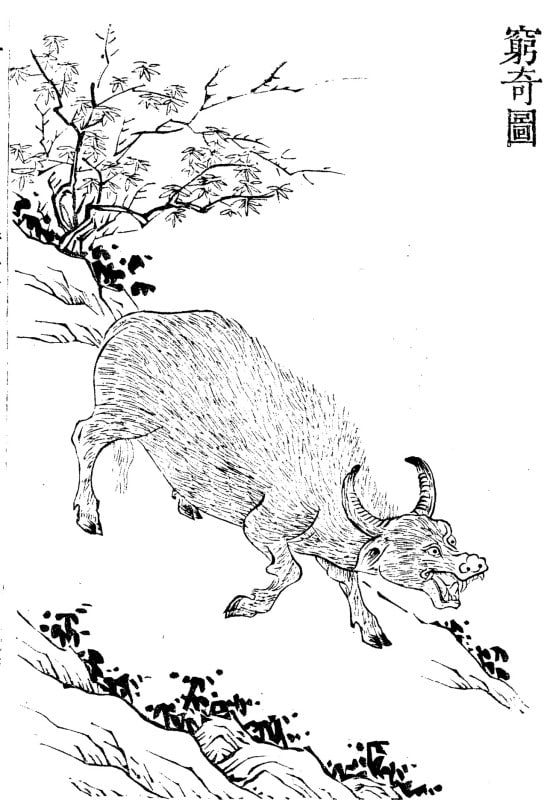
Shanhaijing, chapters 2 and 12; two descriptions and two reputations. The Shanhaijing describes it twice and differently. In the “Western Mountains” it is like an ox with a hedgehog’s spines and eats people. In “Within the Seas: North” it is like a tiger with wings. In the Zuo zhuan Qiongqi is the worthless son of Shaohao, and the Shenyi jing gives it a moral habit to match: it understands speech, and eats whoever is in the right in a quarrel. Yet in the chant of the Great Exorcism held at the Han court at the year’s end (Hou Han shu, treatise on ritual), Qiongqi is one of twelve spirits called on to devour evils. See it: the Qing encyclopedia’s plate pictures the qiongqi in its first form, as a bristling ox.
28. Xiangliu (相柳)
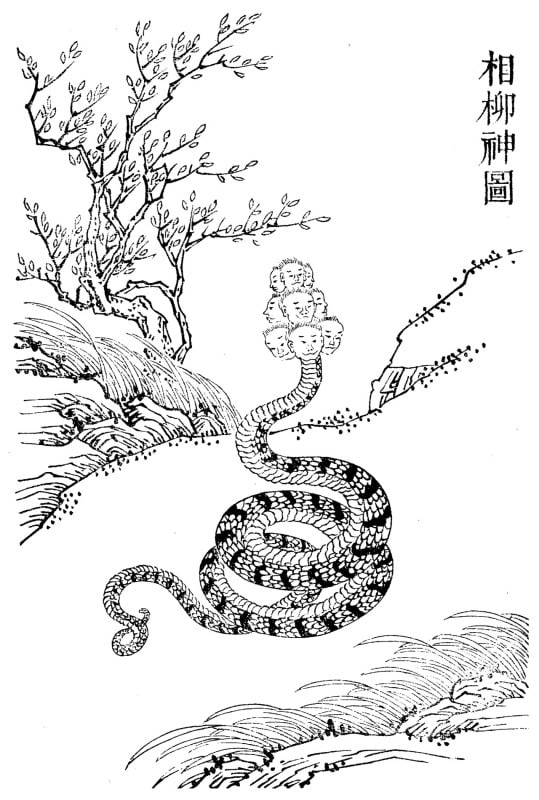
Shanhaijing, chapters 8 and 17; the nine-headed serpent that Yu killed. Xiangliu was the minister of Gonggong, the god blamed for the great flood. The Shanhaijing (“Beyond the Seas: North”) gives him nine heads with human faces on a green serpent’s body, each feeding on a different mountain, and says that whatever he touched turned to marsh. Yu the Great killed him. The blood stank so badly that no grain would grow there, and when Yu dug the ground out it collapsed three times, so he built terraces for the gods on the spot. The nearest relative elsewhere is the Hydra on our list of Greek mythical creatures, another many-headed marsh serpent killed by a hero. See it: a woodcut in the Gujin tushu jicheng draws Xiangliu as a coiled serpent with a cluster of human heads.
29. Kun and Peng (鯤鵬)
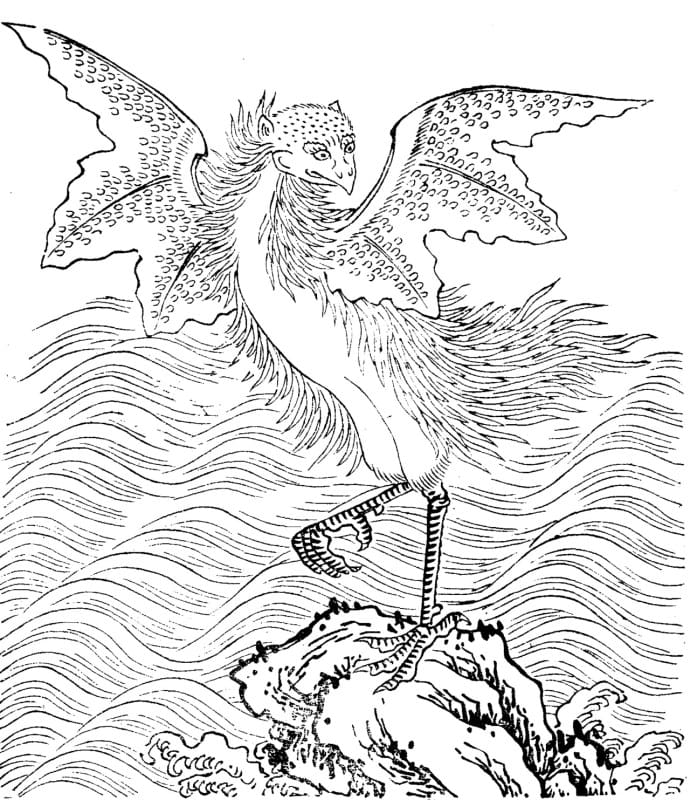
Zhuangzi, chapter 1; the fish that becomes a bird. The Zhuangzi opens with it. In the northern darkness there is a fish called Kun, thousands of li long. It changes into a bird called Peng, whose wings are like clouds hung from the sky. When the sea stirs it sets off for the southern darkness, rising ninety thousand li on a whirlwind. A cicada and a little dove laugh at it: they can barely reach the next elm, so why go so far? The story is about scale, and small understanding failing to imagine great. See it: a Gujin tushu jicheng plate pictures the peng as a great bird on a rock among waves, but the peng lives on mostly in words, as in pengcheng wanli, “a peng’s journey of ten thousand li”, a wish for someone setting out on a career.
30. Bifang (畢方)
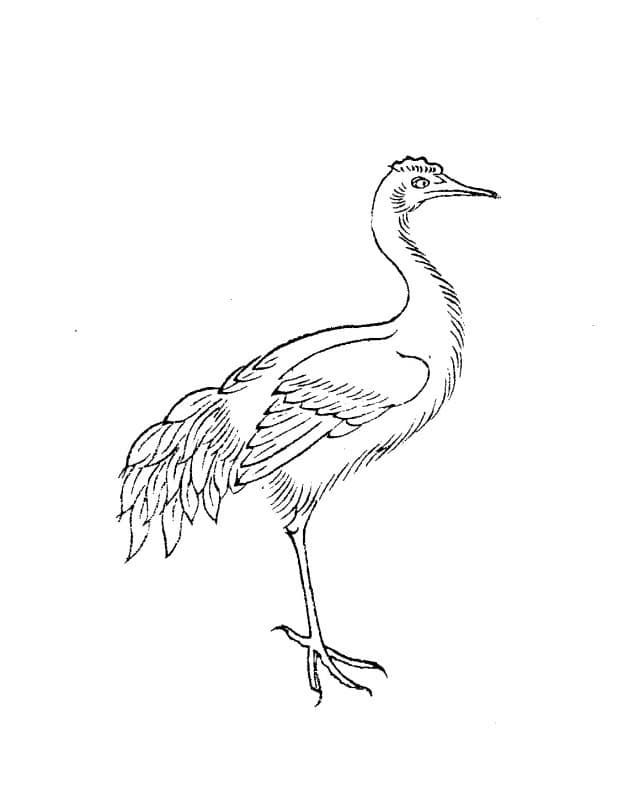
Shanhaijing, chapter 2; the one-legged fire bird. On Mount Zhang’e, says the Shanhaijing (“Western Mountains”), there is a bird like a crane with one leg, red markings on a blue-green body and a white beak. Its call is its own name, and where it appears the town will have freak fires. The Han Feizi (“Ten Faults”) places the bifang beside the Yellow Emperor’s chariot when he gathered the spirits on Mount Tai. The Huainanzi (chapter 13) says that “wood gives birth to the bifang”. It is an explanation for fires that start with no cause anyone can find. See it: the one-legged bifang is drawn as a crane standing on a single leg in the Gujin tushu jicheng of 1725.
Where Chinese mythical creatures can still be seen
Almost everything on this list was made to be looked at, and much of it still is. The four directional animals are on Han roof tiles and tomb doors. Shang bronzes with the taotie mask, Tang tomb guardians and Ming and Qing rank badges are in most large museum collections. The stranger creatures of the Shanhaijing survive on the page, in the woodblock editions that Ming and Qing printers illustrated and in the plates of the Qing imperial encyclopedia Gujin tushu jicheng, the source of eleven of the pictures above. The thirty are best understood as answers to questions people actually had: what the stars in the east are, why it will not rain, who guards a grave, why a town burns.
Image credits
All images are from Wikimedia Commons. Public domain or CC0: the two roof-tile ends, the Zhenwu figure, the Dragon King handscroll, the qilin and phoenix badges, the chimera weight, the guardian lion, the fangding, the tomb guardian beast and the moon mirror (Metropolitan Museum of Art, open access); Chen Rong’s Nine Dragons (Museum of Fine Arts, Boston); ten woodcuts and one tracing of a plate from the Gujin tushu jicheng; the Mawangdui silk banner (Hunan Museum); the New Year print of about 1900; the Leifeng Pagoda photograph by Sekino Tadashi (1918); the stone xiezhi by Gary Todd (CC0); the Qing official’s hat by Daderot (CC0). CC BY: the bixi and its stele at the Ming Tombs by Jorge Láscar (CC BY 2.0), resized. CC BY-SA: the Azure Dragon tomb brick by 向史公哲曰 (CC BY-SA 4.0), resized. Title card by The Popular List.

